
As AI agents start booking flights, moving money, and negotiating contracts on behalf of humans, financial institutions face a new question that KYC was never built to answer: is this AI agent actually authorized to act?
Ten years ago, “Know Your Customer” was enough. A bank verified a human, checked a passport, ran a sanctions list, and moved on.
In 2026, a growing share of the requests hitting banking APIs, e-commerce checkouts, and support desks aren’t coming from humans at all — they’re coming from AI agents acting for humans. This is the logic behind Know Your Agent, the AI-driven verification layer that financial institutions are racing to build before autonomous agents outpace their fraud controls.
What Is “Know Your Agent” (KYA)?
Know Your Agent is a verification discipline built specifically for non-human identity — the AI agents, bots, and autonomous scripts that now initiate transactions, file claims, and query financial systems on a person’s or company’s behalf. Where KYC confirms who a human is, the Know Your Agent protocol confirms which agent is acting, on whose authority, and within what limits.
A working Know Your Agent AI system typically verifies three things before it lets an agent proceed:
- Identity — is this a registered, authenticated agent, or an unknown script impersonating one?
- Authorization — does this agent have permission to perform this specific action, for this specific principal?
- Behavior — does the agent’s current activity match its historical pattern, or does it look like it’s been hijacked, spoofed, or repurposed for fraud?
KYC vs KYA: What actually changes
| Category | KYC (Know Your Customer) | KYA (Know Your Agent) |
|---|---|---|
| Subject verified | Human individual or entity | Software agent acting on behalf of a human or business |
| Core question | “Is this person who they claim to be?” | “Is this agent authorized to act, and is it behaving as expected?” |
| Verification method | Government ID, biometrics, address checks | Agent identity binding, cryptographic agent signatures, behavioral monitoring |
| Frequency | Onboarding plus periodic review | Continuous, per transaction or per session |
| Primary risk | Stolen or fabricated human identity | Rogue AI agents, synthetic identity fraud, hijacked credentials |
| Regulatory anchor | AML/KYC laws, GDPR | Emerging guidance under the EU AI Act and sector-specific fintech regulations |
The distinction matters because agent authentication doesn’t map cleanly onto identity frameworks designed for humans. An AI agent can be legitimately created, then compromised mid-session. It can act correctly for weeks and then execute a single malicious instruction injected by an attacker. Static, one-time verification — the backbone of KYC — simply wasn’t built to catch that.
Why AI agents threaten financial security
According to reporting from PYMNTS, the “KYA moment” is arriving because agentic commerce — AI agents making purchases, comparing prices, and completing checkouts autonomously — is moving faster than the verification infrastructure meant to secure it.
The specific risks financial institutions are now underwriting for include:
- Malicious AI agents built specifically to probe fraud controls, test stolen card data, or automate account takeover at a scale no human fraud ring could match.
- Synthetic identity fraud, now compounded by agents that can generate, maintain, and operate entirely fabricated customer profiles without human oversight.
- Agentic payments abuse — an authorized agent that was scoped to “monitor my subscriptions” quietly expanding into “reallocate my funds. “
- Multi-step AI attacks, where no single action trips a fraud rule, but the sequence — login, reconnaissance, small test transaction, large transfer — adds up to a coordinated exploit.
- Deepfake fraud detection gaps, where synthetic voice or video is used to authorize an agent’s actions, defeating verification steps designed around human presence.
This is also why bot detection in banking has shifted from a customer-experience concern (stopping scrapers and credential-stuffing bots) to a core fraud-prevention discipline. The bots aren’t just noise anymore — some of them are acting with real financial authority.
How a KYA verification flow works
The diagram below shows the core decision path a mature Know Your Agent system runs on every agent-initiated request — not once at onboarding, but continuously.
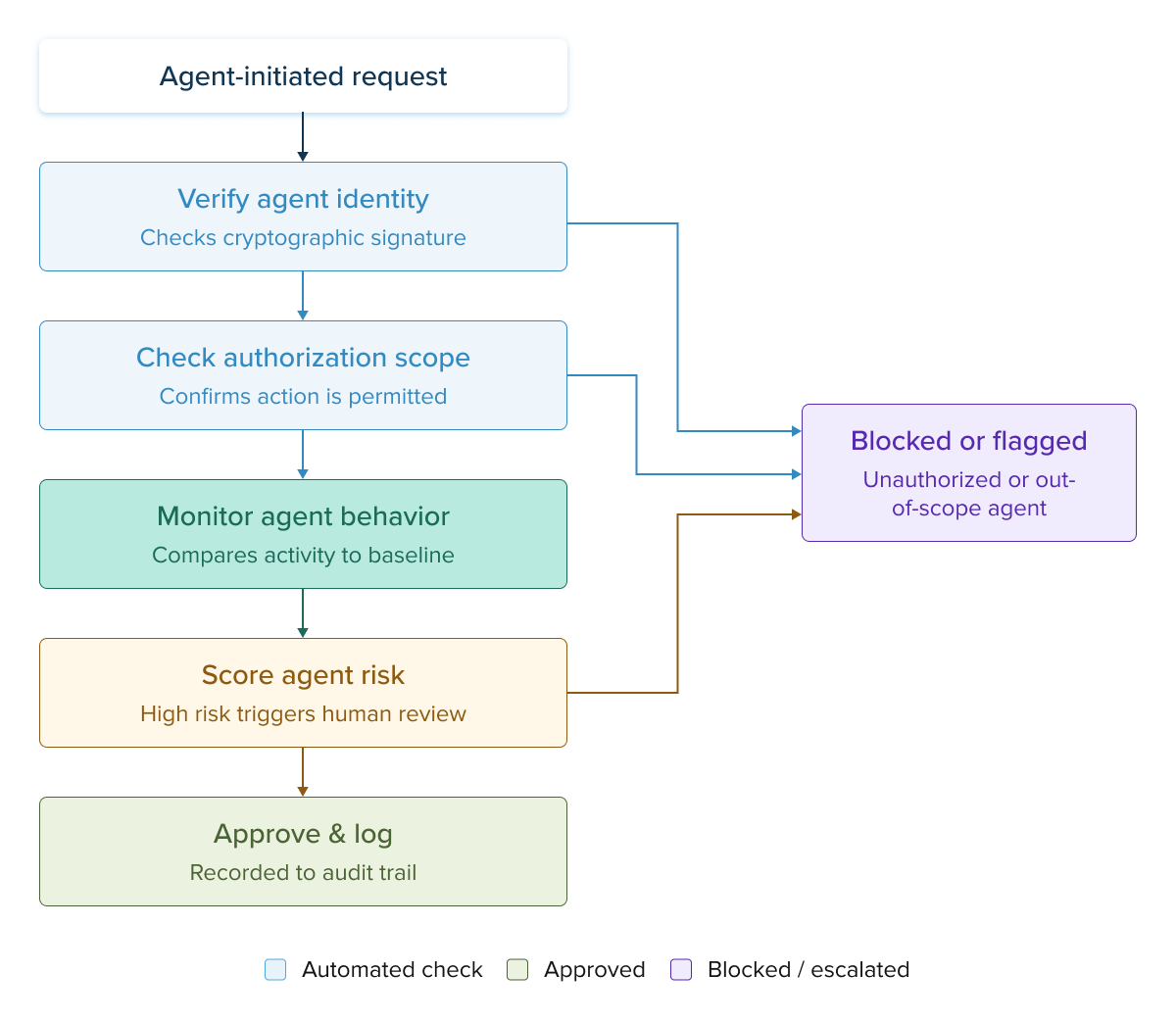
Each stage maps to a specific control:
- agent identity binding and cryptographic agent signatures confirm the agent is who it claims to be;
- agent permission controls confirm scope;
- agent behavior monitoring and agent risk scoring catch drift and hijacking;
- and human-in-the-loop verification provides a manual checkpoint before high-risk actions clear. This is the practical shape of an agent verification framework — not a single gate, but a continuous loop.
AI fake detection: A growing toolkit
Know Your Agent doesn’t operate in isolation — it sits alongside a broader set of AI fake detection capabilities that financial institutions, marketplaces, and platforms are deploying to catch synthetic content and synthetic actors before they cause damage.
Can AI detect fake brand profiles?
Yes — and increasingly it has to. Fraudulent brand accounts and impersonation pages are now generated and maintained by AI agents at a volume that manual moderation teams can’t match.
Detection models trained on registration patterns, posting cadence, and content-generation fingerprints can flag a fake brand profile before it accumulates enough followers to run a convincing scam. The same AI fraud detection in fintech techniques used to score transaction risk — anomaly detection, graph analysis of connected accounts, and behavioral baselining — apply directly here.
Can AI detect fake reviews better than human moderators?
In most volume-based comparisons, yes. AI models can cross-reference reviewer account age, purchase verification, language patterns typical of generated text, and posting velocity across thousands of listings simultaneously — something no human moderation team can do at the same speed or consistency.
Human moderators still outperform AI on ambiguous, context-heavy edge cases, which is why the strongest systems combine automated AI fake review detection with a human review layer for borderline flags, rather than replacing moderators outright.
Deepfakes, fake followers, and scam software
- AI deep fake detection and deepfake AI detection tools analyze pixel-level artifacts, audio waveform inconsistencies, and metadata mismatches to flag synthetic video or voice — increasingly relevant as deepfake fraud detection becomes part of agent authorization checks (verifying that a “human approval” step wasn’t itself synthetic).
- AI fake follower detection identifies bot-purchased or agent-generated follower networks by analyzing account creation timing, engagement authenticity, and network clustering.
- Platforms including dating apps that use AI to detect fake profiles apply similar signals — image reverse-matching, conversation pattern analysis, and device fingerprinting — to catch romance-scam operations before they reach a financial ask.
- On the fraud-prevention side, AI scam detection software increasingly bundles several AI scam detection methods in one pipeline: natural language analysis of scam scripts, transaction pattern matching, and device/agent fingerprinting, often marketed simply as AI scam detection software to fraud and trust & safety teams.
Building an agent verification framework: The core components
A production-grade agent verification framework generally combines the following layers. Sumsub’s own analysis of the Know Your Agent concept frames this as an extension of existing KYC infrastructure rather than a full replacement — which matches what we see in client engagements.
| Component | What it does | Related concept |
|---|---|---|
| Agent identity binding | Cryptographically ties an agent instance to a verified human or organizational principal | Cryptographic agent signatures |
| Non-human identity registry | Maintains a directory of authorized agents separate from human user accounts | Digital identity for AI |
| Agent permission controls | Enforces scope limits by defining what an agent can and cannot do per session or task | Agent authorization |
| Agent behavior monitoring | Continuously compares live activity against historical baselines to identify unusual behavior | Rogue AI agent detection |
| AI agent trust scoring | Assigns a dynamic risk score based on behavior, context, and transaction type | Agent risk scoring |
| Human-in-the-loop verification | Escalates high-risk or ambiguous actions to a human reviewer | Manual review and audit checkpoints |
| Audit trail | Logs every agent decision and action for compliance and post-incident review | AI agent audit trail |
Together, these components let a financial institution answer a much harder question than KYC ever had to: not just “who is this, ” but “is this agent still behaving the way an authorized agent should.”
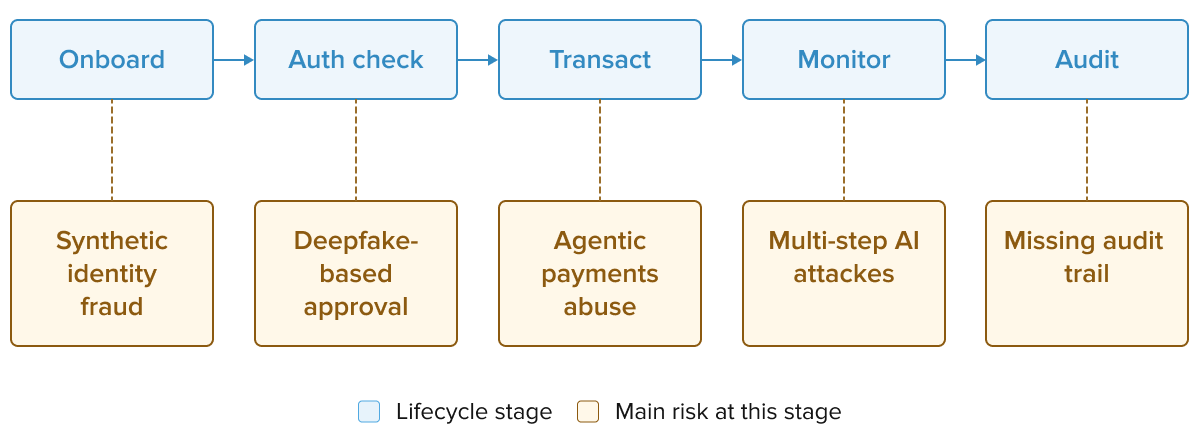
Where AI agent risk enters the transaction lifecycle
Mapping risk points against the lifecycle — rather than treating fraud as a single moment of failure — is what separates a reactive fraud stack from a genuine agentic AI security program.
Agentic payments and autonomous transactions security
Agentic payments — where an AI agent is authorized to initiate or approve a transaction without a human clicking “confirm” — are the sharpest edge of this problem. Autonomous transactions security has to account for an agent that behaves correctly 999 times and is hijacked, spoofed, or manipulated on the thousandth.
That’s a fundamentally different threat model than card-not-present fraud, and it’s why agentic AI security teams are building layered controls: transaction-value caps by default, step-up human-in-the-loop verification above a threshold, and hard-coded permission controls that can’t be overridden by the agent itself, even under adversarial prompting.
This connects directly to broader AI agent governance questions institutions are now formalizing: who owns an agent’s actions when something goes wrong, how long agent decisions must be retained for audit, and how an organization proves — to a regulator or a court — that an autonomous action was in fact authorized.
The regulatory landscape: AI agent compliance and governance
AI agent compliance is still catching up to the technology, but the direction of travel is clear:
- The EU AI Act compliance requirements already classify certain autonomous decision-making systems as higher-risk, with documentation, transparency, and human-oversight obligations that map closely onto what a KYA program needs anyway.
- Financial regulators in the US and UK are beginning to ask institutions how they distinguish human-initiated from agent-initiated transactions in their AML reporting — a distinction traditional KYC systems were never designed to make.
- An agent accountability framework is emerging as the expected minimum: clear ownership of each deployed agent, documented permission scope, and an audit trail sufficient to reconstruct any disputed transaction.
Institutions building toward AI agent accountability now, ahead of formal enforcement, are in a materially stronger position than those waiting for regulation to force the issue — the same pattern we’ve seen with every prior wave of financial AI adoption.
Practical steps: Getting started with know your agent
- Inventory your agents. Most organizations underestimate how many scripts, bots, and AI agents already have some form of system access. You can’t verify what you haven’t catalogued.
- Bind identity before scope. Establish agent identity binding first — a verified, cryptographically signed identity per agent — before layering on permission rules.
- Set behavioral baselines early. Agent behavior monitoring is only useful once you know what “normal” looks like for each agent; start logging before you need to detect anomalies.
- Define escalation thresholds. Decide in advance which risk scores trigger human-in-the-loop verification, so the policy isn’t improvised mid-incident.
- Build the audit trail from day one. Retrofitting an AI agent audit trail after an incident is far harder — and far less defensible to a regulator — than building it in from the start.
Many of these same architectural patterns — permissioning, monitoring, human escalation — show up across our broader work on agentic AI and multi-agent AI systems, where coordinating multiple autonomous agents safely is the central design challenge.
About InData Labs
InData Labs has been designing AI systems since 2014. Today our team of 80+ ML engineers and data scientists builds AI agents and LLM solutions for businesses. Over 12 years we have completed 150+ projects for clients including Wargaming, Flo, AsstrA and Captiv8. AWS and Databricks partner, rated 4. 9 on Clutch. We design and build enterprise AI agents with verification, permission boundaries and human-in-the-loop controls, so agents act only within the scope a business has approved. We usually move from idea to a working pilot in weeks.
Our own GPT-based multi-agent system qualifies inbound leads, scores them and creates CRM records within defined rules, cutting response time from hours to under 2 minutes, 24/7, and lowering the cost per qualified lead by 60–70%. Learn more about our custom AI agent development.
Summary
Know Your Agent is what happens to identity verification once AI agents start acting with real financial authority. It doesn’t replace KYC — it extends it, adding continuous agent authentication, behavior monitoring, and risk scoring to a world where the party on the other end of a transaction might not be human at all.
Financial institutions that treat this as a governance and infrastructure question now — rather than a future problem — will be the ones still standing when agentic fraud, not human fraud, becomes the dominant threat category.
For more on how generative and agentic AI are already reshaping financial services, see our review of AI in financial services and practical AI business use cases in finance, and browse real deployments in our AI agent use cases collection. For teams earlier in the adoption curve, our guide to generative AI deployment and AI agents in finance is a useful starting point before scoping a KYA program.
FAQ
-
Know Your Agent is a verification framework that confirms an AI agent’s identity, authorization scope, and behavioral integrity before and during a transaction — extending the logic of KYC to non-human actors operating on a customer’s behalf.
-
AI agents can be hijacked mid-session, spoofed with synthetic credentials, or manipulated through multi-step attacks that no single transaction rule would catch — creating fraud vectors that didn’t exist when only humans initiated transactions.
-
KYC verifies a human’s identity once, at onboarding. KYA continuously verifies an AI agent’s identity, authorization, and behavior, since an agent can be compromised or repurposed after initial verification in a way a human identity typically isn’t.
-
Through a combination of agent identity binding, behavioral baselining, transaction pattern analysis, and AI agent trust scoring — flagging agents whose activity diverges from their authorized scope or historical pattern.
-
Cryptographic agent signatures, non-human identity registries, behavior monitoring models, anomaly detection, and human-in-the-loop review systems are the core technical building blocks currently in use.
-
The EU AI Act imposes documentation and oversight requirements on higher-risk autonomous systems, and financial regulators are increasingly expecting institutions to distinguish agent-initiated from human-initiated transactions in AML and compliance reporting.