
As artificial intelligence advances, cybercriminals are using it to create increasingly sophisticated, faster attacks against sensitive data. There is a need to highlight and analyse how emerging technologies can lead to AI-enabled breaches involving sensitive data and what organisations might need to anticipate. Identifying how to balance AI and data privacy, as well as the increasing volume of sensitive data in AI, informs more actionable strategies for improving AI security posture.

Source: Unsplash
In this day and age, the way we work and how we produce things is being changed by artificial intelligence models completely, with numerous benefits to our businesses. Nevertheless, LLM data sensitivity is one of the important considerations, as there are new kinds of risks due to the level of automation that AI brings with applications and through generative AI tools as well, which are not in accordance with potential regulatory compliance violations.
Examples of growing concerns for organisations across all industries regarding data exfiltration include an LLM trained on sensitive internal documents and a chatbot that is excessively verbose for a given conversation.
But the question is what the leakage of data is, why this phenomenon occurs, the risks associated with it, and how your organisation’s security group can help prevent it from becoming your next cybersecurity incident-making headline. Let’s have a deep look at these issues to steer clear of what to do and what to avoid.
What is implied by the leakage of data?
The AI leakage of data is considered to be the unintentional sharing of confidential or proprietary data through the output, logging, or API of an AI model. Basically, data leakage is divided into two main types.
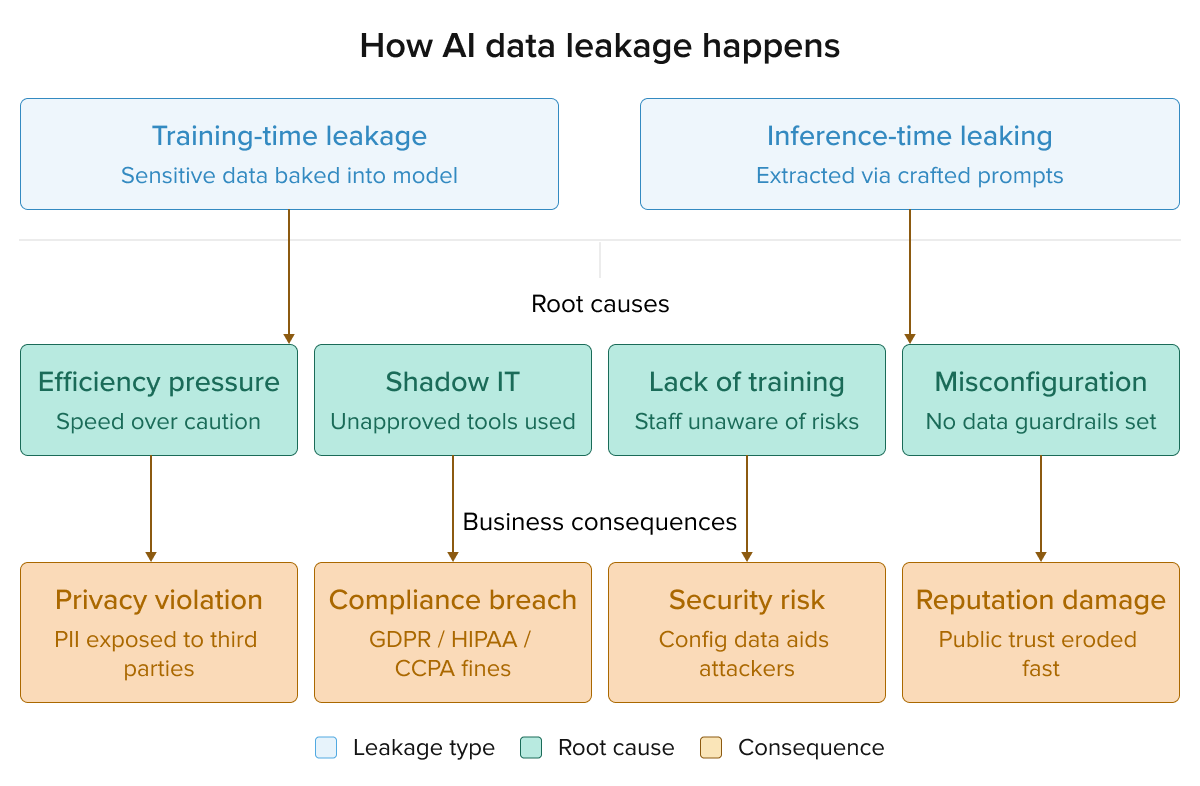
Leakage during training time
The first type is the inclusion of sensitive or private information in an AI model’s training dataset, which can then be recreated or queried later.
Time-based inference leakage
It occurs when an unauthorized third party can collect or extract sensitive or private information by programming prompts for AI models that will lead to the extraction of confidential information while the model attempts to infer from the initial prompt from the third party.
AI data leakage can happen with almost any aspect of an AI model and varies from minor to significant depending on how an AI model is trained or used; that’s why it is key to follow AI translation security for sensitive company data.
What are the reasons for using LLM sensitive data?
The demand for e-generating assistive technologies has skyrocketed due to employees needing efficiency in an ever-changing business landscape.
Today, there is constant pressure to complete assignments with speed and precision in AI product development, so employees have turned to generative AIs that offer quick solutions to challenges assigned to them, whether by their respective employers or internally.
Maximize efficiency
The ability of generative AI to condense and present large amounts of information as analytical insight allows employees of many industries to eliminate the manual requirement of investing hours and sometimes days preparing discovery for insurance claims, legal matters, etc., with the application of AI for sensitive data.
Time-saving reason
Reducing time spent performing repetitive tasks is often the primary goal of deploying large language models.
An example of such a usage is when customer support agents key customer account data into LLMs to prepare responses or to troubleshoot customer service matters. Similarly, an HR employee may key employee pay data into an LLM to quickly create reports and summaries of the organisation’s payroll process.
Limited options
When alternative tools are either unavailable or challenging to use, employees may resort to free-tier generative AI tools as a solution. They will engage in shadow IT practices by using apps that are not authorised by IT due to a lack of tools.
Address complicated issues
When dealing with tech issues, employees often reach out to an LLM for guidance by submitting security configurations and incident reports. This can be useful on one hand, but on the other hand, it may lead to the necessity for protecting sensitive data in Gen AI model responses.
The key risks of AI and sensitive data breaches
Data leaks from an AI model have severe negative ramifications beyond the immediate benefits provided to enterprises. It directly concerns not only compliance issues of AI security and ethics of AI but also impacts on its financial, operational, and reputational performance. Some of the most urgent dangers associated with exposure to data architecture are listed below.
Violations of data privacy

Source: Unsplash
There is no doubt that securing data privacy in AI models is crucial because, unless an enterprise contract specifies otherwise, free-tier generative AI services usually train models using user-inputted queries.
Sensitive information is added to the model’s training data set once it is loaded into these systems. Therefore, the organisation no longer has control over its data. They risk exposing their customers’ or employees’ private data to third parties.
Harms to the security of data
Artificial intelligence is vulnerable to security-related prompts that are leaked to protect sensitive AI data. For instance, there are different testing results and network configuration information. Such information would be particularly useful to hackers who want to identify and use targeted attacks to take advantage of any vulnerabilities in a system.
Problems of compliance with legal requirements
AI collecting sensitive data must adhere to regulations that cover how sensitive information can be shared with LLMs. GDPR governs the uploading of any type of personal data about EU residents, such as their name, email address, and home address. This kind of personal data could result in large GDPR fines if the proper safeguards are not followed.
Companies that leverage an AI-powered data integration platform sensitive to healthcare data must comply with HIPAA privacy regulations. If a California resident’s data is shared without their permission, it may be a violation of the CCPA, which can result in continued legal action or penalties.
The decline of company reputation
If a company is not strict with Gen AI sensitive data disclosure prevention, it will have a large impact on its reputation.
What is more, it will happen very quickly with media coverage. Publicly available data breaches caused by negligent use of generative AI tools may result in a loss of customer trust by exposing the company to negative public opinion and potentially damaging brand reputation in the future. Today’s digital society creates public backlashes that typically cause long-term negative effects.
Inaccurate data ingestion dangers
In addition to sensitive data leaving the organisation, inaccurate or untrustworthy LLM-generated data may also be ingested by the company’s workflow, which presents numerous risks in addition to sensitive data leaving the organisation. As a consequence, the potential for incorrect AI tool insights leading to poor decision-making or compliance violations can severely impact a company’s financial features.
Strategies to lower the risk of Gen AI data breach
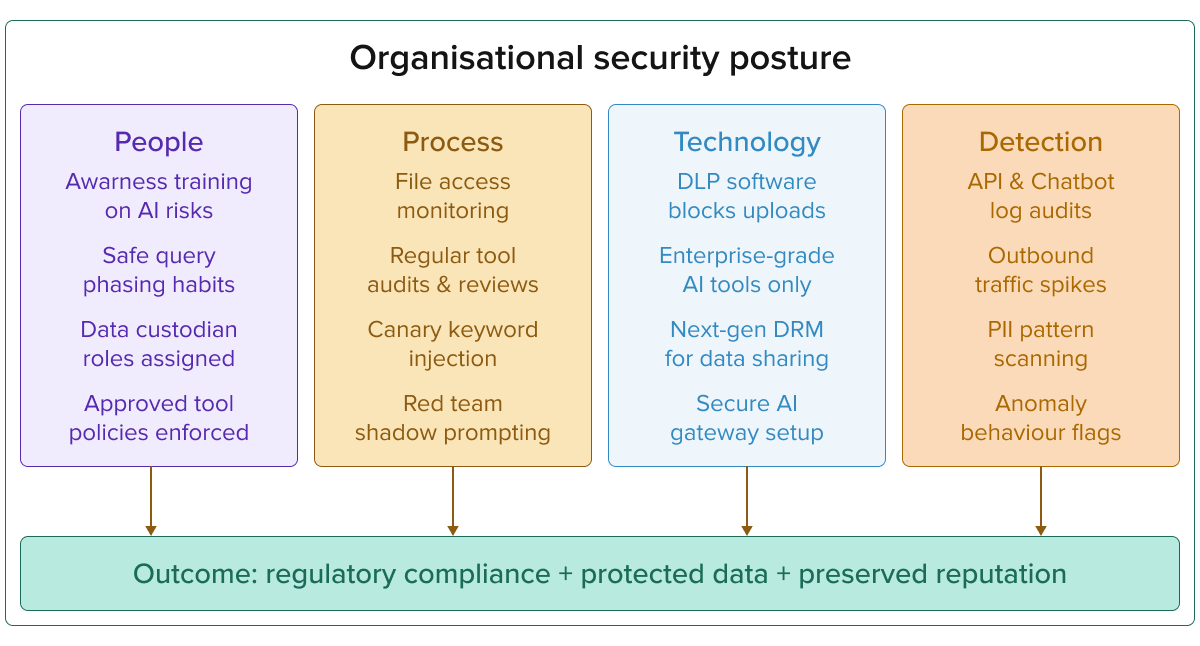
To minimize the risks of generative AI data leaks listed above, companies must uphold a holistic approach that includes employee education, technology implementation, and policy enforcement. Knowing how companies prevent accidental disclosure of sensitive data, AI assistants help significantly save costs and escape unfavourable results. Let’s see what we can do.
Constant employee awareness and training initiatives
It is important to provide employees with adequate training about the best AI-powered solutions to secure sensitive data in LLM interactions, as well as other means of protecting the company from data thefts. The teaching of effective methods for phrasing queries to obtain useful information while minimising their exposure to sensitive information fosters the creation of a culture of accountability where employees understand their role as custodians of the company’s data and information.
Regular observation of files access
Tracking the access of files is a vital procedure consisting of systems that monitor the usage of files. It is strongly recommended for AI platforms, data privacy, and sensitive industries, like the medical fields and the finance sectors. These tools help to detect any abnormal or atypical use patterns and behaviours, for example, such as extended context windows, chain prompting, or high-frequency probing, within the enterprise’s files and their systems very rapidly.
Make technological solution investments
Invest in technology solutions to help protect your AI software’s sensitive data by implementing the data loss prevention software to prevent the uploading of sensitive documents to external sites.

Source: Unsplash
Enterprise-grade generative AI tools also deploy secure, enterprise-level generative AI tools that comply with all applicable regulatory requirements and provide adequate levels of privacy protection. Moreover, it is wise to invest in next-generation DRM to allow users to share sensitive data but prevent them from being able to download or forward that information.
Apply tools approved by the firm
To guarantee that all company-approved tools are accessible and easy to use, provide employees with safe options for free-level generative artificial intelligence services. Assess and amend the company’s tools on a regular basis to ensure that they continue to meet changing business needs and technological advances.
How to recognise if your model has already escaped with data?
Assuming that hackers might have more than one way to gain access to your system, the most obvious being to dump all your data from the database at once, evidence of hacking could come from auditing either the network itself or any of the applications that run on top of it.
Train your data seed sets with canary keywords
It assists to see how many canary phrases will come out in model outputs; if they did come out, then you would know there was certainly a probability of having memorised that information before training your model, which would be considered a data leak.

Source: Unsplash
Employ shadow prompts
Employ shadow prompts by making use of adversary stimuli to try getting to know if your model is a candidate for leaking data by deploying test functions such as this with red teaming.
Logs and transcripts of audits
If you see repeated instances of PII, passwords, or internal identifiers, review the data collection documents, API logs, chatbot transcription logs, or related terms. Logging is not only beneficial for debugging but is also a critical security process.
Spikes in outgoing traffic
Look for large, unforeseen amounts of outbound data traffic from your network to another location. Large amounts of data, for example, over 50 GB, being sent out of your server is common when a successful data theft occurs, particularly during non-peak hours.
On top of all that, selecting the company with strong expertise in data operations also plays a significant role in detecting data leakages.
They have a clear plan of actions: what to do in such situations, how to perform sensitive data scanning for AI, and of course, how to defend your AI software’s sensitive data in advance and thereby understate accidental data exposure. Partnerships with proficient AI firms are able to lower unnecessary expenses, increase productivity, and provide stability.
Summing up
The advent of generative artificial intelligence presents numerous possibilities for business globally; however, AI models will disclose private details if they are improperly configured or programmed to avoid exposing private details. That is why it is a must for them to learn about how organisations manage access to sensitive data with AI assistants. It is related to any sphere, whether it is protecting or handling sensitive payroll data risks or AI-powered sensitive data classification vendors.
Present-day companies ought to take proactive measures today by implementing strong training programmes, AI document review for sensitive data, setting up monitoring systems and using more sophisticated solutions to save what is arguably their greatest asset, which is their data. By not neglecting the protection methods. the enterprises will not only minimize their risk of suffering a breach but also demonstrate to others that they are making the effort to comply with regulatory requirements, which has become crucial in the increasingly complex digital environment we operate in.
FAQ
-
Sensitive information for AI’ is defined as any confidential, secure, or regulated data that should never be shared, exposed, or ingested into a public version of artificial intelligence models. As usual, private personal identifiable information, sensitive company intellectual property, financial or health record data, and security credentials are examples of this.
-
Sensitive data can take many different forms, but as usual, examples include sensitive company intellectual property, private personal identifiable information, financial or health record data, and security credentials.
-
The publicly accessible generative AI tiers should not be used to share any private information, passwords, pre-release financial data, or proprietary or trade secret code.
Checking your privacy settings, anonymising and redacting data, and utilising the enterprise version of generative AI are some best practices for working with AI securely.
For technicians, secure AI gateways, isolated cloud environments, and open-source models are technical solutions that can help secure your process.
-
Based on the context of data being protected, data privacy is usually classified into four main types: informational, physical, communication, and territorial.
These categories indicate how data is protected from unauthorised access in the various areas of one’s personal life and digital footprint.
-
Automated scanning, classification of data, and context awareness are the best way to identify sensitive information so as to avoid data breaches and comply with governmental regulations.
You need to know what you are looking for (PII, financial data, biometric data and authorisation data) in order to identify sensitive data. You cannot go through every single file manually, so it is recommended that you employ an automated discovery tool and leverage the discovery tools available to you.
-
There are four distinct levels of sensitivity classifications that are commonly applied to different categories of corporate data or information: public, internal, confidential, and restricted. This framework helps to identify the individuals or groups who have access to the in