For modern enterprises, scalable Big data analytics solutions enable them to exploit massive datasets and obtain real-time, prescriptive, and actionable insights, thereby enhancing decision quality across all operational and strategic business aspects. To close the gap between data and business value, InData Labs provides comprehensive, tailored data science solutions and explains how to use AI for business analytics to drive success.
In a world with a wealth of robust data engineering services available, businesses today produce more data than ever before. In reality, though, how many of them are making decisions? The amount of data these organisations generate daily is not always best assessed with static dashboards and traditional reporting methods built for an earlier era of business intelligence. You may see generic high-level indexed dashboards that give you metrics over a period of time. They do not, however, provide immediate answers to complex business queries.
As long as companies continue to scale their growth and advance, they are eager to benefit from advanced machine learning development, despite finding it increasingly challenging to maintain these fragmented analytics workflows, creating delays in decreased operational efficiencies and decision-making procedures.

Source: Unsplash
In consequence, corporate leaders are no longer looking for just a platform to be used for visualising data; they are looking for intelligent systems that provide context for their data, can predict probable future events, and can supply insights via automation and executable recommendations automatically. The rapid adoption of AI-powered customer analytics solutions and reporting platforms is being driven by this transformation. So, in this blog post, we are going to dive into a top AI business solutions overview and how AI analytics for business operations in 2026 will work better.
The practical application of AI analytics for business users
AI for business analytics solutions is created to reach intelligent ecosystems for decision support, having the ability to perform in an autonomous and proactive way.
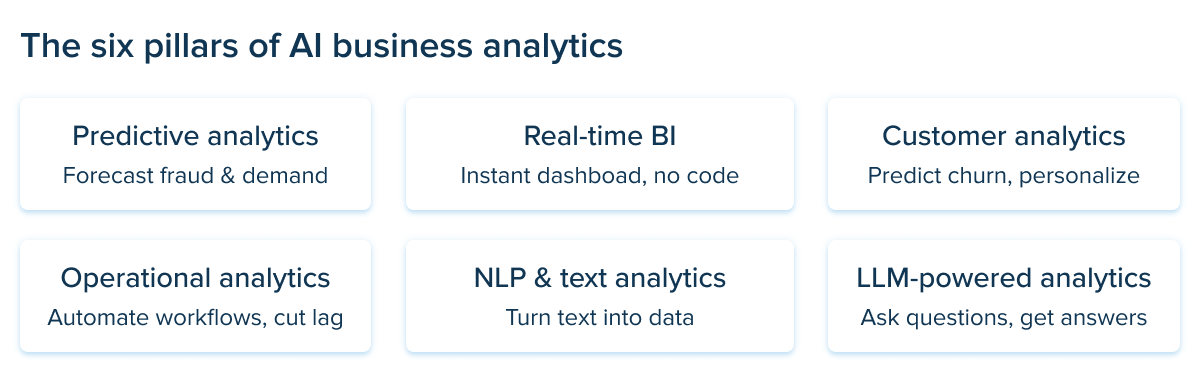
The proliferation of AI data analytics for business users in different industries is being observed across finance, healthcare, manufacturing, retail, logistics, SaaS, and cybersecurity sectors as enterprises are migrating towards cloud-native infrastructure, interactive BI and data visualisation, event-driven architectures, and AI-first operational strategies.
What results can an AI business analytics solution bring to a firm? Let’s zoom in on the advantageous returns more closely.
Predicative analytics
Predictive analytics powered by AI uses machine learning algorithms to examine past transactions of behaviour for all types of data and patterns, thereby predicting the outcomes of the different interactions that will occur over time.
Thanks to end-to-end predictive analytics services, it has become possible to know earlier what could happen and assist enterprises in automating their entire operational, data, or analytics lifecycle. Analysis of larger datasets is much faster than ever before because of the serverless architectures and enterprise-grade scalability.
Practical uses of predictive analytics in business fields can be mainly observed in fraud detection, which uses network activity monitoring to spot possible fraud in almost real time. Forecasting inventory and managing resources using real-time data analysis leads to operational improvements. As for maintenance prediction, it fosters fewer repairs, as you know when equipment will fail.
Real-time dashboards and BI
Thanks to business analytics and artificial intelligence solutions, a company’s data can be turned into real-time, actionable information through expert machine learning consulting and processing.
Non-technical end users can now make enquiries in simple language without generating elaborate SQL queries, receiving automatic results through predictive forecasting automation, automatic outlier detection, and automatic custom dashboard generation.
In marketing, for example, sales managers get reliability analysis of a campaign’s performance, client sentiment analysis, and customer churn in seconds. Quick notifications of supply chain disruptions and optimisation of inventory levels also affect how the organisation works and the relationships with the clientele.
As a result, this data democratisation allows teams across all departments to make immediate and informed strategic adjustments. Companies can respond to market changes with unprecedented agility by reducing their dependence on specialised IT departments.
Customer analytics
With the help of AI for marketing business analytics, customer analytics is able to analyse raw information about customer interactions, find hidden patterns in order to predict future behaviour, and have a clear comprehension of their requirements.
Through the use of this technology, businesses have the opportunity to increase customer retention by automating support and supplying hyper-personalised experiences across the greater whole.
One of the real-world predictive analytics use cases is analysing customers’ historical buying and browsing activity, as well as identifying those who appear to be unhappy.
With this kind of social insight, companies can quickly modify their marketing strategy to match changes in how the public views them as they happen. Therefore, being able to completely comprehend consumer attitudes results in the development of long-lasting brand loyalty while also drastically reducing the rate at which customers leave or cancel subscriptions.
Operational analytics
There is another top AI business analytics tool for enterprises that gives operational analytics to leverage machine learning and real-time data to optimise processes, automate workflows, and predict future bottlenecks on a day-to-day basis.
For the most part, it promotes moving away from historical reporting toward dynamic, forward-looking, data-driven decision-making in the flow of work. Operational analytics can cover inventory and supply chain by anticipating market changes, optimising logistics routes, and minimising overproduction. Dynamic resource allocation allows organisations to automate workflows and adjust staff, energy use, and compute loads in real-time based on spikes in demand.

Source: Unsplash
As regards how generative AI transforms data analytics, firms are deploying GenAI tools to further upgrade the user experience on operational analytics platforms. For instance, GenAI can simulate several ways to mitigate the risk or bottleneck that has been created, whereas predictive operational AI can use scenario simulation to determine possible hazards or bottlenecks.
Creating smart solutions that reside within the day-to-day routines of supply chain managers will change the usual way of work, providing the means to transform supply chains to operate like highly resilient, self-optimising ecosystems.
NLP and text analytics
Custom NLP solutions for business data represent a major leap forward in interacting with the non-organised texts from emails, reviews, and support tickets into actionable, quantitative data as well.
They facilitate the automation of customer feedback tagging, carry out comprehensive sentiment analysis, and give commercial users the ability to query data using conversational techniques, enabling quicker, data-driven decision-making.
Operational AI analytics for local businesses and small businesses bring a lot of value.
In the case of healthcare, NLP technology is leveraged to process patient data and medical documentation, reading electronic health records and doctors’ clinical notes to flag specific symptoms and/or identify high-risk patients. The ability to quickly identify patients who require additional attention contributes to an expedited diagnosis and brings attention to gaps in care. AI and analytics solutions for insurance also help speed up reimbursement turnaround by filing insurance claims as well.
On top of that, streamlining these workflow processes by automating them greatly reduces the administrative burden placed upon specialised personnel so that they can devote more of their time and energy toward actual patient or client care. Owing to this, the smooth conversion of unstructured text into structured information enhances both the level of efficiency in operations and the overall satisfaction of all customers and users.
LLM-powered analytics
Forward-thinking firms with Big data analytics and business intelligence explained are likely to want to have query databases based on spoken natural language rather than having to build the data visualisations or write the SQL queries needed to do the analysis required for decision-making based on information.
AI data analytics for business users can simply ask an AI agent to provide them with the answers to their questions, and it will convert the user’s request into a database query, analyse the trends, and return the results in either a visual format or a narrative format.
Automated storytelling is a useful LLM-driven analytics scenario that converts raw data and data drift into straightforward, executive-ready written reports, removing the necessity to manually make dashboards.
Furthermore, generative AI for smarter data analytics allows the agents to analyse measurement anomalies and determine any hidden factors related to metrics producing different results than expected.
Thus, because analysts have now transitioned from manually compiling reports to much more strategic analytical roles, immediate access to instant data synthesis has allowed these autonomous data-synthesis systems to bridge preferred access between complicated databases and non-technical leaders. The result is that an organisation can develop a corporate culture based on data across its entire organisation.
What makes working with InData Labs beneficial?
Take advantage of business analytics solutions with embedded generative AI from InData Labs to break through your operational procedures, aligned with your company’s goals and objectives. Enterprises can collaborate with InData Labs to embed cutting-edge machine learning models into existing workflows, avoiding data silos and speeding up daily decision-making.
Demonstrates a full stack of competencies
Ranging from traditional analytics to LLM AI analytics for business, no matter what size your business is, we are ready to carry out strategic AI consulting services for your needs.
Real-world predictive analytics use cases
We are ready to display your worth to the business, and our use cases include predictive analytics for workflow analytics at companies like Jira and forecasting sales through predictive models and sentiment analysis to effectively implement HR processes.
As usual, InData Labs changes from being a service vendor to being a valued business partner capable of using data to create measurable operational and financial outcomes. The smart algorithms are tuned to your particular company’s needs, converting the complex flows of historical data into a trusted strategic resource for the future.
A trusted partner for business operational solutions
Through AI analytics storage solutions for small and medium businesses, InData Labs has become a dependable and scalable option that is able to provide advanced analytics and has a long-lasting partnership throughout the entire process. This will enable extensible markets to democratise AI-supported decision-making for businesses of all sizes by giving them useful tools. This common approach keeps reducing the technical barrier to entry, which allows growing companies to smoothly adapt to market changes and achieve sustainable long-term growth.
Summing up
Nowadays, AI analytics tools have significantly altered the way businesses operate, and the future of business intelligence and AI will be cohesively connected to the further prospects of companies and their data decisions derived.
As dashboards have progressed from being purely static to being oriented toward supporting business decision-making, businesses are no longer merely monitoring data but utilising it to take action. This change in the manner in which businesses use their tools illustrates the increasing desire of those looking for tools that not only perform analytic functions but also allow for quick and informed business-critical conclusions.
After that, make a choice of a platform that matches your team’s skills. By wisely adopting AI analytics solutions in agreement with an organisation’s aims, leaders encourage a high return on investment in the end.
FAQ
-
An artificial intelligence solution analyst acts as a strategic link between business requirements and technical implementations of those requirements. Responsibilities include the analysis, design, and implementation of AI systems that will help alleviate business processes, with the absence of the need to build a machine learning system from scratch.
-
Businesses are able to use the power of AI analytics solutions to automate data processing, discover unknown hidden trends, get real-time insights from their entire operations, become more efficient by automating repetitive tasks, and forecast future trends at a scale impossible with manual analysis.
-
AI analytics solutions will be most valuable in those sectors that have large amounts of data and automated processes. Healthcare through diagnostics and treatment, finance through fraud detection and risk assessment, retail through hyper-personalisation, and manufacturing through predictive maintenance and optimising supply chain performance are some of the key industries.
-
When choosing an AI analytics solution, you should look for 4 key aspects: data integration, actionability, security, and scalability. The right platform will plug seamlessly into an organisation’s existing technology architecture, deliver clear automated insights from complex data, and be fully compliant with all relevant global privacy laws.
-
Absolutely, artificial intelligence analytical solutions are now within the reach of small- to mid-sized businesses. With the advent of cloud computing and no-code platforms, SMBs don’t need to concern themselves with costly in-house infrastructure or hiring data science professionals. In fact, today, nearly any business can tap into a diverse selection of powerful, scalable AI possibilities at different price points, from entry-level subscriptions to enterprise-level solutions.
-
On average, implementing an AI analytics solution requires anywhere from 1 to 6 months, depending on how complex the project is. For example, if your company has existing business intelligence tools that already integrate well with artificial intelligence, you will see results in about 1 to 3 months, whereas if your company is implementing a model that will be built custom to your existing data, it could take approximately 3 to 6 months.