
For most companies today, data is not the problem. They have plenty of it! Data from customer interactions and transactions, internal operations and market signals… all of it is available for analytics. The real challenge is to make sense of it fast enough. Traditional reporting methods fall short here, especially when the team is expected to adapt to constant change and respond in real time.
This is the point where business analytics and machine learning overlap in a very practical way. Organizations don’t have to rely on static dashboards and historical data reports. They can turn to systems that learn from incoming data and recognize patterns over time. This is a significant shift in how businesses operate, but it still doesn’t replace human judgment. When companies combine data analytics with machine learning, they are much more capable to interpret complex datasets.
Along with the broader role of AI in business analytics, this approach allows companies to identify opportunities earlier, and reduce the uncertainty in decision-making processes.
What data quality means in machine learning for business analytics
Even the most advanced machine learning data analytics depend on the quality of the data they receive. If the input is incomplete, the entire analysis is unreliable. This is critical when systems automatically process vast amounts of data and generate insights without constant human oversight.
In such situations, even the subtlest anomalies may go unnoticed. These may be unusual login attempts, sudden spikes in account activity, or access from unfamiliar devices on social media like Snapchat. These can be red flags worth checking out, especially when the systems rely on large volumes of automatically collected data. If this type of suspicious activity enters analytics pipelines, the insights will be altered and the decision-making process will definitely be affected.

Source: Unsplash
The challenge becomes more complex as the organization scales its data analytics with machine learning capabilities across different platforms. Snapchat, in particular, generates enormous volumes of behavioral data. If compromised accounts aren’t properly filtered, analytics systems may interpret that activity as legitimate user behavior.
Without a strong validation process, even well-designed machine learning and business analytics workflows can lead to flawed assumptions. Ensuring data integrity is a basic requirement for building analytics systems that businesses can trust.
The definition: What is machine learning in business analytics?
In essence, the machine learning business analytics concept is about using systems that learn from data to improve the way businesses analyze information and make decisions. Traditional business analytics is based on predefined rules and historical reporting. Machine learning solutions evolve as new data becomes available. They uncover insights that would be difficult to detect manually.
The process is enabled by algorithms and statistical models, which make it possible for machines to process vast datasets and refine their outputs over time. This isn’t just about summarizing data. These systems can identify relationships and detect anomalies. The insights they generate are forward-looking. Thanks to machine learning in business analytics, organizations can abandon static reporting and move toward dynamic analysis.
This is how it works in practice: machine learning in business analytics means bringing intelligent systems into the daily decision-making process.
For example, a retail company may use past sales data, seasonality, and current trends to predict how many units of a product will sell next week.
That way, the team can automatically adjust inventory before shortages occur. Marketing teams use these reports to analyze customer behavior and group users for targeted campaigns. In operations, the system can monitor incoming data in real time and flag unusual patterns, such as a sudden drop in website conversions.

Source: Unsplash
The implementation of machine learning algorithms in business analytics is very practical. Instead of analysts reviewing spreadsheets manually, the models continuously process incoming information and generate accurate predictions about outcomes that are likely to happen. As new inputs come, these systems learn and improve. They help teams make faster, data-driven decisions.
How machine learning transforms the analytics process
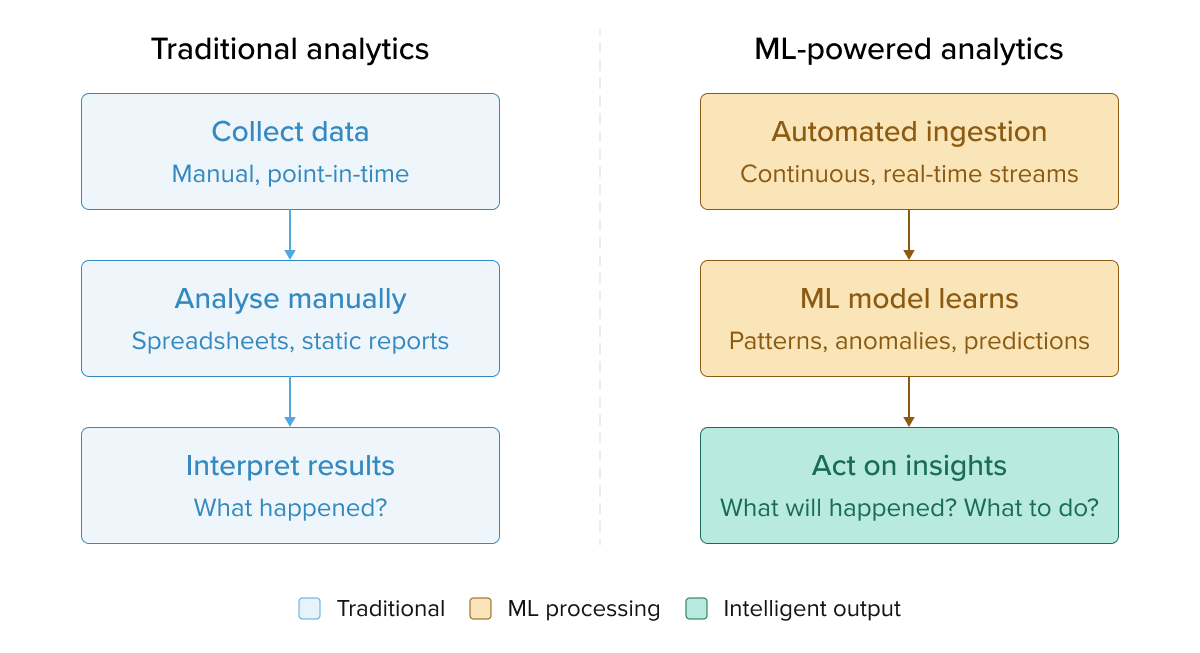
The traditional analytics process is based on collecting data, cleaning it, analyzing it manually, and interpreting the results. This approach used to work, but it’s very limited when teams are dealing with large and complex datasets. Machine learning techniques for business changed the way organizations work with information.
They abandoned static analysis and built systems that can learn and adapt.
The most important change was the organization’s ability to process big data for predictive analytics. The insights are no longer dependent on a single report. They evolve as new data comes in.
These are the main changes brought by this technology:
Automated data analytics at scale
Thanks to machine learning development, large datasets don’t require constant manual input. The workload for teams is massively reduced.
Real-time decisions
Machine learning for business analytics enables a team to act on insights as they happen.
Improved accuracy
Machine learning models keep learning from new inputs. They combine them with historical data to refine their predictions and reduce the possibility of errors over time.
Revealing hidden patterns
Systems can detect subtle connections in data. This helps businesses understand performance better, so their decisions will lead to improved future outcomes.
In the shortest explanation possible, this is a shift from manual analysis to intelligent systems. It makes machine learning data analytics very powerful, and it changes the way companies use insights to move forward.
Advantages of machine learning for business analytics
The real value of business analytics machine learning is so much more than faster analysis. With proper machine learning projects, businesses can make better decisions with more confidence. They will move from reacting to past results to predicting what’s likely to happen next.
1. Realistic predictions
Reliable forecasts are the biggest advantage. Machine learning algorithms analyze large volumes of past data, which makes them able to predict important trends: demand fluctuations, customer churn, or pricing outcomes. Businesses use these insights to plan ahead.
2. Deep customer analytics
Machine learning helps businesses to truly understand their audience. An AI business analytics solution can automatically group people into meaningful customer segments based on behavior and preferences.
For example, an E-commerce platform can identify users that are price-sensitive, as well as those who respond to discounts and come back as loyal buyers. With all this information, a marketing team can develop a targeted strategy.
3. Faster decisions
Automated analysis saves hours that a team would spend on manual reports that require data interpretation. The insights are continuously generated, so decision-makers can quickly act when the conditions change. This is crucial in competitive industries, where timing directly impacts revenue.
4. Improved fraud detection
The ability to detect unusual activity early is another major improvement in the way businesses operate. Machine learning (ML) systems can monitor transactions and user behavior to flag potential risks.
In financial services, risk management models can identify suspicious transactions based on patterns that differ from normal behavior. The systems look for purchases made in unusual locations, sudden high-value transactions that don’t match past spending habits, or multiple rapid transactions in a very short period of time. They also analyze device data and login times to detect inconsistencies.
Let’s say a customer usually makes small, local purchases during the day. Suddenly, there’s a large transaction from another country late at night. The system will immediately flag this deviation from established behavior patterns. This happens before human analysts could notice something is wrong.
5. Continuous improvement
Business analytics and machine learning aren’t static. The system is continuously exposed to new data, and refines its predictions. This learning process is what makes ML systems valuable for long-term strategies.
Main machine learning algorithms in business analytics
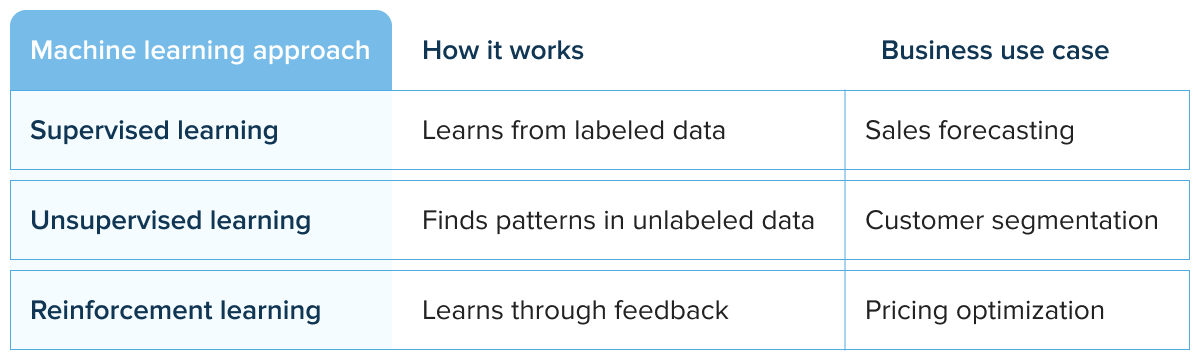
The technical details can get complex, but in most cases, machine learning models fall into three main categories:
1. Supervised learning
This is the most common approach in business environments. The supervised learning method trains models on labeled data. It means that the system already knows the correct outcome, and learns how to map inputs to outputs.
In the simplest explanation, a company can train a model using past customer data. It’s already known which users stopped using a service. The model learns to recognize similar identity patterns, and it can predict which current users are at risk of leaving.
2. Unsupervised learning
This method uses data with no predefined labels. The system doesn’t predict a known outcome. Instead, it explores the data to find hidden relationships. That’s useful for segmentation. For example, businesses can automatically group customers based on their behavior and purchasing habits. There is no need for manual defining of those groups in advance.
Reinforcement learning
Reinforcement learning doesn’t use labeled data. This model is slightly different, as it learns through trial and error. It takes actions, gets feedback, and gradually improves its decisions.
The reinforcement learning approach is used in optimization problems.
For example, it’s great for adjusting pricing strategies and improving recommendation systems. Businesses also use it to automate decision-making processes in dynamic environments. An online retailer can use the method to adjust product prices in real time. The system tests different price points, observes how customers respond, and updates its strategy according to what leads to higher conversions.
Each of these approaches has a different role in ML in business analytics.
The role of AI in business analytics
ML in business analytics focuses on identifying patterns and generating predictions. AI and business analytics take this a step further. AI enables systems to act on those insights. This model can recommend actions and automate decisions, so the need for human intervention is further reduced.
In practice, AI business analytics combines a few capabilities:
- Machine learning
- Rule-based logic
- Real-time data processing.
The goal is to actively support business operations beyond data analytics. For example, an AI-powered analytics platform can automatically adjust marketing campaigns based on user engagement. It can reroute logistics according to demand fluctuations, and prioritize leads based on their likelihood to convert.
Traditional analytics can explain what happened and why it happened. Machine learning adds “what’s likely to happen next?” But business analytics and AI bring us one step further: what should we do about it?
In an advanced setup, generative AI development is used to create dynamic content, generate reports, and simulate different business scenarios. This helps teams explore possible outcomes before making decisions. It’s what’s driving innovation for businesses, since they can move from reactive decision-making to intelligent operations that improve over time.
Real-world applications
Machine learning analytics companies play an important role: they help businesses translate theory into real solutions.
Some large enterprises build internal teams, but most companies rely on specialized partners to design and maintain advanced analytics systems. When the projects involve complex data environments and long-term scaling requirement, the assistance of a specialized service is necessary.
Energy and utilities
ML systems deliver clear value in the energy industry. Machine learning analytics for power companies is used to forecast the demand for electricity and optimize grid performance. For example, models can analyze usage patterns and weather data to predict peak demand periods and help providers adjust the supply. With this, they reduce operational costs and provide a more reliable service.
Predictive maintenance systems also monitor equipment performance and flag early warning signs. If unusual temperature changes or fluctuations in output occur, the teams can intervene to prevent a complete breakdown.
The role of ML companies
Machine learning companies support organizations across sectors by providing the expertise needed for successful implementation of these systems. Experts build reliable analytics solutions based on data engineering and infrastructure setup.
Businesses turn to specialized ML consultants to define their strategy and choose the right approach. That’s how they avoid the trap of pure theoretical use cases, and make sure that the solutions align with their real business goals.
As soon as they have a strategy, companies move into execution with the support of partners that offer end-to-end services. This includes designing custom models and maintaining performance over time. An organization that wants tailored solutions can rely on generative AI consulting to analyze data, but also simulate outcomes and support the decision-making process in an interactive way.
Getting started with machine learning in business analytics
For companies that want to move beyond theory, the first step is actually simple: defining a clear goal.
A business has to identify if ML in business analytics can bring measurable value. From there, the focus moves to data. The team must make sure that the available data is clean and structured in a way that supports analysis. This is the most time-consuming part of the process.
Most organizations work with external machine learning consulting experts to avoid common mistakes and implement the system faster. With proper support, the company can move to scalable solutions that are smoothly integrated into the workflow.
The takeaways
- Machine learning in business analytics moves a company from static reports to dynamic decision-making based on data.
- The quality of data is critical. Even the most advanced system will fail without reliable inputs.
- ML models improve over time. As they evolve, the predictions become more accurate.
- Businesses can gain deep insights into customer behavior and build targeted strategies.
- AI-driven systems move beyond analysis. They recommend actions and automate decisions.
- Real-world applications are found in different industries: retail, finance, energy, utilities, and more.
- The successful implementation of ML models depends on strong data foundations and the right expertise.