The majority of businesses are becoming accustomed to using artificial intelligence to cut costs as its opportunities are becoming apparent. However, an AI-first company prefers to leverage AI to drive revenue growth. Outlining the important AI options that are helping to transform today’s selling practices can teach you how the appropriate use of automated tools can assist you in improving pricing decisions, predicting buyer behaviour, and maximising your profit margins in a matter of days.
Modern businesses are striving to boost their ROI by various means. The profit of a company directly depends on AI tools; however, a relatively large number of leaders express concerns about AI’s impact on gross business revenue growth, according to recent research. This might be due to a large number of AI deployments still being considered “pilot” projects and taking a while to provide financial returns and value.
By using targeted AI applications in this way, businesses can boost their profitability without having to hire more staff members. Instead of hiring more people, companies increase profitability through more effective pricing strategies, more personalised customer interactions, and by allowing sales teams to spend more time on activities designed to generate income. In this article, we will explore AI industry revenue growth trends in 2026 and their business results.
Key AI solutions to improve financial performance
At present, the road ahead for AI-based business prosperity is paved with AI that provides smart solutions to drive business revenue quarter after quarter. Enterprises will witness digital transformation in action if they implement AI and use automation solutions on a daily basis.
Getting the utmost of the power of data science solutions will allow them to upgrade operational efficiency, deliver personalised assistance, and create custom-tailored experiences for customers that will proactively meet their needs.
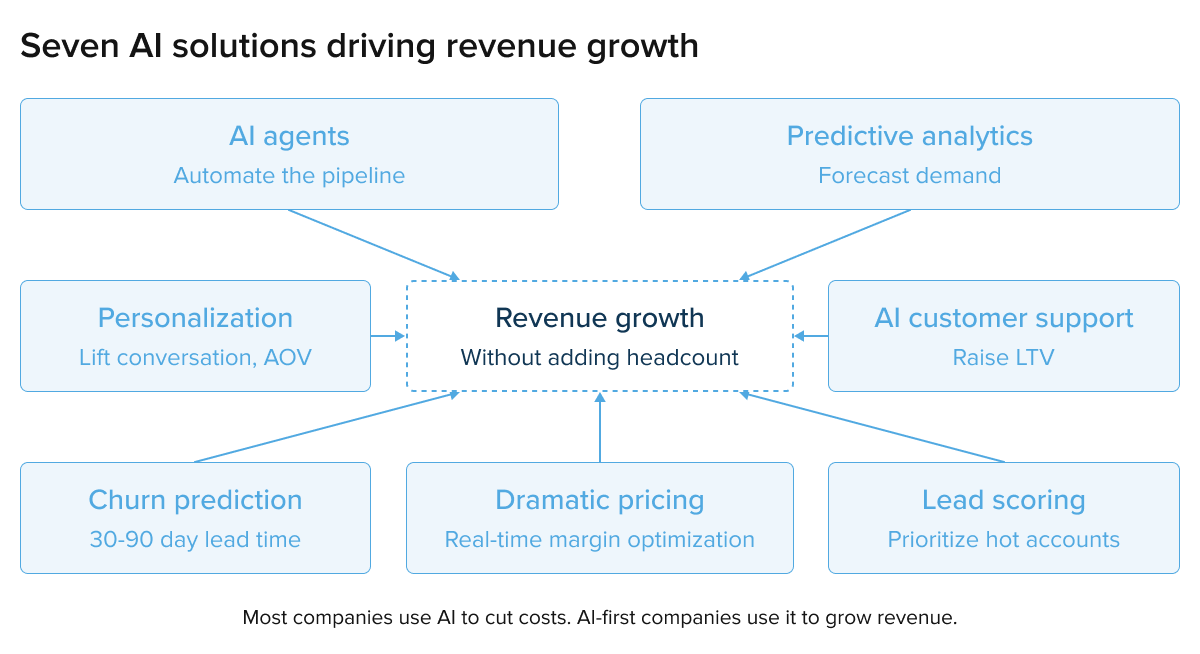
Apart from cutting costs, the way that businesses are able to get revenue growth from AI is by leveraging machine learning development and automation to maximise customer acquisition, optimise pricing, and streamline operations. Those that are leading the way in integrating these technologies will definitely report much greater artificial intelligence revenue than their competitors. The most common types of AI solutions that offer InData Labs to scale efficiently are the following:
Automation of procedures through AI agents
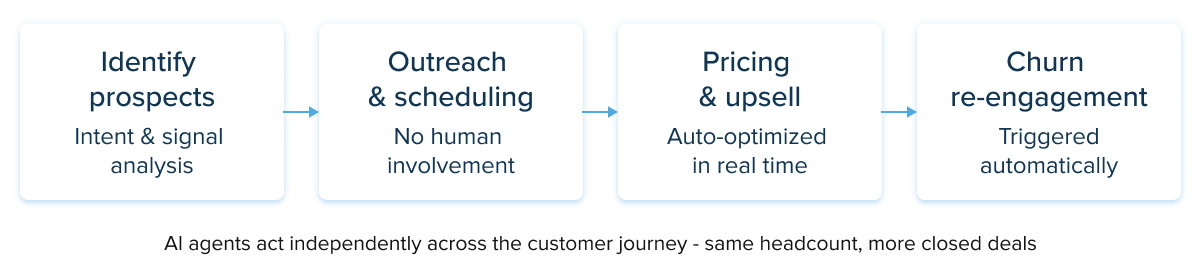
More deals could be achieved far more quickly with the help of AI agents, even with the same resources. AI agents boost revenue through the use of autonomous digital workers to carry out complex, multi-step business processes throughout the customer journey.
Instead of supporting humans, like a chatbot, AI agents foster customer experience consulting that is more tailored; they will take action on behalf of humans by making independent decisions and executing actions through tasks such as lead generation, pipeline management, and dynamic pricing.

Source: Unsplash
Data-driven AI agents for revenue growth are capable of identifying ideal customer profiles by analysing web-based data, social activity, and intent signals to ensure a strong prospect by creating highly personalised outreach emails and scheduling meetings without human involvement.
Through continuous analysis of supply and demand, competitors’ pricing, and historical purchasing behaviour, AI will also auto-optimise pricing while providing instant upsell and cross-sell offers.
In addition to these, an AI revenue agent assists in determining churn signals, like no longer using the service, so automation can occur immediately to re-engage clients and increase their lifetime value. Consequently, a client’s activity is higher, and profit is on the rise.
The tools of predictive analytics
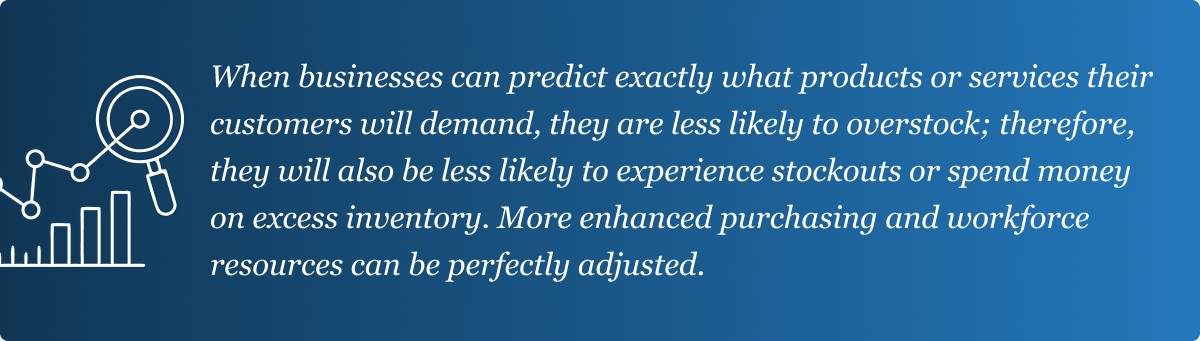
Another way that organisations can use AI is to make use of predictive analytics for artificial intelligence revenue forecasts and less lost revenue.
AI revenue management is easier due to the examination of historical data and currently evolving market data, providing companies with the ability to accurately predict future income and determine relative pricing for both products and services, reducing the rate at which customers leave. Companies that capitalize on these predictive insights typically experience a 10%-20% boost in revenue.
Traditional spreadsheet tools and linear forecasts are frequently static and subject to human error, while machine learning tools are able to evaluate real-time data being provided by CRMs, the health of sales pipelines, and economic data to forecast future deals and sales with greater accuracy. Predictive analytics increases earnings by better machine learning consulting because companies can allocate their resources to profitable opportunities instead of spending time and money on dead opportunities.
Personalisation engines’ effect on income
Artificial intelligence personalisation engines are platforms of AI software development that replace traditional product listings with real-time, bespoke recommendations that enhance the digital shopping experience. By predicting what the customer is looking to purchase next, AI-driven customer experience personalises every aspect of a customer’s shopping experience, leading to increased revenue growth via higher conversion rates and average order values.
The revenue-generating impact of AI-powered recommendations is quite significant, as artificial intelligence recommendations can bring about specific benefits such as much higher conversion rates, average order value, and a substantial percentage of earnings. When product recommendations are tailored based on the past behaviour of particular customers, conversion rates are frequently 10% to 300% higher than those of general recommendations. AI engines can boost AOV by 10–20% or more on average by offering clever cross-sell, upsell, and bundling suggestions as well.
AI-based customer support
Most customer service professionals are deploying AI consulting services to supply their clientele with improved customer support, thereby benefiting from AI in revenue growth management.
Consumers want assistance at any time of day, on the platform of their choice, and without having to wait. The majority of them feel customer service plays a major role in determining their brand loyalty and cite easy access to digital services, online self-service and professional agents as the key customer service requirements.
The quality of client support is crucial due to the fact that investing in AI product development could not be enough to raise profits and guarantee the prosperity of an organisation.
There are more advantages to AI-first customer service positions than just financial savings. Cost savings and efficiencies associated with increased service workload are the two lenses through which astute service organisations evaluate ROI and LTV. Enlarging LTV means keeping customers longer and broadening the number of products and services that those customers buy. It is critical that maximising LTV is a priority, as it is required for artificial intelligence revenue cycles as well as ensuring long-term success.
Models for churn prediction
AI company revenue growth strategies also include the churn prediction models, allowing a fundamental shift from a reactive to a proactive approach to customer retention.
Companies can utilise AI-based models to assign churn risk scores to historical data and behaviour patterns, thus allowing them to focus their attention on accounts at risk of churning out of existence. These scores will allow companies to identify where they are losing revenue and increase the overall customer lifetime value.

Source: Unsplash
On top of that, advanced models are dynamic in that they do not solely depend on static CRM data but rather on the speed of change in the customer’s level of engagement with your company, thus allowing your team 30-90 days of lead time prior to your customer not renewing their subscription.
AI-based dynamic pricing
Dynamic pricing that is fuelled by AI contributes to profit margins by using real-time analysis to eliminate static pricing rules.
By evaluating demand elasticity, competitor pricing, inventory levels, and consumer behaviour on an ongoing basis, machine learning algorithms determine the optimal selling price to both maximise profit and minimise impact on sales volume. The algorithm, which determines the best price based on predetermined business rules, defines artificial intelligence revenue management.
Relying on AI revenue growth, automated markdowns give you the ability to set optimal prices based on the amount of time remaining until clearance, allowing you to sell off dead stock while obtaining maximum value from high-demand inventory. AI tools lessen the possibility of revenue loss due to price mismanagement by enabling you to react instantly to changes in competitor pricing.
Lead evaluation and sales projections
Artificial intelligence revenue models can be aimed at lead scoring and sales forecasting, categorising your pipeline effectively, and enabling you to make better decisions.
AI specifies how likely a prospect is to buy based on the amount of real-time engagement you have had with them over time and the historical interactions you have had with that prospect. By employing this method, AI gives you the information you require to prioritise action accounts and to give you insight into each account’s anticipated close rate.
AI distinguishes between an account’s fit and intent. Active buyers are assigned to the appropriate rep as soon as they meet a threshold of intent to purchase. So, predictive forecasting offers the ability to precisely predict not only the probability of closing a particular deal but also the timing of revenue realization from that deal, as opposed to depending only on intuition to forecast revenue.
Wrapping up
To summarise what we’ve covered, artificial intelligence growth revenue is real to achieve for those who have qualified data and its security, who are eager to upgrade their relationship with customers and make it long-lasting and profitable, and who want to escape from constant client churn and just focus on accelerating company earnings.
Custom AI solutions are the best decision for businesses that are ready to face computational machines for sustained financial development.
FAQ
-
Basically, AI increases revenue by benefiting from key X solutions like predictive analytics, AI agents, enhanced customer support, churn prediction models, dynamic pricing, and so on.
-
Revenue growth is driven by automating operations with artificial intelligence on top of hyper-personalising the customer experience with AI, as well as optimising sales through AI.
-
Predictive analytics techniques play a key role, turning the process for forecasting revenues from one that is reactive and based on historical data only to one that is proactive and based on data-driven decision-making.
-
AI personalises purchases by removing barriers, limiting options, and offering real-time recommendations and offers on relevant products, causing conversion rates to be between 10% and 30% higher.
-
The main obstacles to successfully implementing AI to increase revenue include insufficient quality of data, difficulties in integrating legacy systems, and measuring direct ROI.