TL;DR
Agentic AI turns supply chain management from reactive to autonomous. Unlike generative AI, which waits for human instructions, AI agents monitor data in real time, make decisions within set limits, and act on their own across sourcing, forecasting, logistics, and maintenance. Success depends less on the technology itself and more on connected data, team buy-in, and built-in compliance.
Key takeaways
- Agentic AI acts, not just advises. It uses LLMs as a decision-making layer to interpret requests, plan actions, execute tasks, and optimize processes with minimal human input.
- The market is growing fast. Agentic AI in supply chains is projected to grow from under $2 billion in 2025 to over $53 billion in 2030.
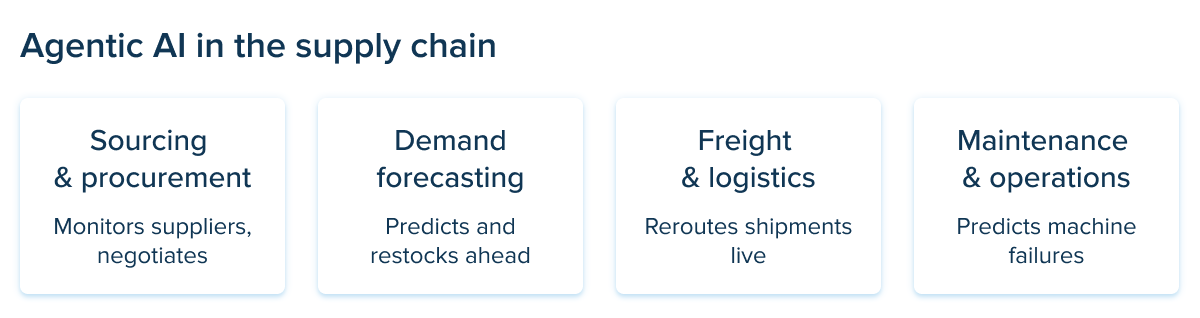
- Four areas benefit most: Sourcing and procurement, demand and inventory forecasting, freight and logistics, and predictive maintenance.
- Humans move from execution to supervision. Managers focus on checking outcomes and strategy, while agents handle day-to-day operations.
- Three common barriers: disconnected data systems, team resistance to handing over decisions, and compliance requirements. Start with low-risk, high-impact processes, keep full audit trails, and build governance into the architecture from day one.
Incorporation of agentic AI in supply chain management operations allows enforcing a collection of refinements for different techniques carried out across the company and reacting in real time without permanent supervision from human beings.
It is expected that important breakthroughs will become possible through AI agent ideas for enterprises, which will give industry the opportunity to foresee disruptions in the supply chain and find necessary means for responding to different contexts. If you are willing to possess the power of AI workflow automation, making go-ahead decisions on applying this technology, it is wise to study what agentic AI in the supply chain is and how supply chain AI agents are capable of creating new opportunities.
Recently, the managers of the global supply chains have faced a great number of challenges that are usually caused by instant uncertainty, ranging from the tensions of the current world disputes to the constantly changing trading policies. Those experts who are dealing with preparations, purchasing, orchestration, logistics and final-leg delivery at the moment receive essential help for cutting costs, upgrading the quality and raising their service tiers.

Source: Unsplash
Despite all of that, thanks to multi-agent AI systems and AI agent development itself, which is the most contemporary technology. Agentic AI supply chain news usually informs us about the fact that it is allowed to make autonomous decisions and execute tasks, resulting in such benefits as the possibility of proactive inventory management and achieving productivity and stability in the supply chain.
In this way, the usage of LLM development for achieving meaningful aims has revolutionised the whole concept.
In this article, we are going to look deeply into the topic of AI agents in supply chains, simultaneously with their key functions, top benefits and why the speedy expansion of enterprise AI development is still shooting up.
What is the heart of enterprise agentic AI for supply chain vendors?
The first generation of AI assistant applications has influenced the supply chain market considerably. It is currently starting the next stage, where vendors invest in AI agents not only to handle simple operations in AI product and software development but also to collaborate with others for long-term prosperity.
Furthermore, procurement specifications are also changing, as the presence of AI consulting capabilities has become a must for choosing the logistic management software, and agentic AI applications in supply chain management have become a necessity, too.
Agentic AI is commonly based on LLM technology but employs it mainly as a control element or a decision-making entity for interpreting complicated appeals and, after that, executing and managing a plan for internal or external processes to fulfil the request. The goal is independence, whereby the LLM takes charge of comprehension and interpreting requests, planning actions, doing the tasks, and optimising procedures with little input from a human user.
There are a wide variety of AI agent examples; consider one of the agentic AI use cases in a supply chain, like in the sample of a global manufacturer whose supply chain is disrupted often due to demand fluctuations and delays on the part of suppliers.
With the help of LLM functioning, the agentic AI in this case would gather immediate inputs from multiple sources about the status of inventory, suppliers, and demand conditions, and the supply chain planning AI agent would create a scheme to change procurement schedules or resource allocation through interacting with the suppliers to meet delivery terms.
Essential areas for AI agents in supply chain management
These days, agentic AI brings about an effect all over the supply chain, producing a strong return on investment for helping prioritise implementations. Agentic AI in supply chain planning’s future today is much beyond prediction, offering advice on executing the required tasks within prescribed limits.
The innovation will give a hand to procurement managers who often have to make real-time changes based on shifting supply and demand trends. With action in place through agentic AI, managers will now have to focus on supervision to observe if the intended result has been reached. Leading companies in agentic AI for supply chains anticipate enormous success with AI strategy consulting introduced to various crucial sectors of the supply chain. The main areas of supply chain agentic AI are the following:
Agile market sourcing and procurement
Purchasing is made much more easily by agentic AI in the retail supply chain and inventory management, fostering sourcing as a constantly active and non-stop process that ensures efficiency, reserves funds, and builds resiliency in the process.
Through the smart systems, suppliers’ markets are non-stop monitored, KPIs are analysed, and periodical negotiations are conducted on behalf of the organisations that agents represent following certain conditions. They also enable spotting new retailers and approving them in case of changing conditions without getting caught.
The approach to risk and expense control becomes forward-thinking in sourcing as well. The agentic AI supply chain monitoring is a wonderful assistant that could monitor all the possible failures that might happen, including supplier defaults, international crises, and poor performance, and modify the procurement process to avoid the failures. In this way, using the agile market sourcing and purchasing strategy ensures reduced costs and improved security of supply.
Stocks and demands projection
In the 21st century dynamic forecasting and inventory decisions should be made using advanced and modern technologies rather than old and outdated practices.
Agentic AI in supply chain planning future enables businesses to convert delayed and tedious processes into dynamic ones to stay informed of current changes or occurrences. It has become possible to supervise metrics, notably sales trends, stock levels, periodic changes, weather conditions, social trends, and so on. Thanks to agentic AI supply chain planning transformation, they can project demand and take respective action at once, thus being able to restock prior to the demand appearing.
Moreover, since there are many companies that already have forecasting processes implemented, it is usually the fastest way to gain the ROI. A robust firm with the full AI readiness assessment is able to maximise the advantages of a streamlined workflow with an agentic AI platform that automates analysis, identifies risks, and develops different possible features which allow making decisions simpler.
Freight efficiency and logistics
When it concerns freight efficiency and logistics, it is obvious that transportation generates an enormous amount of real-time data, such as GPS findings, traffic situations, information about climate patterns, and shipment capacities.
Dynamic route efficiency implies that the agents will modify delivery routes according to the current traffic and weather conditions as well as changing priorities. Manual booking can be replaced with AI agents for supply chain risk and automated decision-making based on prices, safety level of a carrier, and its capacity.
Additionally, the proactive nature of exception management allows the agents to reroute shipments instead of simply waiting till issues arise. The application of IoT sensors and GPS allows for the emergence of a feedback mechanism.
On the whole, agentic AI for retail supply chain optimisation has the ability to perform simulations of logistics situations and assess how diverse aspects affect the logistics performance. Step-by-step coordination and risk mitigation processes can be markedly enhanced by enterprises benefiting from the agentic AI features.
Proactive maintenance and streamlining optimization
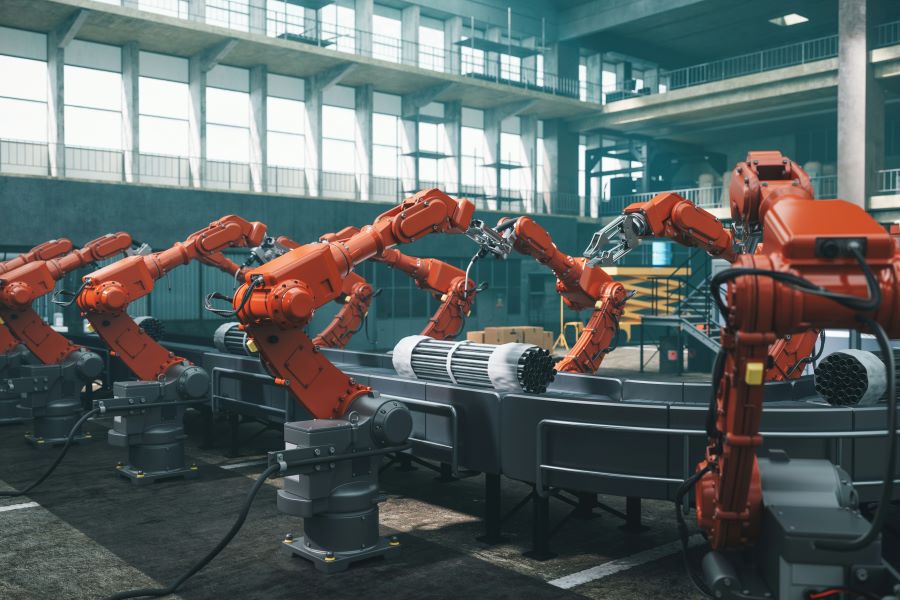
The machines can speak; however, it seems that very few tasks pay attention to their messages. Agentic AI for supply chain optimisation put an end to this situation by converting machine data into actions: detecting malfunctions on time, routine servicing, streamlining the workflow within manufacturing, and many other things. Instead of maintaining machines after a certain period of time, they will analyse real-time output generated by physical instruments and spot leading indicators of a problem in the machine and schedule maintenance service for them.
Source: Unsplash
The same applies to the shop floor; AI agent supply chain security will make changes in production grounded in the availability of machines, priorities of demands, and resource barriers in production, dispensing with time-consuming processes of planning that become obsolete very quickly. The influence snowballs very promptly, thanks to fewer breakdowns, far higher productivity of machines, better utilisation of resources, and tighter schedules.
Hardships encountered when implementing supply chains
Nowadays, there exist lots of agentic AI examples in supply chain companies; they succeed when they know not only how to implement agentic AI in supply chain operations correctly but also what challenges can appear during the application procedures. Even if you have an excellent agentic AI plan, it could fail if there is no adequate groundwork. Let’s dive into three of the most common of them.
Lack of interaction between data
Poor decisions are made because the agents do not have all the required data. This happens when various interfacing systems cannot talk to each other. The best approach to solve the problem is to properly monitor the data quality in real time and to develop data models for all automated systems as stated by common standards.
Pushback from team members
The experts of the supply chain are understandably hesitant when it comes to putting decision-making abilities in the hands of technology.
To build trust in technology adoption, don’t be afraid to include people in problem-solving processes from the very beginning. Start with processes that are not very risky but still have an immediate effect on the business, and be confirmed to maintain full audit trails that will clarify how and why certain decisions were made.
The issues connected with compliance
Supply chain management depends on laws and contracts. Even including AI in supply chain management technology will not change that.
What will change, however, is how your agents will learn compliance starting from day one and building that into their DNA as decision makers. It’s especially crucial for those who use AI agents in healthcare supply chains. If governance is integrated into the architecture of the solution, you can easily scale your solution up.
Wrapping up
Agentic AI is undoubtedly the next step to act rapidly following the decision-centric and regulatory approaches, balancing costs and clients’ expectations. That is the thing that agentic AI in the supply chain is going to change completely; instead of acting as independent analytics or automation instruments, AI agents perform as an intelligent execution layer used in the supply chain processes.
Agentic AI for supply chain-leading companies is unlocking possibilities for every domain without the necessity to substitute the workers, logistics experts, and customer managers. In parallel, businesses are prepared to hand over the running of operations to AI while humans do the strategising.
Agentic AI operates as a united platform that has managed to look at the operation as a whole rather than as a disjointed part. If you think it is time to witness this shift in action, agentic AI is a good choice to start changing your supply chain.
FAQ
-
With agentic AI supply chain solutions, they become less about forecasting and more about making decisions on their own. Instead of waiting for humans to take action, AI agents make assessments and decisions through enterprise systems to execute their plans.
-
AI agents in the supply chain are altering supply chain networks from reactive to predictive systems, which is also lowering costs and improving decision-making capabilities. It is employed in areas like demand and inventory planning, route optimisation, warehouse automation and risk management.
-
The supply chain industry will not be eliminated by artificial intelligence, but it will undergo a significant transformation as a result of it. AI doesn’t replace workers but rather lightens their load by performing repetitive tasks like entering data, forecasting demand, and optimising routes so workers can concentrate on making strategic decisions and balancing exceptions.
-
Agentic AI supply chain management’s application is reshaping the way they operate, converting them from inflexible, reactive networks into flexible and predictive systems. It has been driven by functions like hyper-precise sales estimation, proactive risk management, intelligent inventory orchestration, autonomous warehouse robots, and real-time route optimisation.
-
Agentic artificial intelligence supply chain software allows a shift from basic predictive functions to automatic operations. It does so by analysing many outlines and determining all the possible give-and-takes against the business objectives. AI agents now can autonomously reallocate the stock, redirect shipments, change orders to suppliers, and manage intricate procedures by themselves.
-
Agentic AI can indeed be relied on to handle procurement actions on its own, especially as it handles repetitive tasks that require a great deal of data, such as issuing purchase orders, matching invoices, and making sure everything is compliant. But note that while it can operate independently, there is still a level of autonomy, with top implementations working together with people to find the right balance between effectiveness and hazard.
-
AI agents for supply chain compliance can enhance the precision of demand projections by 20% to 50% as opposed to traditional models. It does this through an automatic flow of operations to examine up-to-date information from the outside environment and reacts to shifts that happen in the market quickly while at the same time verifying predictions without the need for human supervision at all times.