
TL;DR
The biggest value of machine learning in financial services comes from improving decisions at scale, whether that means detecting fraud, assessing credit risk, or processing thousands of financial documents. Real-world examples show that the technology works best when applied to specific, measurable problems rather than broad automation initiatives. Reliable data, explainable decisions, and continuous monitoring matter just as much as the models themselves.
Key takeaways
- Machine learning helps financial institutions detect fraud and assess credit risk in real time.
- AI and ML automate repetitive tasks in document processing and compliance.
- Predictive models support trading, portfolio management, and financial forecasting.
- Reliable data and continuous monitoring are essential for model performance.
- Explainability and regulatory oversight remain critical in financial applications.
- Starting with focused use cases helps institutions measure results before scaling.
Machine learning for financial services stopped being an experiment a while ago. Walk into most major banks, card networks, or lending platforms today, and there’s a model running somewhere in the background, approving a loan, flagging a transfer that looks off, pricing a trade, or routing a support ticket to the right queue. The technology itself isn’t new. What’s changed is how routine it’s become: fewer pilot projects, more production systems handling real volume.
JPMorgan, Mastercard, Affirm, and other financial services companies offer real-world examples of how machine learning is being used, from fraud detection and credit decisions to document processing.
This article looks at who’s actually using it and how.
How banks actually use machine learning
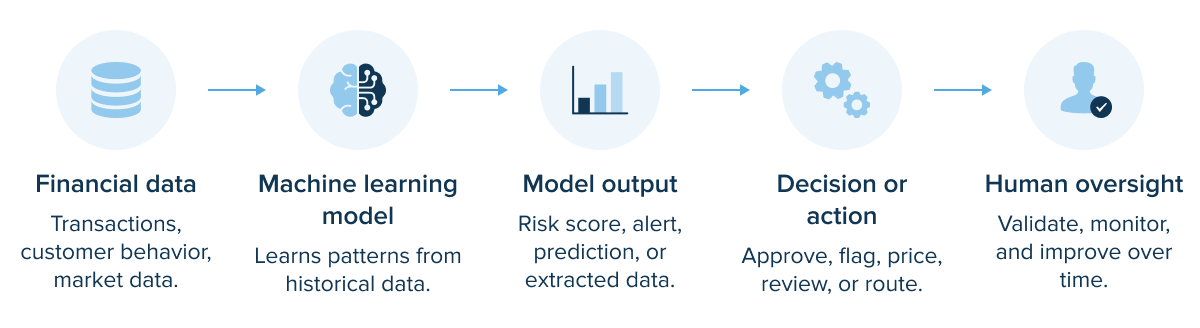
At a basic level, machine learning in financial services means training a model on historical data, such as transactions, loan applications, market prices, and customer behavior, so it can identify patterns and make predictions on new data without a person writing an explicit rule for every case. Finance happens to have unusually rich data sources to draw from: card swipes, wire transfers, years of repayment history, market feeds, even call center logs.
What makes the industry such a good fit is volume combined with repetition. A fraud analyst can review a few hundred cases in a shift. A model scores every transaction on a network in milliseconds, without slowing down by hour six. That’s the underlying shift behind most of the ML technologies covered below, from fraud scoring to document review to the broader set of machine learning use cases in finance that institutions are experimenting with today.
Real-world examples of machine learning in finance
The clearest way to understand machine learning in finance is to look at real-world applications and projects rather than hypothetical use cases.
Fraud detection and real-time transaction scoring
Fraud is one of the most established machine learning applications in financial services. Mastercard’s Decision Intelligence platform, for example, scores transactions in real time using account, purchase, merchant, and device information to assess whether a transaction is likely to be genuine or fraudulent. According to Mastercard, the platform has helped banks score and safely approve 143 billion transactions annually.
More recently, Experian launched Transaction Forensics in 2026, combining identity and financial data with behavioral and transaction analytics. The solution uses more than 80 AI models to identify suspicious activity across bank-to-bank payments. In pilot testing, Experian reported a 200% increase in authorized push payment fraud detection, an 80% reduction in false positives, and 50% fewer alerts.
These examples show how fraud detection is evolving beyond individual transaction scoring, with financial institutions combining multiple data sources and behavioral signals to identify more complex threats.
The rise of generative AI has added another layer to fraud prevention, including new approaches to fraud detection with ChatGPT and identifying fraud involving AI-generated content.
Signals a fraud-scoring model typically weighs include:
- Account and transaction history for the specific cardholder or account
- Merchant category, location, and time of day
- Device and IP data associated with the transaction
- Velocity patterns — how often and how quickly transactions are occurring
- Behavioral deviations from a customer’s established spending profile
Credit decisions and credit scores
Traditional lending relies on credit history, debt-to-income ratios, and other established underwriting inputs. Machine learning allows lenders to analyze more complex financial patterns and make credit decisions using broader signals.
In September 2026, Affirm introduced a transformer-based machine learning model to assess repayment risk using patterns in consumers’ credit histories. In its initial deployment, Affirm reported 3.4% more completed purchases than a control group, with additional loans performing better than a comparable expansion under Affirm’s previous models.
This shows how ML can help identify creditworthy applicants overlooked by traditional scoring methods, while explainability, fair lending, and ongoing monitoring remain essential.
Inputs that ML-based credit models may analyze include:
- Credit history and payment patterns
- Credit utilization and outstanding balances
- Employment and income stability
- Bank transactions and cash flow, where permitted
- Changes in financial behavior
Machine learning can also support decisions after credit has been issued. The InData Labs team developed a predictive model for a debt collection agency to identify accounts most likely to promise repayment. Using LightGBM and historical account data, the model achieved a ROC-AUC score of approximately 0.775, helping collection agents prioritize their efforts more effectively.
Contract intelligence and regulatory compliance
Not every application of data analysis with machine learning in finance faces the customer. JPMorgan Chase’s COiN (Contract Intelligence) is a widely cited back-office example. In its 2016 annual report, the bank said the system used unsupervised machine learning to analyze legal documents and extract important data points and clauses. In an initial implementation, COiN could extract 150 relevant attributes from 12,000 annual commercial credit agreements in seconds, compared with as many as 360,000 hours of manual review per year.
More recently, Bank of Singapore introduced an AI-powered approach to regulatory documentation. In October 2025, the bank announced the rollout of its Source of Wealth Assistant (SOWA), which uses agentic AI to help relationship managers prepare source-of-wealth reports during customer due diligence. According to the bank, the tool reduced report preparation time from 10 days to one hour by automating document analysis and drafting, while employees continue to verify the generated information.
Financial document processing is another area where machine learning can reduce manual work. The InData Labs team provided ML consulting for an invoice and tax return recognition solution, recommending a combination of OCR, rule-based extraction, and machine learning to classify financial document data. The project resulted in an implementation roadmap for improving the client’s existing document processing system.

Source: Unsplash
The lesson is narrower, and more useful, than the headline numbers suggest. These systems automate specific, repetitive document-processing tasks rather than replacing human judgment. The same approach can support compliance operations by extracting information, identifying inconsistencies, and preparing structured records that people can review and audit. This is also part of the broader shift in how AI is reshaping corporate finance.
Algorithmic trading and execution
Trading desks were applying statistical modeling long before “machine learning” became the standard term, making trading one of the more established areas for advanced quantitative techniques in finance. Today, AI and machine learning in finance show up in execution algorithms that break large orders into smaller pieces to limit market impact, in models that price derivatives faster than manual methods allow, and in systems that scan news and alternative data for signals ahead of scheduled reports. For firms competing at institutional scale, this speed is increasingly treated as table stakes, though exactly how much depends on the strategy and the market involved.
KYC, AML, and onboarding
Know-your-customer and anti-money-laundering checks are notoriously manual, and notoriously easy to automate poorly. Machine learning can support these processes by analyzing customer and transaction data, identifying unusual patterns, and helping compliance teams prioritize cases that require closer review.
AI for KYC automation can also support identity verification and ongoing customer risk assessment, while machine learning-based transaction monitoring can help detect patterns associated with potential illicit activity. The goal isn’t to remove human oversight, but to focus analysts’ attention on the cases where their judgment is most needed.
Personalization and wealth management
On the customer-facing side, machine learning and finance intersect in robo-advisors and personalized investment experiences, where models can help tailor portfolio allocations around a client’s risk profile, goals, preferences, and other constraints.
At a broader scale, BlackRock’s Aladdin platform shows how advanced analytics can support portfolio and risk management across large and complex portfolios. The platform combines portfolio management tools with risk analytics, modeling, scenario analysis, and optimization capabilities to help investment teams understand exposures and make more informed decisions.
Not every deployment delivers the same results, though. As real-world predictive analytics examples show, performance depends heavily on the quality and depth of historical data available for training.
Generative AI is beginning to appear here as well, not replacing the underlying models, but sitting on top of them to explain recommendations in plain language. It’s similar to how companies are using generative AI elsewhere: adding a more accessible layer to systems and workflows that already exist.
What makes these systems work
Behind each example above sits a less visible layer that makes the model possible in the first place. Machine learning analytics for financial services is, in practice, more of a data problem than a modeling problem, as institutions need dependable data sources, clean data sets, and a risk management framework that defines what “good” looks like before a model is ever trained.
| Use case | Typical ML technique | Common data sources | Business outcome |
|---|---|---|---|
| Fraud detection | Anomaly detection, gradient boosting | Transaction history, device data, merchant data | Fewer false declines, faster fraud catch rate |
| Credit decisioning | Supervised classification, ensemble models | Repayment history, employment data, alternative data | Broader approvals, more consistent risk pricing |
| Contract review | NLP, clause classification | Legal documents, historical contracts | Faster review, fewer manual errors |
| Algorithmic trading | Time-series models, reinforcement learning | Market feeds, order book data | Lower execution costs, faster pricing |
| KYC/AML | Network analysis, classification | Identity data, transaction graphs | Fewer false alerts, faster onboarding |
| Wealth management | Recommendation models, portfolio optimization | Account holdings, risk profiles | Better-tailored allocations |
This is also where discussions of machine learning in the finance industry tend to get more technical. Choosing the right applications of machine learning for a given institution isn’t only a matter of selecting an algorithm — it means deciding which data sources are reliable enough to build on, then maintaining the pipelines that keep them that way over time, not just at launch. That groundwork, including data audits, pipeline design, and ongoing validation, is usually most of what predictive analytics services actually involve before a model ever gets deployed.
Artificial intelligence and machine learning in financial services
In practice, AI and machine learning in financial services usually appear together within the same project rather than as separate initiatives. A generative AI layer might draft the explanation for a variance in a financial report, while underneath it, a conventional machine learning model is what actually produced the prediction being explained. Knowing when a large language model adds real value, and when a narrower, purpose-built model is the better tool, is increasingly the skill that matters most, and that distinction shows up across many of today’s top fintech AI use cases.
Machine learning for finance: benefits, challenges, and what’s next
The benefits are fairly well established at this point, though each one comes with a practical constraint attached:
| Benefit | What it looks like | Constraint to plan for |
|---|---|---|
| Faster decisions | Applications, claims, and transactions processed in real time | Speed still has to hold up under regulatory scrutiny |
| Broader access to credit | Models weigh signals beyond the traditional credit score | Requires demonstrating the model isn’t introducing new bias |
| Lower fraud losses | Real-time scoring catches more fraud with fewer false declines | Needs continuous retraining as fraud patterns shift |
| Lower operating costs | Automation absorbs repetitive back-office review work | Upfront investment in pipelines and monitoring comes first |
| More consistent risk pricing | Large portfolios priced on the same model logic, not case-by-case judgment | Model drift has to be tracked, or pricing quietly degrades |
Machine learning for finance isn’t something you just switch on and that’s usually where projects go wrong. Regulators are the first wall most teams hit: a credit model has to explain its decisions, to a regulator or a rejected applicant, which rules out some black-box approaches no matter how accurate they test. Data quality comes right after. A model trained on skewed history just repeats that bias, faster, which is why data quality and potential bias need to be assessed before a project moves beyond the pilot stage.
That cost question is worth taking seriously on its own, separate from the data and compliance issues above. Standing up the pipelines, monitoring, and review process a program needs takes real investment before it pays anything back, which is why more institutions now start with a narrower pilot, such as fraud detection or document review, rather than attempting to overhaul risk management all at once. AI cost reduction strategies for business usually come down to exactly this build-versus-buy trade-off, worked through early rather than after a system is already live.
Data analysis with machine learning in finance is already reshaping how fraud teams work. For example, a traditional ML model can assess fraud risk while a language model summarizes the findings for a human reviewer. The direction of travel is fairly consistent across the examples above: more real-time decisioning, more alternative data feeding into credit decisions, and a generative AI layer sitting on top of established models rather than replacing them outright. That same shift is showing up more broadly across the finance industry, as machine learning in finance reduces purely manual review and concentrates human attention on the smaller number of cases a model flags as genuinely uncertain.

Source: Unsplash
A project along these lines usually starts with the same basic building blocks that machine learning development services tend to cover: data readiness, model selection, and a validation plan. From there, the specific AI use cases for financial services worth prioritizing tend to depend on which department has the clearest problem and the cleanest data to start with.
About InData Labs
InData Labs helps businesses across industries develop and implement machine learning solutions, from predictive analytics and data engineering to AI integration. With 12 years of experience, a team of 80+ data experts, and over 150 completed projects, the company has worked on financial services applications, including the debt collection and document processing cases discussed earlier. As an AWS and Databricks partner, InData Labs also helps businesses build the data infrastructure needed to deploy and scale machine learning solutions.
Conclusion
Machine learning in financial services isn’t a project a team finishes and moves on from. It functions more like infrastructure that evolves as new data sources, models, and business needs emerge.
The examples above point to a fairly practical starting point: identify a problem where better prediction or automation can create measurable value, make sure the data can support it, and build governance into the system from the beginning. Expand once the first use case proves itself.
FAQ
-
Mainly fraud detection, credit scoring, algorithmic trading, KYC/AML screening, and document review. These are the most common machine learning applications in finance today, and most institutions start with one before expanding.
-
Fraud models don’t just check a transaction against a checklist. They look at account history, who the merchant is, what device was used, where the purchase happened, how fast transactions are coming in, and whether any of it breaks from how that customer normally spends. That’s the kind of pattern fixed rules tend to miss.
-
Lenders using it aren’t stuck with just a credit score anymore. A model can also weigh income stability, cash-flow patterns, existing debt, and how someone’s repaid in the past. The catch: it still has to be explainable and checked for bias, especially since it’s deciding who gets a loan.
-
Not usually. Institutions using machine learning for financial services tend to keep a person in the loop by design. Most deployments handle high-volume, repetitive screening (flagging a transaction, scoring an application, sorting a document) and leave ambiguous or high-stakes calls to human reviewers. That split isn’t just about trust: for credit and compliance decisions, institutions also need appropriate oversight, accountability, and processes for reviewing or challenging automated outcomes, depending on the applicable regulations.
-
Depends on scope. A narrow pilot, like fraud detection, can reach a working model in a few months when the required data and infrastructure are already available. A full credit-decisioning system takes longer, since machine learning and finance rarely move at the same pace once regulatory review and compliance get involved.
-
AI is the broader category, covering systems that perform tasks that normally require human judgment. Machine learning is one specific approach to building those systems, learning patterns from data rather than following programmed rules.