From the moment an AI-first company starts its journey, its mindset shifts. It doesn’t just bolt on AI to existing processes—it puts intelligence at the core of everything. Modern AI software helps these firms automate decisions, forecast outcomes, and personalize experiences at scale, turning data into the backbone of innovation.
Today’s shift is driven by advances in AI services — from predictive analytics and personalization to full-scale automation — that allow organizations to make smarter decisions in real time.
To understand what separates winners from laggards, we first need to look at what it is in practice, and then explore how they turn that approach into sustainable advantage.
What is an AI-first company?
To grasp the AI-first company meaning, picture two businesses side by side. One treats AI as an accessory—something to be added later. The other designs features, architecture, and even culture around AI from day one. The latter is what we call an AI-first company.

Source: Unsplash
These companies don’t say “we want to add AI,” they say “how can intelligence reshape our product, workflows, and decision-making?”
For them, artificial intelligence first entered companies not as a department but as a lens through which every function is viewed. Over time, they begin to resemble a data science company, using continuous learning loops and advanced analytics to drive every decision, from product design to operations.
The same principle drives how AI for business analysis transforms planning, forecasting, and performance evaluation. Being AI-first is not about hype. It is about embedding models, data systems, and feedback loops into how the business operates. The result: better scalability, faster iteration, and more defensible differentiation.
Real firms that walk the talk
Not every big name can honestly claim to be fully AI-first companies. Some adopt AI as a feature, others as their operating backbone. Below are examples of firms with very strong AI infrastructure, noting how deeply they integrate intelligence.
Google was one of the first global players to champion an AI-first mindset. Its investments in internal models, infrastructure, and algorithmic upgrades across Search, Maps, Gmail, and Workspace show that AI is core to its architecture, not just a layer on top. Its newly launched Gemini Enterprise platform lets organizations build AI agents over data and applications.
Additionally, Google publishes its AI Principles, which outline how they balance innovation with responsible AI development.
Source: Unsplash
Microsoft
Microsoft embeds AI deep into its productivity tools. Its Microsoft 365 Copilot connects models with Word, Excel, Outlook, and Teams, making AI an assistant in daily work. Unlike Google’s model-forward posture, Microsoft often leads with workflows and augmentation.
Its AI consulting and cloud ecosystem, delivered through Azure OpenAI and Copilot integrations help enterprises embed intelligence into custom business applications. But because intelligence influences decision-making, product direction, and user experience across its stack, it qualifies as one of the stronger AI-first companies in enterprise software.
Shopify
Shopify perhaps isn’t fully “AI-first” in the purest sense, but it’s among the pioneers of weaving AI into commerce tools. Its Shopify Magic suite offers merchants content generation, chat automation, and smarter merchandising.
Shopify also reports that many merchants plan to use AI for marketing and content tasks. The company now integrates generative AI services into merchant dashboards, enabling automatic product descriptions, image generation, and campaign optimization — something that used to take entire teams.

It operates in a hybrid space: AI is not the only core, but it is deeply integrated into the merchant experience. Many see Shopify as one of the earlier adopters in e-commerce to approach the AI-first company ideal.
Tesla
Tesla is another interesting case. Its autonomous driving stack, vehicle fleet data collection, and energy systems rely heavily on AI. In that sense, Tesla is closer to being a robotics / AI company than a conventional carmaker.
However, some aspects of Tesla’s operations (manufacturing, sales, service) are still less visible as AI-first. It’s more accurate to say Tesla leans toward the AI-first paradigm: AI is essential in core product functions, but not all operations are yet driven by it.

Source: Unsplash
Remote-first AI companies
A compelling subtype of AI-first is the remote-first ai companies model. These firms combine two modern philosophies: intelligence at the core, and distributed teams as the norm.
Remote-first AI firms depend on strong tooling, written processes, asynchronous collaboration, and platform-level automation to support team cohesion. For instance, data labeling, model reviews, and feature design often happen in shared notebooks and automated pipelines.
Anthropic, a well-known startup in AI safety, operates with largely distributed technical teams. Their model architecture and stack are built so that engineers anywhere can inspect, test, and contribute. Their tools are part of the shared infrastructure.
Similarly, GitLab has operated remotely from its founding. Their culture of documentation, automation, and transparency matches well with the discipline needed by AI-first firms. The combination of remote-first AI companies and intelligence-centered design lets them scale talent globally while maintaining alignment.
The AI-first strategy: What they do differently
Successful AI-first companies don’t just automate; they create complete AI business solutions that blend intelligence with core operations. This mindset turns AI from a tool into a structural advantage, aligning technology with growth. Here are the behaviors they adopt:
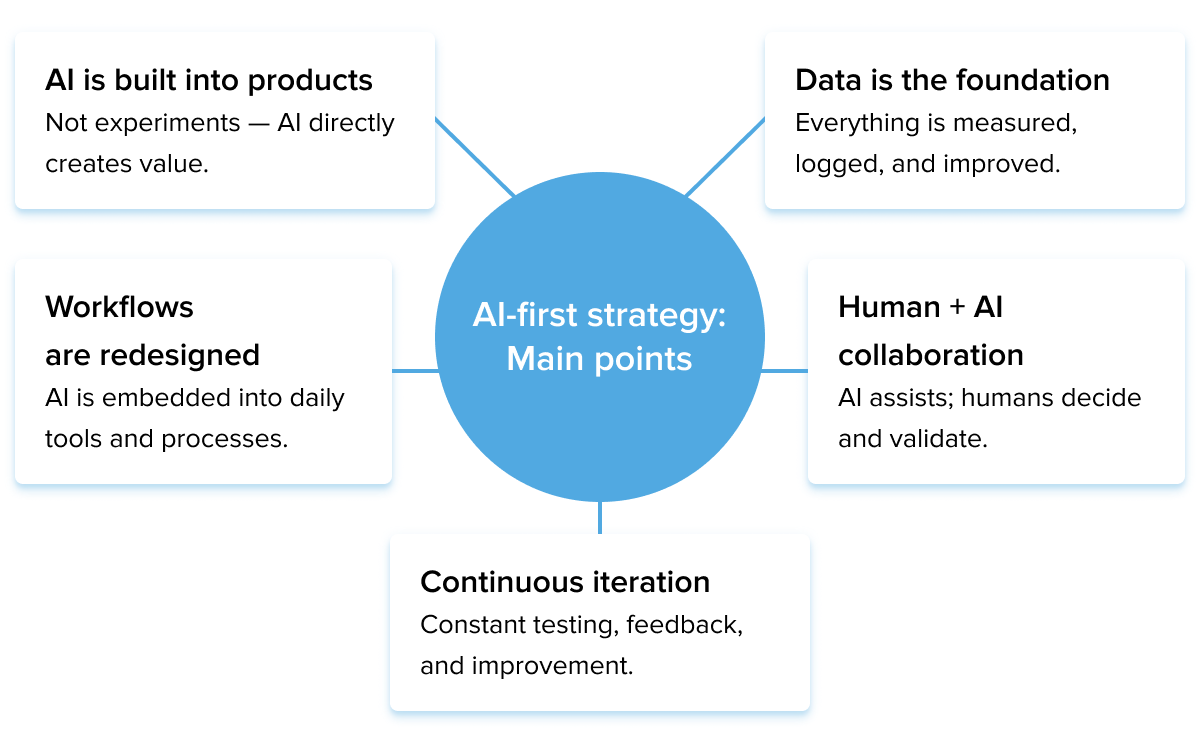
Build AI products, not experiments
These companies use AI to drive revenue and value, not just “proofs of concept.”
For instance, Shopify layers intelligence into their merchant tools—product recommendations, fraud detection, and shipping estimations. Duolingo uses models to personalize learning paths in real time and adjust difficulty. Their AI isn’t a gimmick; it’s woven into the product experience.
When engineers ship new features, they think: where will the intelligence live, how will data feed it, and how will we measure improvement? That discipline separates long-term winners from flashy one-off features. Explore the essential strategies and best practices that leading AI-first companies implement to drive innovation and success.
Data architecture as a first-order concern
Without high-quality data, models fail. AI-first companies invest heavily in data pipelines, annotation systems, feature stores, model versioning, and automated retraining. They instrument every touchpoint: clicks, performance, errors, and conversions.
For example, Google’s internal teams build vast logging and observability systems so every experiment becomes data for future models. This is the google ai first strategy in practice, a foundation that supports scalable AI business use cases across its ecosystem.
Workflows rethought for intelligence
Rather than tacking AI onto existing workflows, these firms redesign how tasks flow. In marketing, product, support—even HR—people interact with AI agents, dashboards, and alerts, rather than spreadsheets.
Microsoft’s strategy with Copilot illustrates this: knowledge workers use AI suggestions in Office apps, not via a separate “AI tool.” That integration is part of the Microsoft AI-first strategy: intelligence embedded in daily flows.
These adaptive systems are also a blueprint for the next generation of AI applications of business, where data, automation, and human expertise combine seamlessly to drive productivity.
Human + machine collaboration, not replacement
The best AI-first organizations treat models as assistants rather than replacements. Human experts validate and tune model output using a variety of NLP tools and interpretability frameworks.

Source: Unsplash
These allow teams to inspect how models reason, improving trust and compliance. They also train and rotate people so that AI-savvy staff understand model failures and fallback logic. Over time, responsibility shifts: machines suggest and humans decide.
Rapid iteration & continuous feedback
Model development becomes like software engineering: cycles of A/B testing, feedback, analysis, retraining. Because the AI is integrated into product flows, teams can collect real signal and iterate quickly.
Errors or drift are not accepted—they are flagged and corrected. This speed gives these companies an edge over more traditional firms bound by slow release cycles.
Challenges, misconceptions & warning signs
Culture and adoption fail to match technology
A company can adopt an AI-first strategy, buy tools, spin up models—and still fail if people don’t trust and use them.
Many efforts stall because employees see AI as risky or opaque. It’s not enough to deploy models; organizations must change how decisions are made and how trust is built. Forbes reports that many firms invest heavily in AI but neglect training or change management, which often leads to low adoption rates.
“Bolt-on” AI is shallow
Some companies try to retrofit AI—add a chatbot, sprinkle automation. That rarely delivers meaningful impact. AI-first firms go deeper: they rearchitect flows, split logic, and rewrite paths around intelligence. If AI is just bolted on, results look superficial and brittle.

Source: Unsplash
Data quality, bias & governance risks
Even strong models fail when data is dirty, biased, or poorly labeled. Without oversight, models may drift or produce harmful results. AI-first firms build governance layers, interpretability tools, fallback logic, and monitoring from day one.
They also plan for security, privacy, and compliance. Models must be explainable and auditable. Without that, executives shy away.
Infrastructure and cost overruns
AI-first development demands compute, storage, pipelines, and people. It’s easy to underestimate costs or build brittle infrastructure. Some companies build models that never go into production because the infrastructure is not mature.
Overreaching too early
Attempting to solve every problem with AI too quickly backfires. The best firms start small, prove impact, then expand scope. Trying to make “everything smart” too early invites complexity, errors, and wasted engineering time.
How to transition toward AI-first
If your company wants to become an AI-first company, the path is gradual but deliberate. Here’s a blueprint:
- Pick a use case with clear ROI—automate a painful, manual, repetitive task first
- Build your data backbone—collect, clean, instrument from day one
- Start embedding intelligence—not as separate models, but as part of flows and UI
- Restructure teams to include roles like model steward, AI curator, data ops
- Establish feedback loops, monitoring, retraining cycles
- Pair every model with human checks, fallback logic, governance
- Scale usage gradually, always measuring impact.
Over time, AI shifts from project to platform. That’s when a digital native becomes a true first AI company.
FAQ
-
An AI-first organization is one that treats intelligence not as a feature but as its foundation.
Instead of adding automation after products are built, these companies design processes, data structures, and decision systems around continuous learning. Every department—from marketing and logistics to HR—both uses and produces data that trains the organization’s models.
-
The first artificial intelligence in recorded history appeared not in today’s neural networks, but in early symbolic programs of the 1950s. One of the earliest was the Logic Theorist, created by Allen Newell and Herbert Simon in 1955 at RAND Corporation. It could prove mathematical theorems, mimicking human reasoning.
-
Most historians credit John McCarthy as the father of AI. He coined the term “artificial intelligence” in 1955 and organized the first AI conference at Dartmouth College in 1956—a milestone that formally launched the field. McCarthy’s vision was for machines to reason, learn, and even understand natural language.
-
Artificial intelligence first entered companies in the 1970s, when businesses began experimenting with rule-based “expert systems.” These programs simulated the judgment of human specialists.
By the early 1980s, firms like Digital Equipment Corporation used systems such as XCON to configure computer hardware automatically—saving millions in labor. AI also appeared in medicine for diagnosing diseases and in finance for early risk modeling. Although computing power limited these early efforts, they proved that AI could deliver measurable business value long before today’s machine learning revolution.