TL;DR
Companies that treat AI research and development as reusable infrastructure rather than one-off projects deliver AI solutions faster, and with less risk. Tech giants like Google DeepMind, Microsoft Research, IBM Research, and NVIDIA invest in AI R&D to advance the technology itself. Firms like InData Labs use their in-house AI accelerator to help clients get a working RAG system or AI agent prototype in 1–2 weeks instead of 1–2+ months.
Key takeaways
- In-house AI platforms speed up delivery. Reusable tools, models, and infrastructure let teams start each project from a working foundation instead of building from scratch.
- There are two main approaches to AI R&D. Google DeepMind, Microsoft Research, IBM Research, and NVIDIA focus on advancing foundation models and infrastructure. InData Labs focuses on faster, lower-cost client delivery.
- InData Labs’ AI accelerator brings three client advantages: a working prototype in 1–2 weeks, lower development costs, and full ownership of a private system with no lock-in to a single AI model provider.
- Most companies don’t need to build their own AI stack. Partnering with a firm that already has a delivery-ready accelerator is often faster and more cost-effective than hiring and building internally.
- AI R&D delivers consistent business benefits: speed, automation, cost reduction, security and governance, flexibility, and better use of limited AI talent.
- Key 2026 AI R&D trends include multi-agent systems, citation-backed RAG answers, built-in governance and auditability, and a shift toward partnering instead of building everything in-house.
Artificial intelligence has moved from a research curiosity to a competitive necessity, and the way a company approaches AI research and development increasingly determines how quickly that necessity becomes a working product. A custom AI solutions platform — a reusable foundation of tools, models, and infrastructure built once and adapted many times — is the clearest expression of that approach. It converts research capability into predictable business value: shorter delivery timelines, lower engineering cost per project, and a system already proven in production rather than assembled from first principles.
For a business evaluating a technology partner, this distinction is far from academic.
A company that has genuinely invested in artificial intelligence research and development has less to build from scratch on any given engagement, which translates directly into lower delivery risk, tighter timelines, and solutions built on infrastructure that has already been tested with other clients—rather than a bespoke experiment assembled under deadline pressure.
This article examines how InData Labs and four other well-known companies structure their internal AI research and development work, then sets out the concrete business benefits of working with a company that has already made this kind of infrastructure investment.
Top AI research companies with in-house AI R&D platforms
1. InData Labs
InData Labs has built an internal AI platform accelerator—a reusable foundation covering knowledge retrieval, agent orchestration, data analysis, and visual workflow automation. Instead of building this infrastructure from scratch for every RAG or AI agent project, the company configures and extends existing modules to fit each client’s data and use case.
The result is measurable: because the underlying infrastructure, model integrations, and orchestration layer already exist, this internal R&D investment lets a client’s specific use case move from requirement to a working, testable prototype in one to two weeks—the time that would otherwise go into building and testing the plumbing is instead spent on the part of the project that’s actually unique to the client.
The platform includes:
- Configurable retrieval strategies—naive vector/hybrid/graph-based/agentic retrieval, chosen per use case
- A model-agnostic orchestration layer—cloud and self-hosted models behind one interface, swappable without rebuilding the app
- An extensible tool registry—built-in and custom Python tools, centrally governed
- Multi-agent workflows—composable specialist agents instead of one general-purpose model
- Source-level transparency—every answer traceable to its source chunk
- Centralized administration—access, usage, and cost managed from one place
See the accelerator in action:
For clients, this translates into three concrete advantages:
- Speed: a working RAG or AI agent prototype your team can use in 1–2 weeks, instead of 1–2+ months.
- Cost efficiency: lower development cost, since the underlying infrastructure already exists and is reusable.
- Full ownership: clients receive their own dedicated, private system—not shared software or a subscription seat—with no lock-in to a single AI model provider.
InData Labs frames this accelerator as the foundation behind its AI consulting and AI product development engagements, rather than as a product a client licenses on its own. Clients typically start with an AI readiness assessment to identify the highest-value use case, then move into AI software development built on top of the existing accelerator—which keeps delivery timelines and costs well below what a from-scratch project would require.
Business benefits at a glance
| Client priority | How the platform addresses it |
|---|---|
| Get to value fast | A working RAG or AI agent prototype in 1–2 weeks, built from reusable components rather than from scratch |
| Control cost | Reused infrastructure lowers build cost versus a fully bespoke solution |
| Keep data private and secure | Validated on our accelerator, then migrated into the client’s own environment, so production data stays under their control |
| Stay auditable | Built-in audit log tracks activity across the platform |
| Avoid vendor lock-in | Supports cloud-hosted and self-hosted models, managed from a single interface |
| Make internal knowledge usable | Teams can turn documents (PDF, Word, PowerPoint, text) into a searchable, AI-queryable knowledge base without coding |
| Reduce reliance on data teams | Business users can query their own data in plain language and get charts, reports, and analysis back directly |
| Automate repetitive processes | Multi-step workflows are built and managed visually, with agents and tools as reusable nodes |
| Govern AI usage | Centralized admin controls for user access, permissions, model usage, and cost |
This delivery-focused model is one way to structure an in-house AI platform.
The next four companies take a different approach—investing in AI research and development primarily to advance the underlying technology itself, rather than to accelerate client delivery.
2. Google DeepMind
Google DeepMind operates one of the most resourced artificial intelligence research organizations in the world, with its own model-training infrastructure, evaluation pipelines, and safety-testing tools built in-house.
Key strengths of its platform:
- Full-stack AI research infrastructure—proprietary tools for training, evaluating, and safety-testing models at massive scale
- Fundamental and applied research—spans foundational artificial general intelligence research alongside real-world applications in healthcare, materials science, and Google’s consumer products
- Flagship outputs—the Gemini family of multimodal models, AlphaFold for protein structure prediction, and Project Astra, an early-stage universal AI assistant.
3. Microsoft Research
Microsoft Research maintains internal platforms for large-scale model training, responsible-AI evaluation, and rapid prototyping, feeding directly into Microsoft’s commercial AI products.
Key strengths of its platform:
- Direct pipeline to production—research feeds straight into Azure AI services and the Copilot product line
- Strong publication record—consistent output of ai research papers shared with the academic and industry community
- Flagship outputs—Microsoft Copilot (integrated across Office and Windows), the lightweight Phi family of small language models, and Azure AI Foundry for building custom AI applications
4. IBM Research
IBM Research has long maintained in-house tooling for enterprise-focused artificial intelligence research, with a particular focus on trustworthy, deployable AI.
Key strengths of its platform:
- Enterprise-first focus—built around trustworthy AI, hybrid cloud deployment, and industry-specific use cases (finance, healthcare)
- Governance tooling—watsonx. governance for monitoring, documenting, and auditing AI models in regulated environments
- Flagship outputs—Watsonx, IBM’s enterprise AI and data platform, and the open-source Granite family of foundation models for summarization, code generation, and retrieval-augmented search
5. NVIDIA
NVIDIA’s internal R&D platform spans both hardware and software, giving other companies the infrastructure to run their own AI workloads efficiently.
Key strengths of its platform:
- Full hardware-software stack—custom silicon, the CUDA ecosystem, and frameworks for building and fine-tuning large models
- Infrastructure-as-enabler model—designed to power other companies’ AI workloads, from cloud providers to autonomous-vehicle makers
- Flagship outputs—the NeMo framework for training and customizing LLMs, the open Nemotron model family, and DGX systems for enterprise-scale training and inference
These four companies represent one model of AI research and development: massive, in-house investment aimed at advancing the underlying technology itself—training foundation models, publishing research, and building the infrastructure to support work at a global scale. Few organizations can operate at that level, and most don’t need to.
For companies that want the benefits of a mature internal AI platform—reused infrastructure, tested components, faster delivery—without building one from zero, partnering with a firm that already owns the accelerator, like InData Labs, is the more practical path.
Why companies need an artificial intelligence researcher in-house
Even with a strong platform, technology alone doesn’t produce results — people do. An artificial intelligence researcher (or a small in-house team of them) is responsible for adapting general-purpose tooling to a specific business problem: selecting the right model, tuning retrieval or analytics pipelines, and validating outputs before they reach production.
For many mid-size organizations, building this capability from scratch is slower and more expensive than expected.
Recruiting is competitive, ramp-up takes months, and a single AI research scientist rarely covers the full stack of data engineering, model selection, and deployment. This is why companies that want to hire AI research developer talent quickly often find it more practical to work with a partner whose accelerator and team are already in place, rather than building an internal function from the ground up.
AI researchers powering modern R&D teams
AI researchers today do far more than train models. On a modern R&D team, they design retrieval pipelines, evaluate agent behavior, and keep a growing catalog of internal tools maintained and reusable across projects. This is exactly the kind of work that separates leaders in AI research from companies that treat AI as a one-off project.
Leading AI researchers tend to work inside organizations that give them reusable infrastructure rather than asking them to rebuild the basics on every engagement — which is also why so many AI research companies now invest deliberately in internal platforms. The pattern holds across company size: whether it’s a large lab or a boutique consultancy, leading AI researchers are most productive when the underlying platform is already solved.
AI in R&D: Transforming corporate innovation
AI in R&D isn’t limited to model-building companies. Across manufacturing, logistics, healthcare, and financial services, internal R&D teams now use AI R&D tooling to speed up literature review, data analysis, and prototyping — the same categories of work an in-house AI R&D platform is built to support.
Structuring this properly usually starts with a simple question: how do you turn “we should use more AI” into something a team can actually execute? An effective AI R&D strategic plan typically starts by mapping existing data and workflows, identifying one or two high-value use cases, and only then deciding whether to build R&D AI capability internally or bring in a partner with an existing platform.

Source: Unsplash
Framed this way, research AI stops being an abstract ambition and becomes a scoped, budgeted initiative with a realistic timeline. The broader shift here is straightforward: artificial intelligence in research and development is moving from an experimental side project to a standard line item in the technology budget, and companies that plan for it early tend to avoid the most expensive mistakes.
Getting this right also depends on ownership. Effective artificial intelligence research and development rarely happens as a side task for an already-stretched engineering team — it needs a named owner, a defined budget, and a platform to build on, whether that platform is built in-house or brought in through a partner.
Benefits of AI research and development
Investing in AI research and development—whether in-house or through a partner with a ready-made platform—tends to pay off in a handful of consistent ways.
1
Speed. Reusable components mean new projects start from a working foundation instead of a blank page. What used to take months of infrastructure work can now be validated in weeks, letting decision-makers see real results before committing further budget.
2
Automation. AI automating research and development tasks—document review, data cleaning, first-draft analysis, code generation—frees specialists to focus on judgment calls rather than repetitive groundwork. This applies equally to internal R&D and to using AI for research more broadly, from checking a hypothesis against existing data to building the first version of a report. Teams that lean on AI for research consistently report shorter cycles between an idea and a testable prototype.
3
Cost reduction. Because core infrastructure already exists, teams pay for configuration and customization rather than reinventing foundational tooling. This is one of the clearest reasons AI in research and development delivers a fast return: less time spent on plumbing means more of the budget goes toward the part of the project that’s actually specific to the business.
4
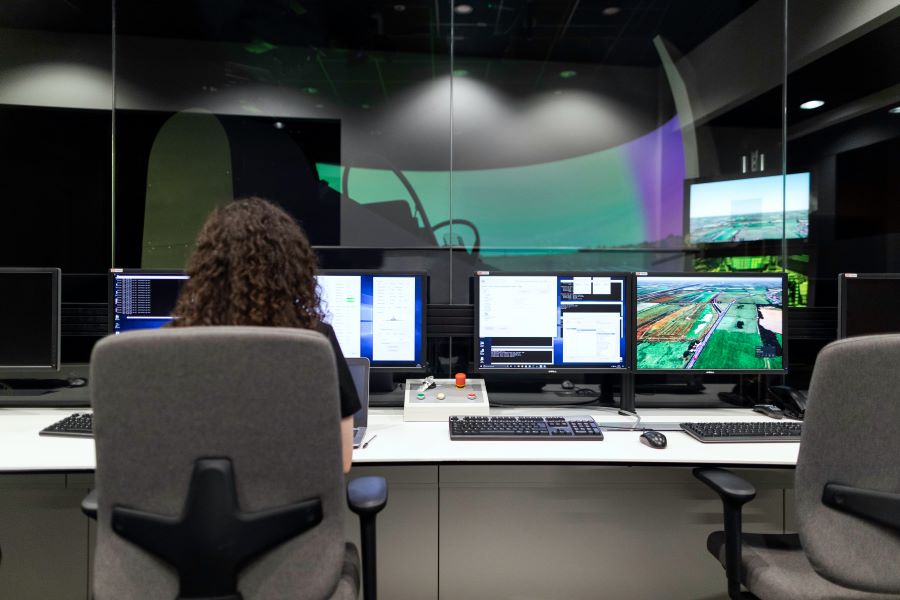
Security and governance. A mature platform typically comes with access controls, audit trails, and the option to run entirely on private infrastructure—important for regulated industries or any company unwilling to send sensitive data to third-party consumer AI tools.
Source: Unsplash
5
Flexibility and independence. Platforms built to be model-agnostic let organizations swap AI providers as the market shifts, avoiding lock-in to any single vendor’s roadmap or pricing.
6
Talent leverage. A working platform lets a small internal team—or a single AI research scientist working with an external partner — accomplish what would otherwise require a much larger hiring effort.
Latest AI research and development trends 2026
Several AI research and development trends are shaping how companies plan their AI roadmaps this year. Multi-agent systems, where several specialized agents collaborate on a task rather than relying on one general-purpose model, are moving from research demos into production tooling—each agent handling a narrower slice of the workflow, from retrieval to validation to execution.
Retrieval-augmented, citation-backed answers are becoming the default expectation for any system built on internal documents, particularly in regulated fields where teams still need to review the source documents behind an answer, rather than trusting a model’s output on faith.
Governance and auditability have also moved from a compliance afterthought to a core design requirement: enterprises now expect every AI decision—from a retrieved document to an agent’s action—to be traceable, logged, and explainable to auditors, regulators, and internal risk teams alike.
Perhaps the most consequential shift, though, is strategic rather than technical: fewer enterprises are trying to build their entire AI stack in-house from scratch. Instead, they are partnering with firms that already have a delivery-ready accelerator—pre-built infrastructure for models, retrieval, orchestration, and governance—allowing them to validate use cases and reach production in weeks rather than months.
Conclusion
Companies that treat AI research and development as core infrastructure—not a one-off project — consistently move faster, spend less, and take on less risk than those starting from scratch each time. Whether that means committing to fundamental AI research at the scale of Google DeepMind or NVIDIA, or partnering with a firm such as InData Labs that has already built the accelerator for delivery—the practical takeaway is the same: reusable infrastructure gets you to a working system faster than starting from scratch.
For most mid-size and enterprise organizations, the practical starting point is not a hiring plan or a from-scratch build—it’s finding out which parts of the work someone has already solved and building from there through services like AI consulting, data science solutions, or machine learning consulting.
FAQ
-
AI in research and development helps organizations move faster at every stage of the innovation cycle—from hypothesis generation to testing to deployment. Teams doing artificial intelligence research and development use machine learning models to analyze large datasets, identify patterns humans might miss, and simulate outcomes before committing to costly physical experiments.
In practice, AI R&D shows up as predictive modeling in pharmaceuticals, automated literature review in scientific research, and rapid prototyping in engineering. Companies increasingly treat AI in R&D not as a separate initiative but as infrastructure woven into existing research and development AI workflows, cutting the time between an idea and a validated result.
-
The major focus of AI research today centers on building systems that are more capable, reliable, and efficient — particularly in reasoning, generalization, and safety. Leading AI researchers and top AI research companies are concentrating resources on large language models, multimodal systems, and artificial general intelligence research, while also addressing interpretability and alignment so outputs can be trusted in production environments. A growing share of AI research papers now also focuses on efficiency: getting strong performance from smaller, cheaper models rather than only scaling up. For most businesses, though, the practical focus of AI research and development is narrower — adapting these advances to solve specific, high-value problems.
-
The purpose of artificial intelligence research is to expand what machines can reliably do — and to translate that capability into real economic and scientific value. Academic research AI pushes the boundaries of what’s theoretically possible; applied AI research and development takes those breakthroughs and turns them into working products, from diagnostic tools to automated analytics. This is also why the demand to hire AI research developer talent has grown so sharply: organizations need people who can bridge cutting-edge research with deployable systems, not just an AI research scientist publishing papers.
-
Three of the clearest benefits of AI research and development are speed, accuracy, and scalability.
- Speed: AI can process and analyze data volumes far beyond human capacity, compressing AI in research and development timelines from months to weeks.
- Accuracy: machine learning models reduce human error in repetitive analytical tasks, from data classification to pattern recognition in large datasets.
- Scalability: Once built, AI-driven R&D initiatives can be extended across departments or product lines without a proportional increase in headcount. This is a major reason companies are using AI to automate research and development rather than growing their teams linearly.