Data analytics companies in USA have fundamentally shifted from being a specialized tech service to becoming the central nervous system of modern enterprise strategy. Whether it’s a regional hospital optimizing patient pathways, a fintech startup detecting fraud in milliseconds, or a global retailer forecasting seasonal demand — the engine behind these decisions is data analytics.
Data analytics companies in USA are driving this shift at scale, giving organizations the infrastructure, expertise, and AI muscle to extract real value from the data they already have. This guide identifies the top players, explains what separates good from great, and helps you find the right fit for your specific needs.
Why the USA leads in data analytics
The United States hosts the highest concentration of data and analytics talent, infrastructure, and investment in the world. According to multiple resources, the global Big data analytics market is on track to surpass $650 billion by 2029 — and American firms are capturing a disproportionate share of that growth.
Several factors explain this leadership. Cloud-based analytics adoption is higher in the US than anywhere else. Open source data science communities are most active here. And the pipeline of AI and machine learning talent coming out of American universities remains unmatched.
But the more practical reality for business leaders is this: Forbes research consistently shows that data-driven organizations are 23 times more likely to win new customers and 19 times more likely to sustain profitability. The gap between companies that operationalize analytics and those that treat it as a reporting function is widening every year.
What is data analytics, and why does the definition matter?
Many organizations struggle to extract value from analytics investments because they’re solving the wrong problem. Data analytics is not just reporting. It is the end-to-end process of collecting, cleaning, modeling, and interpreting data to drive smarter decisions—and it spans a wide spectrum of complexity and capability.
Effective data analytics to improve decision-making draws on statistics, engineering, domain knowledge, and increasingly, large language models and generative AI. The goal isn’t to produce more charts — it’s to change how decisions get made inside an organization.
The 5 types of data analytics
Before evaluating any data analytics consulting company, it helps to understand which type of analytics you actually need:
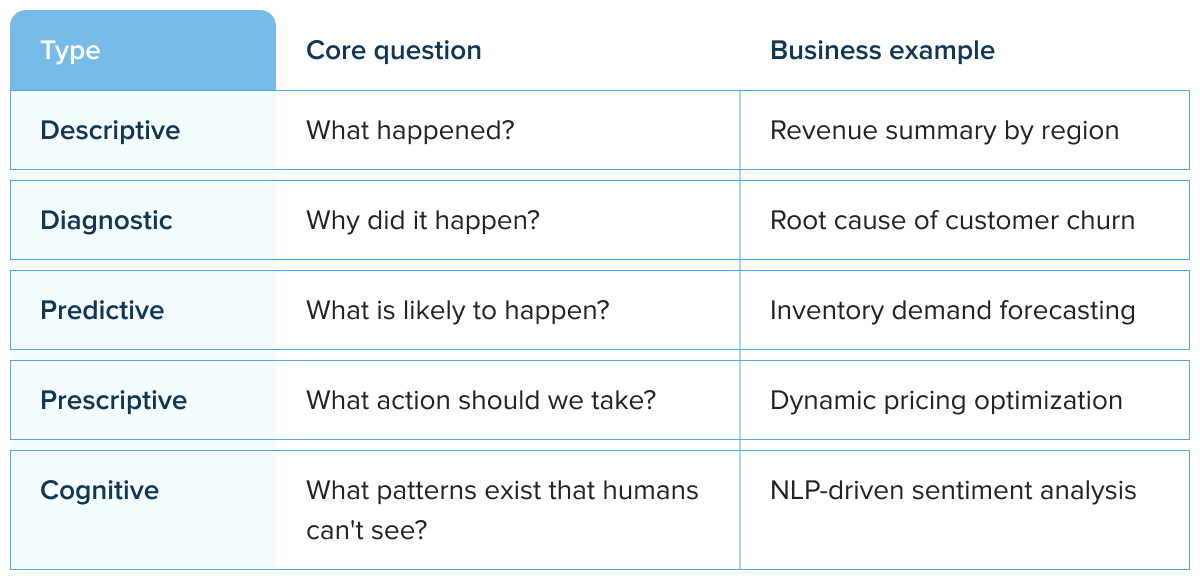
The most capable data analytics solution companies deliver all five as part of an integrated, continuously improving system — not as isolated projects.
What to look for in a data analytics company
The market for data analytics consulting companies is crowded. Many firms offer broadly similar service descriptions but differ significantly in execution quality, technical depth, and business impact. When evaluating any data analytics firm, focus on:
- Genuine AI and machine learning capability — not just tooling familiarity but the ability to build, train, and deploy production-grade models
- Data quality discipline—how a firm handles messy, incomplete, or inconsistent data tells you more than any case study
- Industry fluency—a firm that has worked in your sector understands the regulatory, operational, and competitive context that shapes analytics priorities
- End-to-end ownership—from raw data ingestion to business-facing dashboards, the best partners own the full stack
- Demonstrated ROI — client results, not platform features, are the real differentiator.
Top data analytics companies in the USA
1. InData Labs
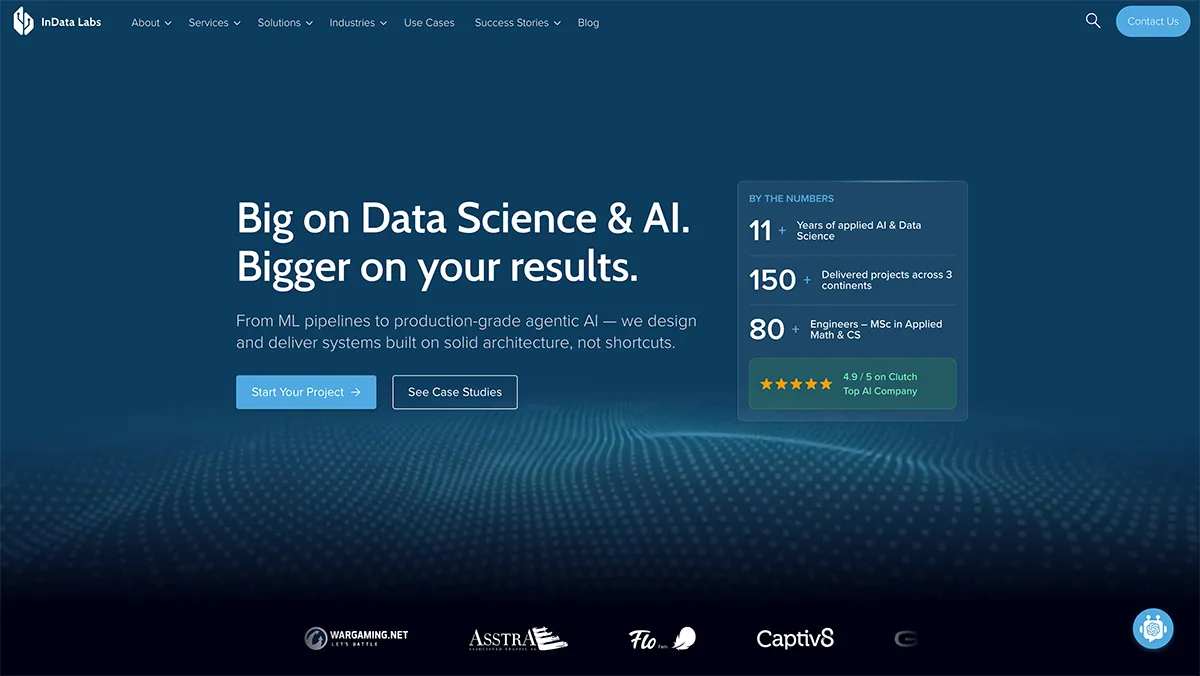
Location: Miami, FL | Founded: 2014
InData Labs occupies a distinct position in the US analytics landscape — sitting at the intersection of deep data science expertise and practical AI product delivery. Unlike pure-play BI vendors or generic consulting firms, InData Labs builds custom solutions designed around each client’s specific data environment, business model, and growth objectives.
The firm’s capabilities span the full analytics value chain. From exploratory data analysis and data evaluation in the early stages of a project, through to Big data development, real-time pipeline engineering, and production AI deployment—InData Labs handles complexity that most data analytics consulting firms in USA are not equipped to manage.
The team’s work spans healthcare, fintech, E-commerce, retail, logistics, and media, with a particular focus on organizations that need Big data analytics services tailored to their specific use cases rather than a pre-packaged platform.
What makes InData Labs different:
InData Labs approaches every engagement as an engineering problem first and a business problem second — which means solutions are built to scale, integrate cleanly with existing infrastructure, and deliver measurable outcomes. The firm’s AI capabilities include LLM for data analytics, generative AI integration, AI software development, and full-cycle artificial intelligence business solutions.
As a high-performance data consultancy with a track record across hundreds of engagements, InData Labs is consistently recognized among the top data science companies in the USA—and for organizations that need a genuine technical partner rather than a vendor relationship, it is the standout choice.
Core service areas:
- Custom AI and machine learning development
- Big data engineering and architecture
- Cloud-based analytics infrastructure design
- Real-time data pipelines and streaming analytics
- Data visualization and business intelligence
- LLM integration and generative AI for analytics
- End-to-end AI product development.
Best for: Organizations that need bespoke AI-powered analytics built around their data, not adapted from a generic platform
2. Palantir Technologies
Location: Denver, CO | Founded: 2003
Palantir’s Foundry and Gotham platforms have become synonymous with large-scale enterprise data integration, particularly in defense, intelligence, and heavily regulated commercial sectors. The company’s approach centers on connecting disparate data sources into a unified operational layer, enabling data-driven decision-making across complex organizational structures.
Palantir is one of the most widely cited names when discussing the biggest data analytics companies globally, and for good reason — its technology underpins some of the world’s most data-intensive operations.
Best for: Government, defense, and large enterprise data integration at scale
3. Databricks
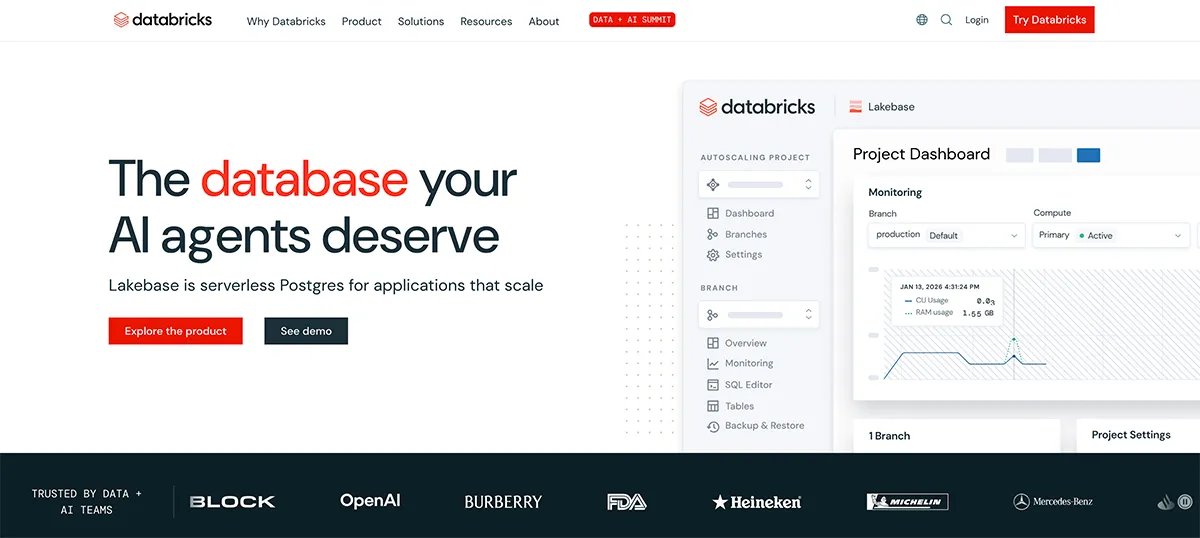
Location: San Francisco, CA | Founded: 2013
Databricks popularized the data lakehouse concept — a unified architecture that combines the flexibility of data lakes with the performance and governance of traditional warehouses. Built on Apache Spark and deeply embedded in the open source data science ecosystem, Databricks has become the default platform for organizations running large-scale machine learning workloads in the cloud.
Its acquisition of MosaicML and continued investment in generative AI tooling have strengthened its position as a platform for end-to-end AI development, not just data engineering.
Best for: Cloud-native data lakehouse architecture, open source ML, enterprise data engineering
4. Alteryx
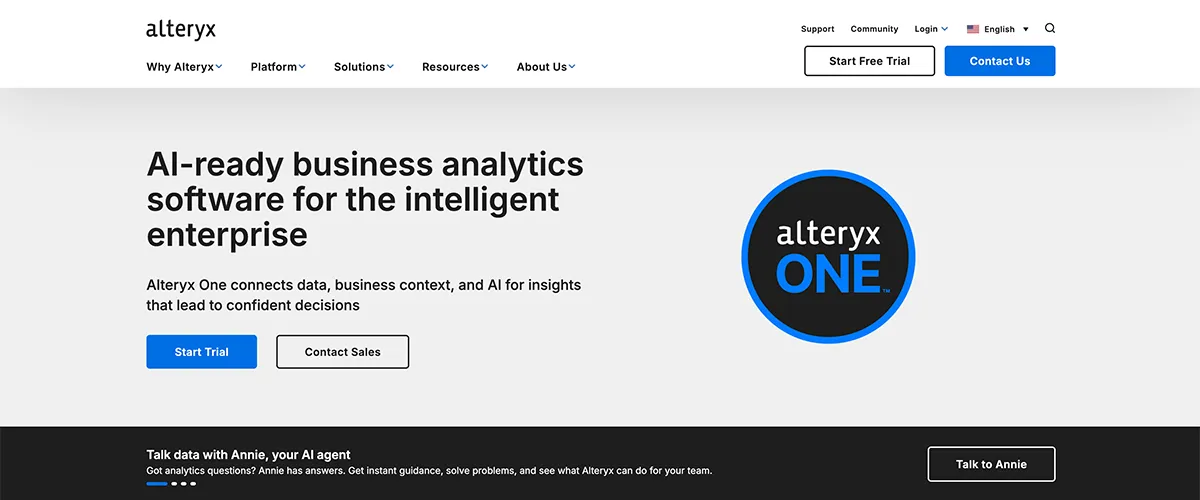
Location: Irvine, CA | Founded: 1997
Alteryx occupies a valuable niche in the analytics market — making sophisticated data preparation, blending, and analysis accessible to business analysts who lack engineering backgrounds.
Its no-code and low-code workflows have earned it a loyal following among finance, operations, and marketing teams that need analytical capability without full dependence on data science resources. Alteryx frequently appears in industry rankings of the most influential data analytics companies for business users.
Best for: Self-service analytics, business analyst empowerment, data preparation workflows
5. Teradata
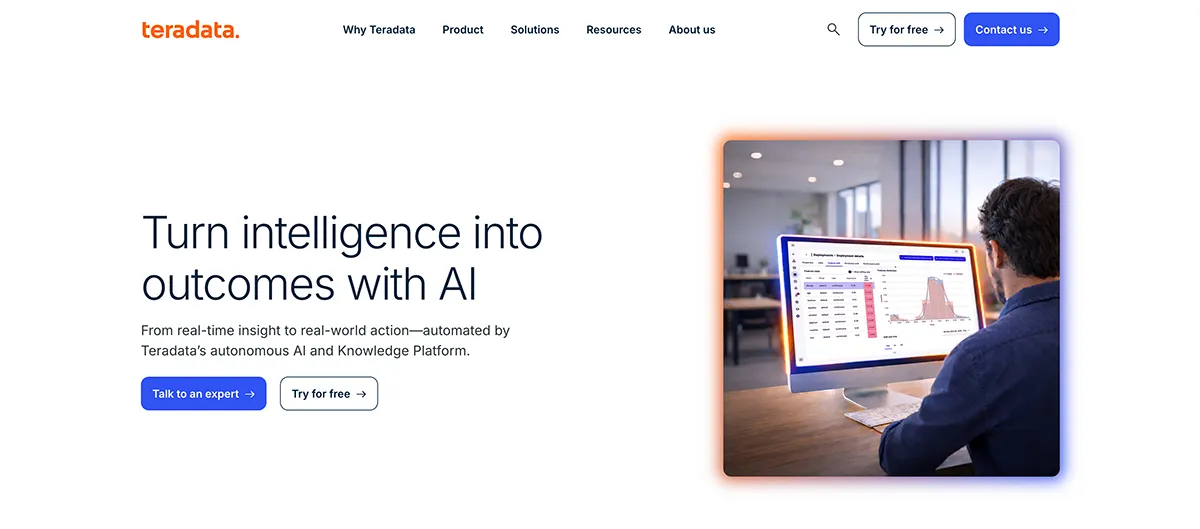
Location: San Diego, CA | Founded: 1979
Few companies can match Teradata’s depth of experience in enterprise data warehousing. Its Vantage platform has evolved to support hybrid and multi-cloud environments while retaining the performance and reliability that made Teradata the default choice for mission-critical analytics workloads in banking, retail, and telecommunications.
For organizations that prioritize data quality, governance, and high-throughput query performance, Teradata remains one of the most dependable big data analytics companies in the US market.
Best for: Enterprise data warehousing, hybrid cloud analytics, high-volume transactional environments
6. MicroStrategy
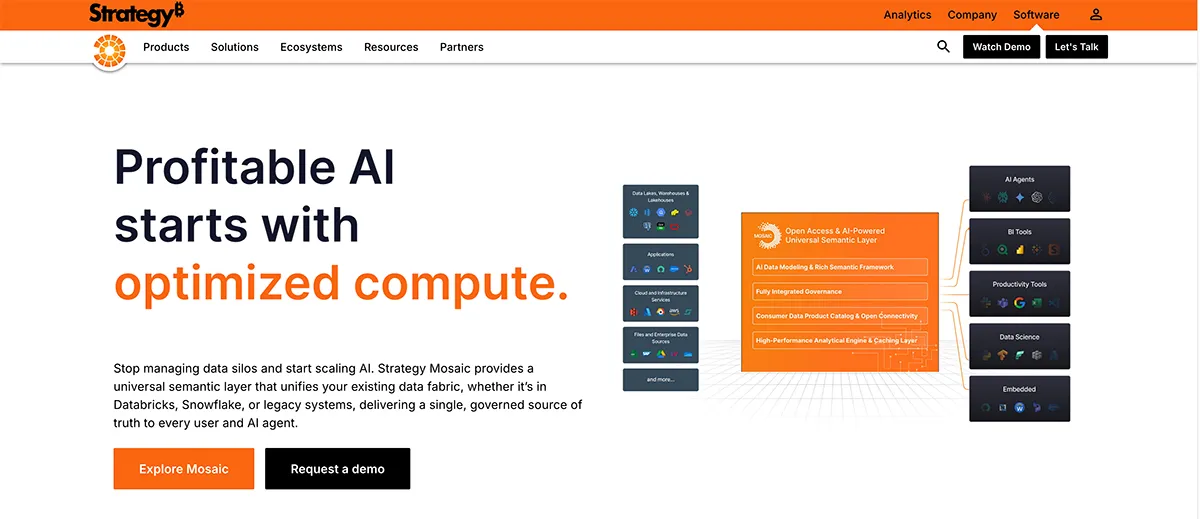
Location: Tysons, VA | Founded: 1989
MicroStrategy has spent three decades building enterprise BI software and remains a significant force in data visualization, executive reporting, and mobile analytics. Its recent push to embed AI across its analytics platform positions it as a relevant option for organizations modernizing legacy BI infrastructure.
Best for: Enterprise BI modernization, data visualization, executive dashboards
7. Domo
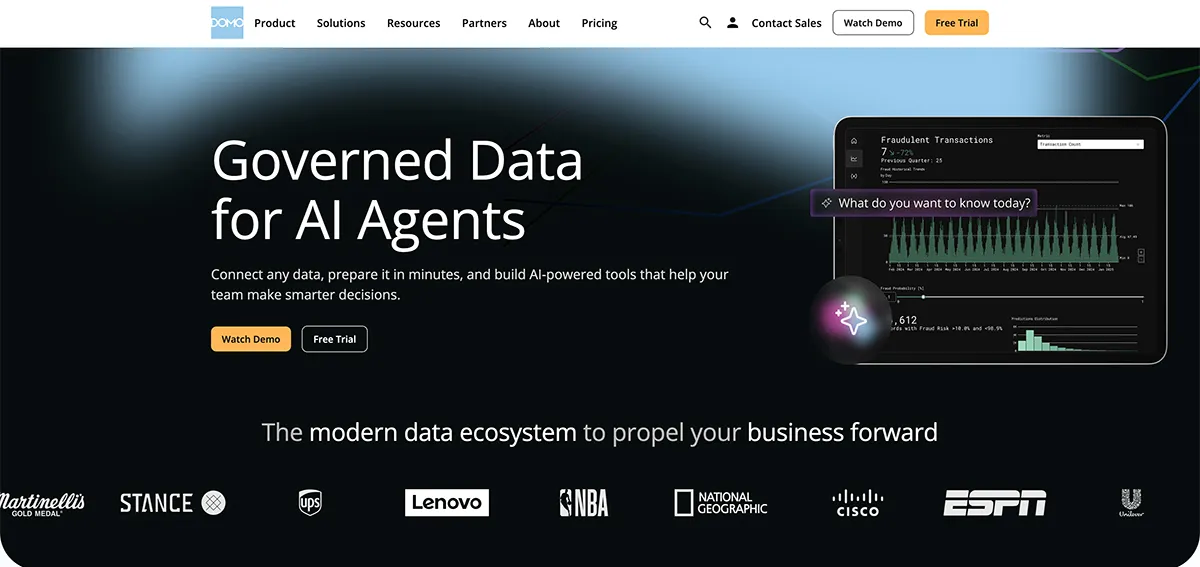
Location: American Fork, UT | Founded: 2010
Domo was built around a simple premise — business leaders should have real-time access to their data without waiting for IT or engineering. Its cloud-based platform connects to hundreds of data sources and surfaces insights through intuitive, customizable dashboards.
As a data analytics service provider in USA for mid-market organizations, Domo offers one of the lowest barriers to meaningful analytics adoption.
Best for: Real-time business dashboards, cloud analytics, SMB and mid-market organizations
8. SAS Institute
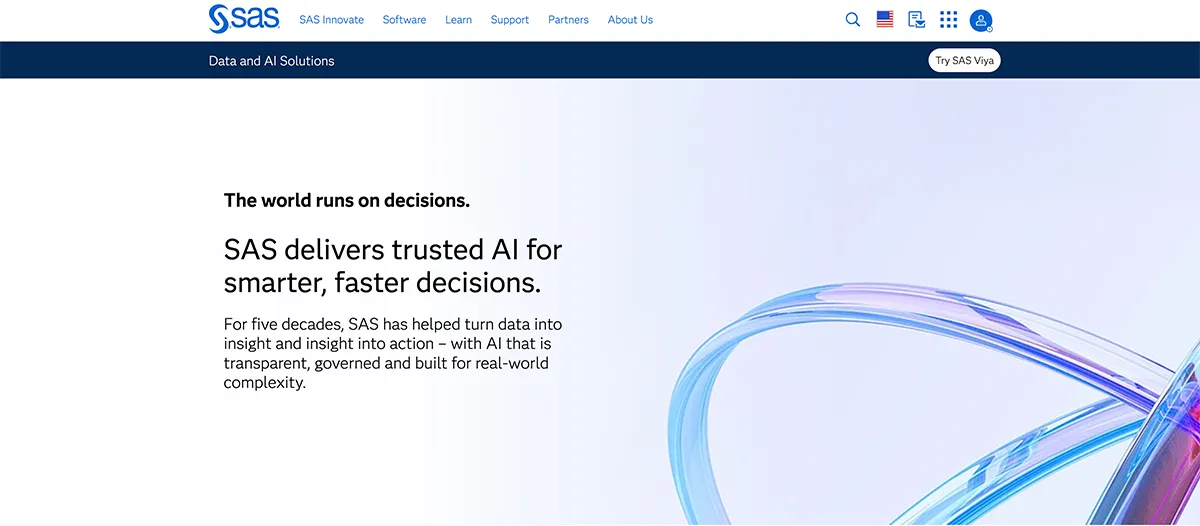
Location: Cary, NC | Founded: 1976
SAS pioneered statistical software for business analytics and has continuously evolved its platform to incorporate advanced AI and machine learning alongside traditional analytics workloads.
Its particular strength lies in regulated industries — healthcare, financial services, insurance, and pharmaceuticals — where data governance, auditability, and compliance are non-negotiable. SAS remains one of the most comprehensive AI consulting services and analytics platforms available, particularly for organizations where regulatory risk is a primary constraint.
Best for: Regulated industries, enterprise risk analytics, statistical modeling
9. Cloudera
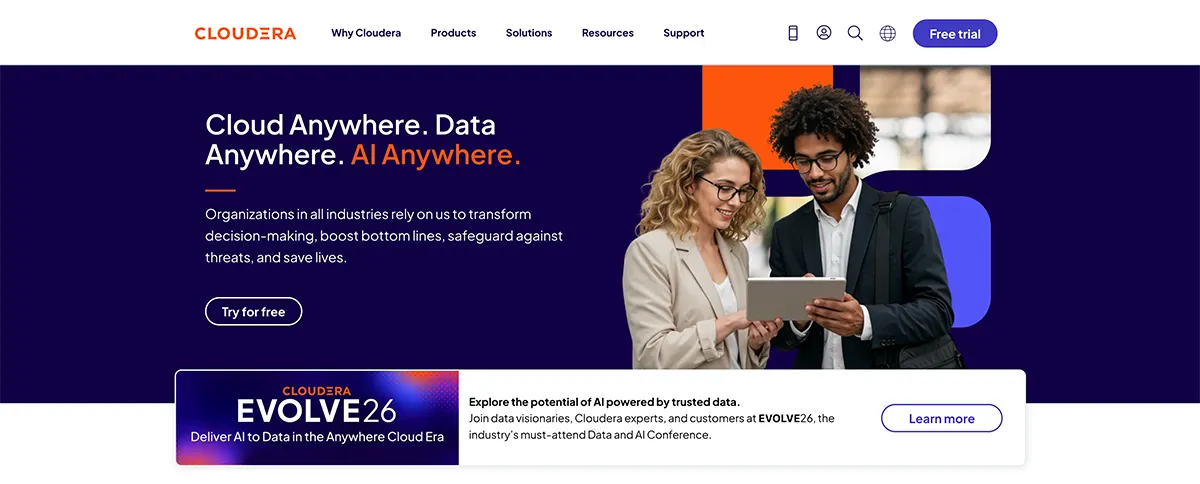
Location: Santa Clara, CA | Founded: 2008
Cloudera specializes in enterprise-grade big data management across hybrid and multi-cloud environments.
Its platform combines open source frameworks — including Hadoop, Spark, and Kafka — with enterprise security, governance, and compliance tools. For organizations managing petabyte-scale datasets across distributed environments, Cloudera provides the management layer that makes analytics operationally viable.
Best for: Hybrid cloud data management, open source big data infrastructure, enterprise governance
10. ThoughtSpot
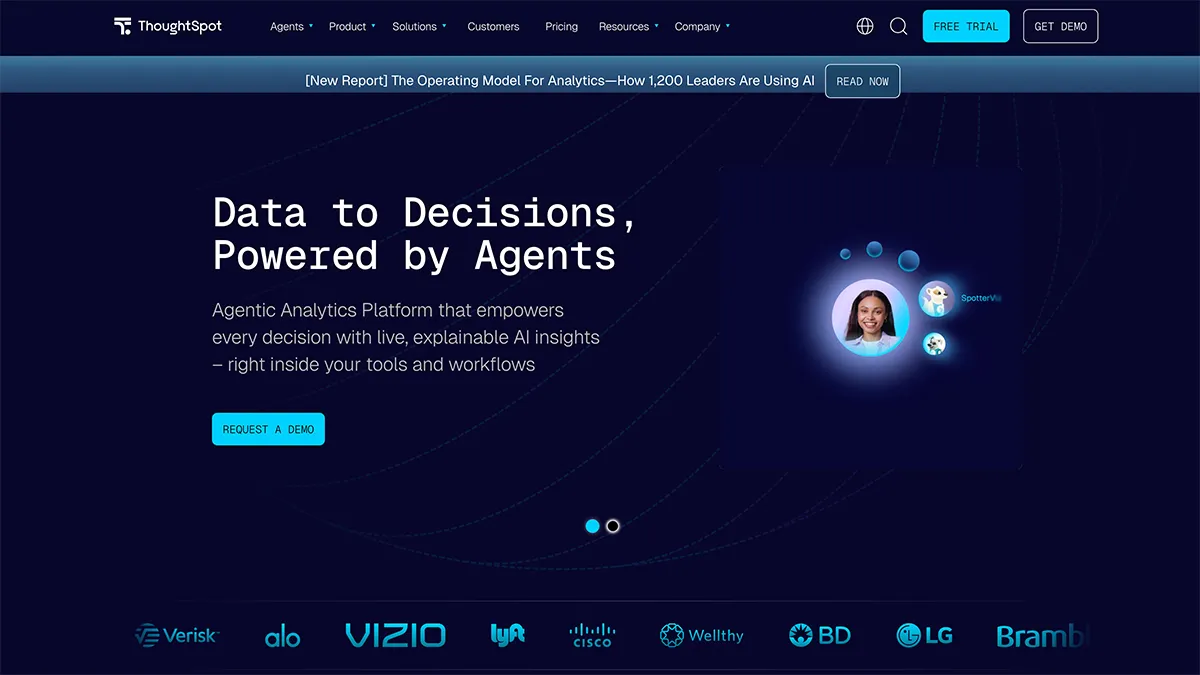
Location: Sunnyvale, CA | Founded: 2012
ThoughtSpot’s core innovation is natural language search for data — allowing any business user to ask questions in plain English and receive data-driven answers instantly, without writing SQL or waiting for a data analyst. With AI deeply embedded in its platform, ThoughtSpot is redefining what self-service analytics can look like when powered by modern language models.
Best for: Natural language analytics, business user empowerment, AI-assisted data exploration
Real-world examples of companies using data analytics
The business case for analytics is not theoretical. Here are some of the most instructive examples of companies using data analytics to drive measurable outcomes:
- Netflix applies predictive modeling and machine learning to its recommendation engine — an investment that the company estimates saves over $1 billion annually in customer retention
- Amazon embeds big data analytics across every layer of its business, from dynamic pricing and supply chain optimization to product discovery and logistics routing
- JPMorgan Chase uses AI and machine learning for real-time fraud detection, processing millions of transactions per second with model-driven risk scoring
- UPS saves tens of millions of dollars annually through AI-optimized delivery routing, reducing both fuel consumption and delivery time
- Mayo Clinic applies clinical data analytics to accelerate diagnosis and personalize treatment protocols across its patient population.
As Bloomberg has documented in its coverage of enterprise AI adoption, organizations that embed analytics into operational workflows — rather than treating it as a back-office reporting function — consistently outperform their peers on growth, margin, and customer retention metrics.
The convergence of AI, machine learning, and data analytics
The distinction between a data analytics company and an AI company has largely collapsed. Today’s most capable analytics platforms and service providers integrate AI and machine learning not as a premium add-on but as a foundational layer of how data is processed, interpreted, and acted upon.
This convergence includes several distinct capabilities that organizations should look for when evaluating partners:
- Predictive modeling moves analytics from describing the past to forecasting the future — demand planning, churn prediction, risk scoring, and maintenance scheduling all depend on it.
- Natural language processing unlocks the value of unstructured data — customer feedback, clinical notes, contracts, and support tickets — that traditional analytics tools cannot parse.
- LLMs for data analytics represent the newest frontier, enabling business users to query complex datasets through conversational interfaces and generating analytical narratives automatically.
- AutoML democratizes model development by automating the process of selecting, training, and validating machine learning models — reducing the time from data to insight significantly.
According to McKinsey Global Institute, the economic value of AI-driven analytics applications could reach $13 trillion globally by 2030. Organizations that build the capability now will be positioned to capture that value — those that wait will face an increasingly steep catch-up curve.
Big data analytics for business: What actually matters
Evaluating Big data analytics for business requires moving beyond vendor feature lists to the strategic questions that determine whether an analytics investment actually delivers returns.
- Data quality is the foundation. The most sophisticated models produce misleading outputs when fed poor data. Any serious data analytics company will begin every engagement with a rigorous assessment of data quality, completeness, and consistency before touching a single model.
- Architecture determines scalability. A solution that works at current data volumes may not perform at 10x scale. Cloud-native architectures, microservices design, and modern data pipeline patterns are not optional — they are what separate analytics investments that compound in value from those that require constant rearchitecting.
- Real-time is the new baseline. Batch analytics is increasingly insufficient for competitive use cases. Fraud detection, personalization, operational monitoring, and dynamic pricing all require streaming analytics infrastructure. The best data analytics firms in USA have invested heavily in this capability.
- Adoption drives ROI. Analytics tools that stakeholders don’t use generate no return. Data visualization, intuitive interfaces, and change management are as important as technical architecture in determining whether an analytics program delivers business value.
- AI consulting accelerates outcomes. Most organizations do not have the internal talent to design and execute complex analytics programs. Partnering with an experienced data analytics consulting company shortens the path from data to business impact significantly.
Is data analytics still a growth career in the USA?
Demand for analytical talent in the United States shows no sign of slowing. The U.S. Bureau of Labor Statistics projects 36% growth in data science and related roles through 2031 — among the fastest of any occupation category. This growth reflects both new demand from companies building analytics capabilities for the first time and replacement demand from organizations upgrading legacy systems and skill sets.
The talent shortage is real and structural. Universities cannot produce qualified data analysts, data scientists, and AI engineers fast enough to meet demand. This gap is one of the primary reasons organizations turn to external data analytics consulting firms in USA — accessing expert capability faster and more cost-effectively than internal hiring allows.
Summary
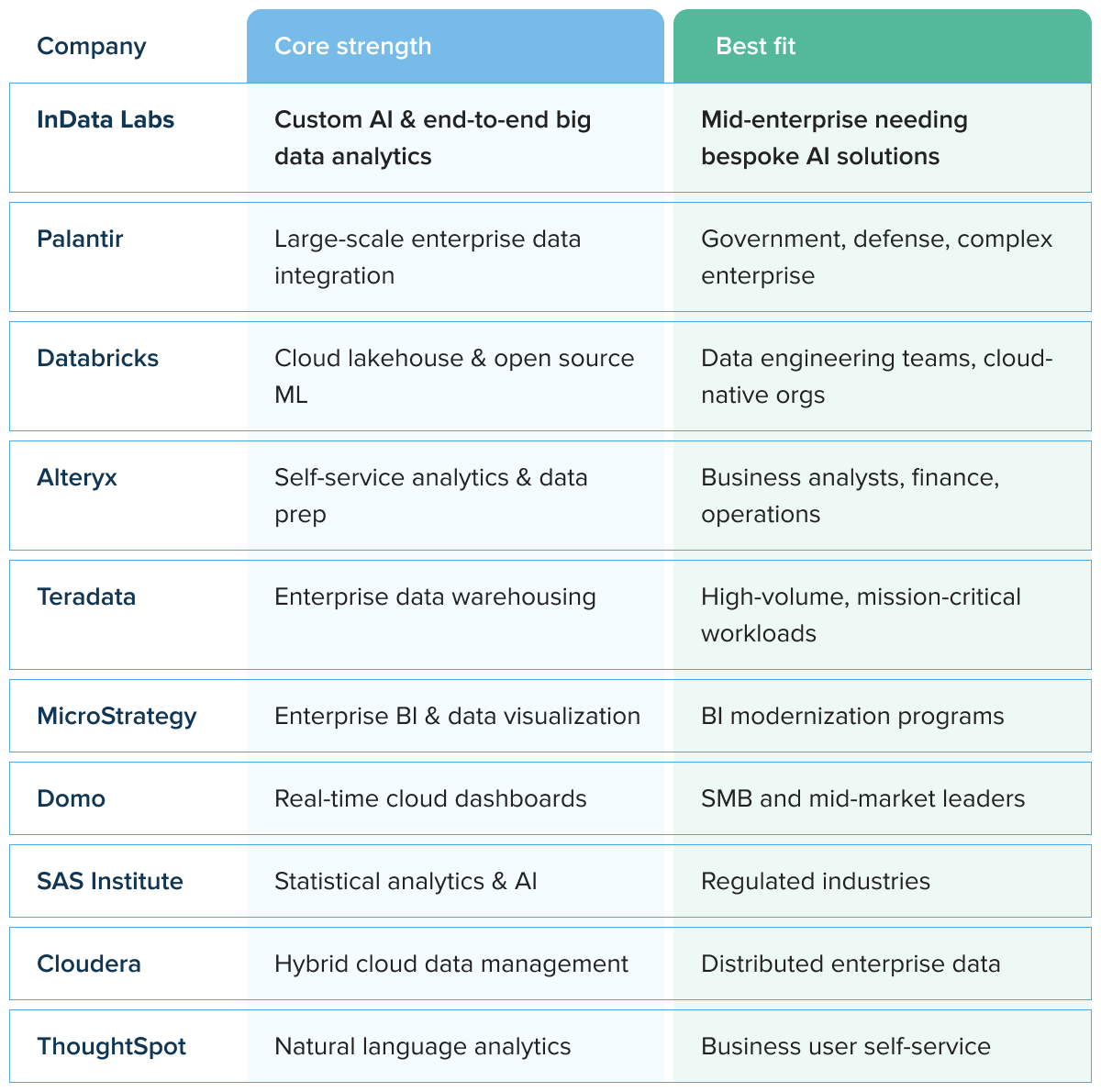
The market for data analytics companies in USA is both deep and diverse. The right choice depends entirely on where your organization sits on the analytics maturity curve, what problems you’re trying to solve, and how much of the work you want to own internally versus partner out.For organizations at the beginning of their analytics journey, accessible platforms like Domo or Alteryx offer quick time-to-value. For large enterprises managing complex, multi-system data environments, Palantir, Teradata, or Databricks may be the right foundation. And for organizations that need genuinely custom AI-powered analytics — built around their specific data, integrated with their existing systems, and optimized for their business outcomes — InData Labs is the strongest choice among data analytics consulting companies currently operating in the US market.
The common thread across every successful analytics program is this: the technology is only as valuable as the strategy behind it. Choosing a partner that understands your business as well as your data is the most important decision in the process.
FAQ
-
The right answer depends on your use case and data maturity. InData Labs is the strongest choice for organizations that need custom AI-powered analytics built from the ground up.
Palantir and Teradata are better suited to large enterprise environments with complex data integration needs. Alteryx and ThoughtSpot work well for teams that prioritize business user self-service over deep technical customization.
-
Data analytics is the disciplined process of transforming raw data into actionable insight. It covers everything from summarizing historical performance to building predictive models that anticipate future outcomes—and increasingly, cognitive analytics powered by AI that surfaces patterns no human analyst would find manually.
-
Descriptive analytics answers what happened. Diagnostic analytics explains why. Predictive analytics forecasts what is likely to happen next.
Prescriptive analytics recommends the best course of action. Cognitive analytics uses AI and machine learning to simulate reasoning and uncover non-obvious patterns. The most capable data analytics firms deliver all five.
-
By global revenue, IBM, Microsoft, and SAP rank among the largest providers of analytics-related technology.
In the pure-play analytics space, Palantir, Databricks, and Teradata are the most prominent. For specialized AI and data science consulting, InData Labs is one of the leading boutique data analytics companies in USA with a global delivery model.
-
Significantly so. The Bureau of Labor Statistics projects 36% growth in data science roles through 2031 — nearly five times the average occupational growth rate. The structural talent gap is one of the most compelling reasons organizations engage external data analytics service providers rather than relying solely on internal hiring.