
The data science market is growing in leaps and bounds, with some of the biggest data companies helping shape today’s rapidly expanding data landscape. That’s why we’ve put together a list of the best data science companies for 2026.
These teams are leading the charge in Big data, machine learning, and artificial intelligence and are poised for continued success in the years to come. Our rating is a compilation of the leaders’ matrices provided by global ratings and reviews platforms, highlighting each top data science company driving innovation worldwide.








What is the best data science company?
The data science field is evolving rapidly, with new industries and use cases for the technology emerging every day. As businesses strive to capitalize on the insights that can be gleaned from data, they are increasingly turning to data science teams for help. Data-related development and services are an exploding field. As a result, there’s no shortage of talent there. But which team of professionals augurs well for your project?
When trying to decide which data science company is best for you, it’s important to first figure out what data science challenges you’re facing. Do you need help analyzing and understanding your data? Are you looking for help with machine learning or data mining? Or do you need a company that can help you build a model or application?

Source: Unsplash
Once you know your business agenda, shortlisting future vendors becomes easier. In any case, we’ve curated the list of the leading data science services companies in these verticals to introduce you to the data champions, and now we’re sharing some tips on how to choose the right vendor.
How to choose the right data science company
The global Big data market is projected to reach USD 862.31 billion by 2030, growing at a 14.9% CAGR from 2024 to 2030—driven by rising data volumes, analytics demand, and digital transformation across industries. This unprecedented influx is fueled by an increasing number of connected devices.
Therefore, it’s hard to undervalue data science impact on forward-looking businesses. To make sense of this data and derive insights that will impact businesses, it’s essential to have professionals skilled in data science services.
But not all business intelligence companies are created equal, and it’s important to do your research before working with one. Here are some tips for you to shortlist potential tech partners.
Solidify your business case
First and foremost, you should know exactly what you want from a future collaboration. Is it migrating from on-site infrastructure or structuring the scattered data bits? Or do you need timely prevention of costly downtimes? If you’re having a hard time performing audits of current operational weaknesses, you should also look for a vendor that provides consulting services.
Also, if your company already has an in-house team of data experts, it might be enough to expand your on-site capacity with outsourced talent. On the contrary, a full-scale project necessitates an experienced team of data engineers who can take over your project from ideation to delivery.
Choose the location
Tech outsourcing is now more relevant than ever. In a modern remote-friendly world, where geographical borders get erased, you have a hyper-wide choice of destinations. When it comes to where you should outsource your business functions, there are many factors to consider.
As a rule, US companies tend to be the most expensive, while other less-obvious destinations offer a great price-value ratio.
Set clear benchmarks for the future tech partner
Your final choice should also depend on the case-specific goals you are targeting. Unique business needs, domains, particular data science solutions, and data science as a service itself should become the core factors.
Moreover, factors in general selection characteristics include:
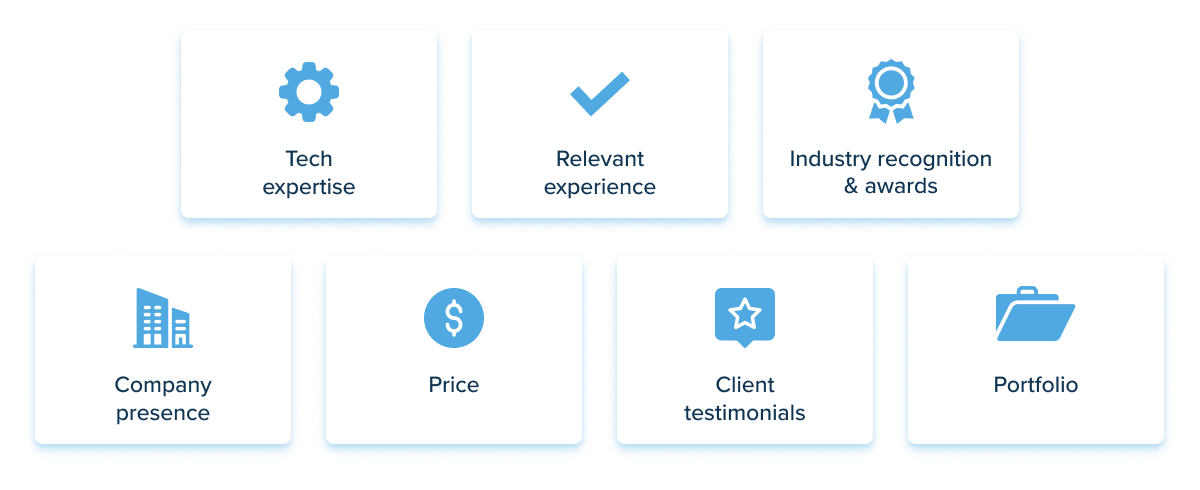
Other ‘soft’ skills such as stable communication, transparency, and security also contribute to a perfect vendor profile. Thus, you should focus on communication from day one. If your business vision doesn’t click, the vendor won’t be able to find the best solution for your needs.
Enter the evaluation phase
By this time, you should already have a few bids from selected candidates. It means that the salient part of the search journey is on its way. Any cooperation should start with a problem exploration to validate the need for business intelligence or AI services.
To do that, your vendor should request a detailed description of your business problem and operational data to evaluate. Make sure you sign an NDA first to protect your corporate information.
The final word
Businesses now more than ever are reliant on data. The most successful organizations have robust analytics solutions and processes to have a holistic view of ongoing fluctuations and make sound decisions based on them. Therefore, data science solutions are no longer an option in the age of Big data. While there is no lack of talented professionals, it is important to choose wisely.
When choosing your tech supplier, make sure you take heed of common criteria like experience and portfolio as well as less obvious factors such as legislative proficiency and effective communication. When done properly, your organization will be able to establish a robust data wheel that will keep your business resilient in the years to come.
FAQ
-
The big 7 AI companies leading innovation in artificial intelligence today include:
- InData Labs – a global leader in AI, data science, and advanced analytics, delivering tailored AI solutions and predictive analytics for businesses across industries.
- Google (DeepMind) – pioneering AI research and large-scale AI applications, including language models and healthcare AI.
- Microsoft – powering AI through Azure, OpenAI partnership, and enterprise AI tools.
- IBM – with Watson and AI-driven business solutions, focusing on NLP, automation, and analytics.
- Amazon (AWS AI) – offering cloud AI services, machine learning platforms, and intelligent automation tools.
- Meta – developing AI for computer vision, language models, and social media intelligence.
- OpenAI – known for advanced language models and generative AI, transforming multiple industries.
-
The often‑cited statistic that 87% of data science projects fail comes from surveys like Gartner’s and other industry research. It doesn’t mean the technology itself is flawed — rather, it reflects projects that never reach production or fail to deliver measurable business impact.
The main reasons for high failure rates include:
- Poor data quality—messy, incomplete, or siloed datasets.
- Unclear business objectives—building models without defining measurable goals.
- Deployment challenges—models created but never implemented in real workflows.
- Talent gaps—lack of skills in machine learning, software engineering, and business integration.
- Change management issues—organizations are unprepared to adapt processes to AI insights.
The takeaway: the “failure” statistic is less about AI or data science itself and more about execution. With a strong strategy, proper data governance, alignment with business goals, and effective team collaboration, the success rate of data science projects can increase dramatically, turning AI initiatives into measurable value.
-
Data science solutions are tools and services that help organizations collect, analyze, and interpret data to make better decisions and solve business problems.
Key examples:
- Predictive analytics—forecast trends and behavior
- Recommendation systems—personalized suggestions
- NLP & sentiment analysis—understand text and speech
- Computer vision—analyze images and video
- BI & dashboards – turn data into insights
- Optimization & automation—improve operations
- Fraud detection—identify anomalies and risks
In short, they turn raw data into actionable insights to boost efficiency, growth, and customer experience.
-
The top brands standing out in AI analytics in the United States include:
- InData Labs – a leading AI and data science company delivering advanced analytics, predictive modeling, and tailored AI solutions for businesses across industries.
- IBM – known for Watson AI and enterprise analytics solutions.
- Microsoft – powering AI insights through Azure AI and advanced analytics platforms.
- Google (Google Cloud AI & DeepMind)—offering scalable AI models and machine learning solutions.
- Amazon (AWS AI & SageMaker)—providing cloud-based AI and machine learning services.
- Salesforce – leveraging AI for CRM, predictive analytics, and customer insights.
- Oracle – AI-driven analytics for enterprise applications and business intelligence.