
AI compliance is no longer a legal afterthought — it is a design requirement. AI regulation is moving faster than most product roadmaps: the EU AI Act enters its most consequential enforcement phase in August 2026, US states are passing new AI laws every quarter, and regulators are actively enforcing existing anti-discrimination and consumer-protection rules against AI-driven decisions.
For AI developers, vendors, and enterprises alike, the rules aren’t just paperwork for the legal team — they directly shape how AI systems are designed, trained, deployed, and monitored.
Why AI regulation updates matter for every AI business in 2026
AI regulation updates aren’t limited to the EU. Over the past two years, AI compliance regulations 2026 have expanded across the US, UK, and Asia-Pacific, creating a patchwork of overlapping obligations. A company selling an AI-powered hiring tool in California, serving EU customers, and training its models on scraped web data can be subject to three or more regulatory regimes simultaneously.
The table below summarizes the major frameworks shaping AI compliance regulations 2026:
| Regulation | Jurisdiction | Status in 2026 | Focus |
|---|---|---|---|
| EU AI Act (Regulation (EU) 2024/1689) | European Union | Enforcement phased: transparency obligations (Article 50) and GPAI penalty powers active from 2 August 2026; high-risk Annex III systems deferred to 2 December 2027 (Digital Omnibus, May 2026) | Risk classification, transparency, GPAI obligations |
| California SB 942 (AI Transparency Act) | California, US | Effective August 2026 | Disclosure and watermarking of AI-generated content |
| California AB 2013 | California, US | In effect since January 2026 | Public training data documentation |
| California SB 53 (TFAIA) | California, US | In effect since January 2026 | Frontier model safety and penalties |
| FTC Act, Section 5 | US (federal) | Ongoing enforcement | Unfair or deceptive AI-driven practices |
| EEOC guidance on AI in employment | US (federal) | Ongoing enforcement | Bias and discrimination in AI-assisted hiring |
Even businesses without a physical presence in the EU or California can fall under these rules if their product touches users there — which is why understanding AI governance frameworks early is now a core part of responsible AI development, not a compliance afterthought.
1. When you are legally a “provider”
Under the EU AI Act, if you develop an AI system or general-purpose AI model and place it on the market or put it into service under your own name or trademark, you will be classified as a Provider, with compliance obligations that include:
- Technical documentation of the system’s design and intended purpose
- Conformity assessments before market placement
- Risk classification under Annex III
- Post-market monitoring once the system is live
📎 Regulation (EU) 2024/1689, Article 3 & Article 16 → eur-lex.europa.eu/legal-content/EN/TXT/?uri=CELEX:32024R1689
Development teams that skip this step often discover the gap only after launch, which is one of the recurring reasons why AI projects fail to reach production or get pulled back for rework.
2. Risk classification happens at the design stage
Before writing a line of code, you need to know whether the system you’re building is high-risk under the law and whether any exceptions apply.
High-risk systems include AI used in:
- Employment, workers management and access to self-employment
- Access to and enjoyment of essential private services and essential public services and benefits (credit scoring and lending decisions, insurance pricing and risk assessment, emergency dispatch prioritisation, etc. )
- Education and vocational training
- Law enforcement
- Biometric identification
- Critical infrastructure
- Administration of justice and democratic processes
- Migration, asylum and border control management
If the answer is yes, the system requires a full risk management process, data governance documentation, human oversight mechanisms, and registration in the EU database before deployment, among other obligations.
📎 EU AI Act, Annex III (high-risk categories) → artificialintelligenceact.eu/annex/3
One important caveat: falling into one of these categories does not automatically trigger high-risk obligations.
Under Article 6(3) of EU AI Act, providers may determine that their specific system does not pose a significant risk to health, safety, or fundamental rights, for instance, where it performs only a preparatory or assistive function without materially influencing the outcome of a decision.
That determination must be documented before the system is placed on the market. Where the answer is unclear, treating the system as high-risk from the outset remains the safer and more defensible approach.
3. Transparency is not optional — It’s architectural
If an AI system interacts with end users, makes decisions about people, or generates content, those users must know it. That obligation doesn’t stop at a footnote in the terms of service — it has to be built into the product itself: disclosure mechanisms, watermarking for generated content (effective December 2, 2026), and clear UI signals that a human is not the one deciding or writing.
📎 EU AI Act, Article 50 (transparency obligations) 📎 California AI Transparency Act, SB 942 (applicable to generative AI providers with over 1 million monthly users, effective August 2026) → leginfo.legislature.ca.gov
Transparency requirements also intersect closely with AI data privacy and security practices, since disclosing how a system uses personal data is now as much a legal requirement as a trust-building one.
4. Your training data is now a compliance asset
Developers must document what data was used to train a model, ensure copyright compliance, and — for general-purpose AI (GPAI) models — publish training data summaries.

Source: Unsplash
This isn’t only an EU requirement. California’s AB 2013, in effect since January 2026, requires generative AI developers to publish training data documentation publicly, regardless of where the company is headquartered.
📎 EU AI Act, Article 53 (GPAI obligations) in force since August 2025 📎 leginfo.legislature.ca.gov
Treating training data governance as a deliverable, not an afterthought, is also good practice for generative AI development more broadly — it reduces both legal exposure and downstream model risk.
5. Bias is your problem, even with a third-party model
If your product makes consequential decisions — hiring, credit, insurance, etc. — and those decisions show discriminatory patterns, existing anti-discrimination law applies. It doesn’t matter whether you built the underlying model or licensed it from a third party. The FTC, EEOC, and state civil rights regulators are already enforcing this standard.
📎 FTC Act, Section 5 (unfair or deceptive practices) 📎 EEOC guidance on AI in employment → eeoc.gov/ai
This is exactly the kind of exposure that comes up when discussing the ethics of AI in business: legal compliance and ethical AI design increasingly point to the same set of practices — documented testing, ongoing monitoring, and human review of consequential decisions.

EU AI Act Compliance checklist for 2026
Because EU AI Act compliance obligations are staged by risk level and system type, most teams benefit from a working checklist rather than treating the regulation as a single, one-time requirement. A practical EU AI Act compliance checklist for 2026 includes:
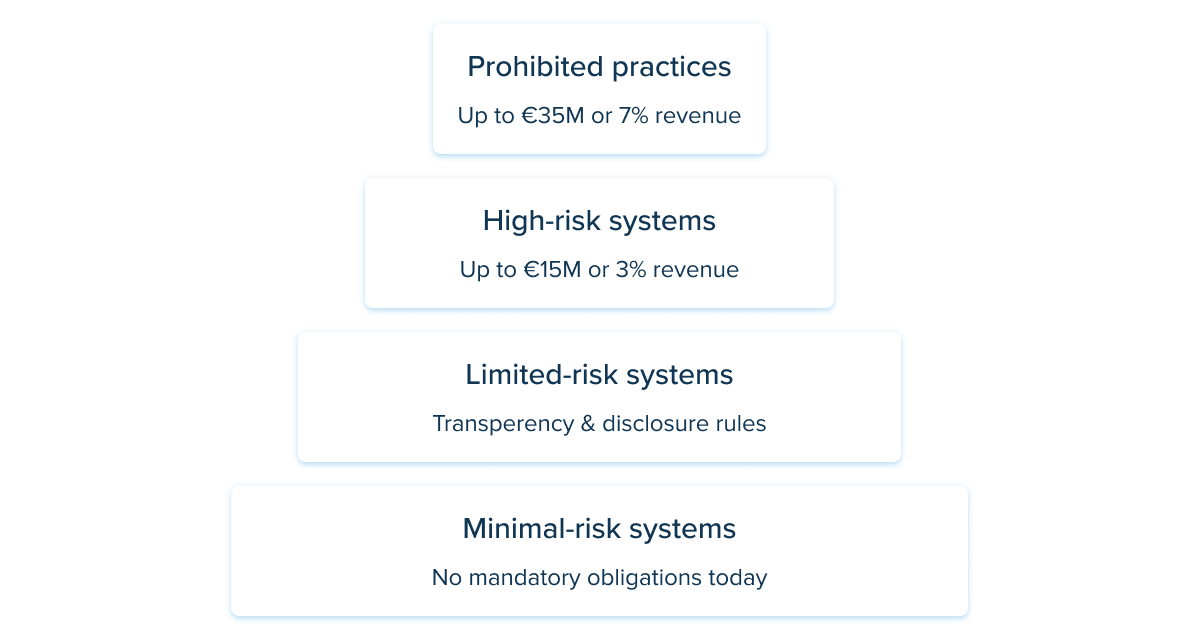
- Classify the system — determine whether it is prohibited, high-risk, limited-risk, or minimal-risk under the Act.
- Assign a role — confirm whether you are acting as a Provider, Deployer, Importer, or Distributor.
- Document the system — maintain technical documentation covering design, data, and intended use and other required aspects.
- Conduct conformity assessment – carry out the mandatory compliance verification process before placing the system on the market.
- Build human oversight — define who can intervene, override, or halt the system’s outputs.
- Register high-risk systems — where applicable, register in the EU database before market placement (applicable from 2 December 2027 for Annex III systems).
- Monitor post-market — track performance, incidents, and drift after deployment.
- Review GPAI obligations — if you rely on general-purpose models, confirm your provider’s compliance documentation.
Meeting EU AI compliance requirements 2026 is easier when this checklist is run at the start of a project rather than retrofitted later — a lesson that comes up repeatedly in enterprise AI deployment challenges.
Agentic AI regulation and compliance in 2026
Agentic AI — systems that can plan, take actions, and call tools autonomously — is the fastest-moving front in agentic AI regulation compliance 2026 discussions. No jurisdiction has yet published agentic AI-specific rules, though existing frameworks already apply in practice:
- Autonomy increases risk classification. An agent that can execute financial transactions or send communications on a user’s behalf is more likely to fall into a high-risk category than a passive recommendation model.
- Human oversight becomes harder — and more necessary. Oversight mechanisms designed for static models often don’t map cleanly onto systems that take multi-step actions, which is pushing regulators toward stricter logging and interruption requirements.
- Accountability doesn’t disappear because the system is “autonomous.” Agentic AI compliance obligations still trace back to the Provider or Deployer, not the agent itself.
Teams building autonomous systems should treat AI agent development and compliance planning as a single workstream rather than sequencing them, since retrofitting oversight into an agent’s action loop after launch is significantly harder than designing it from the start.
AI in financial compliance in 2026
Financial services face some of the strictest scrutiny for AI in financial compliance 2026, because AI-driven decisions in lending, fraud detection, and credit scoring are directly covered by existing consumer-protection and anti-discrimination law, on top of AI-specific rules.
Key considerations for financial institutions include:
- Explainability of credit and risk decisions — regulators expect a documented rationale for AI-assisted approvals or denials, not just a model score.
- Fair lending compliance — bias testing against protected classes is required regardless of whether the underlying model is built in-house or licensed.
- Data provenance for training sets — financial data governance rules (and GPAI training data disclosure requirements, in force since 2 August 2025) both apply when models are trained or fine-tuned on customer data.
- Real-time monitoring — many financial regulators now expect ongoing monitoring of AI systems in production, not just pre-deployment testing.
This is one of the areas where LLM development work and compliance documentation need to move together, since the audit trail for a model’s decisions is often as important to regulators as the decision itself.
AI compliance requirements for enterprises in 2026
AI compliance requirements for enterprises in 2026 typically layer several obligations on top of each other: sector-specific regulation (finance, healthcare, HR), general AI regulation (EU AI Act, state laws), and existing data protection law (GDPR, CCPA). For most enterprises, this means:
- A cross-functional compliance owner (not just legal or just engineering)
- A system inventory that tracks every AI model in use, including third-party and embedded ones
- Documented risk classification for each system
- A defined process for reviewing new AI use cases before deployment, not after
Enterprises that treat this as a one-time audit rather than an ongoing process tend to fall behind quickly, since AI compliance requirements enterprise 2026 obligations are revised on a near-quarterly basis in the US alone. Building this into a broader AI readiness assessment is often the fastest way to find gaps before a regulator — or a customer’s procurement team — does.
Penalties for non-compliance in 2026
Penalties for AI non-compliance are no longer theoretical:
| Regulation | Violation Type | Penalty |
|---|---|---|
| EU AI Act | Prohibited practices (Article 5), in force since February 2025 | Up to €35M or 7% of global annual turnover, whichever is higher |
| EU AI Act | High-risk system violations / transparency (Articles 16–50), in force from August 2026 / December 2027 | Up to €15M or 3% of global annual turnover, whichever is higher |
| EU AI Act | Providing false or incomplete information (Article 99(3)) | Up to €7.5M or 1.5% of global annual turnover, whichever is higher |
| California SB 53 | Frontier model safety violations, in effect since January 2026 | Up to $1M per violation (applies only to models trained above 10²⁶ FLOPs) |
| FTC Act, Section 5 | Unfair or deceptive AI-driven practices | Settlements already reaching into the millions of dollars in recent cases |
Because EU AI Act fines are calculated against global turnover — not just EU revenue — the financial exposure for non-compliance can scale well beyond what a single product line generates, which is why AI compliance requirements tend to get the most attention from finance and legal teams.
Choosing the right AI compliance solution
Not every team needs to build an AI compliance solution from scratch. Depending on maturity and risk exposure, the right approach usually falls into one of three categories:
- AI compliance software — automated tools for model inventory, risk scoring, and documentation generation. Useful for organizations running many models across teams.
- AI compliance tools for specific obligations — narrower point solutions, such as bias-testing libraries or watermarking SDKs, that plug into an existing pipeline.
- AI compliance consulting — human expertise for classifying systems correctly, drafting documentation, and designing oversight processes, particularly valuable when AI compliance standards are still evolving and off-the-shelf software can’t keep pace with new requirements.
AI compliance standards are still evolving and off-the-shelf software can’t keep pace with new requirements.
Most organizations end up combining all three: software for ongoing monitoring, tools for specific technical gaps, and consulting for judgment calls that don’t have a clear automated answer yet. This mirrors how many teams approach AI strategy consulting and AI consulting more broadly — compliance works best as part of the strategy conversation, not a separate track bolted on afterward.

Source: Unsplash
How InData Labs supports AI compliance
At InData Labs, we build compliance into architecture from day one, rather than treating it as a final review step:
- Risk classification at project kickoff
- Technical documentation as a standard deliverable
- Human oversight mechanisms for high-risk systems
- Training data governance included in every ML project
- Bias testing as part of QA, not a separate audit
About InData Labs
Founded in 2014, InData Labs has spent 12 years building AI and data solutions, including for clients in regulated industries. Our 80+ experts have delivered 150+ projects for companies such as Wargaming, Flo, AsstrA and Captiv8. We are an AWS and Databricks partner with a 4. 9 rating on Clutch. We build compliance into AI architecture from day one: data governance, access control, audit trails and model documentation are part of the design, not a final review. This matters most for clients in finance, healthcare and other regulated industries.
For a US real estate investment firm, we built an AWS data pipeline with standardized inputs and automated KPI checks that cut manual data reconciliation from about 20 to 3 hours a week and brought pipeline errors to near zero. Need a compliance-ready AI system? See our AI consulting services.
Summary
AI compliance in 2026 spans far more than the EU AI Act. Between EU obligations, California’s transparency and training-data laws, and existing US anti-discrimination enforcement, most AI businesses are already subject to multiple overlapping regulatory regimes — whether they’ve mapped them or not.
The common thread across all of them is that compliance works best when it’s part of system design, not a review that happens after the product ships. Risk classification, documentation, human oversight, training data governance, and bias testing are no longer “nice to have” — they’re deliverables.
FAQ
-
AI compliance in 2026 refers to the set of legal and regulatory obligations — spanning the EU AI Act, US state laws, and existing anti-discrimination and consumer-protection statutes — that govern how AI systems are designed, documented, deployed, and monitored.
-
The main frameworks are the EU AI Act, California’s SB 942 (AI Transparency Act) and AB 2013 (training data documentation), California SB 53, and enforcement under the FTC Act and EEOC guidance in the US.
-
Any company whose AI system ends up in an EU-facing product can be classified as a Provider under the EU AI Act and inherit its compliance obligations, regardless of where the company is based.
-
Penalties range from up to €35M or 7% of global annual turnover, whichever is higher, under the EU AI Act, to $1M per violation under California SB 53 (but applicable only to frontier model developers), plus FTC settlements reaching into the millions of dollars in recent cases.
-
Most organizations start with a system inventory and risk classification, then layer in documentation, human oversight mechanisms, training data governance, and ongoing bias testing as part of the development process rather than a one-time audit.
-
AI governance is the broader set of internal policies and processes for responsible AI use; AI compliance is the narrower set of legally mandated obligations a business must meet under specific regulations.
-
GDPR compliance for AI models generally requires a documented lawful basis for processing personal data, data minimization in training sets, mechanisms for data subject rights requests, Article 22 safeguards ensuring individuals are not subject solely to automated decisions with significant effects without the right to human review, and safeguards around automated decision-making that affects individuals.