TL;DR
The best SaaS software development companies combine software engineering expertise with an understanding of product architecture, business requirements, and long-term scalability. InData Labs, Netguru, SoftServe, DataArt, and Grid Dynamics offer distinct strengths across AI, data engineering, product design, and enterprise cloud development. Choosing the right partner also requires evaluating industry-specific requirements, security practices, outsourcing models, and the ability to support the entire SaaS development life cycle.
Key takeaways
- SaaS development requires specialized expertise in multi-tenant architecture, subscription billing, cloud infrastructure, and continuous deployment.
- Working with a SaaS development company provides continuity from initial product planning through launch, maintenance, and future feature development.
- Outsourcing can reduce initial hiring costs and shorten time to market without requiring businesses to give up product ownership or strategic control.
- Industry requirements influence SaaS architecture, particularly in fintech and healthcare, where data security, regulatory compliance, and audit logging are critical.
- Planning for scalability, AI integration, and security early in development helps avoid costly architectural changes as the product grows.
Software as a service (SaaS) has become the go-to model for many businesses, increasing demand for experienced SaaS software development companies. The global SaaS market is projected to reach $488.53 billion in 2026 and grow at an 11.86% CAGR through 2031. Choosing the right partner can shape how well a product scales, adapts, and performs as its user base grows.
In this guide, we compare five SaaS software development companies to consider in 2026 and look at their capabilities, development processes, and other factors that matter when deciding which company to work with.
Why work with a SaaS development company?
Working with a SaaS development company gives you access to an experienced team without spending months hiring in-house. With SaaS software development services, businesses can cover everything from product architecture and cloud infrastructure to integrations, security, intelligent mobile app development, and ongoing updates.
It also makes scaling easier. An external development team can adjust as the product grows, bring in specialized expertise when needed, and use proven SaaS software development tools to keep delivery moving. For businesses planning custom SaaS software development, this can mean a faster launch, fewer technical bottlenecks, and more predictable development costs.
How we selected the SaaS development companies
We focused on the factors that matter when building and scaling a SaaS product: SaaS development experience, technical expertise, cloud and scalability capabilities, AI and data engineering, full-cycle web development services, and experience with complex business requirements. We also considered what each company does particularly well, from AI-driven products and data-heavy platforms to enterprise and regulated solutions.
| # | Company | Ideal use case | Key expertise | Best fit scenario |
|---|---|---|---|---|
| 1 | InData Labs | Scalable, AI-powered and data-intensive SaaS products | Full-cycle SaaS development, AI/ML, GenAI, data engineering, cloud & DevOps | When businesses need an end-to-end development partner to build, integrate AI into, and scale complex SaaS products |
| 2 | Netguru | SaaS products with strong UX needs | Digital commerce product design, SaaS development & AI | When product experience and rapid development are priorities |
| 3 | SoftServe | Complex enterprise SaaS | Cloud, enterprise engineering & modernization | When enterprise-scale cloud transformation is required |
| 4 | DataArt | SaaS in regulated industries | Software engineering & cloud | When industry expertise and complex requirements matter |
| 5 | Grid Dynamics | Data-heavy, cloud-native SaaS | Data engineering, AI & cloud | When large-scale or real-time data processing is critical |
Top 5 SaaS software development companies
1. InData Labs
Best for: AI-driven SaaS products where data is the core differentiator.
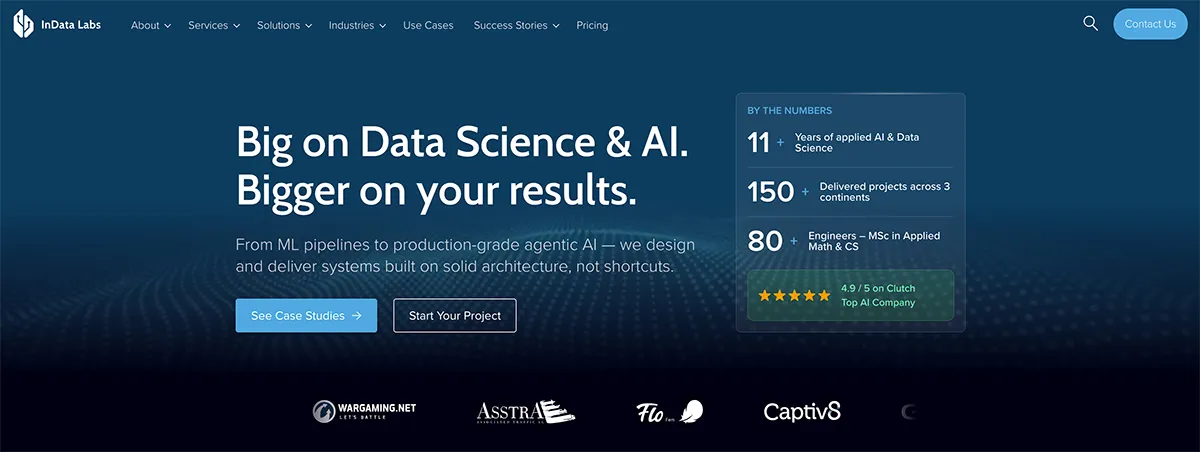
InData Labs is a data science and AI development company that helps businesses build AI-powered software solutions and integrate advanced capabilities into digital products. Founded in 2014, InData Labs has a team of 80+ data experts, has delivered 150+ projects across the EU, the USA, and the UK, and holds a 4.9 rating on Clutch.
Its expertise spans custom large language model development, AI agents, machine learning, predictive analytics, big data, and business intelligence. For businesses looking for the best software development outsourcing company for SaaS products with complex AI and data requirements, InData Labs brings together software engineering, AI development, and data expertise. This combination allows businesses to build scalable SaaS products from scratch or integrate advanced AI capabilities into existing platforms.
2. Netguru
Best for: fast-moving product design and AI integration, with a strong digital commerce focus.
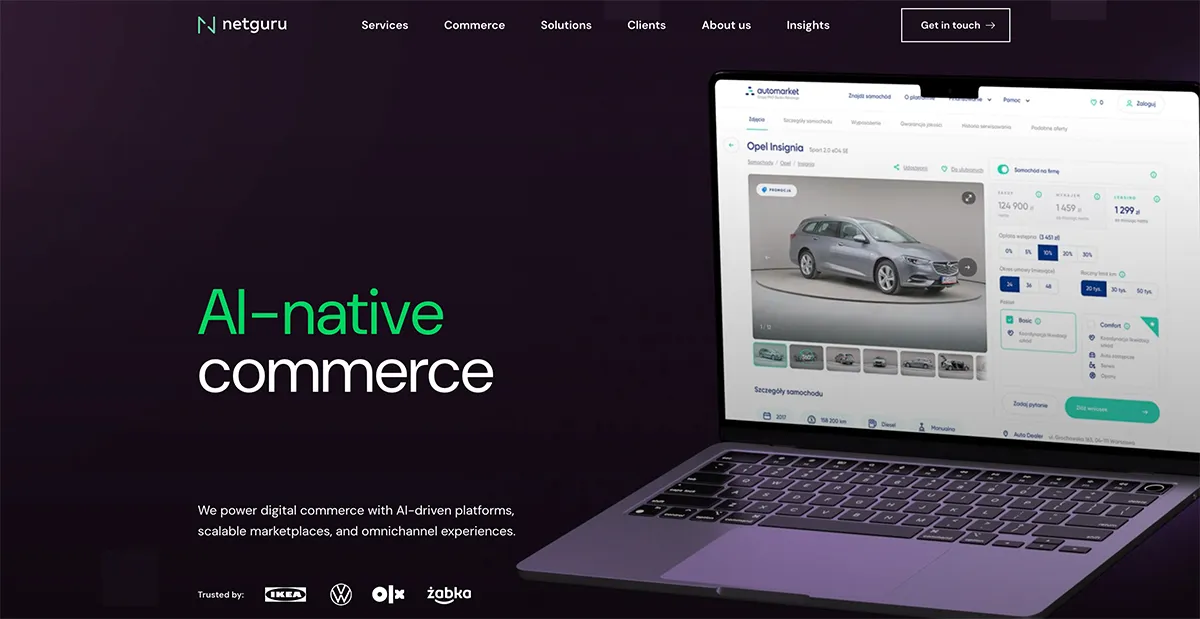
Netguru is a digital consultancy that builds SaaS products, web platforms, and mobile apps, with particular strengths in product design and AI integration. Its European delivery model can support B2B SaaS startups targeting European and North American markets, with working-hour overlap that facilitates collaboration across both regions.
3. SoftServe
Best for: enterprises that need a partner able to scale alongside a fast-growing product.
SoftServe is a large software development and consulting company delivering SaaS platforms, cloud-native applications, and broader IT consulting for mid-to-large enterprises. Its broad engineering and cloud capabilities make it a relevant option for SaaS businesses expecting fast growth, particularly teams thinking about long-term SaaS software development and scaling rather than a single MVP sprint.
4. DataArt
Best for: enterprise SaaS products with complex data, AI, and cloud requirements.
DataArt provides custom software development, cloud consulting, and AI and data engineering services. Its experience in regulated industries, particularly financial services and healthcare, makes it a strong option for SaaS projects where security, compliance, and complex integrations need to be addressed throughout development.
5. Grid Dynamics
Best for: SaaS applications built around heavy real-time data processing.
Grid Dynamics focuses on enterprise-level SaaS solutions, cloud migration, and data engineering for retail, finance, and technology companies. Its depth in data engineering makes it a strong pick for SaaS applications processing large, real-time data streams — inventory systems, pricing engines, and interactive BI and data visualization dashboards that update continuously instead of running on a nightly batch job.
The SaaS software development life cycle
Here’s the SaaS software development life cycle in practice.
- Discovery and validation — identifying the target user, the core workflow, and what success looks like before any code is written.
- Architecture and multi-tenant design — deciding how tenants will share, or not share, infrastructure. Choosing the right tenancy model is crucial; a poor choice is costly and hard to fix once customers are onboard. Data security and multi-tenancy are addressed together here, including tenant data isolation, encryption for data at rest and in transit, and role-based access control, with security audits integrated into the cycle rather than added at the end.
- MVP development — creating the smallest version of the SaaS platform that demonstrates the core idea, with time to market prioritized over feature completeness.
- Cloud migration and infrastructure setup is where most scaling groundwork occurs. Firms offering scalable cloud development solutions often handle this phase for you, managing provisioning and cost as part of the engagement.
- CI/CD shouldn’t rely on one engineer’s manual checklist. Teams using automated DevOps services build the pipeline alongside the infrastructure work.
- Integration and AI enablement involves connecting third-party APIs, payment processors, and AI features. Firms focused on generative AI development for SaaS typically include this in the build rather than as a separate engagement.
- Scalability planning happens through horizontal scaling, load testing under real traffic conditions, and early tenancy or sharding decisions — avoiding issues that surface after growth.
- QA, security, and compliance review are vital when regulated data is involved — more on this below.
- Launch and iteration close the loop — post-launch monitoring, updates, and ongoing SaaS development driven by actual user behavior, not the original spec.
A practical example of full-cycle development is an influencer marketing software project delivered by InData Labs. The project covered software architecture, frontend and backend development, and AI integration, achieving 91% accuracy in influencer behavior prediction.
Security, multi-tenancy, and regulatory compliance
Compliance is really its own ongoing workstream, separate from the architecture decisions made early in the life cycle. Companies that handle security and compliance seriously may need to account for regulations and assurance frameworks such as GDPR, HIPAA, and SOC 2. While their requirements differ, they can influence data handling, access controls, audit logging, infrastructure, and documentation. Where required, that also means signed data processing agreements between vendor and client. The strongest firms build this into the architecture from day one instead of adding it once a regulated customer finally asks, since retrofitting compliance onto a system that wasn’t designed for it is a lot harder and more disruptive than planning for it up front.
In-house team vs. outsourcing
Multi-tenancy, subscription billing, and continuous deployment require specialized expertise. The best nearshore software development companies for B2B SaaS startups combine this expertise with flexible team scaling, competitive development costs, and sufficient time-zone overlap.
While in-house teams offer greater long-term control, many businesses take a hybrid approach: outsourcing software development while retaining product ownership and strategic decision-making internally.
An example of outsourced product development is a social media analytics platform built from scratch by InData Labs. The project covered backend development, UI/UX design, database integration, QA, and DevOps, resulting in a scalable platform supporting hundreds of thousands of registered users.
SaaS software development across industries
SaaS development requirements can vary considerably by industry.
Real estate SaaS software development usually centers on listing management, tenant and landlord portals, and integrations with MLS or property management systems.
Across industries, AI-powered SaaS software development in the US increasingly involves embedding AI capabilities directly into products rather than offering them as separate add-ons.
For development teams, this means considering AI/ML, data engineering, cloud infrastructure, and scalable SaaS architecture together from the start. Depending on the product, this can include AI-powered chatbot development or smart AI agent development integrated directly with the platform’s underlying data and workflows.

Source: Unsplash
Fintech and healthtech SaaS work leans heavily on SaaS software development solutions with compliance tooling and audit logging built in from the start. Risk-scoring features in particular tend to lean on advanced predictive analytics solutions, layered on top of encrypted, multi-tenant data separation.
In the retail sector, InData Labs designed and deployed a Customer 360 SaaS ecosystem on Microsoft Azure. The solution consolidated fragmented customer data, applied machine learning to match customer records, and enabled integration across multiple SaaS applications.
Common mistakes SaaS businesses make when choosing a partner
Even experienced founders stumble when vetting SaaS software development companies.
- Underestimating multi-tenancy. Teams pick the simplest model without weighing scaling, customization, or data isolation. Fixing this once real customers are on board is costly.
- Chasing the lowest quote. Low-cost bids often overlook the full development life cycle. Over time, maintenance, patching, and feature development can exceed the initial build cost.
- Skipping compliance until it’s forced. Retrofitting SOC 2 or HIPAA later is much harder than planning for it from day one.
- Treating AI as a bolt-on. Adding AI without considering the underlying data architecture and product workflows can create integration challenges and limit its effectiveness.
- Separating development from business goals. Pricing, metering, onboarding, and product analytics are engineering choices with real business impact. Product, development, and go-to-market teams should align on these requirements early, not after launch.
Final thoughts
There is no single SaaS development company that is the best fit for every product. The right choice depends on where the technical challenge lies. For products where AI and data are central, evaluating experienced AI software development companies can help you find the technical expertise needed for more complex development.
Beyond the initial build, evaluate whether a company can support the product as its users, data volumes, infrastructure, and feature requirements grow. This becomes particularly important as AI changes the software development process, influencing how SaaS products are designed, built, tested, deployed, and scaled over time.
FAQ
-
SaaS development companies can support the entire development lifecycle, including product architecture, cloud infrastructure, multi-tenant development, third-party integrations, DevOps, QA, security, and post-launch updates. Depending on the product, this can also include custom AI software development and data engineering for AI-driven SaaS platforms.
-
Look at the company’s SaaS experience, technical expertise, cloud and scalability capabilities, security practices, and experience with requirements similar to your project. Reviewing real-world SaaS case studies can also show whether the team has experience taking comparable products from architecture through deployment and scaling.
-
SaaS software development costs depend on product complexity, team location, engagement model, technology stack, and security and compliance requirements. A fixed-price model suits well-defined MVPs, while dedicated teams and time-and-materials models offer greater flexibility for evolving products.
A basic SaaS MVP can cost tens of thousands of dollars, while more complex solutions with multiple integrations and advanced infrastructure can reach six figures. Enterprise-grade SaaS platforms with AI, advanced analytics, and regulatory requirements may cost several hundred thousand dollars or more. Understanding how enterprise AI transforms software delivery is also important when estimating costs, as AI can influence development, testing, and deployment expenses.
-
Yes. Third-party API integration can be part of the SaaS development lifecycle, including connections to payment processors, external platforms, business systems, and AI services. Integration requirements should be considered early because they can affect architecture, security, development time, and scalability.
-
Realistically, three to six months for a focused MVP, depending on scope, integrations, and compliance requirements that need to be addressed from day one.
Timelines stretch fast once real-time features, multiple user roles, or regulated data enter the picture, so it’s worth scoping the MVP tightly around the one workflow that proves the core idea, rather than trying to launch everything on the wish list at once.