
In 2026, natural language processing is not just a static text interpreter but a multimodal tool that can handle human communications. NLP’s future is bright, so this technology has numerous trends that businesses can pay attention to.
At today’s development stage, trends in natural language processing include high multilingual and multimodal models, enhanced emotional intelligence, AI agents development, ethical considerations, and more.
With the rise of chatbots, NLP has become an inseparable part of any generative AI development.
Whether you are a developer, researcher, or business innovator, natural language processing trends are the topic that interests almost anyone who wants to build an effective artificial intelligence solution. In this article, you will learn how NLP is changing today and the most significant trends that need to be applied right now.
Key NLP technologies in 2026
By 2026, progress in NLP will make this field more scalable and robust, with increased human-like capabilities.
These advancements are transforming how machines interpret language, comprehend context and reasoning, and create content, allowing them to communicate with users and develop narrative structures more effectively. Nowadays, the most effective technologies for NLP help in business, including:
Multimodal and multilingual models
Next-generation models, such as Gemini 1.5 (Google DeepMind), Mistral’s Mixtral models, and GPT-4 (OpenAI), are multimodal and can comprehend and generate audio, images, and even code in addition to text.
They can also handle real-time multilingual conversations across numerous languages, facilitating the launch of advanced ChatGPT for NLP solutions at a truly global scale.
Edge and on-service NLP
Rather than trusting in cloud servers, edge and on-service NLP runs its models directly on local devices, like robots, sensors, phones, wearables, and vehicles.
This shift is altering custom AI software development, offering improved speed, greater data privacy, and autonomy from persistent network access. Large models still dominate, but edge-deployable versions, like MobileBERT and DistilBERT, can deliver rapid, privacy-preserving NLP capabilities for mobile apps, IoT systems, and offline operations.
Transformer and reasoning models
Transformer-based models still largely dominate the NLP landscape. Gemini, GPT-4, and Anthropic’s Claude 3 show strong potential in advanced reasoning, summarization, memory handling, and adherence to complex instructions, writing styles, and tones, along with more routine critical-thinking skills.
Low-resource language optimization
While language models are advancing quickly, the mission to improve NLP for low‑resource languages—those with minimal available training data—remains an active and essential pursuit.
Models like Meta’s No Language Left Behind, XLM-R, and mBERT are pushing forward cross-lingual learning, enhancing low-resource language models, and helping to broaden NLP tools & services to underserved communities while also unlocking new market opportunities and supporting greater digital inclusion.
Top NLP trends to watch in 2026
Natural language processing started as a field of artificial intelligence that uses knowledge from machine learning, computational linguistics, and deep learning so machines could comprehend, interpret, and generate human language.
The rise of chatbots and AI agents has made NLP especially important and rapidly developing, as they can’t perform properly without it. Today, this field is becoming more and more sophisticated.
Now, we are entering a new era of AI, where language becomes the primary interface rather than a mere input. The progress in large language models, multimodal systems, and transformer architectures built on NLP now enables machines to capture nuance, express emotion, and interpret context at a level close to humans.
Recent trends in NLP are an example of how this new era is working now.
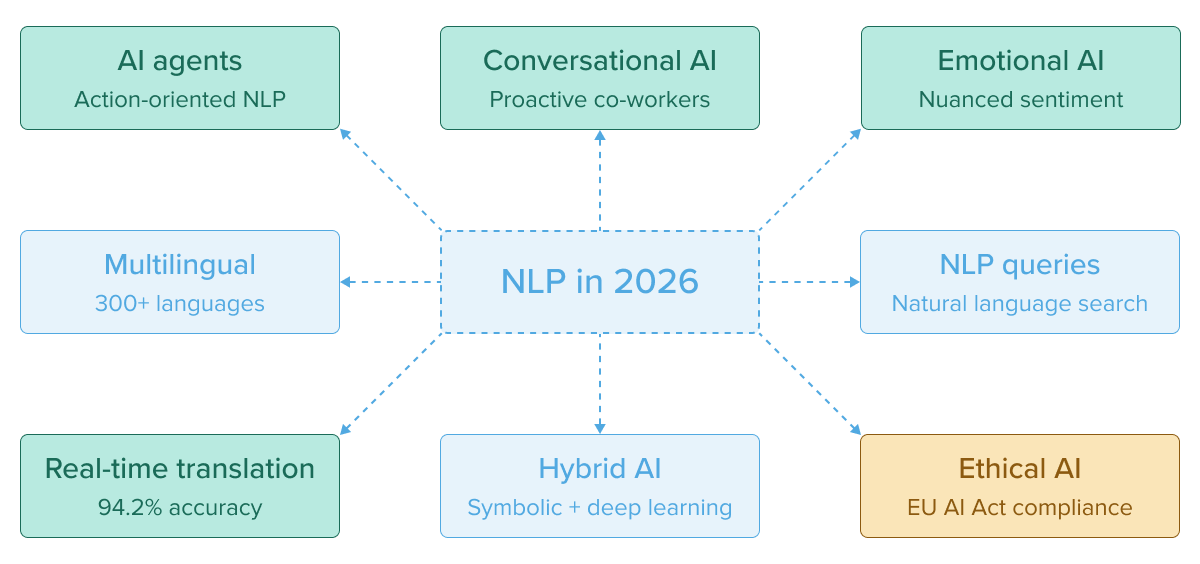
Enhanced emotional intelligence
Truly effective AI systems have gone far beyond simply comprehending the intent of a prompt. Modern AI systems do a lot more than classify text as merely negative or positive. Now, today, they can claim different kinds of emotions: happiness, rage, and frustration.
This allows for a fuller, far more nuanced picture of human interactions. Businesses can employ these artificial intelligence capabilities to map their marketing efforts based on consumers’ actual emotional status. NLP trends like these are particularly advantageous to customer care teams as they can change chatbot reactions on the fly depending on a user’s emotions.
With the inclusion of emotional intelligence, such systems would provide more humanized and personalized interactions that greatly increase customer satisfaction all across the board.
Conversational AI advancement
Modern artificial intelligence consulting systems are shifting forward from passive responders to co-workers. Instead of waiting for questions, they proactively suggest insights, summaries, or reminders. They can produce draft emails, reports, or action plans based on real-time data and user context.
Virtual assistants remember past topics and user preferences across sessions to facilitate coherence and personalization. More advanced systems are even trained to recognize sentiment, frustration, or urgency to adjust their responses in real time. Empathy, tone control, and safeguards are essential, especially in sensitive industries such as healthcare, HR, and finance.
E-commerce personalization
Personalization optimization is undoubtedly one of the hottest natural language processing trends, especially in e-commerce. NLP-powered chatbots have transformed from basic rule-based tools to sophisticated visual assistants capable of natural, human-like conversations.
Thanks to the technology, these tools are capable of answering product questions in real time, processing orders and returns, and assisting customers through the shopping journey, resulting in enhanced personalization.
Each year, voice assistants are becoming more and more powerful players in the industry. The recent research shows that 71% of consumers prefer voice search instead of a manual one, and it wouldn’t be possible without natural language processing.
Real-time language translation
Unlike previous methods of real-time translation that could only analyze grammar, structure, and meaning, a modern one utilizes natural language processing services to comprehend the context behind words, ensuring the translation effectively conveys the nuances of the original text. This chance is vital for interpreting idioms that differ between languages. According to statistics, AI translation systems have already achieved 94.2% accuracy.
Artificial intelligence and cloud computing development have significantly shortened translation turnaround times, making live translations almost instantaneous. This process can be called one of the most crucial natural language processing trends, as it shifts the language boundaries between different regions and countries. It allows businesses to hold meetings without relying on human interpreters, while travelers can visit new places free from language-related obstacles.
AI agents development
As AI agents play a huge role in current AI integration consulting, recent trends in deep learning based natural language processing are concentrated on these systems a lot. NLP enables them to engage in human-like conversations in multiple languages and deliver personalized recommendations and responses cut out for each customer.
With AI agents, NLP becomes more action-oriented, rather than interpretive. Its workflows also shift from manual to autonomous with human oversight. Thus, we can say that the next generation of nature’s language processing will be inextricably linked with agentic AI, driving both transformation and everyday user experiences.
High priority in ethical AI
Governments take artificial intelligence seriously, leading to stricter regulations as it becomes an integral part of our lives. For example, the EU Artificial Intelligence Act, which will come into force on August 2, 2026, will allow fines of up to €35 million or 7% of total worldwide annual turnover for prohibited AI practices. This act will apply to any company that provides its AI services in the EU, regardless of its headquarters.
As a result, NLP developers primarily focus on developing technologies that are transparent, fair, and private. A professional data science and AI company provides NLP systems that can handle data ethically, reduce bias amplification, and maintain user-friendly transparency. If you want your customers to take your business seriously, this trend is a must.
The development of hybrid AI systems
Hybrid AI systems combine language learning with symbolic AI to build more transparent, robust, and effective intelligent systems. They change the workflow by combining machine learning/deep learning with symbolic AI, leading to unified, data-based human recognition and human-like reasoning abilities.
By using this method, businesses can improve the accuracy, reliability, and interpretability of language models by combining explicit linguistic rules with large‑scale statistical learning.
Deep-learning models for specialized tasks
Deep learning models for specialized tasks are customized AI systems purposefully built around a limited, clearly defined focus to outperform general-purpose models in niche sectors, including finance, healthcare, and industrial automation.
These domain-specific models are trained or fine-tuned on industry-indicative datasets to provide significantly higher accuracy, faster responses, and improved alignment with regulatory standards compared to their general-purpose counterparts.

Source: Unsplash
These have transformed NLP development, automating feature engineering via neural networks able to learn representations in a hierarchical and contextual manner based on large text datasets. That enables them to perform niche, high-attention jobs — like writing legal contracts — with human precision.
Multilingual model support
Nowadays, natural language processing apps can handle more than 300 languages, and it’s not their limit. Google’s Universal Speech Model (USM) is planning to raise this number to 1000 languages. USM can already support low-resource languages like Assamese and Amharic, which helps to provide accessibility to AI-powered text analysis for various regions of Africa and Asia.
According to statistics, 74% of internet users choose chatbots for simple questions, while 69% prefer the ones that provide instant multi-language support. The world is moving towards supporting cultural identity. As a result, the demand for multilingual model support will only get bigger.
The future of language models
The future of language models is predicted to be very bright, growing at USD 453.3 billion by 2032 from USD 37.1 billion in 2023, according to multiple resources.
They have already changed how humans work by handling speech recognition, text analysis, and conversational AI, and they will continue to concentrate on multilingual, highly contextual, and embodied AI systems that surpass simple text prediction. Future intelligent natural language processing trends and applications will include the following:
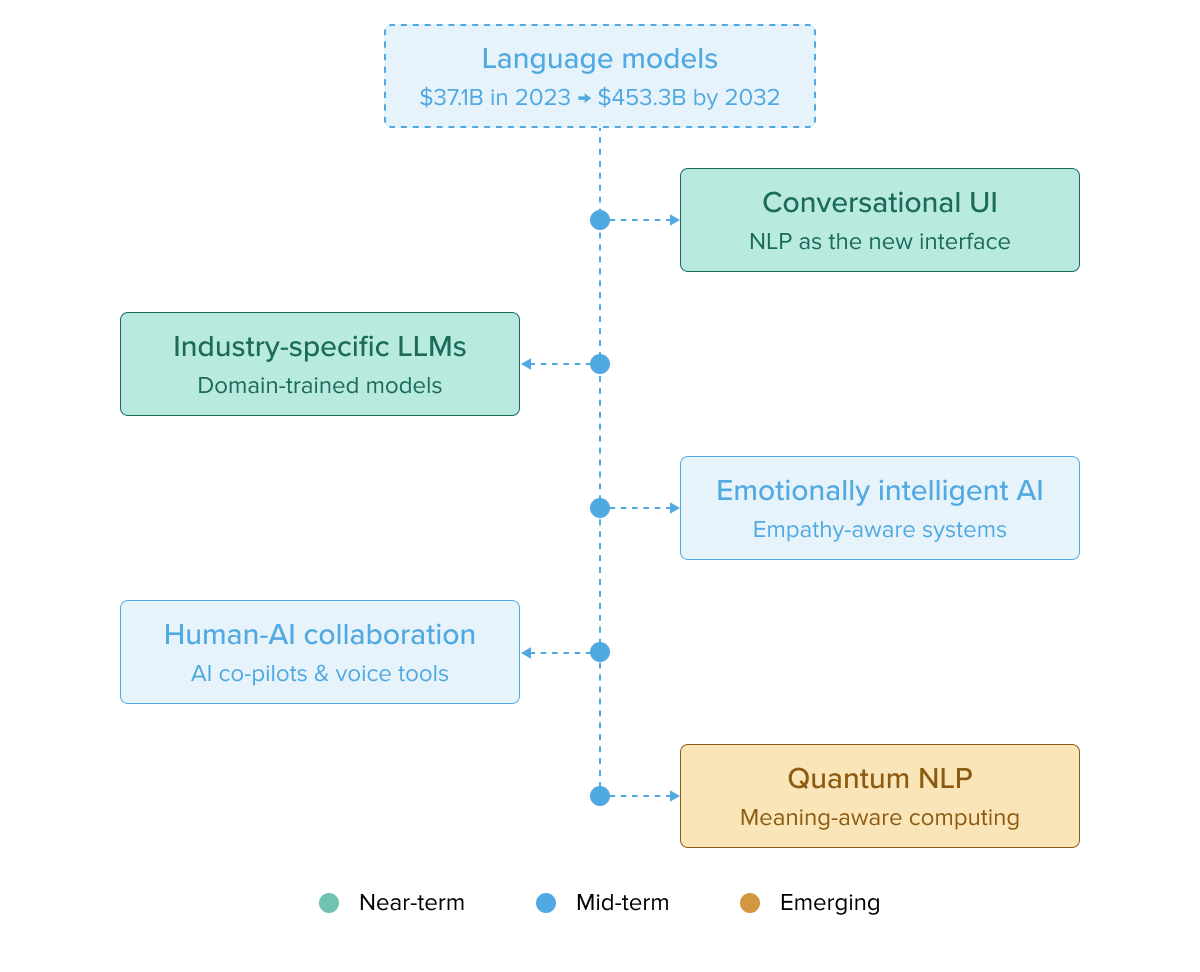
Quantum-accelerated NLP. Quantum natural language processing is a rising field that combines the mathematical framework of quantum mechanics with the linguistic theory of meaning to enable human-language processing on quantum computers.
This method allows the development of systems that are more “meaning-aware,” leading to an emerging era of ultra-effective models capable of managing deeply contextual, ambiguous, and multimodal language inputs at a large scale. Though still an experiment, this method can find solutions to various current NLP problems, like high costs, growing size, and data demands.
Final thoughts
From a tool that helps computers comprehend human communication, natural language processing has become an enterprise standard that transforms the way companies process data and interact with the technology.
From agentic systems to multimodal intelligence and efficient on‑device models, the next wave of innovation is already reshaping the digital landscape. The organizations that embrace these trends today will be the ones defining what “intelligent interaction” means tomorrow.
FAQ
-
In 2026, any reliable generative AI development partner should focus on facilitating their NLP services in terms of safety, multimodality, and advanced model architectures. The most significant trends include enhanced emotional intelligence, the development of AI agents and deep-learning models, personalization advancement, and high priority in ethical AI.
-
AI agents are transforming NLP systems by enabling developers to elevate their capabilities from that of a passive responder to a self-sufficient, reasoning agent working towards a specific goal.
They do way more than just generate language; they operate across multiple steps of action, learn from its environment, and plan accordingly while reasoning and using tools effectively. As a result, the customer has personalized content and a better overall experience.
-
In 2026, both large and small language models play an essential and strategic role in artificial intelligence development. SLMs don’t replace large models, but they change how and where AI is deployed.
LLMs dominate general reasoning and broad knowledge tasks, while small models handle real-world, production-grade applications. This way, AI becomes effective across a wider range of industries and use cases, and organizations of any size can find a more affordable solution for their projects.
-
This year, ethical and regulatory standards are becoming more enforceable, structured, and globally coordinated due to new international laws and lifecycle-management frameworks. Their primary standards include transparency, human accountability, and risk assessment.
-
Compared to a text-based system, real-time voice processing differs in architecture, speed, modality, and complexity. They also have to handle timing constraints, continuous signals, and multimodal interpretation that text-only models don’t need to consider.
Speech processing is also one of the most technically demanding NLP areas today, as it requires robust handling of real-world audio, richer context understanding, and faster models.
However, these processes turn NLP into a dynamic, multimodal conversational system rather than a static text interpreter. Compared to a text-based system, real-time voice processing differs in architecture, speed, modality, and complexity.
They also have to handle timing constraints, continuous signals, and multimodal interpretation that text-only models don’t need to consider. Speech processing is also one of the most technically demanding NLP areas today, as it requires robust handling of real-world audio, richer context understanding, and faster models. However, these processes turn NLP into a dynamic, multimodal conversational system rather than a static text interpreter.