
Hybrid intelligence: The case for AI-human cooperation
Leading firms use hybrid intelligence as a key differentiator to gain an edge over their competitors and maximise the technology investments in today’s highly dynamic business environment.
Through the hybrid model, not only can organisations leverage automation to improve efficiencies, but they can also fundamentally change how they create artificial intelligence software development processes and other operations, making them more innovative. Businesses can create a flexible, future-ready framework that produces reliable, observable results by fusing AI-automated decision-making with human expertise.
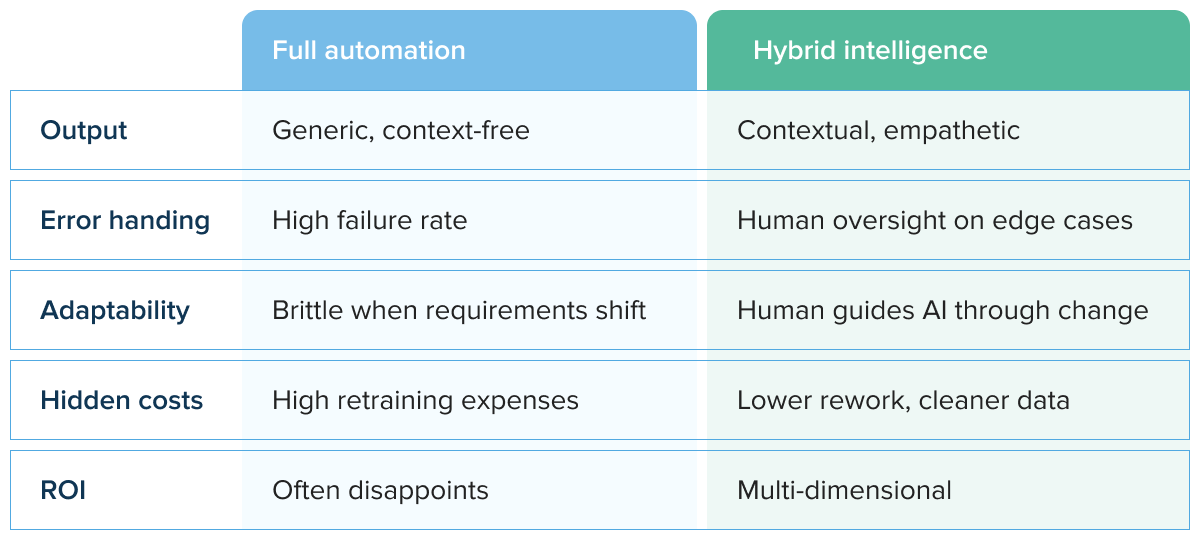
A few key factors can explain such pure AI failure. Autonomy is the common one. Businesses anticipate that AI will manage entire processes, eliminating the need for human labour and cutting expenses. Moreover, in reality, pure AI-first company output may be technically accurate, but it may be generic, flat, and context-free, producing ‘mediocre’ work. Additionally, when requirements change, AI tools become “brittle” and necessitate ongoing retraining. As a result, each of these necessitates additional expenses for training, updating, and the involvement of experts.
In those cases, the concept of a hybrid AI model was developed to effectively combine both of these aspects at its foundation. Let’s delve more into hybrid artificial intelligence systems to know why they produce measurable results.
What is hybrid intelligence?
Hybrid intelligence is considered to be the combination of human intelligence and machine intelligence for better results in business sectors. The major goal of human-machine hybrid intelligence is not to replace workers but to create a model where machines do all the boring, data-driven work and people supply the context of the situation, ethical considerations, and emotional context.
Basically, the oversight from humans happens when there are nuanced and context-driven layers, especially concerning custom AI chatbot development services, which require human ethical reasoning and creative judgement.
At its core, it demonstrates how custom AI analytics solutions‘ rapid analytical ability can be melded with the deep insights provided by automation to create a unique combination that offers organisations and individuals access to strong data-driven capabilities, while continuing to respect and uphold core human values, moral reasoning, and collective stewardship through a cohesive partnership between the two.
Hybrid AI solutions’ practical uses through key areas
After making sense of what hybrid AI is, it is vital to add that hybrid intelligence has been proven to improve the accuracy and efficiency of many areas, including healthcare, finance, manufacturing, and creative industries, with respect to ethical risk management, innovation, and productivity. Let’s take into consideration some good examples of applications of hybrid artificial intelligence systems.
Medical diagnosis
The delivery of personalised therapies and precision medicine is being significantly impacted by the use of hybrid intelligence in the health sector. AI consulting services can help to achieve better accuracy with respect to making diagnoses and generating treatment recommendations.
However, only through the application of human expertise can clinicians interpret the information provided by artificial intelligence algorithms, taking into account various clinical factors, including patient history, emotions, and circumstances. The hybridisation of these two approaches results in improved quality of care, greater precision when developing personalised care plans, improved health outcomes for patients, and more positive patient experiences.
Forecasting in the finance sector
Hybrid expert systems in artificial intelligence also actively take place in the financial realm, supplying oversight, dialogue, and problem-solving by human intelligence. Artificial intelligence-based algorithms provide the ability to analyse financial markets, evaluate risks, and predict future trends in seconds, thereby enhancing the overall effectiveness of the risk management process.
Simultaneously, all of these contribute to the development of more precise risk evaluation, fraud monitoring, and investment planning. The combination of AI’s accuracy with the ethical framework of human experience allows hybrid AI systems to support the ethical responsibilities that both institutions and their clients have to make sound financial decisions and to avoid pitfalls.
Fraud identification in fintech
Due to multi-agent AI systems in hybrid intelligence, fraud identification in fintech could be enhanced significantly. This entails switching from more flexible, real-time systems that can provide precise levels of fraud risk to more traditional methods of detecting fraud based on pre-defined rules that are only effective for detecting fraud after it has already occurred.
Moreover, two primary forms of learning are usually integrated when using hybrid intelligent systems. First, hybrid AI systems used to detect fraud with a hybrid intelligent detection system combine one or more supervised learning models with one or more unsupervised learning models to detect fraud. A second type of hybrid intelligent detection system is able to perform real-time transaction monitoring, resulting in fraud risk assessment scores from 0 to 99.
Enhancement of customer service
Full automation of customer service and support is frequently unsuccessful because of the variability and emotion associated with human communication. Hybrid architectures for intelligent systems leverage AI technologies to process things such as password resets, order tracking, FAQs, and requests, and then transition emotionally complex or high-value requests to live agents.
In addition to these, AI fosters real-time support to agents by suggesting responses, summarising customer activity, and recommending next best actions. As a result, customers receive quicker resolution times and greater satisfaction levels without having to sacrifice service quality with the right support at the right time.

Source: Unsplash
ROI reality: Why full automation is not as effective as hybrid intelligence
The wrong idea about maximum return on investment is often realised from hybrid artificial intelligence systems versus fully automated AI tools. In reality, many companies realise the opposite when replacing all their human workforce with fully automated machine solutions results in extremely increased hidden total costs compared with hybrid model approaches providing far greater and more stable and scalable returns overall.
Better outcomes and the creation of ultimate value
Hybrid systems in artificial intelligence have produced much higher operational efficiency, and this occurs primarily when humans conduct the complex, non-programmable actions while the AI performs the heavy data processing. 
It is crucial because the human adds context, empathy, and strategic thinking to the AI’s output, guaranteeing that the hybrid model’s output is both effective and operationally efficient.
Lower risk and unseen expenses
It doesn’t matter whether it concerns AI software development services, AI product development services, or other applications; high levels of automation can generate error rates that are quite high.
It is vital to consider that much of this productivity is being wasted because the company’s overall production rate is still low due to inefficient processes. Benefiting from a hybrid model allows for human oversight on process execution, therefore decreasing the chance of mistakes occurring and, thereby, avoiding rework costs.
What’s more, to use artificial intelligence successfully, it needs to have a consistent dataset. By using an artificial intelligence hybrid approach, humans are able to control, understand, and clean up data inputting, thus saving on costly processing expenses associated with poor-quality inputs.
Quicker and longer-term ROI
With hybrid artificial intelligence systems compared to fully automatic systems ready for full deployment, a company can benefit from the faster implementation of hybrid systems and therefore receive a return on investment sooner by enhancing the performance of their existing employee workflows.
As for versatility, when processes change in a fully automated system, it often fails. However, in a hybrid artificial intelligence infrastructure, the human component guides the intelligent agent through the changing market conditions, which provides for a greater level of long-term return on investment.
How does hybrid AI appear in practice?
‘Hybrid AI’ refers to a type of HITL system that uses machine learning, including prediction and machine learning based on patterns, and symbolic AI using rules to achieve increased efficiency and reliability.
AI-Powered input and ingestion
Incoming claims are read, and unstructured text is extracted by an AI component using RAG to reference company policy.
Preliminary triage
The system calculates a probable risk score for incoming claims, which results in claims below $500 that are standard being automatically approved by the AI for payment.
Identifying and moving from AI
If a claim exceeds a dollar threshold, uses an uncommon or unknown term defined using natural language processing, or hits a fraud indicator, the system will trigger a “hard stop”.
Human evaluation
A human agent receives a case and will see a summarised document and an explanation of why it was flagged, and the next recommended steps.
Completion and learning
Once approved, denied, or edited by a human, that decision will be included back into training data so that the AI can use it to improve its future accuracy for similar cases.
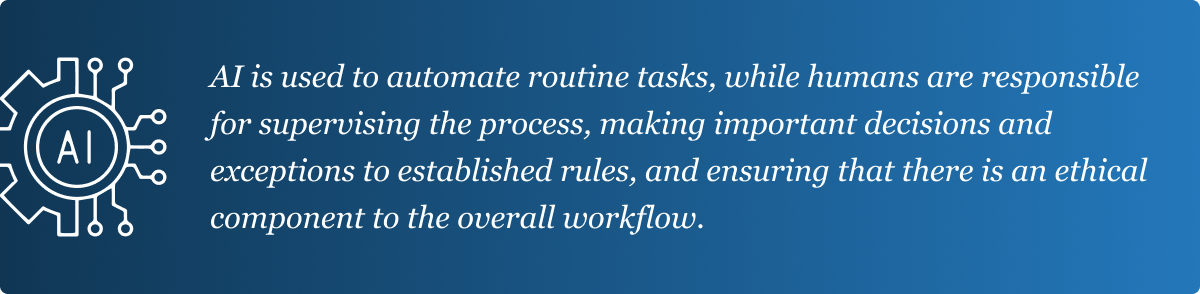
In short, AI is responsible for routine and high-volume tasks, including performing simple sentiment analysis, extracting initial data from invoices, and classifying documents repetitively.
People oversee high-stakes, complex, or ambiguous tasks like creating strategic plans or determining whether to approve high-value claims after taking into account all pertinent information or complaints that have ethical ramifications. An AI exits the loop and escalates the task to a human for resolution if its confidence score is below the predefined threshold or if it violates the predefined rule.
Wrapping up
In conclusion, the hybrid intelligence movement is bringing about a new era of technology and work, giving the opportunity for enterprises to create artificial intelligence systems that integrate natural intelligence from both individuals and teams of people so that their solutions will be effective and meaningful, as well as beneficial. By fusing machine efficiency with human oversight, an AI agent store allows companies to implement specialised, autonomous software that easily integrates into a hybrid intelligence framework.
Nevertheless, companies should bear in mind that building a hybrid AI company demands more than simply changing the technology; it contributes uniquely to the same decision pipeline. If organisations are intentional in moving forward with hybrid intelligence, this will give them the opportunity to embed empathy and purpose into the very fabric of their organisation. It is particularly true in a world where artificial intelligence has taken over.
FAQ
-
Hybrid artificial intelligence is a cutting-edge approach to artificial intelligence that combines different types of AI methods. It combines structured knowledge, usually symbolic AI, which uses rules and logic, with unstructured data, sub-symbolic AI, which uses ML and DL, to develop AI systems that are more reliable, accurate, and understandable than what could be achieved using either type of AI on its own. The combination results in a better understanding of how to reason, be adaptive, and develop strong levels of trust in complex decision-making processes.
-
According to capabilities and functionalities, there are four kinds of artificial intelligence. There are reactive machines, limited memory, a theory of mind, and self-aware AIs. These vary from simple, task-specific systems to hypothetical future AI with self-awareness and an understanding of human emotions.
-
Hybrid intelligent systems are computer software systems that combine multiple techniques from AI and human knowledge or expertise in conjunction with automated techniques in order to form a stronger, more precise, and more flexible system than could be produced by one method alone. These systems fill the gap between machine learning and rule and knowledge-based reasoning or human intuition by solving their respective weaknesses.
-
One of the hybrid AI examples is fraud detection in the banking domain system that combines hardcoded rules for compliance with machine learning to identify new fraud patterns. The method offers greater accuracy and better explainability than a single model by allowing the system to learn new fraud patterns while abiding by predetermined safety regulations.
-
A smart hybrid is regarded as a vehicle technology that deploys both gasoline engines and electrical system components to optimise fuel efficiency and operation by eliminating pressure on the gasoline engine. Hybrid vehicles are considered to be more environmentally friendly than traditional gasoline vehicles because they use alternative energy sources that create less pollution.