
Enterprise AI development has enormous potential to increase productivity and transform a variety of industries.
Nevertheless, to fully reap the benefits of AI-powered solutions, organisations must overcome a number of critical challenges. AI can be very beneficial if you know how to ensure success and what to do to avoid failure, especially in data security and privacy, workflow integration, and keeping up with rapid AI agent development.
One of the biggest challenges organisations face is moving AI from a proof-of-concept stage to a large-scale enterprise production implementation.
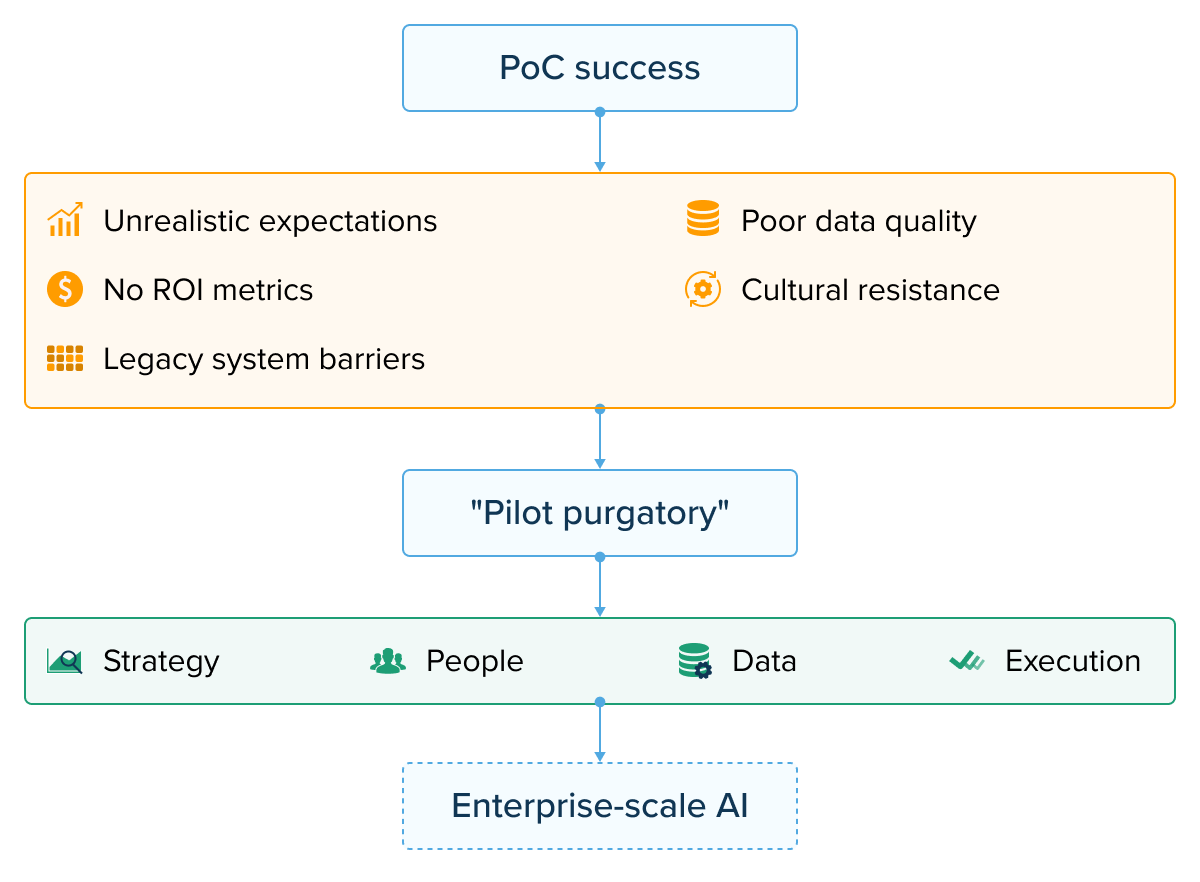
The objective of a PoC is to demonstrate that AI readiness has been completed with a successful pilot in a controlled, isolated environment. The attained enterprise AI adoption strategies’ successful deployment, however, necessitates overcoming infrastructure and data barriers that usually result in a PoC becoming “pilot purgatory”.
The reason for the gap between achieving a pilot initiative and implementing a solution in the enterprise is not actually caused by the technology.
Instead, it is the failure to bring people, data, governance, and business incentives—the essential elements of an AI transformation—together. This disconnect between the vision of an organisation and the ability to execute on that vision is where most organisations lose traction. Since identifying these breakdown points is the first step towards resolving them, we will now look at the primary obstacles impeding the deploying of AI in the enterprise.
Enterprise AI adoption challenges
When you start your AI journey and address AI development companies that bring life into your projects, it is a great step, but you also ought to know there can be common pitfalls in enterprise AI deployments.
To get the utmost benefits of your AI development services’ custom business solutions and have a clear understanding of why a successful PoC doesn’t always turn into a full-fledged product, organizations must overcome several significant obstacles, especially those related to data security and privacy, workflow integration, and keeping up with the swift advancements in AI.
1. Unjustifiably uptight managerial anticipations
There is no doubt that many leaders are full of upbeat enthusiasm when they begin to set their AI workflow enterprise model deployment. On account of the extreme revenue attributed to the use of artificial intelligence.
However, most of the wide-ranging corporate AI rollouts have delivered mediocre averages; only a 5.9% annualised rate of return as a whole through the use of AI products and systems is evident. The failings are directly related to the lack of dissimilarity between expectation and the ecosystem of enterprise AI development solutions.
Most executives compare the progress of their organisation’s enterprise use of AI to these consumer-grade AI implementations.
AI is offered as a service through platforms like ChatGPT and GitHub Copilot, built on consumer-grade architecture, trained on decades of unclassified open datasets, and designed to operate quickly and without delay in a virtually frictionless environment where data is abundant, compliance hardly exists, and one application is used at a time.

Source: Unsplash
What is no less important is that AI is being leveraged within the enterprise functions in a very dissimilar environment. The data feeding AI systems inside corporations exists within a mix of legacy applications, with a substantial number of instances of duplicated, out-of-date, or incompatible data, requiring data security or improper administrative infrastructure. That is why this complexity clearly casts doubt on the concept of plug-and-play AI.
The education of executives with a focus on comparing consumer AI experiences with company-scale AI development can actually help. Enterprise AI agent deployment consultants are also needed for those who start at first. Instead of concentrating only on moonshot objectives, match spending with iterative milestones. Incorporate technical input into decision-making so that leaders have direct access to the teams creating and overseeing the systems under development.
2. Bypassing organisational and cultural barriers
Each year, more and more AI software development companies pay attention not only to expectations but also to reality, as enterprise AI systems remain a major barrier to AI adoption.
Despite their many benefits, LLM models cannot think as humans do. AI agents’ enterprise deployment has memory, planning abilities, and external data, but autonomous behaviour does not remove the need for carefully designed systems.
Automating functional jobs through an AI chatbot development service for E-commerce requires an architecture and control of autonomous actions to ensure reliable operation.
A true example of this is that organisations are not simply employing AI models, but rather, they design systems to incorporate them. To build safely scalable architectural systems, remember to include continuous training models and team and senior management support.
3. Overlooking data-solving issues
Expectations shift from proof-of-concept to enterprise-wide implementation, necessitating the establishment of new requirements.
The first one is enterprise integration and data access, since companies implement AI, there needs to be connectivity established between the internal systems, as well as secure access to proprietary data. Quality data assurance is also a vital step because large volumes of precise, organised, and current data are necessary for AI. Performance and scalability are limited by data that is poorly labelled, inconsistent, or siloed.
What’s more, to avoid challenges in enterprise AI adoption concerning guardrails and failures, there must be established limits, managed failures in edge-case situations, and a safe fallback for those situations. Production monitoring, logging, visibility, and managing multiple users while maintaining latency and cost are necessary to further support AI systems’ overall operation.
The other key point is compliance with cross-disciplinary ownership of processes, which fosters sustainable operational realities, as many integration initiatives code with the intention to showcase possibilities and fail in the end. Create pilots with a focus on production from the outset to ensure easy movement of proof-of-concept into production workflows.
ROI and AI performance aren’t determined
One more of the common pitfalls in enterprise AI deployments is the undetermined ROI and performance of AI. Unlike traditional enterprise software, which can be reliably tested to see if they perform their required function or not, the evaluation criteria for generative AI are much more complex and must take into account many other evaluation criteria.
Regardless of how good the AI is, implementation is ineffective if results are not tracked. Businesses that do not have metrics to evaluate performance or show how they could justify additional AI investment will face challenges with decision-making and enterprise AI agent deployment software.
So, when creating successful evaluations of generative AI, organisations must build evaluation frameworks that take into account the following evaluation dimensions, such as integrity, dependability, relevance, correctness, and policy congruence with corporate policies.
Unfortunately, a large number of companies that embed custom enterprise AI software development into their procedure usually do not specify performance metrics before beginning the project. Due to the length of time it takes for AI projects to yield results, decision-makers may grow impatient or make bad choices.
Furthermore, address a trustworthy AI company if you have no idea how to set KPIs aligned with the overall business objectives, improve customer satisfaction, lower costs, or increase efficiency. To ascertain whether the AI project is successful and to make adjustments to the plan, evaluate performance on a regular basis in conjunction with business goals.
The best methods for scaling up from a pilot project
In order for businesses to ensure the successful adoption of AI, they must create an appropriate climate for success by employing a well-thought-out strategy and having realistic goals along with a leadership commitment to their implementation.
Adopting these guidelines will help ensure that your AI-related projects provide significant and measurable outcomes. There is a list of best practices for your pilot project to scale in a proper way.
1. The verification of your pilot’s success
Verify your pilots’ success using precise metrics, compare your baseline measurements with the actual results, and keep track of both the successes and the lessons learned.
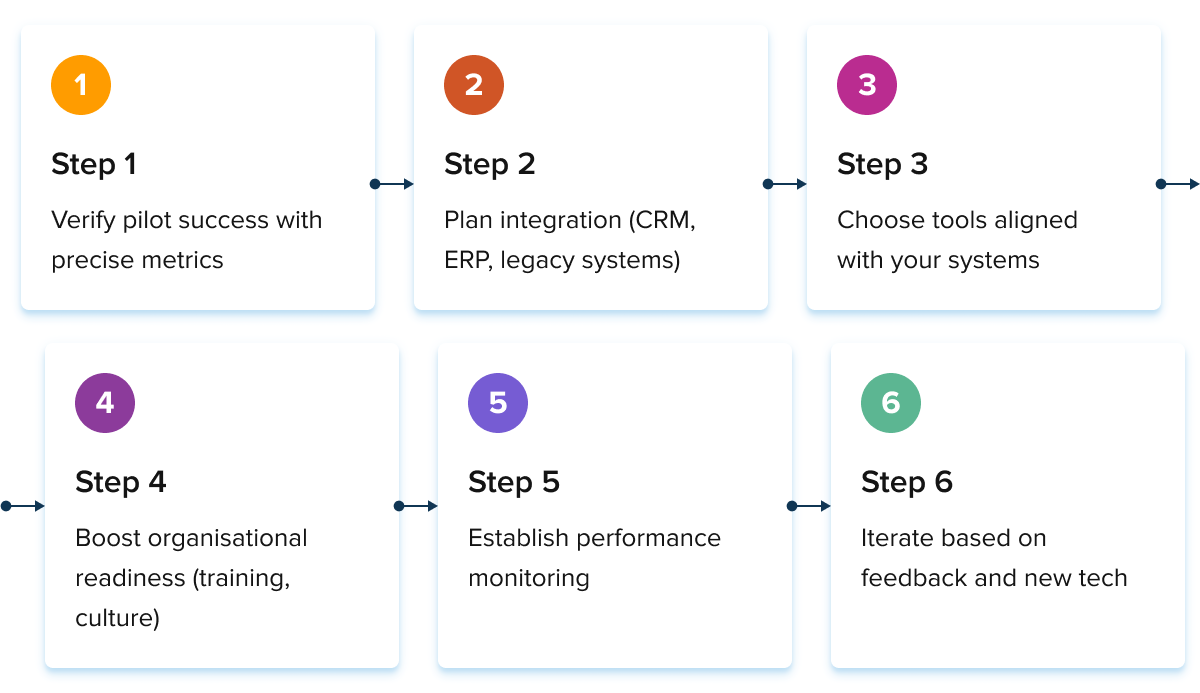
2. Step-by-step planning of further actions
Enterprise AI development and integration must follow a certain list of actions, like a plan for CRM and ERP, tools for cooperation and communication, outdated systems that won’t be replaced anytime soon, and other enterprise AI deployment checklists.
3. Give the tools careful thought
Not all businesses are suitable for every AI solution. Companies shouldn’t select tools solely based on marketing claims or trends. Instead, leaders might concentrate on whether a solution aligns with their current systems, procedures, and future requirements.
4. Boosting your organization’s preparedness
Technical equipment, operational availability, AI software consulting, cultural sensitivity, and spending money on training investment are all components of an organisation’s readiness.
5. Establishment of performance monitoring and tracking
Create monitoring systems that assess productivity and efficiency improvements, the effects of costs, the indicators of quality, uptake by users, and customer satisfaction metrics.
6. Constant improvements due to feedback and new tech
Make conclusions according to the clients’ feedback, keep up with AI advancements, keep an eye out for model drift, and take care of any biases that surface to stay agile.
Summing up
To wrap everything up, it is crucial to remember that strategy, data, people, and execution are essential success factors for any business wishing to set up enterprise AI development services, as these days, there will be both opportunities and risks associated with businesses adopting AI.
Following the specific plan and taking into account all the problems of enterprise AI development, companies that take advantage of established best practices while avoiding common pitfalls should have the greatest chance to leverage AI and achieve a significant competitive advantage.
Additionally, to bridge the gap between the initial stage of creating a potentially beneficial AI app and a fully operational enterprise application, it is a must to understand it, as it is considered to be the first step to overcome it, but not enough.
Putting the operational testing and design, evaluation of data quantity and quality, adequate ROI, following performance metrics, combating cultural issues, and assessing customer feedback in the first place as well. Whether you want to automate your workflow or need AI deployment for predictive analytics, if you’re new to the field, use trustworthy AI partners to achieve measurable, clear, and confident outcomes.
FAQ
-
A combination of technical, structural, and tactical issues, including issues with data quality or governance; integrating with legacy systems; a lack of qualified personnel; organizational culture that is resistant to change; the expense; an uncertain return on investment; security levels; ethical governance; and adherence to laws and codes of conduct, are the main challenges to enterprise adoption of AI.
-
The critical challenges enterprises face with AI integration include the following: data security challenges during AI deployment, and structural and operational matters.
Some of these include poor data quality and governance issues; difficulty integrating AI solutions into legacy systems; lack of adequately trained personnel to use AI; resistance to change brought on by corporate culture; high expenditure; uncertainty with respect to return on investment; inadequate security; and ethical and legal compliance and adherence to appropriate codes of conduct.
-
There are ten benefits of artificial intelligence in being able to perform tasks more efficiently, accurately, and innovatively within an industry.
Among these benefits are repetitive task automation, accessibility and effectiveness, applications and AI chatbot development for everyday life and support, diminished human error, making decisions more quickly and wisely, creativity and new prospects, better customization, enhanced security and cybersecurity, improved big data management, and healthcare innovations.
-
Unfortunately, close to 90% of AI pilots never get produced at scale and are referred to as being in “pilot purgatory.” The main cause of the high failure rate isn’t that enterprise AI software development or AI technology itself is faulty, but that the pilot’s basic principles didn’t align with how it would be used in a real-world production setting.
-
Significant technical challenges arise when integrating artificial intelligence with legacy ERP or CRM systems. Out-of-date architectures, fragmented data, and poor interoperability mostly cause these challenges.
Reconciling monolithic, on-premises systems with contemporary, cloud-based AI, guaranteeing data quality, preserving system performance, and managing security and compliance risks are some of the main obstacles.
-
Adherence to the European AI Act and GDPR at scale necessitates a shift from ad hoc or project-based compliance to an AIMS that incorporates governance throughout the entire AI system lifecycle. The NIST AI Risk Management Framework for risk assessment, ISO/IEC 42001 for AI management systems, and EuroPrivacy for certifying AI as GDPR-compliant are some of these crucial frameworks.