
AI adoption in retail in 2026 helps businesses to provide omnichannel experiences, phygital strategies, hyper-personalization, and automation, making shopping not an ordinary routine but an interesting journey that enhances customer satisfaction and loyalty.
Industries react differently to the adoption of AI: some treat it with caution, others broaden their horizons with it, and retail is one of them.
AI retail technology trends in 2026 show that the industry enters a new phase, where it is focused not on experimentation but integration and execution. The industry transforms, and generative AI helps it a lot. Read further to know all the latest trends and predictions needed for a successful business in the new year.
What is AI in retail?
AI in retail is the use of artificial intelligence to help retailers operate, from customer experience personalization to supply chain optimization. AI-powered tools for business can provide 24/7 support by running virtual shopping assistants, automating reordering, or optimizing retail operations.
AI tools scrutinize vast amounts of customer and sales data in real time. By doing so, they can predict product demand, personalize promotions for individual shoppers, and dynamically adjust pricing. These processes help ratilers to pinpoint consumer behavior patterns, foresee market trends, and boost overall operational efficiency.

Source: Unsplash
For instance, AI systems can automatically optimize inventory levels by using sales trends and offer highly personalized product recommendations that increase conversion rates.
Adoption of AI in retail
Today, it is impossible to imagine an industry that doesn’t utilize LLM development, GPT integration services, and other AI technologies in its workflow. Statistics say that last year, 71% of organizations applied generative AI to at least one of their business processes. Most of all, AI is used in the industries of sales, marketing, and product development.
AI use cases in retail also impress with their diversity and widespread use: almost 90% of retailers apply AI to their operations or evaluate AI initiatives.
Spending is expanding enterprise-wide, and retail leaders anticipate a 52% jump in artificial intelligence investments beyond traditional IT over the next year.
Such an impressive jump in investing is also caused by consumer demand. According to the study, 71% of consumers want their shopping experience to have AI integrated. Gen Z and Millennials are especially interested in it, which is why their numbers are even higher.
Machine customers are AI-driven systems that autonomously make transactions on behalf of human consumers. For instance, without any human intervention, a home assistant can stock up on household supplies, a smart fridge can make a delivery, and a smart printer can reorder ink when the toner runs low.
It’s safe to say that retail artificial intelligence solutions are the most important trend in 2026. Not long ago, they were a new word in the industry that gave businesses extra attention and bonuses. Now, AI retail trends are the first thing retailers should check and implement to make their new year prosperous and effective.
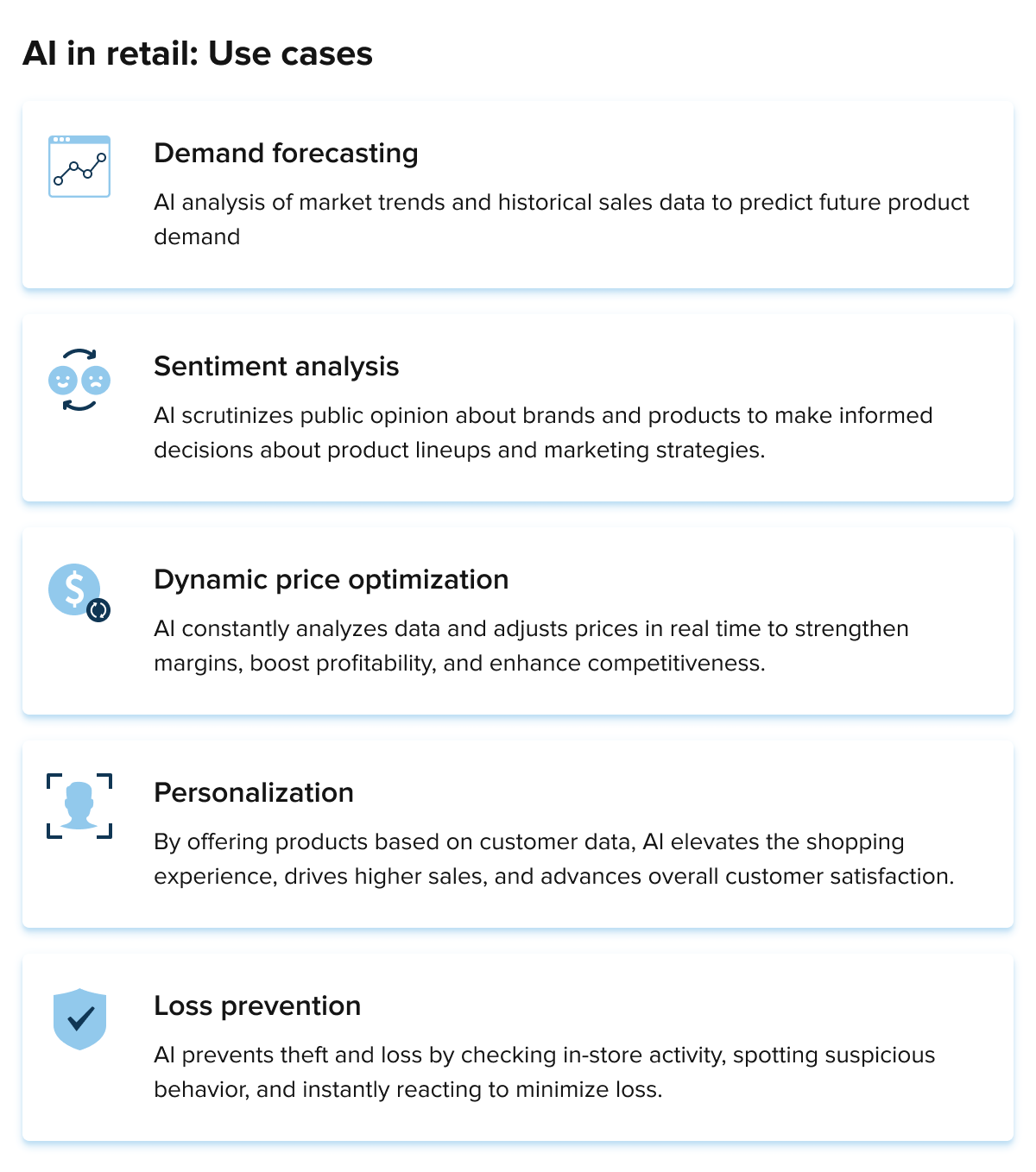
How AI in retail will work in 2026
Due to the development of E-commerce and online shopping, many retailers have already utilized AI in their workflow for the past 10 years. However, it only helped them to predict customer behaviors and optimize campaigns.
Today, AI changes how the industry works completely, and any company that wants to stay relevant should invest in these technologies. Here are the predictions of how AI will transform work in retail in 2026:
Retail automation
AI in retail 2026 is mostly about building smarter stores and supply chains. Customers in Europe and North America will more frequently encounter frictionless, self-service experiences and reap the benefits of faster delivery and better-stocked shelves due to AI and robotics quietly working in the background.
The retailers that succeed will be those who combine operational efficiencies with human effort, leveraging automation to improve service quality instead of simply reducing costs.
1. In-store robotics and IoT
Automation now reaches far beyond the checkout counter. Retailers use generative AI development to handle routine in-store activities such as price verification and inventory monitoring.
Technologies like smart shelves and shelf-scanning robots powered by RFID (Radio Frequency IDentification), cameras, and weight sensors provide real-time inventory insight, generate data on shopping behavior, and support proactive restocking. According to a McKinsey report, smart shelf technology can lower out-of-stock incidents by up to 30% and reduce manual inventory checks by 40%.
2. Warehouse automation and micro-fulfillment
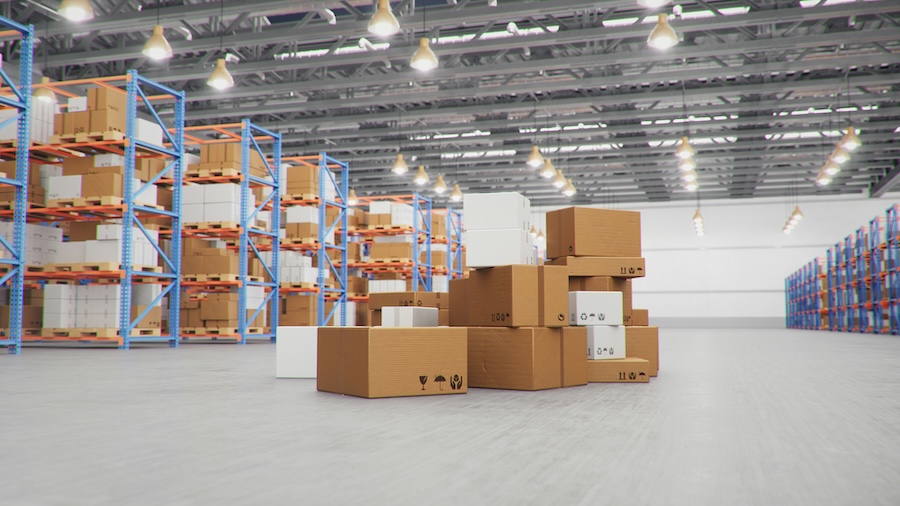
Micro-fulfillment centers are rapidly expanding as retailers focus on same-day delivery and streamlined in-store pickup. In their report, the Business Research Company predicts that by 2029, this market will reach $43.5 billion, growing at 46.8% CAGR.
Leading grocery chains in the U.S. and Europe, such as Kroger with Ocado and Carrefour’s urban fulfillment hubs, are investing in compact, robot-enabled facilities to meet the growing demand for speed and convenience.
Source: Unsplash
3. Predictive inventory and supply chain AI
Retail operations are becoming increasingly resilient with the aid of AI-based demand forecasting. Through the analysis of historical sales, local events, seasonality, social signals, and weather patterns, artificial intelligence in retail business allows companies forecast product demand, enhancing availability while reducing overstock and supply chain inefficiencies.
4. Omnichannel and “phygital” strategies
From the customer’s perspective, in 2026, the line between online and offline shopping is about to vanish. By 2026, omnichannel retail has turned from a way to stand out to the standard expectation, meaning a seamless experience across stores, mobile apps, websites, and other touchpoints.
Hence, retailers use psygital (physical + digital) strategies to make shopping not an ordinary routine but an interesting journey. AI retail technology trends include:
5. Real-time inventory visibility
A key pillar of omnichannel retail is to make it clear to the clients which products are available and where. Retailers are putting money into giving real-time inventory across every store and warehouse.
As a result, customers can both know where they can buy the needed goods and how long they can be delivered from other locations. By 2026, more retailers will enable options like “ship from store” or “order in‑store for home delivery,” allowing them to combine inventory across locations to meet demands from any channel.
6. Unified customer journey
Nowadays, customers are shifting more seamlessly between different shopping channels. It’s totally normal when a person finds a product on social media, searches it online, tries in a shop, and only then makes a delivery via mobile app. 73% of shoppers search online before making a purchase.
In 2026, AI trends in retail industry will help companies to make these processes seamless. The main goal is to preserve a unified customer profile and deliver inventory information, aligned pricing, and brand experience across every channel.
7. Cross-channel loyalty programs
Omnichannel loyalty programs are being changed to combine both physical and digital engagement. One of the best examples of such a strategy is extremely successful in North America and launching in Europe, Starbucks’ reward app that allows customers to make an order ahead online (digital) and take it away offline (physical) while still earning bonus points.

Source: Unsplash
Companies try different ways to enhance customer loyalty to find the one that suits their business the best. This includes rewards a customer can get either online or offline, bonuses given not only for purchases but also for digital engagement, omnichannel perks, and so on.
8. Shift of spend from acquisition to retention
For over ten years, marketing budgets have mostly concentrated on acquisition. However, tighter overall margins, declining third-party data, and rising advertising costs are pushing companies to change their approach. In 2026, retention strategies are set to take center stage.
Getting a new customer has never been so high-cost. With increasing customer acquisition costs, fierce competition, rising CAC, and fragmented channels, gaining each new customer has become more complicated and expensive. As a result, retailers can’t entrust paid acquisition the way they used to.
Due to these changes, repeat customers have become considerably more valuable. They tend to spend more, have lower service and support costs, make purchases more often, and are more apt to loyalty programmes and subscription offers. Nowadays, retailers should focus on the following:
Personalized special offers: Blanket discounts lose margin and train customers to wait for sales. In 2026, businesses will focus on personalized rewards, post-purchase surprise offers, exclusive upsell offers, and limited-time “VIP perks” for high-value customers.
Loyalty programmes: Customers want perks that feel earned, not generic. Retailers should concentrate on developing dynamic loyalty tiers, experimental perks, app-only rewards, early excess events, and curated offers that give a sense of exclusivity.
Premium post-purchase experiences as a retention engine: When acquisition reaches its limits, post-purchase strategies bridge the gap. Investment will shift toward branded, highly engaging tracking experiences, effortless self-service returns, personalized post-purchase journeys, product education content, and fostering customer communities.

Source: Unsplash
Reimagination of brick-and-mortar retail
Despite all the fears, offline stores are still on the roll as they satisfy human preferences that online shops can’t substitute: social interactions, the sensory and tactile experience, and the necessity of taking an item home.
However, in 2026, brick-and-mortar stores will take on a new function of being experience centers, fulfillment hubs, and essential connection points within an omnichannel strategy.
Experimental retail and “retaitaintment”
If a store today wants to gather loads of customers, it should not just be a point of sale but an immersive destination.
To make their shop a desired one to visit, retailers should turn it into places where people can do things, attend events, test products, or simply have fun. The most effective strategies are:
- Interactive and high-tech experiences: In 2026, one of the top AI retail trends is the use of AR/VR and interactive displays to attract customers. These elements make shopping not a process but an event, elevating both conversion rates and loyalty.
- Entertainment and leisure: Today, retailtainment – the process of combining retail with entertainment – has become more dominant. Stores can hold events associated with their products (e.g., yoga classes, workshops, ect) to provide experiences a customer can’t get online.
- Showrooms and flagships: More and more bands are opening stores that function as showrooms – places focused not on convenience but on the desire to present a product’s unique features, where customers can test some goods for later delivery. Brands actively launch short-term themed pop-up stores to draw attention. As a result, it is expected that, by 2032, the pop-up retail market will reach $144B from $95B in 2025.
Phygital integration in-store
If a store wants to be high-performing in 2026, it needs to integrate digital conveniences seamlessly into physical places. Recent technology trends include the following:
- Assisted selling and clienting: businesses use predictive analytics solutions to provide their staff with AI “copilots” or clienting apps on tablets and smart glasses that show previous purchases, preferences, and offer personalized suggestions. This way, store employees turn from passive responders to proactive advisors.
- Smart store infrastructure: A phygital store in 2026 should customize offers on displays in real time and recognize its loyal customers upon entrance by using QR code scan, an app, or facial recognition.
- Omnichannel service (BOPIS/BORIS): Phygital stores should be convenient for online customers, too, by offering them pickup and return spots. Returns are becoming more convenient too: you can hand back an online purchase at a store counter or use a network of return kiosks—no packaging or label required.
Rise of conversational commerce
Due to the evolution of chatbots from simple Q&A to full-fledged shopping concierges, 2026 is the year of maturation for conversational commerce. AI chatbot development will shorten the time between product discovery and purchase, especially in North America, where major big-box retailers are making significant investments.
Europe is moving in the same direction, though more caring about privacy and regulatory adherence. If retailers want a strong competitive edge, they need to apply AI agents to make their business conversational while still upholding data ethics and preserving a genuine human element.
Rapid growth in the use of AI chatbots and personal AI shopping agents: The concept of agentic commerce is developing swiftly, which is why retail analysts forecast that by 2026, one in four shoppers will rely on AI-driven chatbots when shopping.
Advanced AI agents not just offer advice, but take actions on behalf of customers or even make purchases. Already now, one in three U.S. consumers allows artificial intelligence make purchases for them, and nearly one‑third have already turned to ChatGPT to help guide their purchasing choices.
According to McKinsey, retailers that master personalization have achieved revenue boosts of up to 40%, and that impact will carry over into conversational shopping channels as well.
Amplification of sustainability commitments
Nowadays, sustainability is becoming one of the key factors in establishing retail prices and business strategies. Emerging environmental regulations are changing retail economics by imposing stricter standards on everything from how products are made and packaged to the overall environmental impact of day-to-day operations.
It’s especially seen in Europe, where the European Union mandated that by 2025, 65% of packaging waste should be recycled, which is why companies needed to invest in designing their packages into more sustainable ones.
However, this process can also help to bring new customers and extend the target audience, as the Millennial and Gen Z generations tend to choose sustainable brands. Even studies show that customers are ready to pay about 10% more if the product is sustainable.

Hyper-personalization and omnichannel experiences
Personalization has evolved a lot from just calling someone by their name in the email. The world is already living in the age of hyper-personalization. And if you don’t want to be left behind because you can’t even meet the basic requirements of today’s customers, start winning at delivering relevant, seamless and emotionally engaging experiences.
By processing behavior, transaction and context-based information, AI can power deep, live personalization that serves customers tailored content, messaging and offerings in real time across a variety of channels. AI for personalization provides retailers with the following perks:
1. Revenue growth: Hyper-personalization is not just a marketing enhancement but a driving force to boost sales and competitive advantages.
2. Higher loyalty and retention: Together with omnichannel processes, hyper-personalization can considerably strengthen customer loyalty, leading to more predictable sales and lower acquisition costs.

Source: Unsplash
3. More relevant customer journeys: AI constantly estimates new data to always suggest to customers what they need at this moment. Stores with AI under their belt usually provide the best message, channel, and moment for each shopper, building experiences that feel uniquely designed.
Conclusion
Even a few years ago, it wasn’t expected how quickly and deeply artificial intelligence would infiltrate the life of almost everyone. Such rapid changes logically led to the fear of the devaluation of human labour as, sooner or later, almost everything will be substituted by AI. In reality, even the most advanced AI can’t replace what’s real. On the contrary, it amplifies the advantages of real things and helps them to find their target audience.
Modern retail is mainly concentrated on elevating revenue growth for retailers and making the shopping process a captivating experience for customers, and artificial intelligence makes it a reality. AI in retail trends 2026 include omnichannel and phygital experiences, compliance with sustainability regulations, special attention to loyal customers, and turning offline shopping into an event worth waiting for.
The future of AI in retail is highly promising, which is why companies are actively investing in it. Retail AI trends show that nowadays, online and offline markets are not rivals for each other. A successful retail business knows how to combine them, making its stores a comfortable place for diverse customers, and AI helps them in this.
FAQ
-
In 2023, the global artificial intelligence in retail market was valued at USD 3.2 billion. According to the studies, the global AI retail market is estimated to be valued at USD 13.86 billion in 2026. Hence, this sphere continues to grow rapidly.
-
Nowadays, retailers face such difficulties as high competition, customers who are tired of ordinary shopping, and challenges in attracting new customers. All these problems can be solved by an artificial intelligence application.
AI in retail helps businesses to blend both physical and digital markets to turn the shopping process into an event full of diverse experiences. Phigytal and omnichannel strategies allow stores to go viral, leading to new customers and enhanced loyalty.
-
There are many places AI can fit into retail. Some of the obvious ones:
- Smart devices (fridges, printers, home assistants) that can order supplies on their own when they run low with no or minimal human input
- AI agents and chatbots that could interact with your customers at any point in time
- Recommendations tailored to your user history/previous purchases
- Predictive demand by automated inventory forecasting.
-
AI technologies can provide numerous practical, high-impact solutions for optimizing operations, decision-making, and customer experience. Some of the industry’s areas are especially effective if AI is applied to them.
Artificial Intelligence in retail sector results in better forecasting and planning, enhanced omnichannel experiences, customer service automation, data-driven inventory management, simplified work for retail teams, and so on.
-
Nowadays, it’s impossible to imagine a top-level business that doesn’t use AI in its workflow. Artificial intelligence solutions for retail are noticeable in Amazon, Sephora, eBay, and other leading brands.
However, it doesn’t mean AI is only for big players. In 2026, it will be used by the stores of all levels and sizes that want to keep up with the times and increase their revenue.
-
It is predicted that by 2033, the AI in the retail market size will reach USD 97.83 billion, which means its future is highly promising. It is expected that the market will be even more data-driven, immersive, and connected than we have today. There will be no split into offline and online markets.
Instead, we will have a seamlessly integrated physical-digital environment, where stores, apps, and home devices will provide a capturing shopping journey together. We will also see the demographic shift. As boomers retire, Gen Z will be the main focus group, meaning marketing will focus on their main values, like sustainability, digital fluency, and transparency.