
Rapid progress in artificial intelligence technology is bringing about changes in how the healthcare system functions and creating value for patients and the business of medical care. Digital health implementations’ influence on market dynamics identifies a number of practical case studies that demonstrate the application of AI in digital health in 2026 and provides insights to assist decision-makers in preparing for the wave of technology trend transformations.
Technology is a major driving force behind many of the modifiers taking place within the life sciences sector. One defining characteristic of this decade is expected to be the growth and wide applications of digital healthcare platforms and tools. They are expected to become commonplace within the industry over the next five years.
Following its original use cases as discreet proofs-of-concept in the fields of diagnostics, workflow enhancement, and patient engagement, AI will have made significant progress toward large-scale implementation within hospitals, insurance firms, pharmaceutical producers, and health-tech vendors.
It is not surprising that trends in the digital health sector will likely evolve how healthcare costs are structured, create strategic advantages, establish regulatory and legal requirements, and now add new expectations for patients, and much other digital health news in 2026 is being anticipated.
As a result, numerous governments and non-governmental organisations are currently working on creating frameworks that encourage innovation while also assisting in upholding patient trust through regulations. But what are the most forthcoming digital health AI predictions company leaders and clinicians are waiting for? Let’s take a closer look.
Future major AI predictions for digital health
In the year 2026 and onwards, automation will be an integral part of the evolution of modern AI-powered healthcare solutions.
Unlike the current approach, where AI is seen as an ‘additional’ service offering, it will also be considered a core competency for doctors, managing all aspects of clinical workflows, administration, and patient engagement in real time. The intelligent systems will continue to provide advanced solutions for scheduling, triage, documentation, and billing without interruption by operating behind the scenes.

Source: Unsplash
Because of this transformation within the digital health community and AI, the capabilities of Big data analytics solutions in healthcare will expand from traditional tools to being adaptable learning systems with the ability to improve over time as a result of the user’s interaction.
AI agents for improved patient care
AI agents are already poised to revolutionise how patients receive care and how they are supported and cared for, but this year, they also promise to take away the barriers of distance for access and oversight by providers.
Smart devices such as wearables, implanted by medical professionals, will continue to evolve and allow medical providers to have detailed, real-time, remote monitoring of the patient’s heart rhythms and cardiac data, blood sugar levels, and other biological functions, making it possible to provide efficient care for patients suffering from chronic diseases while improving their quality of life.
Sleep will be increasingly recognised as a critical biomarker of overall health and wellness, which is why health tech companies are creating and developing highly accurate, sophisticated devices that monitor, record, and analyse the sleep patterns of users.
Additionally, more customised apps and AI digital health services will offer control over medical records, the capacity to anticipate infections and medical emergencies, and real-time technological solutions to prevent such emergencies.
An AI process can automate common, routine administrative tasks like data entry, electronic health record summarisation, and claim processing, freeing up clinicians to focus on patient care with less overhead as well. Therefore, consumers will depend on the usage of artificial intelligence chatbots and digital assistants for responding to healthcare-related enquiries.
Generative AI for early disease detection
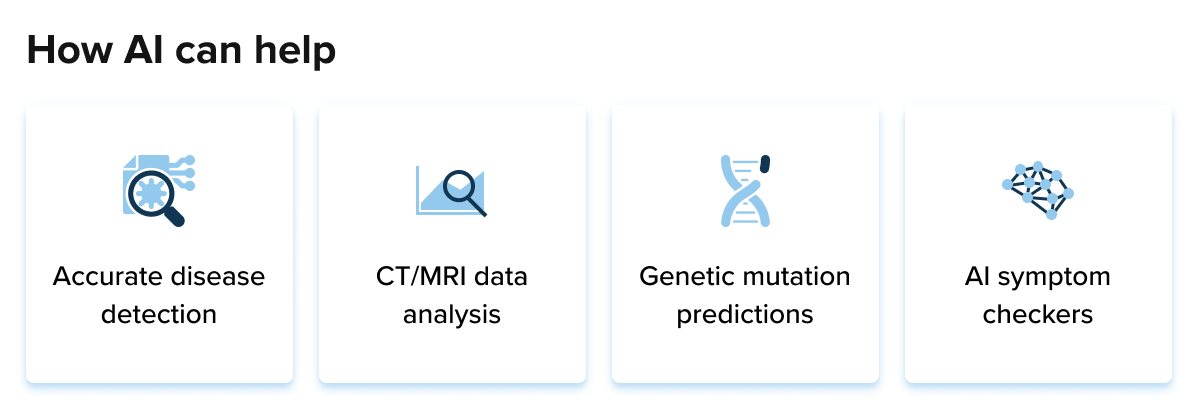
Generative AI opens up new possibilities for medical workers in terms of achieving more accurate disease detection results as quickly as possible. It means that GenAI stands out for its ability to synthesise multimodal data, simulate disease progression, and detect subtle anomalies before physical symptoms appear. There are a lot of digital health use cases available nowadays.
In previous years, it has been a little difficult to predict more correct detections without using generative AI.
One of the best examples of this is that generative AI is able to develop predictive models of genetic mutations in people and forecast the probability of developing various types of inherited diseases such as Huntington’s disease or cystic fibrosis.
For cancer patients, generative artificial intelligence operates like an AI symptom checker and digital health assistant and is actively applied in the radiology sector. It is also able to help doctors identify early-stage changes in the patient’s imaging, like CT or MRI scans, that human radiologists may not yet be able to see. The rise of preventative and predictive healthcare to forecast risks.
AI-human collaboration for better patient outcomes
The collaboration between artificial intelligence and people will probably be closer than ever before, as the same aims unite them, and digital health trends are still growing further.
Due to the fact that AI software development is a customisable technology, personalised AI-grounded solutions such as patient-facing chatbots enhance engagement and adherence. Another important application of AI in the medical realm is precision medicine, where AI is able to develop a separate treatment plan based on an individual’s genetic composition, lifestyle choices, and previous response to medication or treatments that also makes the therapy processes easier.
What is more, although AI digital health solutions are capable of handling the heavy lifting of data processing, the involvement of human input ensures that the final decision is made with full context and a deeper understanding of the complexities involved. This method combines human empathy and critical thinking with the scalability and effectiveness of artificial intelligence.
Cybersecurity for better patient data trust
Data architecture in healthcare governance takes precedence on account of it being defined as a strategic blueprint for aligning clinical and operational data assets with regulatory, ethical, and safety requirements. Consumer clinical-grade data, a fast development of IoTs and a foundation of interoperable infrastructure and embedded artificial intelligence expand the attack surface of digital health. In particular, the growing use of connected medical devices in anaesthesia and ICUs has created an increased potential risk.
However, a collaborative effort that integrates healthcare, technology, and cybersecurity fields will be required to develop dynamic solutions and policy updates that protect both patient safety and data integrity. The need for proactive protection involves implementing effective protocols for securing sensitive healthcare systems.
In the coming years, purchasers will evaluate security posture as a top-tier consideration when selecting digital health products; it is not just a box to tick off at the time of procurement. Thus, network security, patch management, and a robust team of employees and training are vital elements to digital health market trends these days.

Source: Unsplash
AI healthcare governance for transparency
Along with solid protection, artificial intelligence in digital health ought to focus on transparency from general ethical principles to technical, tiered, and enforceable disclosure standards. Transparency regarding AI use for both patients and staff and educating users on appropriate AI use are two crucial, related issues that health systems may deal with. Clinicians require hands-on training to deploy AI in an ethical and efficient manner, and patients value knowing when AI aids in their care.
Furthermore, successful resolution of these areas will increase patient confidence in the adoption of digital health technology trends and assist in reducing risks. Most digital health AI companies have adopted formalised policies regarding AI transparency by forming a governance oversight committee that will monitor the use of AI within the organisation, a risk-based consent framework, and privacy notices.
Empowerment of digital high-tech for providers
AI platforms for digital health unlock new opportunities for healthcare providers, empowering and enabling them to take advantage of sifting through the massive amounts of personal patient health data, in essence allowing them to provide personalised medical treatments tailored to individual patients, which includes their continuously monitored health data, their lifestyle habits, and their genetic makeup. AI enables healthcare professionals to modify treatments in real time in response to patient feedback, too.
At the present moment, Big data development in the medical field is becoming commonplace and allowing practitioners to have immediate access to research evidence and clinical practice guidelines based on their own personal patients’ conditions, histories and current health status.
They will also have access to the most up-to-date information, enabling them to better anticipate future patient outcomes and provide care for their patients.
RPA and AI agents for improving decisions
RPA allows computers to perform tasks that were previously done only by humans since it uses automated programs to carry out many repetitive tasks. Many of these tasks could be carried out without human intervention, such as filling out forms, entering data, and tracking items.
A robotic program can automatically verify whether a patient has insurance and, if so, what benefits that plan provides by logging into the respective payer’s web portal. As for AI, it conducts complex tasks that require cognition, including predicting patient outcomes, optimising schedules, and improving diagnostic accuracy.
Nevertheless, more organisations prefer combining RPA with AI, which frequently produces the best outcomes. RPA can automate tasks requiring legacy systems or lower-level technology, while AI can assist with complex data analysis and decision-making. This widespread digital health industry trend of combination will produce a fluid, integrated approach to automating healthcare operations.
Data-based tasks automation for efficiency
In 2026, healthcare enterprises are moving towards a more integrated form of technology, known as “intelligent orchestration”. This new approach utilises an organisation’s data collection capabilities as a foundation for backend operations.
With this evolution, healthcare firms are now focusing on delivering measurable ROI from their investments to decrease both the amount of time that physicians spend and the administrative waste due to excess clinician workloads and clinician burnout. In addition to concentrating on decreasing administrative waste, automated inventory control systems for medical supplies and equipment are being implemented.

Source: Unsplash
For instance, medical workers can now use autonomous replenishment systems to prevent inventory depletion and assist healthcare institutions in cutting down on needless costs, thanks to the advancement of real-time medical supply monitoring using digital health and artificial intelligence.
Key advantages of AI digital health trends 2026
The main benefits of the agentic systems that can be done today include the following:
-
Workforce support
AI acts as a digital partner between patients and medical professionals, saving time and fostering productivity.
-
Speed of diagnostics
AI agents that specialise in the analysis of multi-modal datasets, such as X-rays, MRIs, and lab tests, can identify critical abnormalities within seconds of receiving the results.
-
Operational autonomy
AI agentic systems can navigate the complex rules and regulations governing the process of authorising and reimbursing for medical care autonomously and in real time.
-
Predictive prevention
Advanced algorithms in AI can track and flag high-risk patterns for several diseases and conditions, including but not limited to sepsis, heart failure, etc.
-
Precision personalized treatment
AI assistants combine vast amounts of clinical, lifestyle, and genomic data into a customised precision treatment plan, including digital mental health.
-
Ongoing monitoring
With medical-grade wearables and IoMTs, we are able to monitor the biometrics of patients 24 hours a day, 7 days a week, and immediately provide remote monitoring and intervention.
-
Administrative functions
AI can coordinate all administrative functions, such as billing and appointments, which can reduce these operational costs.
Wrapping up
To conclude, AI for digital health and imaging has turned into an inevitable technology. Its integration into healthcare is delivered, priced, and experienced at every level and will be part of the digital transformation of the medical system.
Digital technologies alone, however, will not be sufficient to achieve success; in order for companies to realise it, they must have a clear strategy, considering digital health solution pricing, AI, providing access to quality data, and forming strong business partnerships. Organisations that invest wisely today will be positioned to thrive in the future environment of intelligent healthcare systems.
FAQ
-
Intelligent diagnosis, more mature diagnostic imaging, more advanced digital triage assistants, proactive monitoring, predictive analytics, and improved patient-specific treatment plans are the main emerging trends within digital health and AI ecosystems. As AI is being used in more critical roles in healthcare, the need for robust governance has become a larger focus as well.
-
The main AI trends are embodied AI, which incorporates intelligence into physical robotics, and agentic AI, where autonomous systems carry out intricate workflows. Additionally, imaging intelligence, conversational AI, and outcome-based pricing are regarded as current innovation leaders.
-
We will see a variety of ways in which healthcare automation will be integrated with AI to craft highly functional solutions.
Some of these implementations will be in the form of developed protocols for individualised patient care plans, enhancing clinical support of medical decision-making and administrative support to replace traditional paperwork, and developing new pharmaceuticals through research and experimentation.
-
The biggest challenge is the ethical dilemma that exists in collecting, storing, and sharing patient data due to the deployment of AI within a healthcare setting. To avoid these, organisations should develop safeguards to keep confidential patient information secure.
-
AI contributes to diagnostics, engagement, operations, analytical functions, and clinical decision-making for digital health use cases.