Significant improvements in generative AI development and data science open new horizons across many industries each year, and these advancements have also been effectively incorporated into healthcare IT solutions.
Literally before the coronavirus outbreak, such changes seemed impossible to us, but at the present moment, doctors and patients are actively using AI-driven personalized medicine for many purposes, like the ability to provide preventive care, shorten the time to market, and save costs.
Businesses in the healthcare IT ecosystem, from machine learning development teams to AI consulting firms, are competing to develop scalable solutions for digital health that transform the way patients, researchers, and clinicians engage with data.
In this article, we will go over what AI in personalized medicine means in the context of wellness programmes, how AI is being used for medical consultations, its main benefits, the main obstacles to its adoption by healthcare organisations, and its application.
What does personalized medicine AI mean?
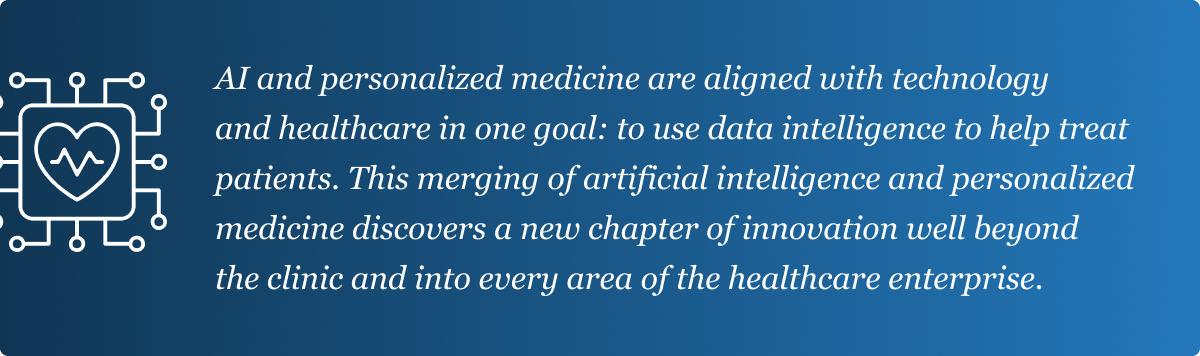
AI in personalized medicine refers to the harnessing of artificial intelligence algorithms that apply large and complex medical data sets to customise treatment designs, healthcare approaches, history, and diagnostics.
In addition to these, AI in healthcare systems accurately generates clinically appropriate treatment recommendations for patients by combining genomics, lifestyle, diagnostic imaging, and electronic medical records.

Source: Unsplash
At its essence, AI for personalized medicine is about machine learning strategies to evaluate similarities and differences among patient types through Big data analytics, including hardware and software connected to a multitude of wearable devices, IoT healthcare apps, clinical electronic databases, and non-clinical electronic databases.
The stage for medical professionals and organisations can be easier to both predict and estimate the patient’s degree of risk of diseases, to observe and manage the patient’s self-care behaviours, and to recommend customized and appropriate interventions.
What role does AI play in medical consultations?
AI-driven personalized medicine is rapidly becoming one of the most valuable examples of digital transformation in the healthcare realm. By leveraging algorithms and cloud-based analytics, organisations are able to replicate expert decision-making and enhance diagnostic efficiencies, leading to increased patient engagement.
In the radiology example, AI consulting tools for medical imaging, for instance, can identify early signs of abnormalities in CT scans, MRI scans, or X-rays with a high degree of accuracy. In the ever-growing area of mental health, some chatbots facilitate real-time emotional support therapy or therapy through digital means, achieving better patient outcomes and decreasing clinician needs.
However, the real doctors cannot be replaced by artificial intelligence completely; it is necessary to underline that AI serves as a means to augment the clinicians in personalized medicine, as it relates to a consultation. An algorithm will analyse genetic data, suggest treatments, and forecast side effects while AI is involved in a medical consultation. Instead of being overburdened with administrative duties, this enables the clinician to spend more time interacting with the patients.

Source: Unsplash
The scope of medical AI consultants is advancing to extend deep beyond hospitals. Medical consultation AI agents are now incorporated into applications and provide real-time, individualised health guidance.
The benefits of AI in healthcare and AI consultants
Implementing artificial intelligence in personalized medicine will produce real value for companies and medical centres seeking to modernize their processes and enhance patient benefits.
Below are examples of how AI medical consultants could be reinventing healthcare institutions to increase the effectiveness of many facets of medical management and business issues.
Higher diagnostic accuracy
Medical image AI consulting tools can recognise faint patterns that the human eye would sometimes miss in domains like the radiological sector. As a result, diagnoses are more precise and treatment times are shortened.
For example, AI models trained on millions of scans enable the detection of early-stage cancer with unprecedented accuracy, providing direct support for in-practice clinicians during AI-driven medical consultations.
Personalized and forecasting care
Referring also to the methods of healing, there are numerous examples of artificial intelligence in personalized medicine, such as permitting clinicians to forecast how a patient will respond to specific drugs or remedies.
To predict outcomes, algorithms use big data analytics to connect genomic, lifestyle, and clinical variables. It allows adverse side effects, improves adherence, and raises the standard of care in general.
Reduced expenses and enhanced efficiency
Health artificial intelligence consultants are capable of cutting down on administrative work by removing the requirement for documentation, scheduling, and even reporting.
According to statistics, about 30% of medical expenses are related to administrative work. Personalized medicine using AI solutions is saving not only costs and time but also diminishing human errors. Besides, predictive models also optimise resource usage and assist facilities in reducing unnecessary tests and readmissions.
Accelerated research and innovation
AI health consultants in clinical research enable scientists to analyse extremely large-scale sets of data, identify new biomarkers, and model the potential efficacy of medications. Together with the development of machine learning and generative artificial intelligence, organisations can innovate new precision therapies at a quicker pace.
On top of that, the velocity of innovation is raising the threshold of artificial intelligence in personalized medicine across the continuum of scientific domains.

Source: Unsplash
Better support for mental wellness
To increase the availability of mental health services, artificial intelligence has appeared as a necessary component these days.
The methods to adopt the possibilities of AI can range from clever chatbots to applications that provide people with emotional support, behaviour tracking, and even the analysis of their moods around the clock. The combination of digital health solutions and AI medical consultation experience ensures that mental wellness services are always available.
Infrastructure for expandable medical care
Healthcare systems are able to grow with AI-based platforms without sacrificing quality. Health networks can provide consistent, individualized care to larger patient populations through cloud computing, IoT connectivity, and big data analytics, as it is now a crucial edge in competitive healthcare markets. As a consequence, enhanced and tailored medical solutions are achieved faster than ever before.
Barriers to the adoption of AI by healthcare institutions
Many healthcare organisations haven’t been able to fully utilise AI, in spite of the fact that it is already delivering on its benefits to use the power of clinical data analytics to produce quick returns through lower costs, increased clinical productivity, and bespoke medical care.
It should come as no surprise that many healthcare organisations and hospitals are still hesitant to incorporate AI into their patient care settings even after the pandemic. This is because of a number of issues, including poor data quality, implementation problems, siloed data systems, ethical concerns, lack of vendor lock-in for AI consulting, and more.
Nevertheless, understanding these obstacles is key to any intelligent health consulting initiative that intends to provide continuing success. Below are the most common adoption barriers to know.
Data fragmentation and integration
A lot of healthcare data is kept in silos across departments, formats, and legacy systems. AI adoption by industry is an incremental process that requires clean, interoperable data in order to work smoothly. That is why medical institutions ought to develop expertise in data science and healthcare IT around integrating lab results, electronic health records, imaging archives, and data streams from wearable devices to include these data into existing platforms. There are a large number of AI consulting companies that are ready to help with implementation and overcome these obstacles.

Source: Unsplash
Regulatory and ethical challenges
The systems will be subject to strict data privacy and medical device regulations upon the adoption of medical AI consulting. The ethical guidelines for using AI in healthcare sectors are intended to reinforce developers, users, and regulators to improve the way these technologies are designed and used while maintaining appropriate oversight.
Infrastructure and expense
The delivery of technology-enabled personalized medicine solutions powered by AI must have compulsory elements such as a robust cloud infrastructure, secure data pipelines for data gathering and artificial intelligence algorithm generation, and continuous development of the machine learning component. The cost can be very high and is determined by the size of the project.
Enterprise-wide, deferential AI personalized medicine platforms, which integrate IoT healthcare applications and Big data analytics, can cost several hundred thousand dollars or more, based on the volume of data and customization requirements. But many organisations exhibit a tremendous return on investment once the viability of implementing digital health solutions has been established and have taken positive advantage of them in their work.
How to implement AI health consulting programs
To leverage AI capabilities to advance personalized medicine, IT leaders and healthcare executives can follow a thoughtful approach:
- Assess readiness. First of all, pay attention to assess readiness. It involves analysing data maturity, IT comparison, and staff competence.
- Find partners. Work with trustworthy AI consulting or healthcare IT solutions providers who focus on generative AI development and machine learning development.
- Start small. Conduct targeted smart health consulting projects to study feasibility and ROI.
- Check compliance. Activate a regulatory expert and medical education AI consultants to help your team receive training on ethics and standards.
- Gradual scale. Once validated, continue to use AI-based medical consultation systems and incorporate them throughout departments, and tie into IoT healthcare application systems for a continuous flow of data.
This approach will enable the organisation to take full advantage of AI-focused solutions for personalized medicine while managing the risk.
Wrapping up
In conclusion, the combination of AI health consultants and AI’s role in personalised medicine with physicians and clinicians represents the next phase of medical advancement.
Many years ago, people could not even find an answer to how AI contributes to personalized medicine, but nowadays, they strive to make the most of existing solutions. Smart health consulting projects can take place in the spectrum of patient care, from the radiological sector to mental health, clinical diagnostics, to AI consulting strategy.
The key to success will be intentional implementation, ethical oversight, and a firm grasp of how AI in health consultations will play a complementary role to human expertise. What is more, personalized medicine and AI will enable care to shift from reactive to proactive, from treatment to prediction. Now is the moment for companies investing in AI in healthcare to create scalable and reliable infrastructure that enables universal access to precision medicine.
In the end, artificial intelligence health consultants are being strategically deployed to make healthcare smarter, faster, and more human-centred. By embracing artificial intelligence in personalised medicine, forward-thinking businesses are not only improving patient outcomes but also redefining the entire landscape of AI adoption in the healthcare industry.
FAQ
-
Artificial intelligence plays multiple roles in medical consultation, AI consulting, and systems. It supports clinicians by interpreting diagnostic images, analysing patient histories, and generating personalized treatment suggestions.
Additionally, these AI medical consultations represent the idea of integrating with the hospital flow, increasing accuracy and efficiency, and lowering administrative burden.
-
No, it isn’t. Large language models, such as ChatGPT, are excellent at processing massive amounts of data and helping with documentation or instruction, but they lack a doctor’s capacity for clinical reasoning and 100% accurate disease diagnosis. In spite of these, they can help doctors come to conclusions faster than ever. Artificial intelligence systems, including AI in health consultations, were developed to facilitate but not replace traditional human decision-making.
-
The most common AI in healthcare is considered to depend on clinical experience with it, which ranges from diagnostic imaging technology, predictive analytics systems, and digital health solutions that advance patient monitoring to medical image AI consulting that is notably more impactful and spread in the areas of radiology and pathology.
-
The cost of an AI consultant is determined by the size of the project. A small AI medical consultation or smart health consulting project generally would be in the range of $30,000 to $100,000.
On the other hand, enterprise-wide differential AI personalized medicine platforms, which integrate IoT healthcare applications and big data analytics, can cost several hundred thousand dollars or more, based on the volume of data and customization requirements.