The scope of Big data analytics has been gradually broadening, and it now plays a leading role in the development and management of digital health solutions. The vast majority of businesses and healthcare institutions continue to deploy either IoT-based healthcare applications or AI in preventative healthcare technologies, as they have made great strides in medical imaging and diagnostics.
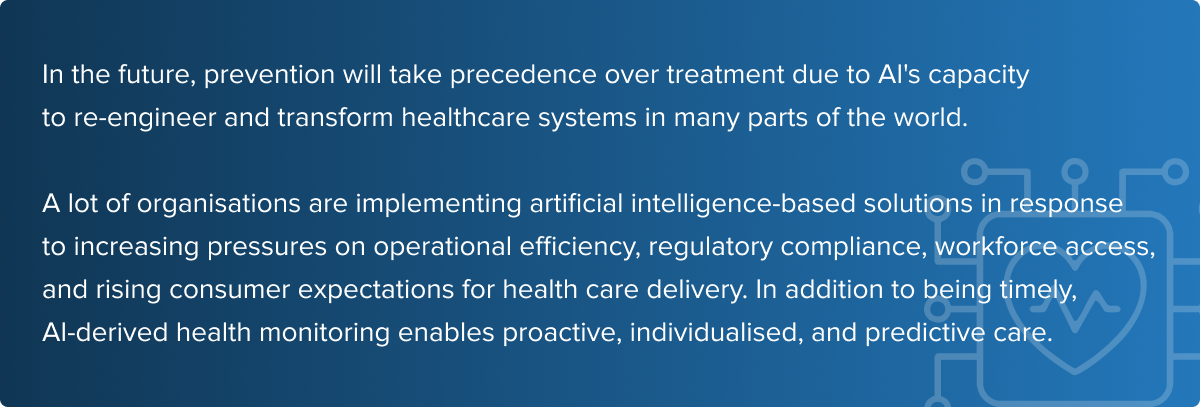
In the coming years, AI will significantly upgrade clinical decision support systems as well as the development of predictive, personalised care plans based on historical medical records, test results, and other patient-specific data.
In this article, we will look at what the future of AI in preventative healthcare might look like based on actual and evolving models, the benefits that businesses will gain from adopting AI, and predictions for what businesses ought to expect in terms of competition.
Models for preventive analytics
Preventive analytics refers to the usage of data science, statistical modelling, and intelligent automation to figure out future events, detect risks prior to their occurrence, and support proactive decision-making with the help of AI-powered healthcare IT solutions.

Source: Unsplash
The goal of prescriptive and predictive analytics is to give a plug to positive outcomes and make prevention more precise and understandable. The following are important AI-enabled preventive analytics models for medicine:
Predictive risk scoring algorithms
This type of algorithm combines a patient’s medical history with genetics, environment, and other behaviours to provide healthcare companies with insight into the risk that particular patients will develop certain conditions.
For insurance and healthcare networks that manage large patient populations, data analytics allow for the allocation of limited resources as well as the targeted proactive intervention of at-risk patients.
Machine learning power forecasting models
By utilising massive datasets collected from sensors and wearable devices, claims systems, and clinical record systems, predictive models are able to predict health deterioration, likelihood of hospitalisation, adherence to treatment plans, and flare-ups of chronic diseases. In conjunction with significant financial investments into machine learning development, these predictive models allow clinicians to make evidence-based decisions before crises arise.
AI-enhanced diagnostic models
The implementation of artificial intelligence in the healthcare sector increases the speed at which a patient’s diagnostic workflow occurs through the ability to identify patterns in an image that are not visible to the human eye.
Through the use of AI in medical imaging, early-stage cancers, cardiovascular irregularities, neurological conditions, and pulmonary conditions could all be identified, resulting in the opportunity for earlier intervention.
The preventive analytics models in healthcare
Behavioural prediction models leverage lifestyle patterns, engagement history, and digital behaviours to establish the optimal communications and preventative care strategy for each patient. Furthermore, AI in disease prevention enables businesses to deliver more tailored digital therapeutic and wellness programmes to their patients.

Source: Unsplash
For every component of the healthcare system, predictive fraud analytics models continue to be a valuable resource.
By detecting patterns in fraudulent billing, abnormal provider behaviour, and misuse of benefits, the role of AI in preventing healthcare fraud is significant enough, as it is being used extensively in the healthcare space to help ensure financial protection and compliance with applicable instructions, while also maintaining the trust of its patients.
Key benefits of AI and preventive medicine
What are the next 5 years going to be like for AI in preventive medicine and digital technology? Let’s examine in more detail how the advantages of AI will be important advancements in these fields in the future.
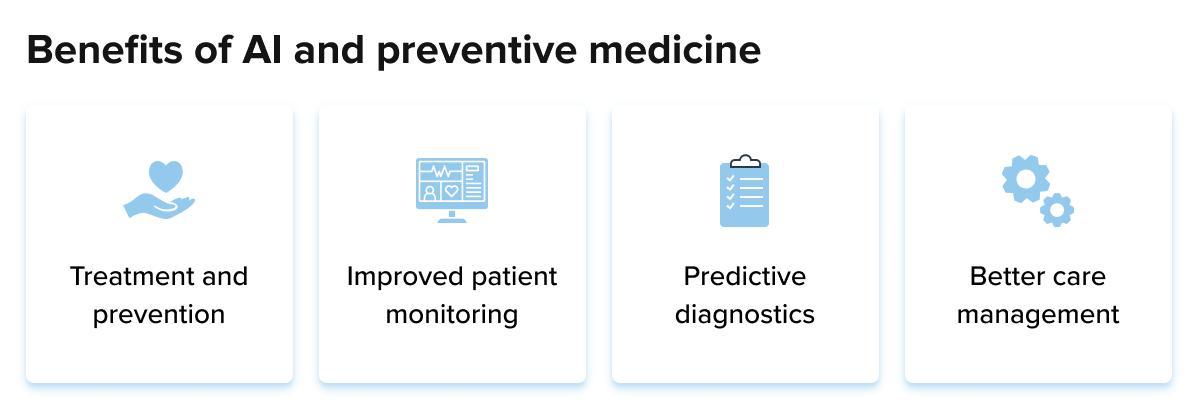
Treatment and prevention
Adoption of AI by the medical industry promotes the potential to analyse patient data in real time, forecast medication adherence, and create more precise and efficient dosage plans, enabling the most accurate medication management.
One example would be AI’s ability to detect early warning signs of complications or adverse drug reactions before clinical symptoms appear. The way patients interact with preventive medication has changed dramatically as a result of positive AI advancements. It enables patients to monitor their personal health, receive personalised notification alerts, and modify their behaviour in response to automated recommendations based on the patient’s health data.
Such developments have proven to be particularly relevant to the management of chronic illnesses, as consistent adherence to medications is critical for the prevention of these diseases.

Source: Unsplash
Constant patient observation
Patient monitoring has emerged as one of the fastest-growing areas in the field of preventative care, and AI is playing a dominant role in providing healthcare providers with access to continuous streams of physiological data and alerts regarding any potential risks that might occur. For cutting-edge machine learning to reliably track blood pressure, blood oxygen levels, and heart and breathing rates, basic cameras can supply sufficient digital data.
Due to AI-based health monitoring apps, AI health monitoring systems, and AI health monitoring platforms, healthcare providers can have access to real-time health data from patients regardless of where they are located.
As long as AI patient monitoring systems are integrated into a healthcare enterprise’s operation, they will provide the necessary infrastructure for the definition and support of long-term population health management strategies.
Moreover, contactless, image-based monitoring of hospitalised patients with AI and machine learning is going to advance further.
Bespoke care management
Care management refers to the management of patients at the highest level of risk within a healthcare setting. It can also take many forms, such as care coordination, post-discharge follow-up calls, and transition coaching, among others.
AI allows clinicians to monitor their patients’ health status and supply early interventions. These enhanced care management tools leverage AI-powered predictive analytics for early detection and prevention of diseases and will provide doctors with personalised communication workflows and treatment plans utilising generative AI capability.
For the business aspect of healthcare, implementing these AI-enhanced care coordination tools will result in increased patient engagement, decreased operating inefficiencies, reduced healthcare spending, and enhanced compliance with value-based care standards and initiatives.
In addition to these benefits, the behavioural health indicators, including mental health indicators, provide clinicians with the ability to identify emotional risk factors early and to intervene prior to the escalation of the emotional risk into a crisis.
Preventive diagnostics
AI in early disease diagnosis and prevention is quite valuable and is a widespread type of more timely diagnosis these days. This is achieved through advanced imaging technologies and pattern recognition systems that enable radiologists, pathologists, and laboratory scientists to accurately analyse and interpret medical images, laboratory test results, and genomic data.
AI is providing many benefits to radiology, as evidenced by its possibility to be equipped with machine learning algorithms trained on millions of imaging examples. These algorithms are capable of identifying anatomical, functional, and pathological anomalies in images that may otherwise not be detected by a human eye because of cognitive fatigue or bias.
The advantages of these AI health monitoring systems are not just accurate diagnoses but also the reduction of the amount of time it takes to arrive at a result. In a marketplace characterised by intense competition, this reduction in time to result is one of the most important metrics for healthcare providers. To learn more about AI advanced analytics and its benefits, please watch a video:
Providing immediate feedback
Thanks to qualitative AI health monitoring, instant feedback to patients through real-time recommendations based upon their behaviour, biometry and the surrounding environment is available today.
A lot of people have the opportunity to correct or change their health habits if it is necessary for them. AI, for example, enables notifying a person if their blood sugar levels are approaching a diabetic range or alerts them to abnormal heart rate patterns that may suggest an arrhythmia risk.
Real-time feedback benefits businesses by facilitating patient engagement, treatment adherence, lifestyle changes, and preventive care engagement as well.
Within five years, a significant number of businesses will have implemented conversational AI, digital coaches, and self-checking systems to provide each patient with tailored recommendations for improved health and well-being.
How AI works in preventing healthcare fraud
AI is generating significant value in a space that is rarely mentioned – fraud prevention. Healthcare fraud costs companies billions of dollars each year, but AI systems can detect fraud in patterns that cannot be detected by humans. The best examples of AI healthcare fraud prevention are identifying abnormal claims and healthcare claims denial prevention AI.
With elevated regulatory scrutiny surrounding healthcare fraud, many businesses are now using AI fraud prevention technologies to support their efforts to secure data integrity and financial sustainability.

Source: Unsplash
On top of that, these technologies enable AI to prevent internal threats to healthcare data via alerts to security teams when they detect attempts to gain unauthorised access to data or indications of unusual system behaviour and potential internal breaches.
Wrapping up
To conclude, AI is projected to carry out its duties in the healthcare sector further and faster with more accurate and visible outcomes. Healthcare institutions will implement subscription-based chronic disease management, AI-assisted preventative measures, and digital health therapies to remain competitive in today’s healthcare marketplace and in order to gain a foothold in the next years.
Proactive developers and other stakeholders are working to correct these issues. However, healthcare professionals need to keep in mind that AI tools complement clinical expertise, knowledge, and critical thinking abilities rather than replacing them.
Collaborating with AI in preventive healthcare in the future can appear as an irreplaceable tool because its value provides organisations with plenty of pros that help to save time, foster immediate and precise results, and protect from undesirable and invisible people’s errors in advance.
FAQ
-
AI is currently used in radiology, pathology, cardiac analysis, managing chronic diseases, remote patient monitoring, virtual assistants, analysing claims, and creating individualised treatment plans.
-
AI prevents diseases by analysing data to identify early warning signs, predicting associated risk factors, recommending modifications to lifestyle, monitoring vital signs constantly, and providing actionable information to clinicians before the appearance of symptoms.
-
The foremost hurdle faced by all of the organisations implementing AI within the healthcare industry is establishing trust and confidence in this technology.
-
The biggest benefits of AI in healthcare are speed of processing of large amounts of information with high accuracy, increased opportunities for early detection, and modified healthcare delivery based on individual patient needs.