In 2025, almost nobody will be impressed with doing routine tasks with the help of a chatbot. We have had Alexa for almost 11 years and Siri for 13. Then why is everyone talking about AI agents?
AI agents are not only for large businesses anymore. Read this article to know how this technology works, its key benefits, and why its innovation and efficiency are reshaping various industries for the better.
The new face of chatbots: What is an AI agent?
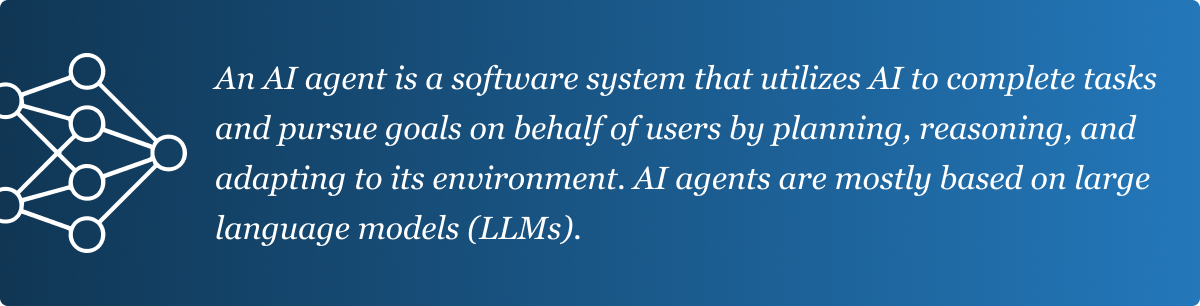
However, unlike traditional LLMs, they deliver results based not only on the data they were trained on but also on APIs and additional tools, which allows them to have extended reasoning abilities to meet more complex goals.
Agentic AI is capable of freely streamlining processes, gathering up-to-date information, and generating subtasks aligned with its objectives. AI agents can also retain memory from one interaction to another, advancing their accuracy and reasoning power over time. And with the improvement of generative AI development and conversational AI technology, some agents communicate with humans using everyday language.
AI agents tend to be the most effective when integrated into a broader network. There are five types of AI agents depending on the level of difficulty. Here they are:
- Simple reflex agents operate solely on a set of rules without holding memory or querying other agents when they need extra information.
- Model-based reflex agents can execute defined operations based on a specific set of rules but can store past data. It can upgrade its model by receiving new information.
- Goal-based agents leverage external resources to plan and carry out a predetermined, specific goal.
- Utility-based agents utilize external tools to select a series of steps for reaching a goal, while also considering predefined criteria such as time requirement.
- Learning agents have the same capabilities as the previous ones, but they can learn. They independently update their knowledge base with ongoing streams of new information. Watch a video to learn more about Agentic AI:
Key benefits of AI agent implementation
LLM development boasts numerous models, which can be found in various locations. In this vast market, it can be challenging to find one that can address all the challenges a company faces. Here are some benefits you can get if you choose agentic AI:
Data-driven decision-making
As AI chatbots are good at analyzing vast and complex datasets, they can forecast trends, detect patterns, and deliver insights that a human worker can easily miss. As a result, a company can make well-grounded, evidence-based decisions. This data-driven approach bolsters strategic planning and mitigates the risks of costly missteps.
24/7 availability
Unlike human agents, AI agents can deliver unwavering support and consistent results around the clock. For example, they can manage customer queries regardless of time zones and beyond office hours.
Today’s market requires quick response and a high level of personalization to stand out from the rivals. This tool will help you to surpass client expectations and get a competitive edge.

Source: Unsplash
Minimized business costs
AI agents operate on a consistent model that adjusts to various situations and changing conditions, allowing them to work without human intervention. This is a perfect tool for routine tasks that will cut down costs that come from human inaccuracies, process ineffectiveness, or slow manual workflows.
Elevated accuracy
A good business starts with good data. Nowadays, data is the most valuable resource any company has, and it should be handled properly to bring the desired results.
They considerably mitigate the risk of errors in routine tasks, as they provide timely, accurate data insights, build error-free analytics and reports, and efficiently communicate with your clients.
AI agent use cases: All you need to know
From finance to healthcare, multi-agent AI can reap the benefits for any industry. Let’s take a look at some real examples.
Healthcare
According to statistics, in 2024, the global healthcare market of agentic AI was estimated at USD 538.51 million and is projected to reach USD 4.6 billion by 2030. This interest in developing AI in the healthcare industry has become even higher as new technologies allow to automate health data investigation and streamline administrative processes in overburdened healthcare institutions.

Source: Unsplash
In clinical settings, the ability of agentic AI to provide access to large datasets from across departments can not only considerably reduce time spent on administrative tasks like scheduling, billing, and resource allocation but also fully automate routine tasks, such as remote patient monitoring and prior authorizations.
Here are some more examples of how AI agents can improve the work of hospitals:
1. Diagnostic support for clinicians
By analyzing patient data like history, symptoms, lab results, and so on, AI agents can formulate diagnostic hypotheses and treatment recommendations. It can help clinicians to make more sound and faster decisions, which can be especially useful in staff limitations or complicated situations.
2. Personalized patient monitoring and intervention
AI can constantly check patients with chronic diagnoses via wearable devices. Besides identifying possible risks, coordinate follow-up appointments, notify both patients and healthcare providers, and adjust prescriptions within approved parameters, leading to enhanced disease management and reduced hospital admissions.
3. Optimized administrative processes
Agentic AI automates routine operations like managing records, scheduling appointments, handling insurance claims, and sending reminders. Hence, these processes decrease mistakes, lower operational costs, and enable staff to concentrate on patient care.
Leveraging predictive analytics, AI systems streamline pharmaceutical management, support diagnostic efforts, and track patient vitals in real time, enabling early detection of possible complications.

Banking and financial services
The World Economic Forum predicts that agentic AI will define a “transformative era” for finance. The technology’s ability to adapt swiftly within high-speed, data-intensive environments shows its impressive potential for changing the industry.
AI agents can handle financial processes like investment portfolios, make investment decisions, estimate risks, analyze market data, and tailor strategies based on personal financial objectives and market dynamics. As a result, you get improved decision-making, enhanced compliance, and optimized workflows.
For example, autonomous AI is used to handle ongoing threat analysis to determine anomalies and mitigate potential risks. The same principles make them highly effective in tasks like loan underwriting and compliance tracking, which require robust oversight of intricate, data-intensive processes.
Customers can also see these changes and benefit from them. Agentic virtual assistants and AI-powered agents provide intelligent financial guidance by streamlining wealth management tasks and developing investment strategies tailored to individual risk profiles and market trends. Learn more about AI data investment management by watching this video:
All in all, the use of agentic AI in finance allows companies to mitigate possible disruptions and harness data to maximize value and boost operational performance.
Improved customer experience
The research held by Gartner shows that by 2029, 80% of common customer service issues will be handled by agentic AI without human intervention. Generative AI consulting can increase response quality over time and provide immediate access to critical customer records, leading to hyper-personalized and deeply contextual experiences. This can be very useful at a time when customer expectations are only getting higher, resulting in elevated exhaustion and stress among customer service teams.
Unlike GPT integration services that rely on scripted responses, AI agents predict forthcoming demands and act proactively, enhancing customer satisfaction and relevance.
By having natural language processing in its software, agentic AI can communicate with customers in a natural and dynamic way, delegating complex cases to human specialists when needed. By utilizing sentiment analysis, these tools analyze customer interactions to spot emerging issues immediately and take proactive actions, such as issuing support tickets or processing refunds.
As agents can operate across integrated platforms and retain customer data over time, they excel at delivering tailored and proactive support. Deploying AI in these settings can both enhance customer satisfaction and cost savings due to increased accuracy and the reduced need for human intervention.
Retail
According to statistics, only 26% of customers think that digital assistants make their shopping experience worse, while 48% support AI chatbot development. Agentic AI provides personalized customer experience by updating inventory control, anticipating consumer trends, tailoring product suggestions, and powering automated customer support through intelligent chatbots.
Based on customer needs and demand predictions, AI agents can streamline pricing and stock management, hampering stock-outs and other disruptions.
The commercial use of ChatGPT is impressive, but agentic AI can bring even more benefits by choosing product selections and promotions based on personalized customer purchase histories and preferences.
To improve results, they utilize real-time context, such as geographic data, weather conditions, and emerging trends. AI agents can be effective even in physical retail locations, where they can track shelf stock and oversee inventory in real time.
As a result, your business gets higher conversion rates and boosted customer satisfaction because of the technology that increases revenue through targeted marketing and cuts down inventory issues.
Supply chain
It is no surprise that experts predict that by 2030, the AI agent market in supply chain and logistics will reach USD 16.84 billion.
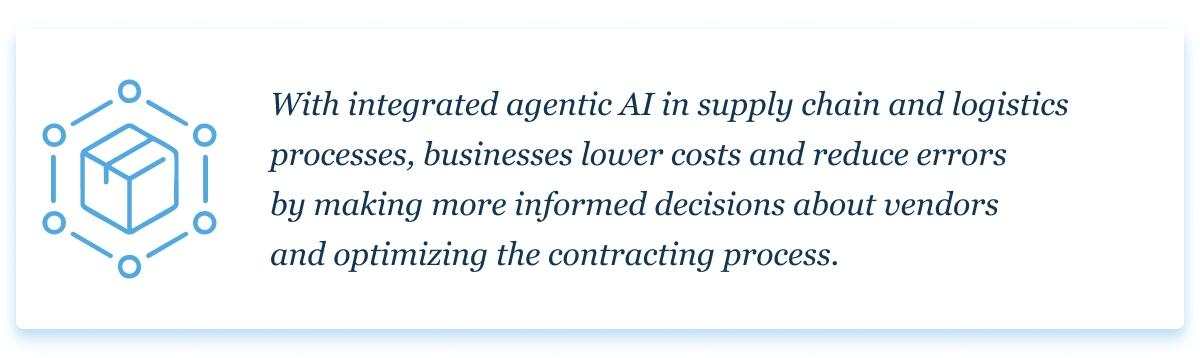
AI agents suit the supply chain industry perfectly, as one of their key benefits is the ability to scrutinize data and customize tasks without human intervention. They can simplify the vendor evaluation procedure by assessing potential suppliers based on their economic effectiveness and sustainability performance, as well as determining any possible risks.
Processes like purchase ordering and contracting can also be automated by the technology, leading to reduced manual effort and maintained precision in handling supply operations. Agentic AI introduces an additional layer of verification within the procurement cycle by cross-checking workflows against criteria such as inventory levels, resulting in prevented disruptions. Two of the most impressive use cases of AI agents in the supply chain industry include:
1. Intelligent transportation systems
AI agents can plan and upgrade transportation processes in real time, complying with changes such as delivery schedules, traffic congestion, or weather conditions. They can also negotiate rates, identify optimal carriers, and adjust delivery routes for faster deployment and fewer expenses.
2. Proactive risk management
To mitigate potential risks, AI agents constantly track operational data, analyze the environment to find possible difficulties like geopolitical events or natural disasters, and elaborate on mitigation strategies. If some disruption happens, they immediately adjust delivery routes, find alternative suppliers, and communicate with stakeholders to reduce the consequences.
3. Marketing
Every day, data marketing departments must handle extensive amounts of data, while customers are overwhelmed by the numerous offerings in the modern market. In this situation, AI agents are in high demand. GPT Integration Services have revolutionized the e-commerce industry, and, as a result, more and more customers utilize AI tools for shopping advice instead of conducting their own online searches.
Agentic AI is highly effective in marketing and e-commerce, as it is capable of autonomously performing various communication and promotional processes, such as updating ad performance in real time, personalizing content, building audience segments, and handling campaigns. Previous automation and AI tools could manage these activities too, but they needed more human input to work without disruptions, while AI agents can maintain their effectiveness on the same level independently.
With predictive analytics, AI agents scrutinize customer behavior to determine the best timing and messaging tactics for a particular campaign, so later human agents can use this information to arrange communication flows themselves. As a result, businesses have robust customer personas built by AI agents and driven by extensive datasets that provide additional insights for marketing campaigns.
Social media AI chatbots can communicate with users, track brand mentions, and create relevant responses more precisely than their previous non-agentic models. Agentic AI can also provide customers with loads of tools, data sources, and previous user behaviors to better anticipate consumer demands, for example, by suggesting vacation packages customized to multiple group travel choices and external factors such as the weather.
Bottom line
It can be rightfully said that today, agentic AI is one of the most powerful examples of modern AI development, which transforms business and personal interactions from almost all industries.
Whether expanding business capabilities or elevating customer experience, its opportunities are endless. Of course, AI agents have several challenges, such as cost and difficulties in integration with existing systems, but still, the benefits obviously outweigh the potential drawbacks, especially when agents are implemented ethically and strategically.
The studies from various industries show that the future of AI agents is very bright, so if you are still in two minds whether to invest in it or not, be sure that the innovation, effectiveness, and accessibility they bring will pay you back much more.
FAQ
-
Due to the ability to autonomously manage complex tasks, make informed decisions, and effectively communicate with both systems and customers, AI agents are reshaping almost all industries. The most impressive use cases are seen in such industries as healthcare, finance, customer experience, supply chain and logistics, retail, and marketing.
-
A traditional ChatGPT is considered a large language model rather than an AI agent. Like AI agents, ChatGPT can comprehend and generate human-like conversations and assist with coding, writing, and answering questions, but it can’t make informed decisions and work without human input.
However, the new ChatGPT is an AI agent because it not only answers questions but also performs complex, multi-step tasks.
-
An AI case is the use of artificial intelligence for developing or analyzing some practical challenges to improve the workflow process.
-
To stay a top-notch streaming service, Netflix provides advanced customer engagement and personalized recommendations. To make it happen, they utilize AI to collect data and analyze customer preferences and habits.
Generative AI also helps the service reduce costs by automating processes such as subtitles, dubbing, and even creating visual effects for shows.