
Artificial intelligence (AI) has become an integral part of doing business, with applications across most industries. The synergy between human expertise and AI efficiency can drive innovation while reducing operational costs.
According to McKinsey’s State of AI 2025 report, over 70% of organizations now use AI in at least one business function — and many are realising direct AI cost savings as a result.
In supply chain management, 41% of respondents saw a cost reduction of 10% to 19% after implementing AI. Around 20% of marketing and sales teams, 32% of manufacturing departments, and 25% of HR leaders had similar cost savings.
But how does AI reduce costs? And which industries can benefit most from it? Let’s find out.
|
70%+ of organizations use AI in at least one business function |
41% of supply chain teams cut costs by 10–19% with AI |
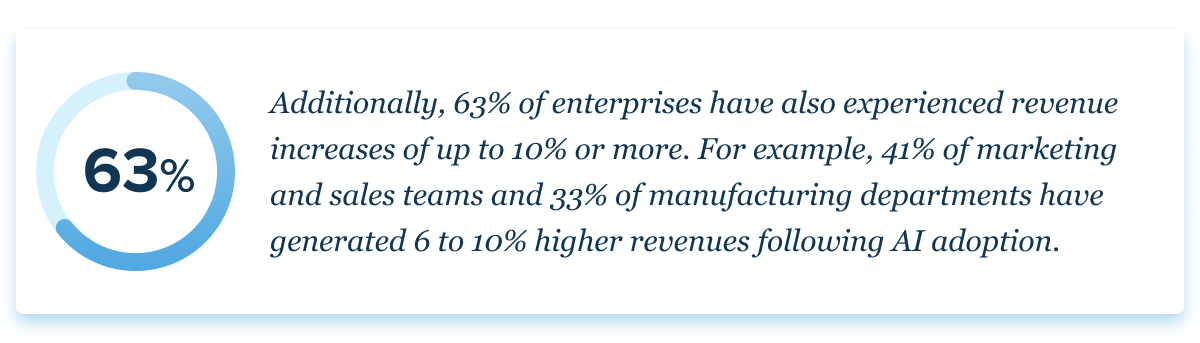
63% of enterprises saw revenue increases after AI adoption |
|
88% of organizations report AI had a positive impact on revenue (NVIDIA State of AI 2026) |
30% saw revenue grow by more than 10% after AI adoption (NVIDIA 2026) |
57% of companies achieve significant cost savings through AI agents (Accelirate, 2026) |
How much money does AI save businesses?
The financial impact of AI cost reduction varies by sector and use case, but the data points consistently upward. According to Accenture (2025), companies that have fully scaled AI report average cost savings of 20–30% in automated functions. McKinsey estimates that generative AI alone could add $2.6–4.4 trillion in annual value globally across business functions.
Key benchmarks for AI cost savings across industries:
- Customer service: AI chatbots reduce support costs by up to 30% while handling up to 80% of routine queries.
- Manufacturing: predictive maintenance driven by ML cuts unplanned downtime costs by 25–40%.
- Finance: automated document processing and fraud detection save banks an estimated $447 billion annually (Juniper Research, 2025).
- Supply chain: AI-driven demand forecasting reduces inventory holding costs by 20–50%.
- Software development: AI-assisted coding tools reduce developer time on routine tasks by up to 55% (GitHub Copilot research, 2024).
For businesses exploring AI cost efficiency, these figures represent realistic targets — not outliers. The exact savings depend on the complexity of the implementation, the quality of the underlying data, and the degree of process change management applied.
How AI can help companies cut costs
OpenAI’s ChatGPT, Google Gemini (formerly Bard), and similar tools have been on everyone’s minds over the past few years. These platforms use generative AI to produce text, images, videos, and other types of content.
McKinsey’s latest report, The State of AI 2025, found that more than half of businesses now use generative AI tools for cost reduction AI strategies, up from 33% in 2023. Another 20% reported using this technology to create new income streams.
For instance, the Associated Press leverages generative AI development to create news reports. Not only does this strategy help reduce costs, but it also allows reporters to save time on research and streamline repetitive tasks.

Source: Unsplash
However, this technology is just one subset of artificial intelligence. There’s also machine learning, deep learning, computer vision, neural networks, natural language processing (NLP), and more.
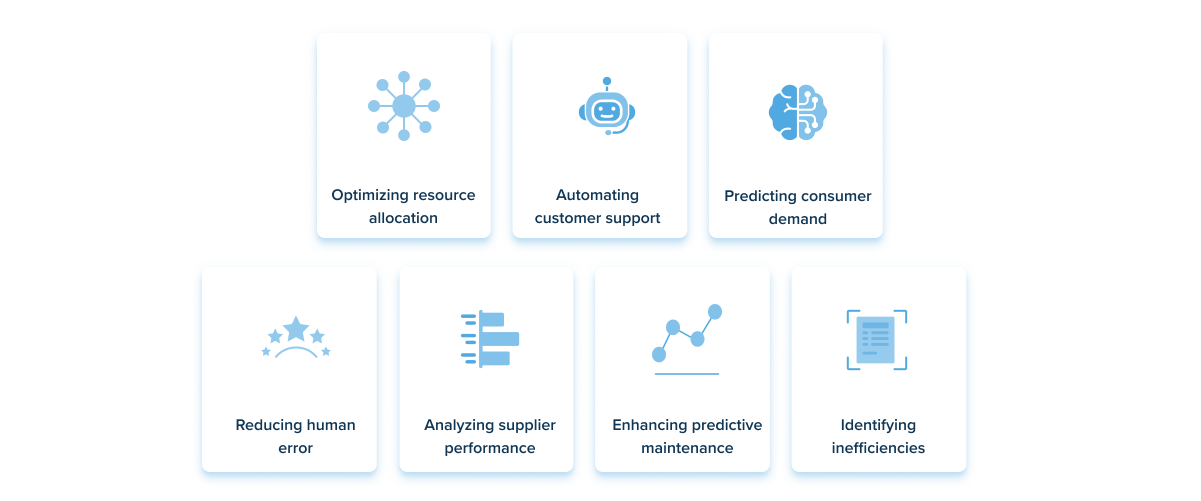
Companies can use these AI systems to detect fraud, create better products, and automate their operations. Take deep learning, for example. This branch of AI drives AI cost efficiency and enables enterprises to cut costs by:
A 2025 study by Statista assessed the impact of artificial intelligence on AI cost reduction in eight business areas. The sectors that seem to benefit most from AI adoption include manufacturing, service operations, and marketing and sales. Around 4% of all companies saw cost savings of at least 20%, and 28% lowered their costs by 10% or less after adopting AI. One-tenth of enterprises experienced cost reductions of 10 to 19%.
AI cost reduction: Real-world examples
Microsoft, Tesla, IBM, Amazon, and other leading brands leverage cost-reduction AI strategies to keep costs low and stay at the forefront of innovation. For instance, Tesla uses artificial intelligence to collect data from its vehicles. These insights allow the company to continuously improve its products, optimize energy usage, and address issues early in the production process.
Additionally, Tesla factories deploy AI-powered robots to automate manufacturing processes and manual tasks. The result? Faster time to market, higher accuracy, increased AI efficiency, and lower costs.

Source: Unsplash
Smaller companies can leverage AI for business efficiency just as effectively as enterprises. From AI-powered content creation tools that cut marketing costs to intelligent customer support chatbots that replace first-line support teams, the barrier to entry for impactful AI cost savings has dropped dramatically since recently.
Here are some real examples of how AI has reduced operating expenses.
1. Klarna
One of the most striking AI cost reduction stories of 2025 comes from fintech giant Klarna.
The company deployed a single AI customer service agent that handled the equivalent workload of 853 full-time employees — saving $60 million by Q3 2025. Response times dropped from 11 minutes to under 2 minutes, while customer satisfaction scores held steady.
2. Walmart
Walmart has made AI central to its cost reduction strategy across retail operations.
Automated storage and retrieval systems in its warehouses improved productivity by 20%, while AI-driven price optimisation enabled over 30,000 price reductions in 2025. The company’s use of robotic arms for grocery sorting and autonomous delivery systems has already cut labour costs by 15% in pilot markets, with plans to scale across all US locations.
3. OneDigital
HR and benefits firm OneDigital was spending $120,000 annually on interview scheduling alone — consuming 40% of its talent acquisition team’s time. After deploying conversational AI in 2024, scheduling costs dropped to near zero, and the team redirected those hours entirely toward strategic hiring work.
4. Airbnb
Airbnb uses artificial intelligence to generate listing summaries, analyze guest behavior, and make custom recommendations. Moreover, its AI-powered chatbots are available 24/7, guiding customers through the booking process.
The travel platform also leverages this technology to weed out fake profiles and protect users from spam. Its dynamic pricing strategy is powered by AI, too. For example, rental rates may increase or drop based on seasonal demand. These features enable Airbnb to cut overhead and operational costs, maximize revenue, and deliver personalized experiences.
5. WPP
WPP, a global creative agency based in London, deploys generative AI to create stunning ads. Its AI-powered tools allow top brands like Nestle and Mondelez to cut marketing costs and expand their reach.
“The savings can be 10 or 20 times.”
— Mark Read, CEO of WPP, Reuters
For example, the agency used AI to virtually recreate an African landscape for a commercial shoot instead of dispatching a film crew to that respective location — a compelling example of generative AI delivering direct AI cost savings.
6. Amazon
Another example comes from the tech giant Amazon, which uses AI-powered algorithms to optimize costs and deliver outstanding service. Amazon will check your location and traffic data to identify the most efficient delivery routes — this step alone allows the company to cut costs and expedite shipping.
Source: Unsplash
Some Amazon factories also use AI-driven robots to pack and ship orders, resulting in lower overhead costs and higher AI efficiency. Moreover, its marketing teams employ AI to display personalized product recommendations based on factors like:
- Buyer’s location
- Browsing history
- Purchase behavior
- Trending products.
This approach enables Amazon to delight customers, drive repeat sales, and maximize marketing spend. In some cases, it may reduce the likelihood of product returns—and the associated costs.
7. Ralph Lauren
Ralph Lauren and other fashion brands use predictive intelligence to create products that resonate with their customers. These AI-driven insights allow them to better understand consumer preferences and forecast product demand. Predictive analytics data is invaluable to product design, manufacturing, and marketing operations.
Over time, this technology can reduce manufacturing costs and boost profits. Plus, it often leads to increased customer satisfaction and loyalty. Ralph Lauren also uses generative AI to streamline content creation and other marketing activities — part of its efforts to keep up with the latest technology and reach more customers online.
How does AI improve efficiency?
Investment in AI efficiency is accelerating rapidly — global AI spending is forecast to surpass $600 billion by 2028 (IDC, 2025), driven by enterprise demand for automation, AI cost reduction, and competitive advantage. Let’s see how businesses can leverage the efficiency of AI.
Generative AI’s efficiency in customer service
According to McKinsey, about 75% of the value delivered by gen AI lies in four main areas:
- Customer operations
- Research and development (R&D)
- Software engineering
- Marketing and sales.
Enterprises can tap into AI for business efficiency to automate and streamline customer operations. According to Tidio’s 2025 chatbot report, 88% of consumers have interacted with a chatbot, and satisfaction rates continue to climb as AI models improve. Businesses deploying AI-powered chat—built on solutions like LLM development—report measurable AI cost savings, some reducing support costs by up to 30%.
Moreover, chatbots can cut customer support costs by up to one-third while increasing conversions. This technology can also retrieve customer data, helping human agents provide more accurate answers and make personalized recommendations that may increase sales.
Additionally, genAI is capable of turning customer data into actionable insights. For example, it can identify the most common customer queries and complaints — data you can use to create a knowledge database or FAQ section, improve your products, or optimize your services. These features can boost customer service productivity by up to 45%, notes McKinsey.
AI’s role in research and development
When it comes to R&D, businesses can integrate AI to enhance innovation, accelerate time-to-market, and stay competitive in rapidly evolving markets. Here are a few specific ways R&D departments can reap the benefits of AI:
- Natural language processing: Enables workers to quickly analyze unstructured data from research papers, patents, and customer feedback to identify valuable insights, emerging trends, and areas for innovation.
- Predictive modeling: AI algorithms create predictive models that forecast market trends, customer preferences, and potential outcomes of R&D initiatives.
- Rapid discovery: In pharmaceuticals, AI is already used for drug discovery, molecular modeling, and clinical trial optimization—dramatically accelerating timelines.
- Automated experiments: Robotic systems controlled by AI algorithms can conduct experiments, analyze results, and generate insights, reducing R&D costs significantly.
Software engineering and AI
Many developers are already using AI to support their day-to-day tasks. AI-assisted development reduces costs in enterprise software delivery — from generating code snippets that help teams work faster to automated testing, bug detection, and maintenance analysis. In some cases, AI can even debug on its own, freeing engineers for higher-value work.
Using AI for sales efficiency and marketing
Artificial intelligence can streamline every step of the sales process, from lead generation to follow-up support. It’s also capable of forecasting sales, identifying high-value leads, and onboarding new customers. Here are a few examples of how companies are using AI for business efficiency in sales:
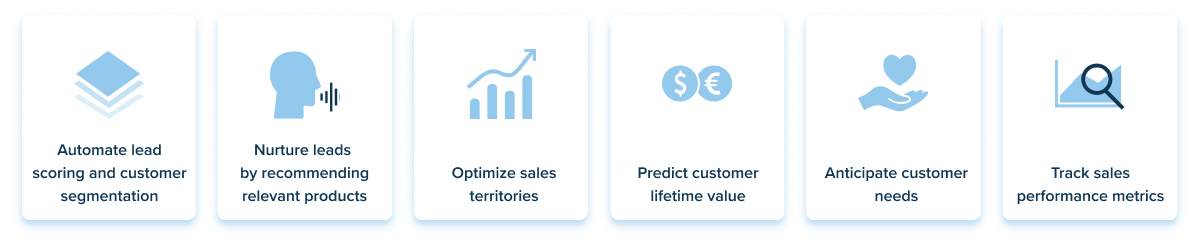
For example, online marketplaces like Amazon and Alibaba leverage deep learning, NLP, and chatbots to analyze customer needs, forecast demand, recommend relevant products, and optimize inventory levels. They also implement dynamic pricing on product pages based on insights from data analysis.
Additionally, AI can significantly enhance marketing efficiency through automation of repetitive tasks—gathering and analyzing customer data across channels, creating accurate customer profiles, identifying new trends, and managing campaigns end-to-end from content development to A/B testing, running marketing analytics reports, and optimization.
Embrace AI for energy
By using AI for energy efficiency, companies can reduce their energy bills. The impact of artificial intelligence on energy efficiency also translates to a lower carbon footprint, helping enterprises with their efforts to go green.
Here are some ways businesses can use AI for energy efficiency:
- Detect anomalies in energy consumption
- Enable intelligent control for HVAC and refrigeration systems
- Optimize building management systems
- Predict energy consumption
- Improve grid performance.
Siemens, Panasonic, LG, IBM, and other trusted brands have developed AI-based cooling solutions. According to multipe studies, these technologies can reduce energy consumption by 20% to 73%.
Artificial intelligence and energy efficiency go hand in hand, notes a study published in the International Journal of Environmental Research and Public Health. AI allows manufacturing companies to innovate faster, optimize their R&D processes, and improve manufacturing operations — helping decrease their energy usage over time.
Project management using AI
AI can streamline collaboration and all the many tasks associated with project management to improve AI efficiency. Some of the places where AI helps large companies include analyzing past data to predict future needs and outcomes, resource allocation, real-time progress monitoring, identifying risks, and optimizing spending.
AI-powered tools like Taskade, Trello, and Asana are already enabling users to automate project workflows, identify work patterns, summarize documents, and more. Some also feature built-in translation tools, eliminating language barriers in the workplace.
The role of AI in accounting efficiency
Most accounting tasks can be fully automated, enabling significant AI cost savings and leading to higher productivity. This is possible due to AI-driven technologies like robotic process automation (RPA) and optical character recognition (OCR).
RPA enables users to automate business operations, including those related to accounting. This technology can perform various tasks, including processing invoices as well as:
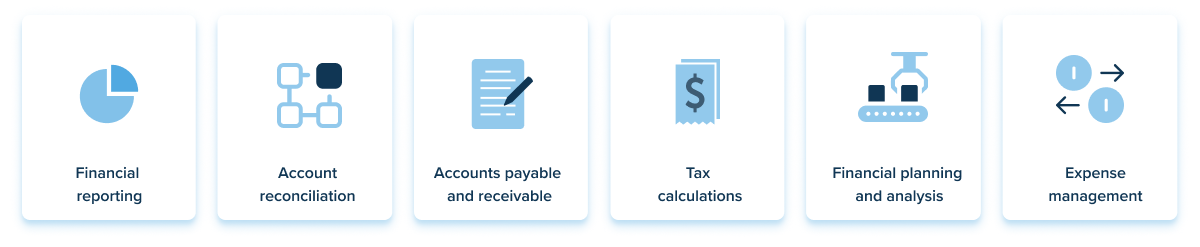
For example, RPA “bots” can extract data from invoices, receipts, or bank statements and enter it into your accounting system, reducing the need for manual data entry and resulting in fewer errors.
OCR can scan and digitize physical documents, streamlining accounting workflows and consolidating data in the cloud. Another potential use of AI in accounting is to facilitate financial reporting and compliance—AI algorithms can detect compliance issues early, allowing businesses to proactively address them.
Agentic AI: The next frontier of cost reduction
Beyond chatbots and automation tools lies the next wave of AI cost efficiency: agentic AI. Unlike traditional AI tools that respond to single prompts, AI agents can plan, execute multi-step tasks, and operate autonomously across systems—with measurable impact on operational costs.
|
171% average ROI from agentic AI deployments (2025–2026 enterprise data) |
74% of enterprises achieved ROI within the first year of AI agent deployment |
40% of enterprise apps will embed autonomous AI agents by end of 2026 (Gartner) |
The enterprise results are already in. Agentic AI deployments at companies like DXC Technology and Rimini Street reduced complex workflow cycle times by 30–50%—roughly three times the efficiency gains of rule-based automation applied to the same processes (TechTarget, April 2026).
Grupo Bimbo reports tens of millions in savings after deploying thousands of low-code AI agents. Dow Chemical expects annual multi-million-dollar savings from invoice scanning agents that automatically flag discrepancies. These results signal a shift: agentic AI is no longer experimental — it is delivering production-grade AI cost reduction at scale.
Looking ahead, Gartner projects that by 2028, at least 15% of daily work decisions will be made autonomously by AI agents, up from effectively 0% in 2024. For businesses planning their AI cost reduction roadmap, agentic AI represents the highest-leverage investment available today.
A note on realistic expectations: McKinsey’s Jubilant Ingrevia case study (November 2025) shows that EBITDA improvements of 15–25% from AI require simultaneous digital transformation, operational redesign, and workforce upskilling—not AI alone. Companies that treat AI as a standalone tool consistently underperform their targets. Plan for change management from day one.
How can AI enhance throughput and efficiency?
The power of AI may seem like science fiction, but it’s actually the result of decades of research and innovation. Think about its ability to continuously learn from the data it’s trained on. AI technology mimics human intelligence and is therefore capable of performing some cognitive tasks, such as:
- Compiling and interpreting data
- Learning how to get better and better at a given task
- Identifying trends and patterns
- Interpreting written and spoken language
- Making connections between events
- Determining the best course of action based on data (a process referred to as “inferential efficiency in AI”).
Unlike humans, AI doesn’t experience fatigue, boredom, or information overload. Consequently, it can analyze massive amounts of data and run through millions of tasks within hours. These capabilities allow it to outperform the human brain in most areas — and it’s a core reason why AI cost efficiency gains compound over time as models improve with more data.
About InData Labs
In the 12 years since our founding in 2014, InData Labs has delivered 150+ AI and data projects that made it from pilot to production. Our 80+ experts work with companies such as Wargaming, Flo, AsstrA and Captiv8. We are an AWS and Databricks partner, rated 4. 9 on Clutch. We start with the highest-value AI opportunities, build a realistic roadmap and deliver solutions that reach production, so cost savings show up in operations, not just in a pilot.
For AsstrA, our OCR system processes 300, 000 invoices a year four times faster than manual work and saves 15, 000 man-hours annually (case study). Talk to our AI consulting team or estimate your project with the AI cost calculator.
Next step: How to harness artificial intelligence for efficiency and cost savings
Now you know how AI can improve workplace efficiency and other aspects of running a business. The next step is to select an appropriate AI model and train it with data.
For example, you can connect it to your customer relationship management (CRM) system, email marketing platform, or accounting software. These integrations can help maximize the AI model’s efficiency, leading to better outcomes.
By leveraging AI for business efficiency, you’ll achieve real AI cost efficiency — getting more done in less time while reducing operational spend. But for your AI cost reduction efforts to be successful, it’s crucial to analyze your existing processes and identify areas where this technology can be deployed.
Last but not least, consider implementing a training program. This will ensure your staff knows how to use this technology to its full potential. Later, you can take the steps needed to build an AI team for even better results. Last but not least, consider implementing a training program. This will ensure your staff knows how to use this technology to its full potential. Later, you can take the steps needed to build an AI team for even better results.
FAQ
-
Recent 2025 research from Capgemini found that organizations are already seeing measurable cost benefits from GenAI, with more than 20% reporting or expecting operating-cost reductions in some business functions. The savings come primarily from automating routine work, improving employee productivity, and reducing the time required for business processes.
-
AI reduces costs primarily through automation of repetitive tasks, faster data processing, predictive maintenance, and reducing human error. Across functions like customer service, manufacturing, finance, and logistics, AI cost reduction comes from replacing manual effort with scalable, always-on systems that operate at a fraction of the cost.
-
AI improves business efficiency by accelerating decision-making, eliminating bottlenecks, and enabling teams to focus on high-value work. Tools like intelligent automation, demand forecasting, and AI-driven analytics give businesses real-time insight and faster execution across every department.
-
AI reduces operational costs by automating workflows, optimising resource allocation, and reducing waste. In operations-heavy environments such as manufacturing, logistics, and customer support, AI cost savings of 20–40% are achievable through targeted implementation.
-
Generative AI helps reduce business costs by automating content creation, accelerating software development, streamlining customer communications, and enabling faster R&D cycles. Businesses using generative AI for marketing alone report content production cost reductions of up to 60%.