
Edge artificial intelligence is already closing the gap with other algorithm types in both adoption and performance. Far from its infancy, this cutting-edge AI advancement now underpins a fast-growing global market, with steadily increasing implementation across healthcare, manufacturing, retail, and automotive proving it’s no longer a proof-of-concept technology, but active infrastructure.
Cutting-edge AI technology explained
The concept of cutting edge AI tools came into existence because of edge computing — a decentralized computing framework — so it functions similarly. Unlike machine learning, deep learning, or natural language processing, it isn’t a unique model type. Instead, it revolves around the algorithm’s location.
This is no longer a niche approach. The global edge AI market has grown to roughly $24–34 billion in 2026 and is forecast to reach around $96 billion by 2031, with growth driven by demand for privacy-preserving processing, real-time inference, and AI-enabled automation across industries. The hardware side alone — chips, sensors, and processors built to run models locally — already makes up more than half of that spending.
What’s changed most since the early days of edge AI is the model side. Running full-scale models on constrained hardware used to be the bottleneck; that’s largely been solved. Small language models designed for edge deployment now deliver 80-90% of large model capabilities while running entirely on-device, thanks to techniques like quantization, which can shrink a model four to eight times without meaningfully hurting accuracy. That’s why a voice assistant can now process a request locally in a fraction of the memory it once needed.
Modern devices are built around this shift. Flagship smartphones now carry NPUs that would have been considered server-class hardware five years ago, powering real-time on-device capabilities like language translation, voice recognition, computational photography, and increasingly, on-device LLM inference for models like Gemini Nano, Llama 3. 2, and Phi-4 Mini. The same shift is happening in laptops, where chips built for local AI processing are bringing LLM inference to mainstream devices without cloud connectivity.
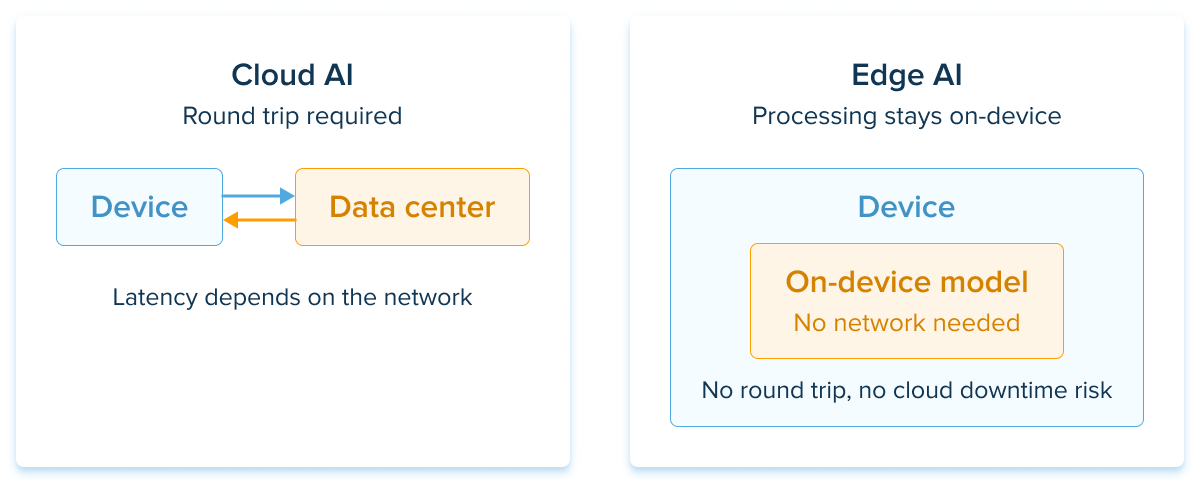
Usually, algorithm learning depends on data transfers. Typical cloud AI services train and deploy machine learning models from a centralized infrastructure. That’s still the standard for training large models — but for inference, the balance is shifting. Edge AI offers a clear advantage in time-sensitive scenarios, and it’s now mature enough to handle far more than simple pattern recognition.
Edge AI isn’t just cutting-edge on its own — it’s changing what’s possible with AI more broadly. Since it doesn’t rely on internet connectivity and can’t be impacted by a centralized cloud environment experiencing downtime, it opens up real-world use cases — from medical devices that analyze readings on-site to autonomous vehicles processing dozens of camera feeds in real time — that conventional, cloud-dependent algorithms simply can’t reach.
Why is edge AI better?
Conventional models have many performance gaps — they require human intervention to understand context, are prone to logical errors and can’t readily see correlations. While cutting-edge artificial intelligence shares many algorithm-inherent issues, it’s far more reliable, accurate, resilient and scalable. For general applications, it is better than other options.
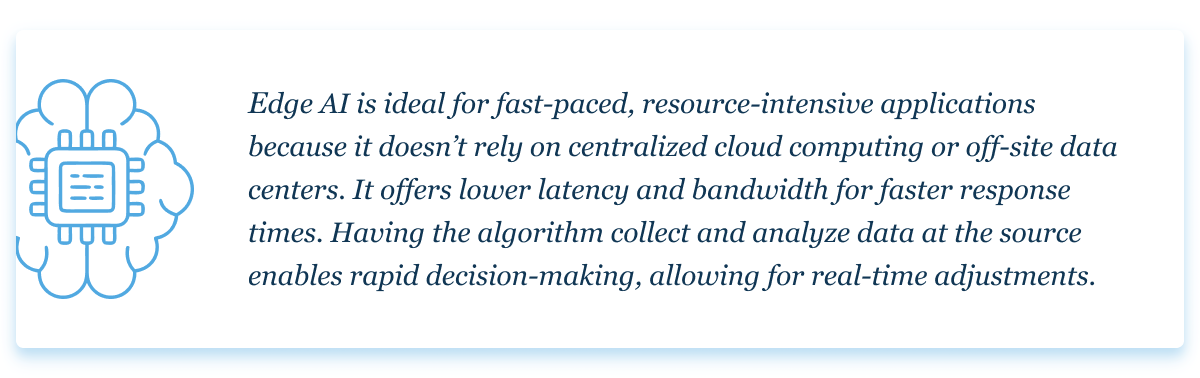
Since the machine learning model at the edge functions in a decentralized environment, it can make subtle adaptations much faster. It doesn’t rely on constant data transfers and can rapidly react to changes. As a result, the algorithm receives continuous performance improvements in a more private, secure setting. The decreased reliance on internet connectivity and a centralized computing infrastructure makes edge AI better.
While AI is cutting-edge, it isn’t as affordable. Deploying and running a machine learning model on a decentralized infrastructure with minimal data transfers is much less expensive. Additionally, its performance enhancements and improved processing can lead to indirect cost savings for businesses.
What can edge AI be used for?
Edge AI is similar to conventional algorithms in that it is highly versatile. Unlike natural language processing or deep learning models, it is easily scalable and readily available. While any industry can adopt it, it is mainly present in the healthcare, retail, consumer technology and transportation sectors.
Cutting-edge AI applications
Many cutting-edge AI companies are beginning to leverage artificial intelligence at the edge in any scenario where data privacy or low latency is critical. Since AI has numerous applications in every industry, businesses quickly discovered relevant use cases. Naturally, they used this technology to fill the gaps conventional algorithms have.
Organizations can use edge AI for any time-sensitive tasks. For instance, healthcare professionals can use AI at the edge in surgical robots or diagnostic computers because its low latency and decreased reliance on internet connectivity guarantee faster response times. Notably, its decentralized nature keeps patients’ personally identifiable information secure.
Data-based forecasting is another example of cutting-edge technology in action. This technology can substantially reduce overhead costs by minimizing downtime, improving productivity, and adapting in real time to schedule shifts. While conventional algorithms can leverage predictive analytics, their response times are slower and may be less accurate — which is exactly what makes cutting-edge technology different: it processes and reacts to change on the spot, not after the fact.
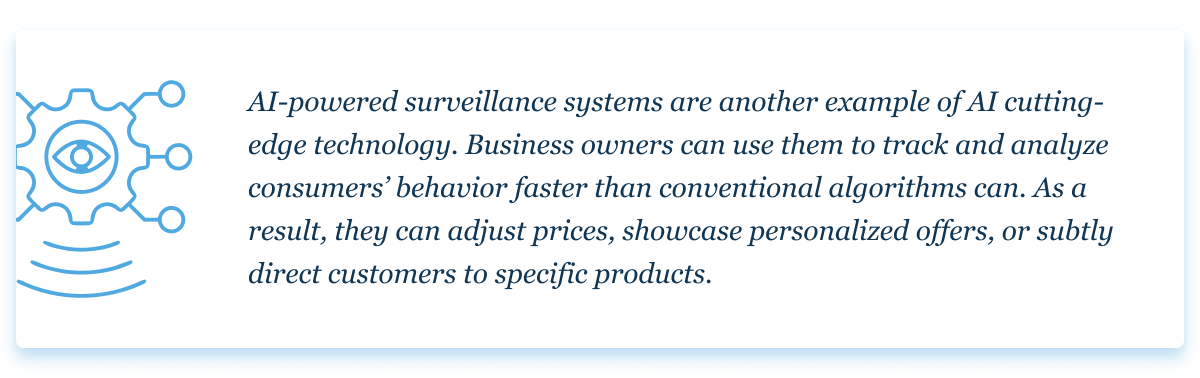
Businesses can also use machine learning at the edge for rapid media analysis. Since it doesn’t rely on data transfers, this breaking-edge technology can quickly examine images and videos on-site. This concept applies to AI-powered cameras, facial recognition devices, and smartphone photo galleries. It’s helpful in any scenario where an algorithm must quickly interpret visual information — another reminder that AI at the edge isn’t a future promise, it’s already running in the devices people use every day.

Source: Unsplash
What is an example of edge AI?
Cutting-edge artificial intelligence has many real-world use cases and applications. Many AI case studies prove the value of leveraging machine learning models at the edge. Moreover, implementation success stories are abundant in sectors like consumer technology, retail, transportation, energy and manufacturing.
Cutting-edge AI tools
This technology has produced many cutting-edge AI tools. AI-powered computer vision is one such example, combining machine learning at the edge with a conventional visual interpretation device — a clear case of edge AI technology in practice — results in a robust machine capable of analyzing images and videos on the same device where the data is sourced.

Source: Unsplash
Many industries already use cutting-edge machine learning tools. For instance, the higher education sector uses automated messaging algorithms to contact students about updates on their academic performance. This real-time communication is far superior to conventional methods since it enables early intervention.
Some tools are simply improvements on other algorithm types. For example, decentralized natural language processing leverages cutting-edge AI deep reinforcement — another form of edge AI technology built to run closer to the user. Consequently, chatbots will respond faster, interpret input better, and react more accurately. This innovation, powered by cutting-edge machine learning, could result in real-time language translation and highly realistic voice assistants.
Cutting-edge AI technology
Transportation businesses can use cutting-edge AI deep reinforcement to make self-driving cars a reality. Since vehicles’ sensors rely on localized machine learning at the edge instead of data transfers to a centralized cloud infrastructure, the algorithm can make real-time adjustments on the road autonomously. This improves safety and performance.
Wearables are another example. While AI-powered Internet of Things (IoT) devices already exist, they have various security and performance gaps. Machine learning at the edge fixes these issues at a reduced cost because it isn’t reliant on data transfers. Consumers then experience low latency, lower bandwidth requirements and secure information collection.
Why use edge AI?
More business opportunities will appear as more cutting-edge AI companies realize edge AI’s potential. It will likely become one of the most prominent technology trends across numerous industries as rapidly increasing adoption rates spur innovation. Whether someone is an aspiring entrepreneur or a midsized business owner, they can benefit from its implementation.
Future market trends
Already, market trends suggest artificial intelligence at the edge will reach a tremendous value. The market is projected to grow from USD 27.01 billion in 2024 to USD 269.82 billion by 2032, exhibiting a CAGR of 33.3% during the forecast period.
While the consumer technology sector will undoubtedly drive massive revenue, business acceptance also seems promising.
Considering most organizations have already implemented AI to some extent, they will likely readily adopt this improved technology once it exits its proof-of-concept stage and becomes a sure investment — provided it’s backed by solid machine learning development rather than a rushed pilot.
While edge AI adoption rates may seem relatively low compared to other similar algorithm types, they will undoubtedly skyrocket soon. It will likely become one of the top trending technologies worldwide in a few years.
Business opportunities
Aside from the allure of promising market trends, startups, and midsized businesses should consider implementing edge AI because it offers numerous opportunities. This responsive, adaptive technology guides proactive business decisions, adapts to changing market conditions, and helps solve issues rapidly and privately.
Already, organizations leverage artificial intelligence and machine learning for cutting-edge problems. An AI implementation strategy becomes paramount as a growing number adopt this technology. Carefully considered, realistic implementation expectations will reveal more business opportunities and improve outcomes.
What is leading edge AI?
Edge AI first appeared in the early 2020s as an inevitable advancement of edge computing. Since then, state-of-the-art research and development have propelled it into new areas. Further exploration becomes increasingly crucial as the amount of mobile and IoT devices expands while existing cloud computing solutions remain the same.
AI agents: the next leading edge
If edge AI is about where intelligence runs, AI agents are about what that intelligence is now allowed to do on its own — and 2026 is the year this shifted from pilot projects to production infrastructure.
The gap between experimenting and truly operating at scale, though, is still wide.
McKinsey’s global survey found that 88% of organizations report regular AI use in at least one business function, and roughly four in five say they are adopting agents in some form — yet fewer than one in four companies has actually scaled an agentic system into routine use.
Separately, S&P Global Market Intelligence and Ringly. io both put the share of enterprises running agents fully in production at around 31–51%, depending on how “production” is defined, which is a useful reminder that adoption statistics in this space vary considerably based on methodology.
What’s driving the momentum isn’t hype — it’s fit. Deloitte’s survey of over 3, 000 global leaders found that 85% of companies expect to customize agents specifically to their own business needs rather than deploying an off-the-shelf assistant, and the clearest commercial signal so far — Salesforce’s Agentforce — has already reached meaningful annual recurring revenue with triple-digit year-over-year growth, according to its own fiscal 2026 disclosures.
Key benefits driving adoption:
- Faster, more consistent execution — agents handle multi-step tasks (research, drafting, routing, follow-up) without waiting on a human at every handoff.
- Lower operational overhead — routine decisions and workflows that once needed dedicated staff time can run continuously in the background.
- Better fit with existing systems — modern agents connect to enterprise data and tools directly, rather than operating as an isolated chatbot layer.
- Compounding returns — unlike a single automation script, a well-scoped agent keeps producing value as it’s extended to adjacent tasks.
The organizations pulling ahead aren’t the ones deploying the most agents — they’re the ones treating agent design as an engineering discipline from the start: clear scope, integration with real systems, and monitoring built in from day one. That’s the same principle underpinning solid AI software development: the technology is only as reliable as the architecture built around it.
Is edge AI the future?
Deploying devices at the edge with AI ensures better performance at lower costs. While further research and development is necessary to find widely applicable, commercially viable implementation solutions, this technology has already started moving from pilot projects into mainstream deployment across numerous industries.
Edge AI’s growth trajectory now backs that up with real numbers. Estimates vary depending on exactly what’s being measured — hardware alone, or hardware plus software and services.
Grand View Research estimates the market at around $30 billion in 2026, growing to nearly $119 billion by 2033. That range of estimates is itself worth noting: edge AI’s market size is still somewhat dependent on how fast edge computing infrastructure and specific model types mature, which is part of why forecasts differ so widely between research firms.
Source: Unsplash
However, while cutting-edge AI shows promise, its current adoption rate isn’t as high as machine learning, natural language processing, or deep learning. Moreover, its market value estimates still rely heavily on the popularity of edge computing and various model types — which is exactly why the estimate spread above is so wide.
Companies must achieve successful implementation if edge technology is going to surpass similar algorithms to become the future of AI-powered devices. Since business outcomes improve with AI consulting, third-party assistance should be a serious consideration. This way, startups, entrepreneurs, and even midsized businesses can follow the guidance of people with subject-matter expertise to identify realistic goals and prove the tool’s viability.
While edge AI’s commercial viability and operational use cases may not seem as robust as similar technologies, they’re closing the gap quickly. Hardware alone already makes up over half of total edge AI spending, and the shift toward small, on-device language models — capable of 80-90% of large-model performance while running fully locally — suggests these innovations will pave the way for the next generation of AI-powered devices for consumer and business applications.
When will edge AI become widespread?
Edge AI is no longer an emerging concept — it’s an established part of how AI gets deployed today, running quietly inside the devices people already use. Market value and adoption both reflect a technology that has moved well past the early-adopter phase and into mainstream infrastructure.
For the most part, AI at the edge is business-centered because it delivers cost-effective efficiency gains. Consumers benefit from low latency and fast processing in chatbots, voice assistants, IoT wearables, and photo analysis, but for them, the difference in speed is largely invisible — it just works, without a noticeable trade-off.
Startups and midsized businesses are the primary drivers of edge AI adoption. The technology is already widespread across these segments, and the pace at which any individual company benefits from it comes down to how deliberately they implement it. Businesses that embrace it well position themselves to move faster and bring products to market sooner than those still relying on cloud-only architectures.
Edge AI is the future of AI-powered technology
Industry experts and researchers have proven edge AI’s cutting-edge capabilities. Its accuracy, speed, and performance are far better than conventional models. Moreover, its versatility is unparalleled — it has use cases for every sector, from consumer technology to health care. These marked improvements will soon make it one of the most sought-after technologies.
FAQ
-
Cutting-edge AI refers to the latest advancements in artificial intelligence — the technologies pushing past what was previously possible in speed, autonomy, or where processing happens.
Understanding what is cutting edge technology in this context matters because the term isn’t tied to one model type; it describes whatever sits at the frontier of AI capability at a given moment. Right now, that frontier includes edge artificial intelligence, autonomous agents, and models compact enough to run directly on a device.
What does cutting edge technology meaning actually come down to in AI? In practice, it means solutions that outperform the current standard — faster response times, lower costs, or new capabilities altogether. Some circles also refer to this frontier as breaking edge technology, describing innovations still being refined before mainstream adoption.
-
Edge artificial intelligence is used to run AI models directly on or near the device collecting the data, rather than sending it to the cloud first.
Common edge AI implementations include real-time video analysis, voice assistants, industrial sensors, and medical diagnostic tools — anywhere a fast, local response matters more than raw processing power. AI at the edge is especially valuable in settings with limited or unreliable internet connectivity, where a cloud round-trip simply isn’t practical.
-
The core benefits of edge AI technology are speed, privacy, and reliability. Because processing happens locally, response times drop dramatically compared to cloud-dependent systems — critical for time-sensitive applications like autonomous vehicles or surgical robotics.
Data also stays on the device rather than traveling across a network, which strengthens privacy and reduces exposure to security risks. And since it doesn’t depend on constant connectivity, edge AI software keeps working even when the network doesn’t.
-
Real-world examples of edge ai tools include AI-powered security cameras that detect anomalies on-site, smartphone features like on-device photo enhancement and voice recognition, wearable health monitors that analyze biometric data in real time, and industrial equipment that predicts maintenance needs from sensor data without a cloud connection. Cutting edge machine learning and cutting edge deep learning models are increasingly compact enough to run these use cases entirely on local hardware.
-
Artificial intelligence at the edge works by embedding a trained model directly onto a device — a smartphone, camera, sensor, or industrial controller — instead of relying on a centralized cloud server. The device collects data, processes it locally using the embedded model, and acts on the result immediately, without a data transfer round-trip. This is why edge ai technology is often paired with specialized hardware, like NPUs, designed specifically to run models efficiently on limited power and memory.
-
Industries adopting cutting edge software development built around edge AI span healthcare (diagnostic devices, surgical robotics), manufacturing (predictive maintenance, quality control), retail (in-store analytics, smart cameras), automotive (autonomous driving systems), and logistics (real-time fleet monitoring).
As edge ai implementations mature, adoption is expanding well beyond these early movers into nearly every sector that relies on real-time data.