
Currently, AI for businesses has proved dynamite across every field leaders strive to achieve. However, the wide variety of AI tools available today directly affects the cost. Companies must be aware of a few important factors and understand why it is imperative to take the financial cost of implementing GenAI into projects into account in order to improve operations.
In recent years, AI software development has become a major focus of a wide range of companies of all scales. Numerous businesses continue to deploy the benefits of generative AI applications, which are undoubtedly a very exciting development that is quickly evolving within the machine learning field.
With rapid evolution, integrated generative AI is developing a large market area to which businesses are applying their core operations, including features such as generating original content or solving complex problems.

Source: Unsplash
What is more, business owners and entrepreneurs must realize the financial implications of adopting generative AI, taking into consideration the financial viability of fully implementing advanced AI.
This article covers the various costs associated with generative AI development, including developing phases, components and any hidden costs. It is also meant to provide you with a so-called generative AI cost calculator necessary for making better and more efficient financial decisions, regardless of whether you are just beginning or are planning on a large-scale roll-out in the fast-changing field of generative AI.
Let’s plunge into this subject to find out precisely what future financial costs might entail.
How does generative AI function, and what is it?
Generative AI is considered to be a section of AI that generates data that has a similar form or use to that of existing data. Generative AI models are intended to produce new content in the form of text, images, audio, or other media types, in contrast to traditional AI models and systems, which concentrate on carrying out specific tasks, such as identifying patterns and making predictions based on available data.
At its core, GenAI relies on advanced algorithms to learn from huge amounts of input data to output similar-to-human results and abilities; it does so through algorithms that leverage reinforcement learning or neural networks and variational autoencoders.
Owing to AI chatbot development, a wide range of music could be made, as well as works of art, written pieces of work, and an entirely new, realistic, virtual reality environment. In the context of artificial intelligence business solutions, it enables companies to provide personalised customer experiences, improve operational efficiency and develop product designs, among many other things.
Gaining a solid grasp of generative AI makes it possible to calculate the expenses related to utilising this technology. GenAI prices cover not only the original development but also the costs of continuous data collection, deep learning training, deployment, and upkeep.
The cohesion between the model, deployment plan, and generative AI costs
The biggest influence on cost factors for enterprise generative AI will come from the model you choose and the way you apply it. If you don’t choose the right combination, you run the risk of going over budget on a model that offers too much performance or failing to get a model that generates a good return on investment.
It is actually worth selecting a model and release method because they ought to meet all of your objectives. Comprehending use case difficulty and the sensitivity of data will aid in deciding how to pick up and implement an AI model. With all these obstacles, it can be wiser to come to generative AI consulting firms to choose and implement your model appropriately.
Backbone models of AI for business are a significant source of expense
It is common knowledge that each AI system has a foundation of a simple AI chatbot or a traditional full-blown type of AI system, performing the types of functions associated with generative AI, for instance, generating text, images, and code. It includes LLMs of various kinds, all of which contain very large amounts of data and can be deployed for many enterprise use cases.
One of the major determining factors impacting both the inherent capabilities of a generative AI system and the associated costs to implement and operate such a generative AI system will be based on the number of parameters that exist within the foundation model. In other words, the number of parameters contained within a given foundation model helps determine how effective and accurate that generative AI system may be.
In addition to these, performance may also be impacted by other factors such as the quality and diversity of training data, the efficiency of the architecture used, and how closely aligned the foundation model is with the task being performed. As a result, a smaller but finely tuned foundation model may perform better in some circumstances than a larger generic foundation model while also lowering the cost of generative AI pricing models.

Source: Unsplash
The AI is run by a managed and a self-hosted model
Generative AI models can generally be classified into two primary categories depending on how they are made available to users: proprietary and open-source.
In terms of speed and ease-of-use, closed-source API solutions may provide a better alternative when compared to open-source alternatives conforming to similar requirements. If you are seeking customisability, generative AI for strategic cost management, or flexibility when it comes to compliance, then despite the additional effort required to implement open-source models properly, they may be worth your consideration.

Source: Unsplash
Although open-source foundation models can be extremely powerful, they often need significant amounts of computing resources and tuning to align with enterprise requirements.
SLMs represent an emerging alternative: they are compact, fine-tuned models that deliver many benefits characteristic of LLMs while needing much less infrastructure or training. SLMs can be used on-premise, can be processed effectively using a fewer number of available GPU resources, and are also very well-suited for performing specific domain-related activities for which LLMs would not be a practical application.
Common options of generative AI
Generative AI models come in a variety of forms, each with a unique architecture and purpose.
1. Generative adversarial networks
They are widely used, but they rely on two neural networks competing to produce new data: the discriminator assesses how closely the newly generated data resemble the original data, while the generator attempts to produce new data. Deepfake production, image synthesis, and video synthesis are a few uses for GANs.
2. Variational autoencoders
According to these probabilistic models, input data is encoded into a latent space and then decoded to produce new data. The two neural networks that make up VAEs are an encoder and a decoder. Applications that demand a high degree of diversity and high-quality new data are the main uses for VAEs.
3. Transformer models
They perform a variety of functions in neural networks and have revolutionised NLP. Self-attention is applied to both text sequence generation and processing in the transformer architecture.
4. Diffusion models
Models based on diffusion create pointed vectors in latent space through two phases throughout the training method. The first phase, or “forward diffusion”, gradually introduces randomly generated noise to the training data set; the second phase, or “reverse diffusion”, removes the randomly generated noise to restore the data samples. Starting from a completely random noise, reverse denoising allows you to produce new data.
Different methods for applying generative AI advantages, and the cost involved in each method
After you choose what type of model to use, there are four different ways you can implement those models. Each approach will have different advantages and disadvantages in terms of the cost of deploying custom generative AI models in 2026, the level of customization available, the degree of performance, and the complexity of operating the models.
Benefiting from a pre-trained model “as is”
The cost of using generative AI services varies significantly depending on the vendor, model size, and usage volume. Pricing has become considerably more competitive in 2026 as the market has matured.
OpenAI’s GPT-4o is currently priced at around $0.005 per 1K input tokens and $0.015 per 1K output tokens, while GPT-4o mini—a more cost-efficient option for lighter tasks—sits at approximately $0.00015 per 1K input tokens.
Anthropic’s Claude 3.5 Sonnet runs at $0.003 per 1K input tokens, and Google’s Gemini 1.5 Pro starts at around $0.00125 per 1K tokens for shorter contexts. For high-volume deployments, most major providers now offer batch processing discounts of 40–50% off standard rates.
Foundation models have grown dramatically in scale and capability since the GPT-3 era, and that growth is reflected in their cost structure. GPT-4 is estimated to have been trained on roughly 1.8 trillion parameters, compared to GPT-3’s 175 billion. Meta’s Llama 3, released in 2024, ranges from 8B to 405B parameters and has become one of the most widely adopted open-source options in enterprise settings—specifically because it balances strong performance with manageable deployment costs.
The important shift in 2026 is that raw parameter count is no longer the primary driver of either performance or cost.
Architectural efficiency, training data quality, and fine-tuning methodology now matter just as much. A well-tuned 7B-parameter model like Mistral 7B can outperform much larger general-purpose models on specific domain tasks—at a fraction of the infrastructure cost. Matching model size to the specific use case is now one of the most effective levers for controlling generative AI spend.

Source: Unsplash
Moreover, because the foundation models are easily accessible, companies can begin utilising them efficiently for testing and minimising the expenses associated with GenAI development costs. Another fantastic advantage of this technology is the use of foundation models as a starting point for AI software engineers, allowing programmers to solve complex problems without spending all of their time creating a custom solution.
Making adjustments to a closed-source model using your data
Modifying a closed-source model with your data is well-suited to companies that have domain expertise but want to avoid the overhead of managing their own infrastructure. Fine-tuning a commercially available model on your internal datasets improves accuracy on specific tasks — tone, terminology, and classification behavior—without requiring a full custom build.
The cost structure typically combines a one-time fine-tuning fee with ongoing usage costs per token or API call. OpenAI currently charges $0.008 per 1K tokens for fine-tuning GPT-4o mini, with trained model usage at $0.012 per 1K input tokens and $0.016 per 1K output tokens.
Google Vertex AI offers fine-tuning for Gemini models with pricing that scales based on the number of training examples and output tokens generated. Anthropic supports fine-tuning for Claude models for enterprise customers under custom agreements.
Beyond the model providers, platforms like Microsoft Azure OpenAI Service and Google Vertex AI offer managed fine-tuning environments with built-in data governance, compliance controls, and deployment pipelines — making them the preferred route for enterprises operating in regulated industries.
Estimated total costs for this approach typically range from $15,000 to $80,000 depending on dataset size, number of fine-tuning runs, and ongoing usage volume. The trade-off remains the same: faster implementation and strong performance gains, but ongoing per-token costs, limited data portability, and dependency on the vendor’s roadmap and pricing decisions.
A cost-efficient alternative worth considering: RAG
Before committing to fine-tuning, many enterprises find that retrieval-augmented generation delivers comparable accuracy improvements at a significantly lower cost. Rather than updating model weights, RAG connects a base model to an external knowledge base at inference time — retrieving the most relevant documents and passing them as context alongside the user’s query. The model responds based on that specific information without any retraining required.
For most mid-scale deployments, total RAG infrastructure costs — embedding generation and vector database hosting via tools like Pinecone, Weaviate, or pgvector — run between $5,000 and $30,000, well below a typical fine-tuning pipeline.
Beyond cost, RAG offers several practical advantages: knowledge stays current as the underlying data changes without requiring a new training run, responses can be traced back to source documents for auditability, and hallucination risk is substantially reduced by grounding outputs in retrieved context rather than model memory alone.

Source: Unsplash
RAG and fine-tuning are not mutually exclusive. Many mature enterprise deployments combine both — fine-tuning to adapt the model’s behavior and tone, RAG to supply it with current, domain-specific knowledge. Understanding when each approach is appropriate, and when to combine them, is one of the most consequential decisions in any enterprise GenAI project.
Employing the “as is” model of an open-source foundation
Getting the utmost of an open-source model from an existing library “as is” is best for organisations with existing infrastructure and light customisations needed or where compliance-related customisations will be difficult to implement.
Artificial intelligence cost estimation according to this model is considerably lower, but it provides numerous advantages, like the absence of the need for software licences or vendor fees, and it could be deployed on your premises or in the cloud. For easy or low-risk tasks, performance is acceptable, but the output might not be subtle.
One of the key factors is that enterprises ought to know how to calculate cost savings from AI support because this type of model requires internal development operations and constant model hosting support.
Each open-source model has different computing requirements based on the model’s size and frequency of input or output. Typical example models include Llama 4 Scout, Qwen 3.5, DeepSeek V3.2, and Mistral Small — all available via Hugging Face and deployable on-premise or in the cloud. Infrastructure, integration, and basic operations for this approach typically run between $20K and $50K.
By making use of an open-source model “as is” versus customising it, your organisation can greatly reduce the whole cost of ownership while improving your data governance responsibilities in systems used for internal purposes at the same time. However, note that general-purpose models will generally not perform well for very specific, merchandise-type and business-specific content with no tuning.
Modifying an open-source model via your data
If enterprises wish to maintain the greatest levels of control, accuracy and privacy in their data, modifying an open-source model via their data will be an ideal option for them.
There are plenty of examples of such models, like Llama 4, Mistral, DeepSeek R1, and Qwen 3.5, available via Hugging Face. Enterprise generative AI pricing models to implement Gen AI: $80,000-$190,000+, which includes the implementation of infrastructure, development of the model and tuning of the model along with internal support.
As for the model, it fosters the greatest independence and flexibility as it relates to vendor dependency and allows you to train using proprietary or sensitive data. Besides, it demands a significant investment in infrastructure, skill sets and time, giving an opportunity for the deployment of models on-premise or in the cloud with GPU-based compute. It requires GenAI transformation cost and regular support for MLOps and maintenance of the model once deployed.
Most companies that take this path are in regulated industries such as healthcare, finance and IP-intensive industries. In addition, companies that are making long-term investments in AI capabilities are also common on this path. Although there is a high upfront cost, there is considerable strategic flexibility with this custom approach.
Building secure and scalable GenAI solutions with an experienced tech partner
Implementing generative AI successfully is not only about choosing the right model — it also requires selecting the right technology partner.
An experienced AI development company can help businesses reduce risks, accelerate deployment, optimize infrastructure costs, and ensure enterprise-grade security and compliance throughout the entire AI lifecycle.
By working with a trusted generative AI partner, companies can benefit from:
- Faster time-to-market
- Cost-efficient infrastructure planning
- Secure data handling and governance
- Scalable AI architecture
- Custom model development and fine-tuning
- Integration with existing business systems
- MLOps automation and monitoring
- Regulatory compliance support
- Ongoing optimization and maintenance
- Reduced operational complexity and vendor risks.
An experienced AI team can also help businesses choose the most effective implementation strategy based on their goals, budget, compliance requirements, and internal capabilities — whether that means leveraging commercial APIs, deploying open-source models, or building fully customized enterprise-grade AI systems.
Want to know more about how InData Labs does it? Watch the video.
Major cost factors affecting enterprise generative AI
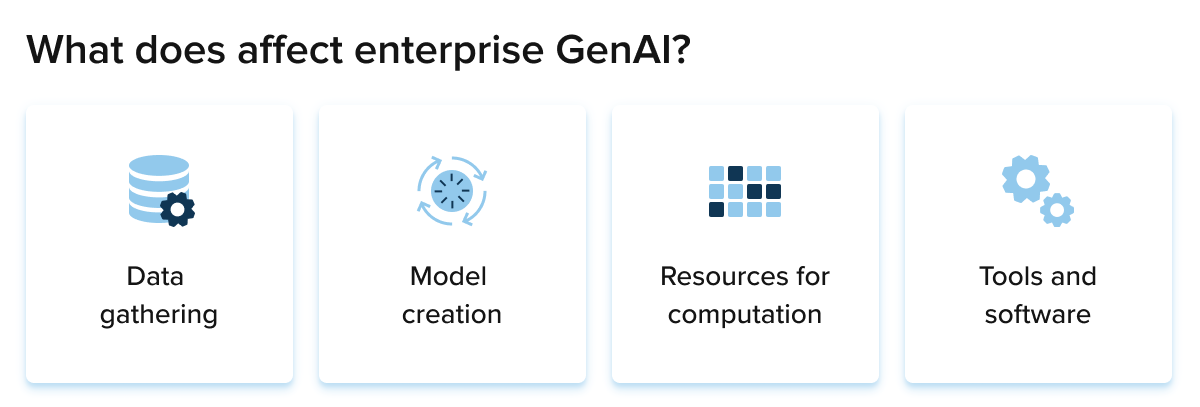
GenAI strategic cost management implies all the major factors that can affect it. Let’s name the major ones.
Large datasets must be gathered and processed in order to create a generative AI of high quality.
You have the option of customising an existing model or creating a new one from the ground up. There are expenses and difficulties associated with each route.
To create and train the generative AI models, you need a lot of processing power. The GenAI price of high-performance hardware should be taken into account.
The additional generative AI price includes learning machine learning frameworks and libraries.
As enterprises move beyond single-model interactions toward agentic AI, a new layer of costs enters the picture.Agent orchestration — coordinating LLMs with external tools, memory systems, and other agents — adds expenses that standard GenAI budgets often miss: orchestration frameworks like LangGraph or AutoGen, infrastructure for parallel model calls, tool integrations, and the monitoring and audit trail systems needed to govern autonomous actions responsibly.
Summing up
Applications of generative AI can open doors for creativity and innovation in businesses. Keeping an eye on the share price of generative AI and the stock price of generative AI solutions can give you important information about market trends that affect investment choices as well. It will assist you in defining the goals of your project, choosing suitable and compatible technologies, and enabling cooperation with a skilled development team.
Gaining a solid understanding of the aforementioned points during the development process will enable you to successfully negotiate the challenges of implementation and create an application that eventually advances your corporate objectives.
FAQ
-
The GenAI development cost for a custom application usually varies from $25,000 to $500,000 or more, based on what you intend to create.
An enterprise system with advanced functionality, custom integration of sensitive data, and the capacity to handle massive volumes of data with security and scalability features will be far more expensive than a basic chatbot example.
-
High inference costs related to scaling compute power as user traffic increases and frequent fine-tuning to prevent data drift are the main hidden costs of ongoing model maintenance.
To stop hallucinations and guarantee the system’s long-term dependability, a substantial amount of resources must also be devoted to human-in-the-loop monitoring and safety moderation, and to comparing the prices of generative AI marketing platforms.
-
Data must be sourced, cleaned, standardised, labelled, and secured before training can start. This stage often accounts for 30–50% of the entire GenAI cost. While enterprise programmes can spend over $100,000 just on data readiness, small initiatives typically spend between $10,000 and $40,000.
-
The simple ROI formula, which is (Net Benefits ÷ Total Costs) × 100, is a good place to start. This computation offers a straightforward method for gauging the financial impact AI has on your company. Track metrics like lower labour hours, higher customer satisfaction, or higher sales on a regular basis for accurate results.
-
Simple, consumer-grade generative AI tools cost about $30 per month, while custom, enterprise-grade AI platforms can cost over $1 million.
Due to API usage, customisation, and data engineering, development costs usually range from $25,000 to $75,000 for MVPs to $80,000 to $250,000+ for production-ready solutions.