Artificial intelligence has been a game-changer for the E-commerce industry. According to Shopify, retail sales are projected to amount to around $7.80 trillion by 2028.
E-commerce industry size and forecast (2025-2030)
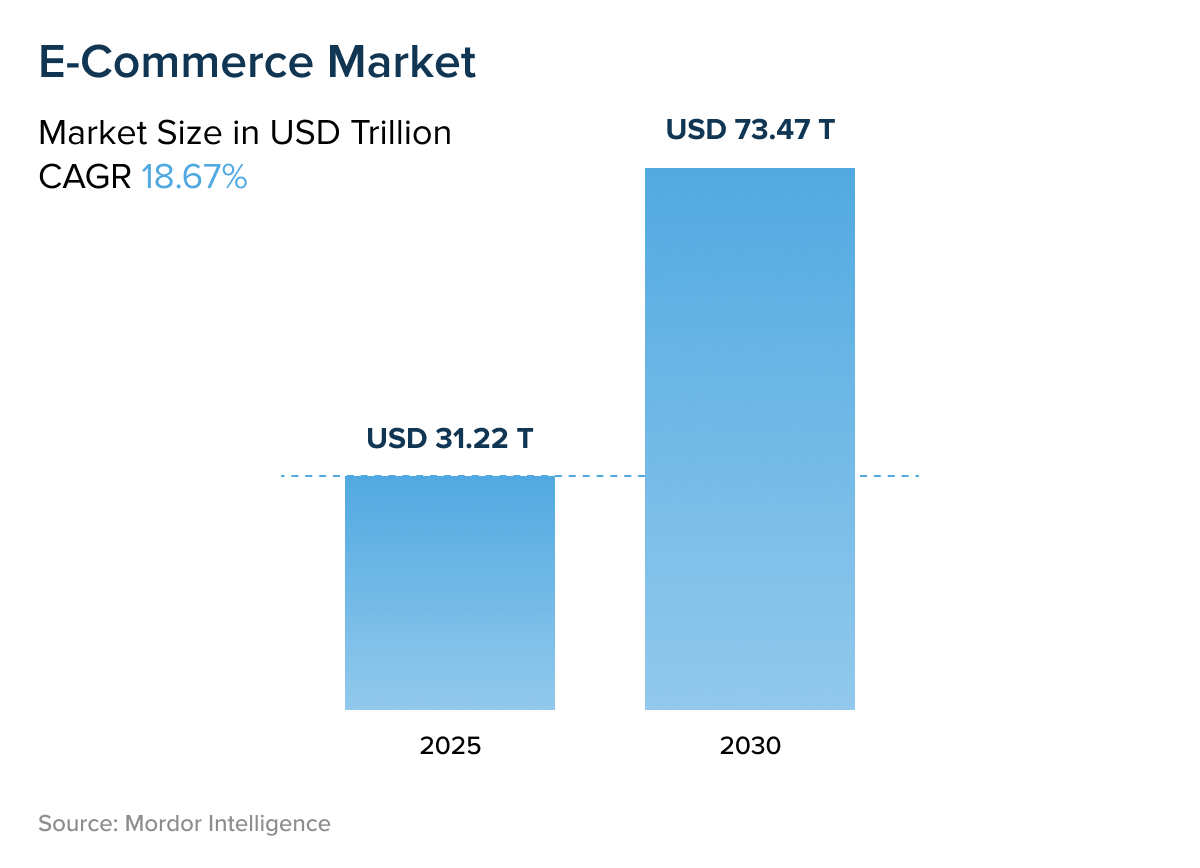
In the coming years, the vast majority of future purchases will be facilitated by E-commerce as digital channels continue to reshape how consumers shop.
No doubt, AI will be shaping retail digitization. AI has pretty much to offer the retail industry. Depending on the nature of a business, audience, the pace of development, AI implementation can bring a set of unique perks to most E-commerce businesses.
AI cannot guarantee your company overnight success. But it gives much food for thought and informs decision-making processes. Therefore, B2C, B2B E-commerce need human expertise. Along with that, consulting on custom-tailored AI software development can ensure you some most valuable AI inferences.
If you’re curious to know how to adopt Big data, intelligent assistants, automation, and augmentation into your retail business, read on to learn 13 ways of how AI can be used in E-commerce for your business to flourish.
1. AI agents
Over the next few years, AI agents will move from experimental tools to core infrastructure in E-commerce. AI agents can reason, learn from context, and take autonomous actions across multiple systems—transforming how E-commerce businesses operate, sell, and engage with customers.
Here are the key use cases of AI agents in E-commerce:
1. Hyper-personalized customer experiences
AI agents enable real-time personalization across digital and physical channels. They recommend products based on behavior and context, tailor pricing and promotions to individual shoppers, and dynamically adapt websites, apps, and in-store experiences—making each interaction more relevant and conversion-focused.
2. Autonomous customer support
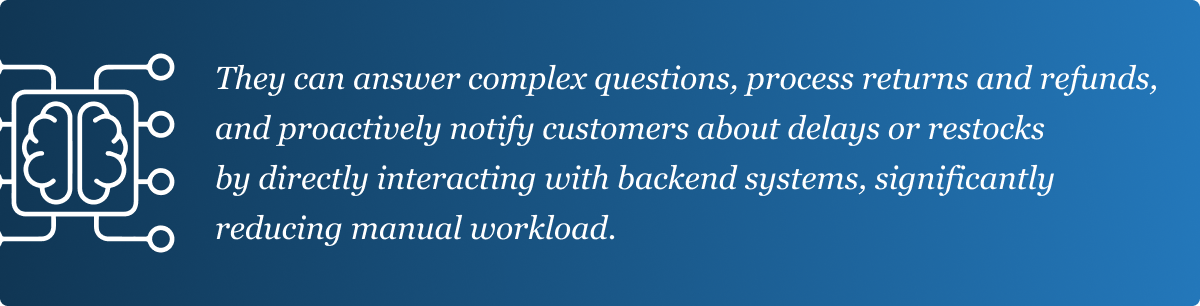
AI agents manage customer interactions end-to-end across chat, voice, and messaging.
3. Smarter inventory and demand forecasting
By continuously analyzing sales patterns, local demand signals, weather, events, and supply chain constraints, AI agents optimize stock levels in real time. They can trigger reorders, rebalance inventory across locations, and adjust assortments to minimize stockouts and overstock.
4. Dynamic pricing and promotion optimization
AI agents adjust pricing and promotions in real time based on demand, competition, and inventory levels. This allows retailers to stay competitive while protecting margins and maximizing the effectiveness of promotional campaigns.
5. In-store AI agents and smart retail spaces
In physical stores, AI agents power smart shelves, real-time inventory visibility, and digital assistants for staff and customers. They help connect online and offline experiences while improving store operations and customer engagement.
2. Big data
Online retailers gather and process lots of data, but all the data needs to be analyzed to bring in value. The collected data can fit into such categories as Behavior, Action, and Product. Companies can harness Big data for problem-solving and creating solutions to help address business challenges.
Predictive analytics solutions can increase sales, revamp customer experience, and facilitate attracting new customers. Predictive analytics help retailers analyze masses of historical data on user-product interactions.

Source: Unsplash
Using them, it’s easy to see how customers respond to your products, spot customer churn, and find out your business strengths and weaknesses. Getting the analytical insights, a retailer makes the shopping experience cater to a specific audience and exact users. If the service or products are fine-tuned, customer loyalty and greater sales guaranteed.
3. Demand forecasting
Understanding and predicting customer actions is not an easy thing to do. If you run a startup or want to enter a new market, demand forecasting is one of the critical aspects you need to concentrate on first. Without anticipating customer expectations, your business may face serious challenges.
However, by gaining a solid grasp of your market and recognizing situations that influence customer behavior, you can make informed decisions to make your product or service more valuable. Current ecommerce trends artificial intelligence reveal many ways AI can augment business through technology.
For example, IKEA has improved supply management and reduced costs by leveraging advanced AI-driven demand forecasting. This approach has given them a competitive edge, allowing them to deliver high-quality goods at prices 30% lower than competitors. Operating globally, IKEA successfully maintains demand by relying on accurate forecasts powered by custom-tailored software and automation. These demand forecasting applications also enhance data visibility and enable robust risk management strategies across their supply chain.
4. Recommender systems
Rich datasets can breathe life into recommender systems. One of the most known uses of AI in E-commerce for generating recommendations is Amazon’s recommendation engine. It provides millions of users with a personalized web page when they visit Amazon.com. Another industry giant, Netflix’s recommendation system is estimated to drive the majority of content viewed and saves the company significant costs annually in customer retention.

A recommender system is a must-have for E-commerce providers and online retailers. Using such custom solutions, you can increase sales, boost user satisfaction, and manage to understand users’ needs better.
5. Localization of customer experience
It is another level of personalization. And it is one more example of AI in E-commerce completing data-related tasks with maximum efficiency. Such an option is great for providers and promoters of booking services, tours, entertainment activities, and events. Seeking new ways to generate revenue, companies offer local recommendations to their clients.
AI-driven solutions can piece together various types of information on consumers and provide insightful inferences based on that. IBM Watson enables natural language capabilities that make automated interactions with consumers and gathering of valuable data possible. As a result, consumers can make informed decisions in a matter of seconds and receive non-trivial recommendations aligned to their current location.
6. Automated warehouse processes
Optimization and robotization within warehouses allow reducing costs of manual operations and offer time-saving ways to manage inventory. Computer vision-powered robots, like those hosted by Amazon’s or Ocado’s warehouses, can recognize, pick, wrap, and distribute items several times faster than human employees. To add more, automated invoice filling-in and processing help escape errors and ensure that the right customer will get the ordered item.
Smart warehouses allow managers to relocate the human workforce and increase productivity. Operations bound to predictable physical actions, data collection, and data processing are most likely to become fully automated in the short run.
7. Augmented reality
It is one of the most amazing opportunities for retailers to provide unforgettable customer experience and persuade customers to come back for mere purchasing in the future. AR technology fills our real reality with virtual objects, visual effects, or captions and gives the engaging experience of the fusion of what is real and what is virtual. AR finds wide applications in games and along with that, retail and E-commerce.
It powers such solutions as AR Mirror and Virtual Dressing Room, which allows customers to see without trying on how pieces of clothes, footwear, or glasses, or other items of their choice look on them without trying on. Amazon and IKEA have already put into practice cutting-edge solutions.

IKEA Place mobile app lets users put 3D versions of furniture in real rooms over the smartphone camera. Virtual furniture is easy to turn at any angle and place in any corner. Consumers can now find out in advance whether an interior item will fit into a place and whether it will look beautiful with the overall design.
8. Visual search
As a part of the computer vision field, visual search draws the attention of B2B and B2B companies of various sizes. AI-enabled visual search engines, like Google and Kiddle, ASOS, to name a few, transform the future of E-commerce today.
Visual search is a proven and useful application of AI in E-commerce. Industry leaders utilize it to optimize websites and offer a more intuitive customer experience.
However, the function is not yet as accurate as text search. The AI algorithm behind the scene needs massive datasets to learn to pick the right options out of millions of images. The technology experiences significant improvement currently, and in a short while, it will be used at its full capacity. So, it is high time to optimize your website search engine for image-heavy queries to get prepared for the future.
9. Automated product tagging
Machines can learn to identify different visual attributes automatically, which can be useful for product tagging in a catalog. For instance, a leather jacket can get the tags “long sleeve,” “black,” and more automatically. It is a time-saving and swift process that only requires approval from a human employee. Automatically generated tags are essential for text or visual search, targeted recommendations, and smooth customer experience as a whole.
Automated product tagging assists with managing catalogs and improving the searchability of items across the web. Moreover, it comes as a great help as it allows automatic suggesting similar purchasing items based on customer preferences. That capability can increase the size of an average order.
10. AI integration into CRM
To gain leading positions in the market, retailers can harness the benefits of AI in E-commerce regarding the creation of more efficient sales processes. Automated problem-solving solutions are the key to streamline strong sales processes and let AI do this work far more efficiently than humans. Integrating AI into your CRM can facilitate you getting in touch with customers at the right time and on the right platform. AI-enabled voice assistants can address customer queries and solve a range of some most common issues while completing multiple tasks simultaneously.
Such technologies as speech recognition and natural language processing empower well-known assistants Siri and Alexa and also chatbots to replace humans. And artificial employees progress in doing it better and better. Custom-tailored speech recognition solutions with the capability of integration into the existing CRM is the way to provide new opportunities for your sales team.

Source: Unsplash
11. Useful insights into customer behaviour
Unsurpassed customer experience is one of the cornerstones of a successful company. To achieve that milestone, retailers and E-commerce providers can leverage AI to analyze customer data, assess, and predict customer behavior.
AI helps marketers monitor to what extent the website is user-friendly or whether the language of emails and chatbot-generated answers is engaging enough. Machines can automatically gather comprehensive data about the way users navigate the site, pages they click first, the level of engagement, and more.
Also, AI can successfully monitor money transfer activities and ensure errorless operations and servicing users 24/7. Consumers can get instant answers to simple FAQs. All those customer actions can provide marketers with valuable data on behavior. Automated systems collect that data and then let human analysts make data-driven strategic decisions based on customer preferences and habits.
12. Price optimization
An optimal and competitive price stems from customer preferences. Self-learning AI-driven algorithms analyze massive amounts of data and suggest the best pricing options. The longer a company uses such algorithms, the more precise the suggestions get. The reason is that AI solutions learn from historical data.
However, implementing AI can not solve all the matters. Business owners should have a clear understanding of the business goals and take into account the development perspectives. In this case, it will be possible to load AI solutions with meaningful tasks and use the inferences properly to get valuable results.
For example, Walmart and Amazon use AI price optimization capabilities to fine-tune their existing pricing strategies. That is another way new technology assists in satisfying and anticipating customer desires to end up maximizing revenue.
13. Brand monitoring and reputation management
Among the applications of AI in E-commerce that we overview in this article is monitoring brand visibility and customer feedback on products and services. What your customers think about your brand dramatically impacts the whole strategy of your business.

Source: Pexels.com
Browsing through social media is a time- and resource-consuming daily task. By adopting AI, you can fully automate this task and provide your marketing team with more time for creative and intellectual tasks.
AI will help you estimate the scale of customer satisfaction by detecting and analyzing positive, neutral, and negative reviews online. It is fantastic if your brand receives only words of praise. But even if you offer top-notch products or services, competitors may attack your brand by posting and sharing fake unfavorable reviews. Automating the process of searching and detecting brand mentions in a fake context, you can manage and support the good reputation of your brand.
Running a marketing campaign, you can employ AI to assess the results. Algorithms can monitor brand exposure during mass events and collect relevant data to help you understand whether your investments into ads have paid off or not.
Bottom line
The benefits of artificial intelligence in E-commerce and online retail that your company can enjoy are diverse and depend on the niche your business occupies in the market and the goals you set to achieve. In this article, we have covered only a range of ways how you can implement AI to get rapid and tangible results.
InData Labs offers expert consulting on developing custom AI solutions for E-commerce and retail. We are here to help you decide on a solution that will perfectly augment your business strategy, provide teams across departments with task automation options, and let in advanced technology to revamp your business in line with the latest tendencies.
FAQ
-
The current landscape of applied AI in E-commerce market trends shows rapid adoption across retail and online shopping platforms. AI is no longer limited to basic personalization and chatbots—brands are using advanced machine learning and intelligent agents to power dynamic pricing, real-time product recommendations, automated customer service, and demand forecasting. These technologies help retailers improve conversion rates, optimize inventory, and deliver tailored experiences at scale.
As investment in AI grows and tools become more accessible, businesses of all sizes are leveraging AI to stay competitive, enhance operational efficiency, and meet evolving customer expectations.
-
A custom AI solution can definitely be developed to automatically detect E-commerce data trends.
By leveraging machine learning and advanced analytics, such solutions can analyze vast amounts of sales, customer behavior, and market data in real time. These tailored AI systems can identify emerging patterns, forecast demand shifts, and highlight anomalies specific to your business, enabling faster and smarter decision-making.
Developing a custom AI tool allows it to be perfectly aligned with your unique data sources, product range, and business goals—making it a powerful asset in staying ahead of ecommerce AI trends and gaining a competitive edge.
-
AI is transforming E-commerce by enabling personalized shopping experiences, automating customer support, optimizing inventory and pricing in real time, and providing data-driven insights. This leads to higher sales, improved efficiency, and better customer satisfaction.
-
According to recent industry data, roughly about 50 % of E‑commerce businesses have already adopted AI technologies in their operations today, with many more testing or planning implementations.
Additionally, broader retail statistics show that around 89 % of retailers are either using AI or running pilot projects, demonstrating how widespread AI adoption has become in online commerce and related functions like personalization, analytics, and automation.