Contact Us

AI software development companies in the USA: Top 15 firms for 2026

16 July 2026
Top 15 AI consulting firms for 2026

The global AI software market is projected to reach USD 1,458.89 billion by 2034, growing at a CAGR of 21.43% — and the United States sits at the center of that expansion. The USA hosts approximately 29,618 AI companies, representing roughly 32.5% of global AI firms. With that many options, the challenge is not finding a partner — it’s separating the ones that deliver production-ready AI from the ones that deliver polished presentations.

This guide profiles the top AI software development companies in the USA for 2026 — evaluated by technical depth, industry expertise, delivery track record, and compliance maturity. Whether you are looking for a boutique AI lab or an enterprise-scale AI software development company in the USA, this list will help you make an informed decision.

What defines the top AI software development companies in the USA in 2026?

Before diving into the list, it is worth clarifying what separates a strong AI development partner from a weak one. When evaluating an AI software development company, the key criteria include: a portfolio of production-deployed AI solutions (not just demos or prototypes), domain expertise in your industry, transparency around their AI tech stack, a clear discovery or PoC process before full commitment, and verifiable client reviews on third-party platforms like Clutch or G2.

In 2026, two additional factors matter significantly: agentic AI readiness and compliance depth. Companies that scored well on compliance and technical depth were ranked higher, since these are the two most common failure points for US AI projects in 2026.

The common tech stacks among top US-based AI software development firms include PyTorch, TensorFlow, OpenAI API, LangChain, LlamaIndex, Hugging Face, AWS SageMaker, Azure OpenAI, and Google Vertex AI. MLOps platforms — including MLflow, Weights & Biases, and Kubeflow — are increasingly standard for firms serious about long-term model maintenance.

The top 15 AI software development companies in the USA

InData Labs
Founded: 2014
Focus: AI, GenAI, ML, NLP, Big Data
1. InData Labs

InData Labs is a leading AI software development company with 80+ specialists delivering custom AI solutions to businesses globally. Since 2014, InData Labs has built a reputation for end-to-end delivery — from AI consulting and architecture through to production deployment and post-launch optimization.

The company’s core expertise spans custom generative AI development services, large language model development and fine-tuning, AI agents, natural language processing, predictive analytics, and big data application development services.

InData Labs takes a structured approach to every engagement — beginning with a discovery phase that includes stakeholder interviews, data readiness assessment, and tech feasibility review before any development begins. This reduces delivery risk and ensures that every solution is aligned with measurable business outcomes.

IBM
Founded: 1911
Focus: Enterprise AI, Cloud, NL
2. IBM

IBM remains one of the most established names in enterprise AI software development. Its watsonx platform, launched in 2023 and expanded through 2025–2026, provides enterprises with a foundation for building, deploying, and governing AI at scale.

IBM’s AI development capabilities span NLP, predictive analytics, intelligent automation, and AI governance — with particular strength in regulated industries such as finance, healthcare, and government.

Google Cloud AI
Founded: 1998
Focus: Cloud AI, ML Infrastructure, GenAI
3. Google Cloud AI

Google Cloud AI offers one of the most comprehensive AI development ecosystems in the USA through Vertex AI, Google AI Studio, and Gemini API integrations.

The platform is widely used by AI software development companies and enterprise engineering teams as the backbone for training, deploying, and scaling custom AI models.

Microsoft Azure AI
Founded: 1975
Focus: Cloud AI, OpenAI Integration
4. Microsoft Azure AI

Microsoft Azure AI is one of the most widely adopted platforms for enterprise AI software development in the USA. Through its partnership with OpenAI, Azure provides access to GPT-4o, DALL·E, and Whisper APIs — alongside Azure Machine Learning for custom model training and deployment.

According to McKinsey’s State of AI 2025, 78% of organizations now use AI in at least one core business function, with 39% already reporting measurable bottom-line EBIT impact from their AI deployments.

Amazon Web Services
Founded: 1994
Focus: Cloud AI, ML Infrastructure
5. Amazon Web Services (AWS)

AWS remains the leading cloud platform for AI-powered SaaS software development in the USA. SageMaker, Bedrock, and Rekognition are among the most widely used AI development services in enterprise environments.

AWS’s infrastructure is the foundation for hundreds of AI-driven software development companies across the USA — from startups building MVPs to enterprises deploying production ML systems at scale.

Palantir Technologies
Founded: 2003
Focus: Enterprise AI, Data Integration
6. Palantir Technologies

Palantir is one of the most recognized enterprise AI software companies in the USA, known for its powerful data integration and analytics platforms. Its AIP (AI Platform), launched in 2023 and widely adopted through 2025–2026, enables enterprises to deploy large language models and AI agents directly on top of proprietary operational data.

Palantir serves defense, financial services, healthcare, and manufacturing.

C3 AI
Founded: 2009
Focus: Enterprise AI Applications, Predictive Analytics
7. C3 AI

C3 AI is a global leader in enterprise AI software development, offering a suite of pre-built AI applications for industries including manufacturing, energy, financial services, and defense. Its agentic AI platform is one of the most mature enterprise offerings in the USA for organizations seeking to deploy autonomous AI workflows at scale.

LeewayHertz
Founded: 2007
Focus: Generative AI, LLM Development
8. LeewayHertz

LeewayHertz covers one of the widest technical spectrums on this list, with end-to-end AI/ML engineering across custom model development, AI agent development, LLM fine-tuning, computer vision, NLP, and cloud AI on AWS, Azure, and GCP.

The firm serves enterprise clients across retail, financial services, and healthcare with a particular focus on generative AI integration and intelligent automation.

DataRobot
Founded: 2012
Focus: Automated Machine Learning
9. DataRobot

DataRobot is an enterprise AI platform that automates the end-to-end machine learning process — from data preparation through model deployment and monitoring. The platform is particularly strong for organizations seeking to accelerate model development without deep ML engineering resources.

DataRobot’s MLOps capabilities are among the most mature in the USA for enterprise deployment and model governance.

Accenture
Founded: 1989
Focus: Enterprise AI Transformation, Generative AI
10. Accenture

Accenture is one of the largest AI software development and consulting organizations operating in the USA, with thousands of AI specialists and deep industry verticals across finance, healthcare, retail, and manufacturing.

Accenture is arguably the biggest name among AI solution providers. They have thousands of AI experts and deep industry verticals. However, their engagement models are often rigid and come with a premium price tag suitable only for the largest budgets.

RTS Labs
Founded: 2012
Focus: AI-Driven Software Engineering, Data Science
11. RTS Labs

RTS Labs specializes in senior-led, ROI-driven delivery, helping businesses leverage data to make better decisions. Their AI and data science teams focus on creating custom solutions that provide actionable insights, helping clients stay ahead of the curve in a data-centric world.

RTS Labs is particularly well-suited to mid-market companies seeking a US-headquartered AI software development partner with a focus on measurable business outcomes.

Coherent Solutions
Founded: 1995
Focus: AI Software Engineering, Digital Transformation
12. Coherent Solutions

With over 30 years of digital engineering experience, Coherent Solutions brings significant enterprise software depth to AI development.

The firm has built a strong practice in AI-powered SaaS development and intelligent automation — with delivery centers across the USA and Eastern Europe enabling competitive pricing without sacrificing engineering quality.

SoluLab
Founded: 2014
Focus: AI, Blockchain, IoT, Custom AI Solutions
13. SoluLab

SoluLab is a digital transformation partner that excels in emerging technologies — combining AI development with blockchain and IoT integration for companies requiring multi-technology solutions.

The firm serves clients across healthcare, fintech, and retail with end-to-end development services from strategy through deployment.

Azumo
Founded: 2016
Focus: Custom AI Software Development, Data Engineering
14. Azumo

Azumo is a U.S.-based software development company that helps organizations build intelligent digital products using modern technologies such as artificial intelligence, cloud computing, and data engineering.

The company specializes in providing dedicated nearshore development teams from Latin America, allowing businesses to scale engineering capacity while maintaining real-time collaboration.

Master of Code Global
Founded: 2004
Focus: Conversational AI, NLP, GenAI, LLM Integration
15. Master of Code Global

Master of Code Global has over a decade of enterprise NLP deployments, with a portfolio spanning AI-powered virtual assistants, voice bots, and intelligent routing systems for Fortune 500 companies.

LLM integration, GenAI rollout, and chatbot development are their strongest practice areas.

How to choose the right AI software development company in the USA

Selecting the right AI development partner is one of the most consequential decisions a business can make. The global AI market is growing at 30.6% CAGR toward $3.5 trillion by 2033 — the financial consequences of choosing the wrong AI development company compound across the full project lifecycle.

Here is a practical framework for evaluating AI software development companies in the USA:

1. Boutique AI lab vs. large-scale enterprise developer

Boutique AI-first firms offer deeper specialization, faster engagement cycles, and more flexibility on scope. Enterprise consultancies like Accenture bring scale, global delivery, and organizational change management — at a premium. The right choice depends on your project complexity, internal AI maturity, and budget.

Boutique AI-first firms typically charge $100–$250/hour with project minimums starting around $25,000 for a proof-of-concept. A mid-scale AI solution generally runs $50,000–$200,000.

2. Verify production track record, not just demos

Any firm can demonstrate a compelling prototype. What matters is whether they have delivered AI solutions that reached production, were maintained over time, and generated measurable business outcomes. Review case studies carefully — look for specific metrics, timelines, and post-launch performance data.

Production track record

Source: Unsplash

3. Assess compliance and data privacy capabilities

For US-based businesses, CCPA compliance is a baseline requirement. For healthcare, HIPAA applies.

For companies with European operations, GDPR and the EU AI Act add further requirements. Confirm that any AI software development company you evaluate has documented processes for data privacy, security, and regulatory compliance — not just a policy page on their website.

4. Evaluate their AI tech stack

The most common tech stacks among leading US AI development firms in 2026 include:

  • Frameworks: PyTorch, TensorFlow, JAX
  • LLM/GenAI: OpenAI API, Anthropic Claude, Mistral, LangChain, LlamaIndex
  • MLOps: MLflow, Weights & Biases, Kubeflow, SageMaker Pipelines
  • Cloud platforms: AWS, Azure, Google Cloud
  • Data engineering: Apache Spark, dbt, Airflow, Kafka

A firm that cannot speak fluently about MLOps — model versioning, drift detection, retraining pipelines — is unlikely to support your AI solution effectively after launch.

5. Define your pricing model expectations

AI software development pricing models typically take one of three forms: time-and-materials (most flexible), fixed-scope (most predictable), or dedicated team (most scalable). Standard AI build timelines run 6 to 9 months at most agencies. Annual maintenance runs 15 to 25% of the initial build cost. Data readiness is the most common hidden driver: clean data requires 10 to 15% of total project budget; fragmented legacy environments push that to 25 to 40%.

6. Confirm IP ownership and post-launch support terms

Before signing any agreement with an AI software development company in the USA, confirm: who owns the trained model weights, who owns the training data pipeline, and what the handover process looks like. Also clarify post-launch support terms — including how model drift will be monitored and how retraining will be managed over time.

How AI software development companies handle generative AI integration with legacy systems

One of the most common questions businesses ask AI development companies is how they handle GenAI integration with existing legacy infrastructure. The short answer is: carefully, in phases, and with significant upfront discovery.

The typical integration approach involves:

  1. API-layer integration — exposing legacy system data through APIs that the AI application can query, without requiring full system replacement
  2. RAG (Retrieval-Augmented Generation) — connecting LLMs to proprietary data via vector databases, enabling AI to reference internal knowledge without retraining
  3. Event-driven data pipelines — streaming data from legacy systems into AI-ready data stores in near real-time
  4. Middleware and orchestration — using platforms like LangChain, LlamaIndex, or custom orchestration layers to manage multi-step AI workflows across disparate systems
The AI software development process at InData Labs specifically addresses legacy integration during the discovery phase — mapping data flows, identifying integration points, and designing architecture before any model development begins.
Talk to our AI consultants
Not sure where AI fits into your business? Our AI consultants help you assess your data readiness and build a clear roadmap — before you invest in engineering.
Get a free AI consulting session

What is the average time-to-market for a custom AI MVP?

Low-code plus AI approaches compress build timelines to 8 to 12 weeks. Standard AI build timelines run 6 to 9 months at most agencies.

For a custom AI MVP, a realistic timeline breakdown looks like this:

  • Discovery and scoping: 2–4 weeks
  • Data preparation and pipeline: 3–6 weeks
  • Model development and training: 4–8 weeks
  • Integration and testing: 3–5 weeks
  • Deployment and handover: 2–3 weeks

Realistic timeline breakdown

Total: 14–26 weeks for a production-ready AI MVP, depending on data readiness, infrastructure complexity, and integration requirements.

Companies with clean, well-structured data and existing cloud infrastructure can compress this timeline significantly. Those with fragmented legacy data or complex integration requirements should plan for the longer end of this range.

Protecting intellectual property in custom AI development

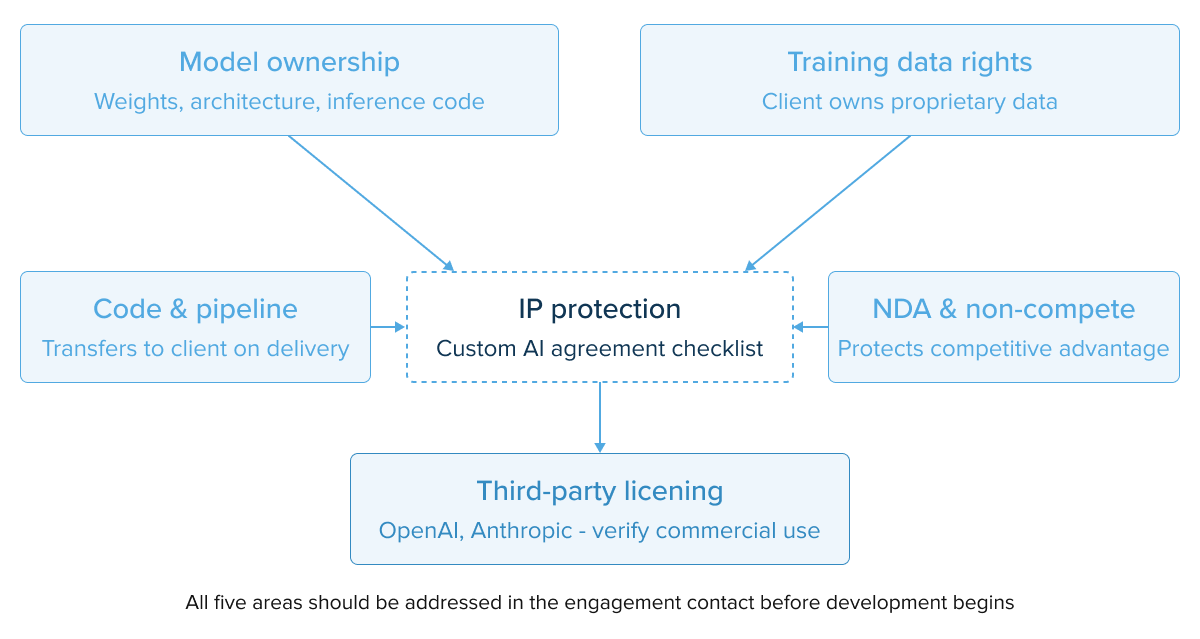
IP protection is one of the most overlooked aspects of custom AI software development. When working with an external AI development company in the USA, businesses should ensure the following are addressed in the engagement contract:

  • Model ownership — the trained model weights, architecture, and inference code should belong to the client, not the vendor
  • Training data rights — any proprietary data used to train or fine-tune models must remain under the client’s ownership and control
  • Code and pipeline ownership — all custom code, data pipelines, and integration scripts should transfer to the client upon delivery
  • Non-disclosure and non-compete clauses — particularly important when the AI solution represents a competitive advantage
  • Third-party model licensing — if the solution uses third-party foundation models (OpenAI, Anthropic, etc.), confirm that the licensing terms permit your intended commercial use

Onshore vs. offshore AI software development in the USA

Onshore AI software development in the USA offers several advantages: timezone alignment, easier communication, CCPA and federal compliance familiarity, and proximity to US-based enterprise clients. However, it typically comes at a higher cost.

Offshore and nearshore alternatives — Eastern Europe, Latin America, and Southeast Asia — offer competitive rates with varying levels of AI engineering depth. The most effective model for many US businesses in 2026 is a hybrid approach: a US-based engagement manager and solution architect paired with an offshore or nearshore engineering team — delivering US-standard quality at blended-rate pricing.

InData Labs operates this model effectively, with a US presence in Miami and engineering capability in Lithuania and Cyprus — providing US clients with a responsive, compliant, and cost-effective AI-driven software development partnership.
Onshore vs. offshore

Final word

The market for AI software development in the USA has never been more competitive — or more consequential. Choosing the right partner determines not just the quality of the first delivery, but the long-term value your organization extracts from AI investment.

The companies on this list represent a range of specializations, scales, and delivery models. The right choice depends on your use case, industry, data maturity, budget, and internal AI capability. For companies looking to build custom AI business solutions with a technically credible, end-to-end partner — InData Labs offers the combination of AI research depth, production engineering experience, and business alignment that complex AI projects require.

For a broader view of AI software development companies worldwide, or to explore how AI can improve the software development process within your organization, visit the InData Labs resource library.

FAQ

  • Technical depth across ML, LLM, and GenAI frameworks; documented production deployments with measurable ROI; industry-specific experience; transparent discovery processes; verifiable third-party ratings; and compliance maturity for CCPA, HIPAA, or GDPR depending on the industry.

  • Leading firms implement data minimization practices, maintain documented data processing agreements, apply encryption and access controls to training data, and conduct compliance reviews during the discovery phase. For healthcare clients, HIPAA-compliant infrastructure and BAA agreements are standard.

  • MLOps covers model versioning, performance monitoring, drift detection, automated retraining pipelines, and deployment orchestration. Without a defined MLOps strategy, AI models degrade over time as real-world data distributions shift away from training data. Top AI development companies build MLOps into the engagement from day one — not as an afterthought.

  • Look for case studies with specific metrics (not just logos), evidence of production deployment (not just PoC), diversity of technical approaches (fine-tuning, RAG, custom model training), and post-launch performance data. A strong portfolio demonstrates both technical breadth and business alignment.

  • Data collection, cleaning, anomaly detection, and recurring reporting can be automated to a meaningful degree. Interpretation and decision-making still require human judgment — understanding context, validating results, and acting on insight. The best AI solutions for data analysis support decision-makers rather than replace them.

Ready to evaluate your options? Contact InData Labs to discuss your AI development requirements and receive a tailored engagement proposal. Contact us

Contact Us

We're easy to talk to. Whether you have a fully scoped project or just a rough idea, get in touch and we'll help you move it forward. Email us at info@indatalabs.com or fill in the form — we typically respond within one business day.

    By clicking Send Message, you agree to our Terms of Use and Privacy Policy.