Digital transformation, rapid AI adoption, and accelerated product cycles have fundamentally changed how companies build software. Traditional hiring models struggle to keep pace with evolving project demands, niche technical requirements, and the speed required to deliver intelligent, data-driven products.
For organizations building AI-first products, advanced analytics platforms, or enterprise-grade data systems, success increasingly depends on access to deep expertise in AI, machine learning, and data science, not just additional development capacity.
Instead of relying exclusively on fixed in-house teams, organizations choose to hire an extended development team composed of specialized AI engineers, data scientists, and machine learning experts who integrate directly into existing workflows.
This approach enables businesses to fill critical skill gaps, respond quickly to changing priorities, and access top-tier global talent required for AI-driven innovation.
This tactical playbook explains how to hire an extended development team, how these teams operate in practice, when they are the right choice, how to manage them effectively, and most importantly, how to choose the right software development partner to deliver long-term AI and data science success.
What is an extended development team?
An extended development team is a collaboration model in which external software professionals work as a direct extension of your in-house development team.
The goal is not to replace your internal staff but to strengthen them. Extended teams are commonly used to fill a skill gap, meet short-term project requirements, or accelerate delivery when internal capacity is limited.
These teams may include software developers, QA engineers, DevOps specialists, data scientists, or AI engineers, depending on the needs of the project.
How extended development differs from outsourcing
Traditional outsourcing focuses on handing off work. Extended development focuses on collaboration.
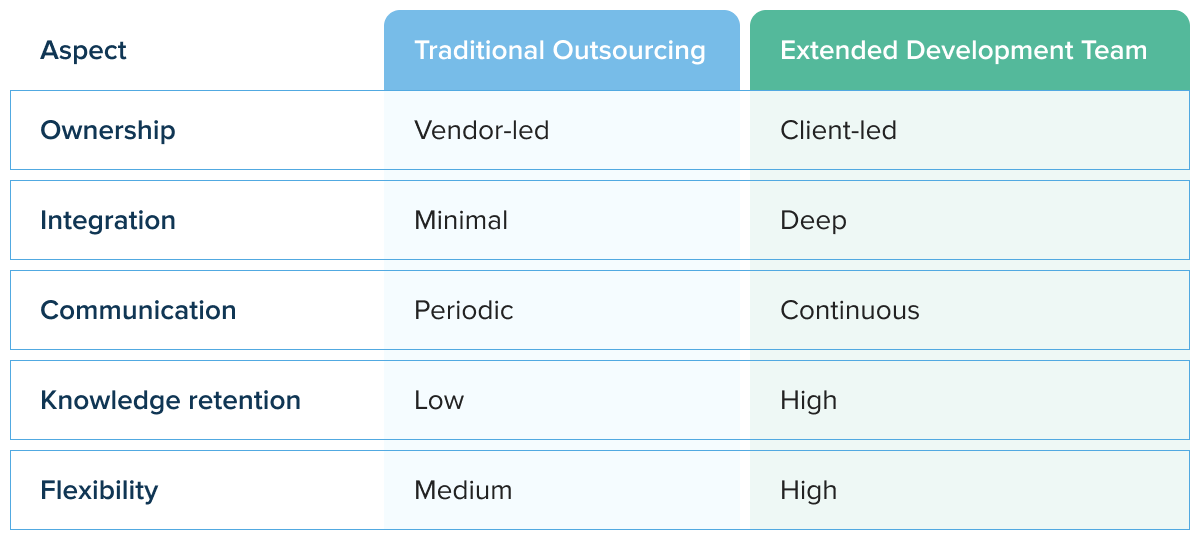
An extended software team allows organizations to remain in control of the development process while benefiting from external expertise and a broader talent pool.
Core team and extended team – How they work together
The effectiveness of an extended team model depends heavily on how the core team and extended team collaborate. When these teams operate in silos, the model fails. When they operate as one unit, it becomes a powerful delivery engine.
The core team typically retains responsibility for:
- Product vision and roadmap
- Business priorities
- Architectural decisions
- Stakeholder communication
The extended team focuses on:
- Feature development
- Specialized execution
- Testing and quality assurance
- Accelerated delivery of defined components
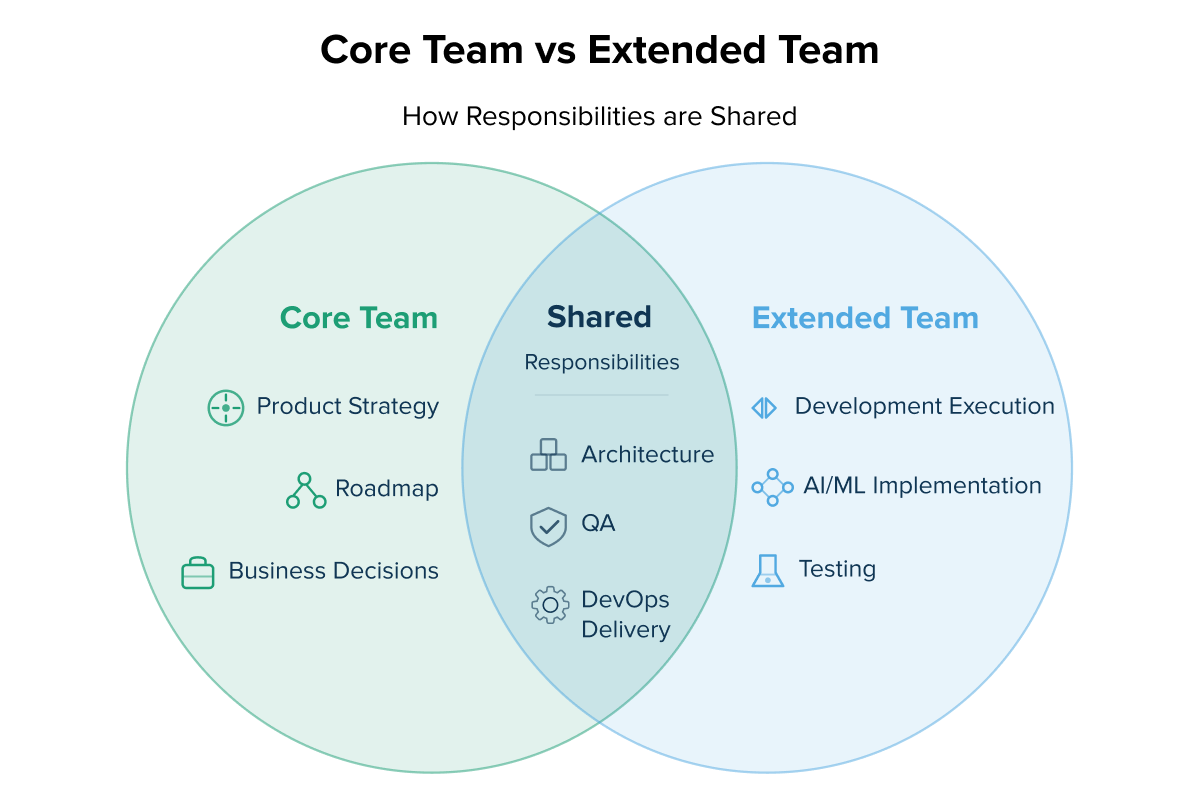
Core team vs extended team: Responsibility matrix
This shared responsibility model ensures alignment while allowing each team to focus on what it does best. Clear ownership prevents confusion, duplication of work, and delivery delays.
Extended development team model explained
The extended development team model combines internal leadership with external execution power. It is especially effective when organizations face fluctuating workloads or require niche skills for a limited duration.
Key elements of a successful extended team model include:
- A clearly defined extended management team
- Transparent reporting structures
- Shared project management tools
- Continuous feedback and performance monitoring
Components of the extended team model
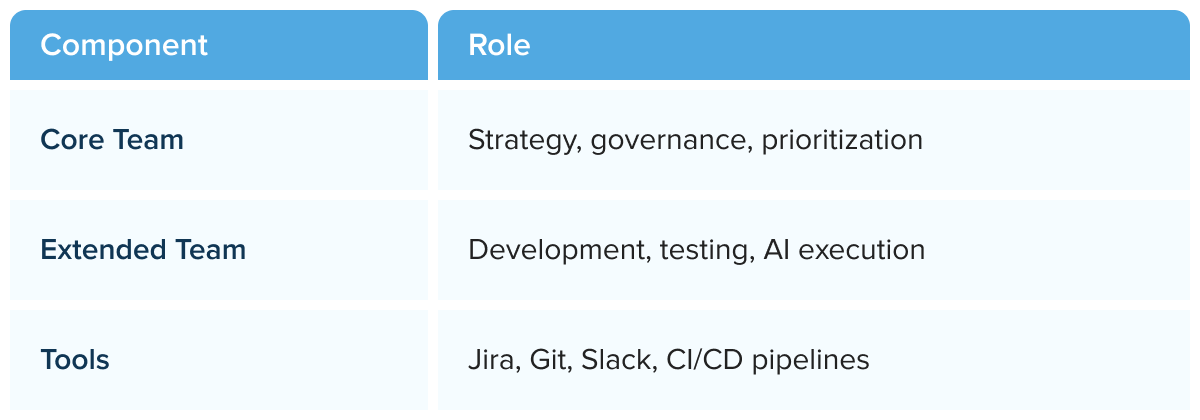
This structure ensures that extended development supports long-term product goals rather than becoming a short-term workaround.
Team extension vs staff augmentation vs outsourcing
One of the most common sources of confusion for decision-makers is the difference between extended development, staff augmentation, and traditional outsourcing. While these models may appear similar on the surface, they serve very different strategic purposes.
Understanding these differences is critical when choosing the right engagement model for your business goals, project complexity, and internal maturity.
Key differences explained
- Staff augmentation focuses on temporarily adding individual contributors to fill short-term skill gaps.
- Traditional outsourcing involves handing over entire projects or deliverables to an external outsourcing company with minimal internal involvement.
- Extended development sits between these two models, emphasizing long-term collaboration, deep integration, and shared ownership.
Comparison table: Engagement models
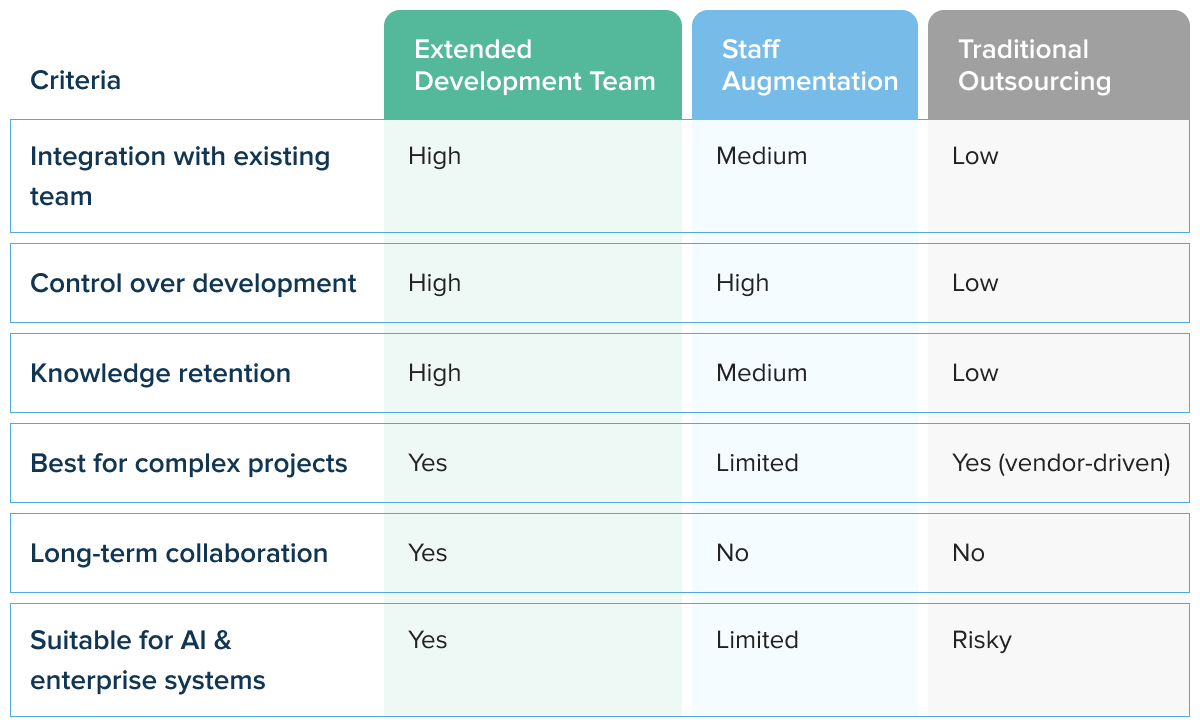
Why this matters:
For complex initiatives, especially AI, data science, and extended enterprise software, extended development teams offer the best balance between control, scalability, and expertise.
Staff augmentation may work for short spikes in workload, but it rarely supports long-term architectural ownership or innovation.
Why businesses choose extended development teams
Companies choose extended development teams primarily to accelerate AI and data science initiatives, where specialized expertise, rapid experimentation, and scalable execution are essential.
Rather than adding generic development capacity, organizations leverage extended teams to access highly skilled engineers capable of delivering complex AI software development projects under tight timelines and evolving requirements.
This model allows businesses to scale teams up or down efficiently, reduce long-term hiring risk, and achieve faster time-to-market, critical advantages when building and iterating on advanced AI business solutions.
Extended teams are particularly valuable in a competitive talent landscape where experienced AI engineers are scarce. This shift is further reinforced by global IT outsourcing market growth, which continues to accelerate as organizations seek more flexible, expertise-driven models to support innovation and delivery at scale.
Cost perspective
These strategic benefits are also reflected in the long-term cost dynamics of different team models.
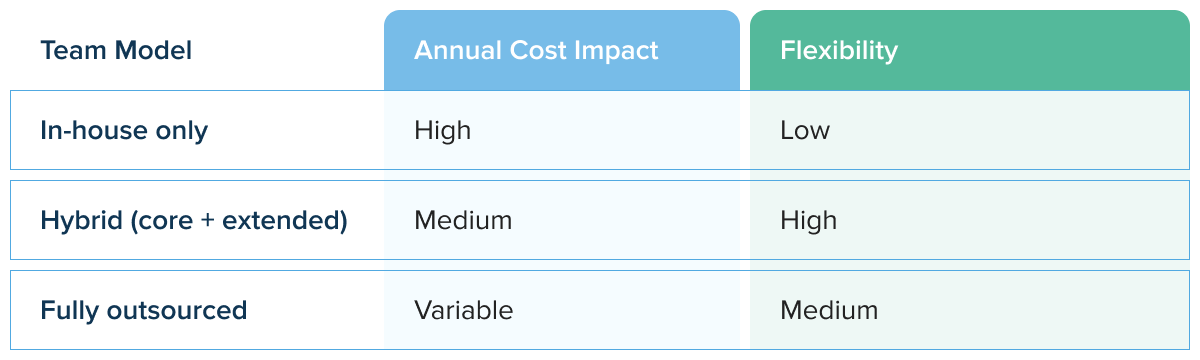
By combining in-house stability with external flexibility, organizations achieve a balanced and resilient development process.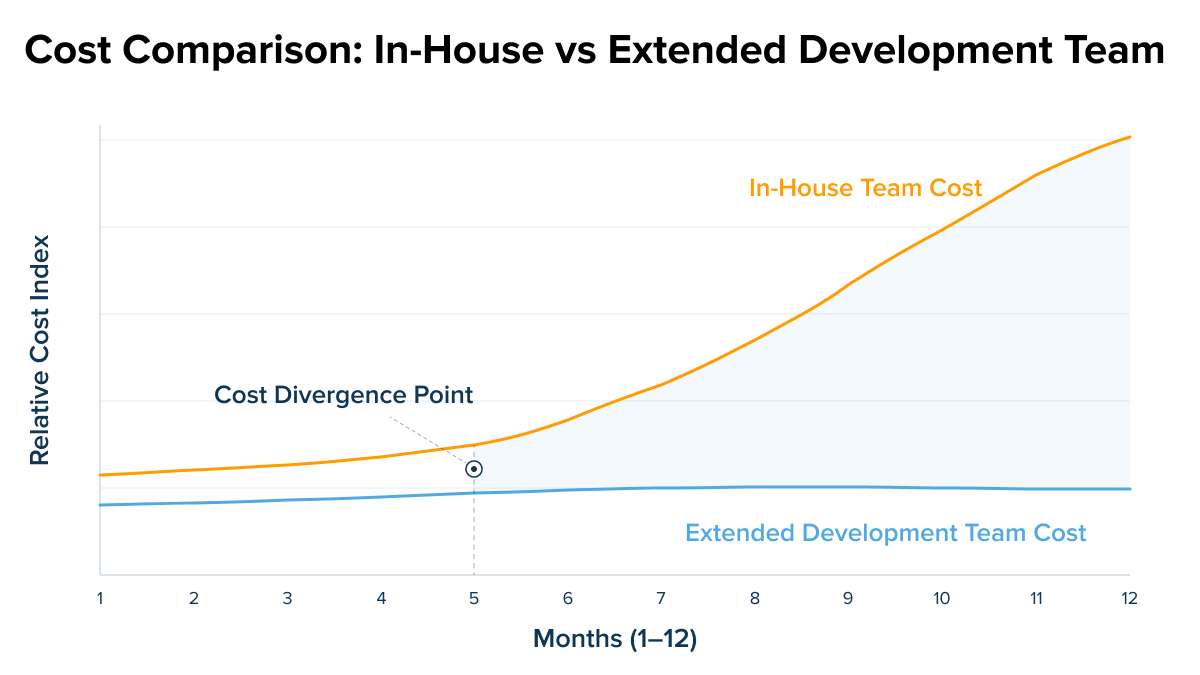
Project demands that signal you need an extended software team
Certain project requirements clearly indicate when an extended software team is the best solution:
- Legacy system modernization
- Enterprise platform expansion
- Tight deadlines and aggressive timelines
- Temporary or evolving skill gaps
- Complex AI or machine learning projects that require specialized expertise
Project type vs team strategy
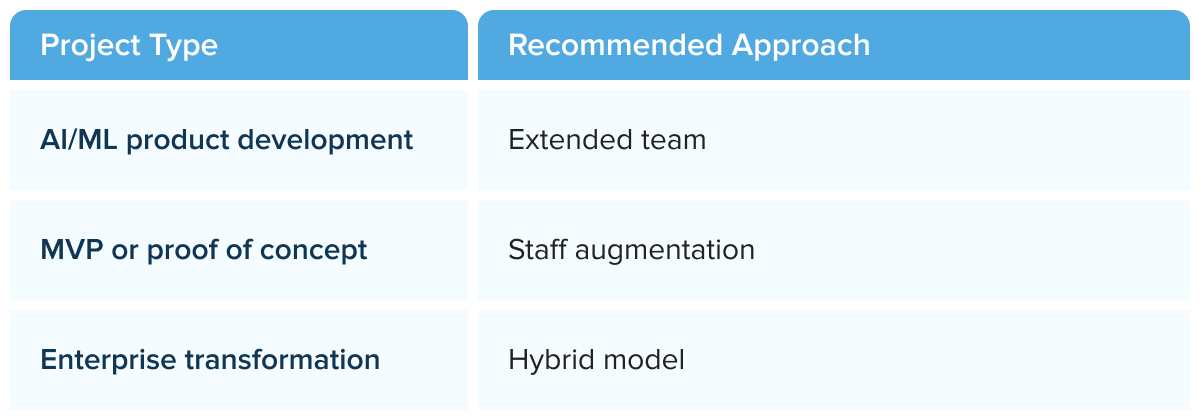
When leaders decide to extend my team, they gain the flexibility to meet immediate demands without committing to permanent structural changes.
Risks of extended development teams and how to mitigate them
While extended development teams offer significant advantages, they are not without challenges. Ignoring these risks can undermine delivery quality and long-term outcomes.
The key is not to avoid extended teams, but to implement them correctly.
Common risks
- Communication breakdowns: Time zones, cultural differences, or unclear expectations can slow progress.
- Unclear ownership boundaries: When responsibilities between the core team and extended team are not clearly defined, accountability suffers.
- Inconsistent quality standards: Without shared coding standards and review processes, quality can degrade.
- Over-dependence on external talent: If knowledge transfer is neglected, businesses risk long-term dependency.
Mitigation strategies
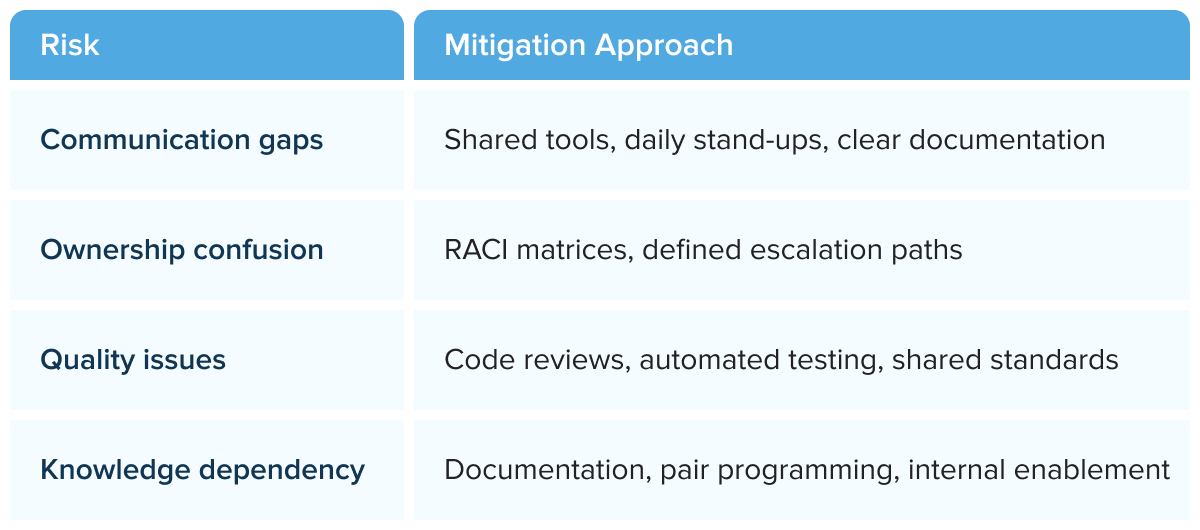
By addressing these risks proactively, organizations can turn extended development into a stable, long-term operating model rather than a short-term workaround.
Extended team vs dedicated team – strategic differences
Organizations often compare an extended team with a dedicated team when planning to extend dedicated software development team capacity.
Extended team vs dedicated team
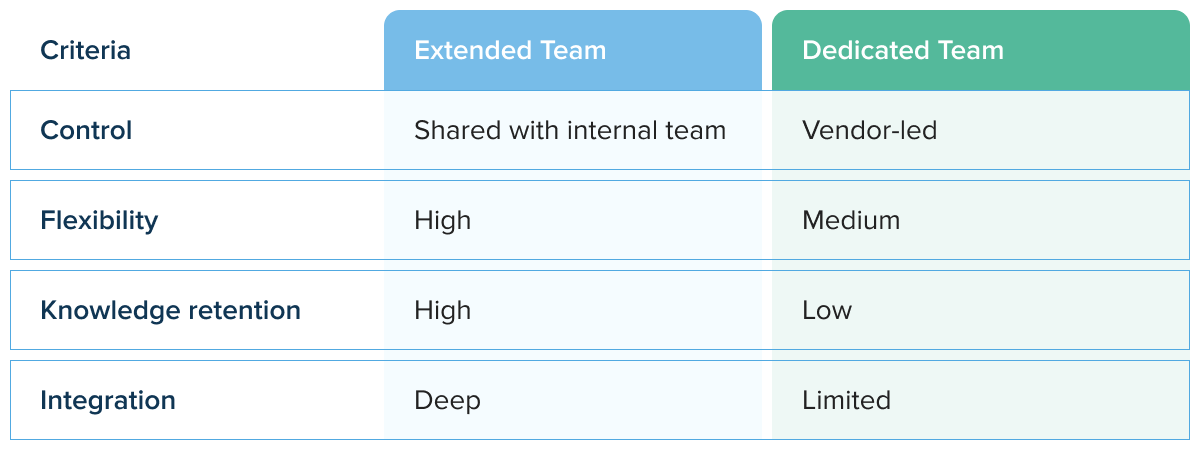
Extended teams are ideal when collaboration, transparency, and long-term knowledge retention matter most.
How to choose a software development company
Choosing the right partner is critical to the success of an extended team. Knowing how to select a software development company ensures long-term value, not just short-term delivery.
For advanced analytics and AI initiatives, working with an experienced data science company reduces delivery risk and improves solution quality.
How to choose the right software development company
When choosing the right software development company, evaluate the following:
- Experience with extended development teams
- Technical depth relevant to your domain
- Strong communication and collaboration practices
- Security, compliance, and IP protection
- Proven delivery of AI and data-driven solutions
A structured approach to choosing a software development company reduces risk and ensures the partnership supports long-term growth rather than short-term execution.
When evaluating long-term partners, it’s important to work with a extend your team company that understands collaborative delivery models and integrates seamlessly with existing workflows.
Assessing a provider’s broader AI services offering also helps ensure they can support your extended team beyond initial development and into long-term optimization.
Governance, KPIs, and performance metrics for extended teams
One of the most common reasons extended teams underperform is not a lack of technical skill, but the absence of clear governance and measurable success criteria.
For AI and data science initiatives in particular, organizations often complement extended teams with AI consulting to define governance models, establish success metrics, and align delivery with long-term AI and analytics roadmaps.
Without this structure, even highly capable teams can struggle to translate technical output into sustained business impact.
Governance best practices
High-performing extended teams operate within a shared governance framework that provides clarity, accountability, and alignment across internal and external stakeholders. Effective governance typically includes:
- Clearly defined decision-making authority across product, engineering, and data teams
- Transparent escalation paths to resolve technical and delivery issues quickly
- Regular performance and delivery reviews aligned with business objectives
- Shared success metrics that link engineering output to AI and data science outcomes
KPIs to track for extended development teams
To ensure extended teams deliver measurable value, organizations should track a balanced set of KPIs that cover delivery efficiency, quality, collaboration, and innovation, especially for AI-driven projects.
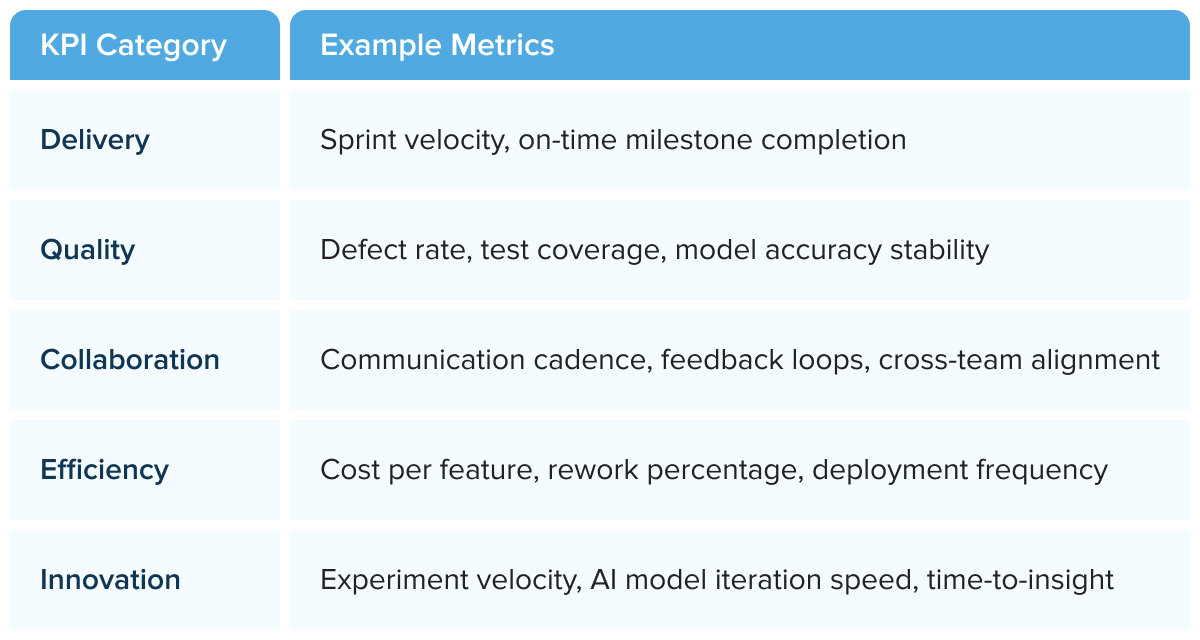
Tracking these metrics consistently helps organizations ensure that extended teams deliver tangible business value, accelerate AI and data science initiatives, and contribute to sustainable, long-term product success, rather than simply producing code.
Choosing a software development company for extended teams
Knowing how to choose a custom software development company is especially important for AI-driven and enterprise solutions. Custom development partners should demonstrate:
- Industry-specific experience
- Ability to scale teams rapidly
- Strong DevOps and MLOps practices
- Proven delivery of complex systems
Custom development evaluation checklist
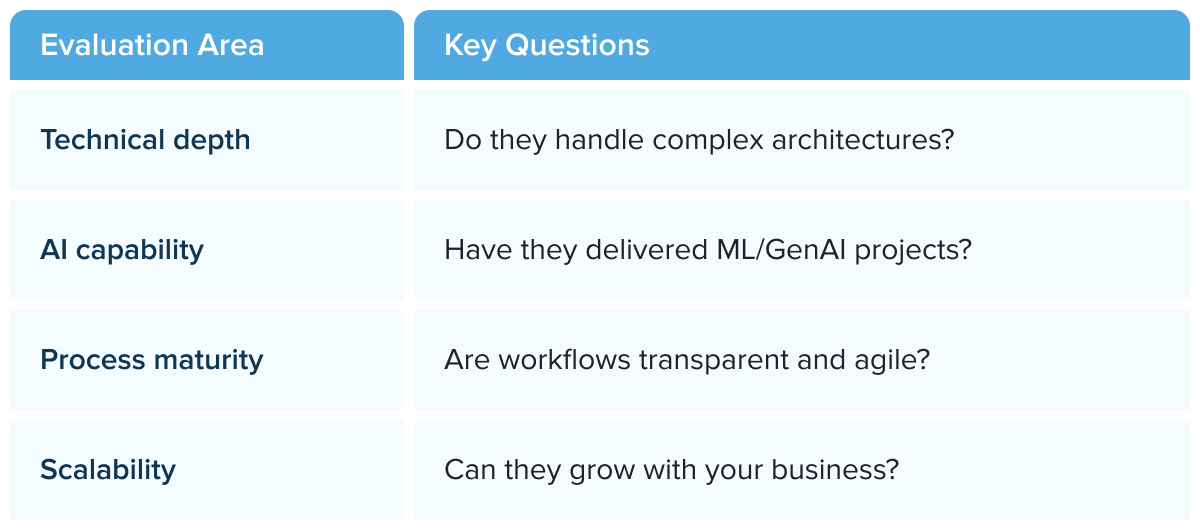
Custom partners should be able to support both current requirements and future expansion.
Extended enterprise software & AI-driven teams
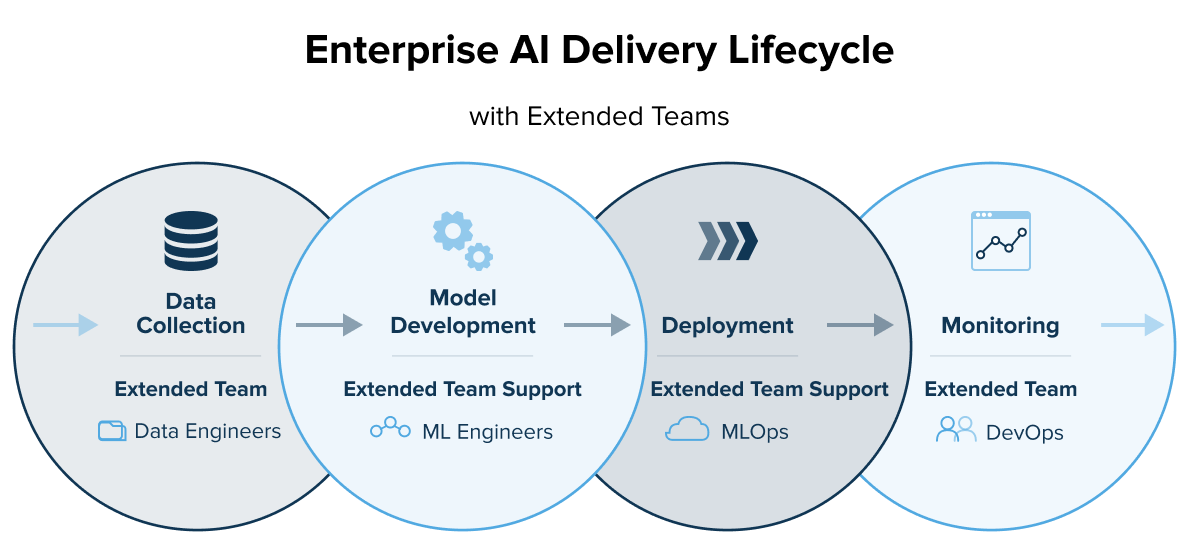
AI projects require expertise across multiple disciplines. The diagram below illustrates how an extended team supports each stage of development and delivery.
AI-first enterprise systems and team extension
As organizations scale digital operations, they increasingly rely on extended enterprise software ecosystems that connect AI, analytics, and automation across multiple business functions. These systems are rarely built in isolation. Instead, they require cross-functional collaboration, deep technical expertise, and the ability to evolve continuously as business needs change.
To meet these demands, many companies partner with an experienced Generative AI company to extend their teams with specialists who understand large language models, intelligent automation, and enterprise-grade AI architecture. This approach enables faster execution while maintaining alignment with internal systems and long-term product strategy.
Aligning AI execution with business outcomes
A critical success factor in enterprise AI initiatives is ensuring that technical implementation supports real business goals. Understanding how to use AI for business analysis helps extended teams translate models, data pipelines, and automation workflows into insights that directly support decision-making.
This alignment allows organizations to move beyond experimentation and ensure AI investments deliver measurable, scalable value across departments.
Enterprise AI use cases and NLP-driven solutions
As AI adoption matures, organizations explore broader AI applications of business to identify where intelligence and automation can deliver the highest impact. In this phase, extended teams often work with advanced NLP tools to develop solutions such as document processing systems, conversational interfaces, and intelligent search capabilities.
A common and highly practical enterprise example is building an AI chatbot for customer service, which helps organizations reduce response times, automate repetitive interactions, and improve customer experience without increasing operational overhead.
Role of extended teams in advanced AI delivery
In advanced AI initiatives, the extended team model functions as a structured delivery approach rather than a staffing mechanism.
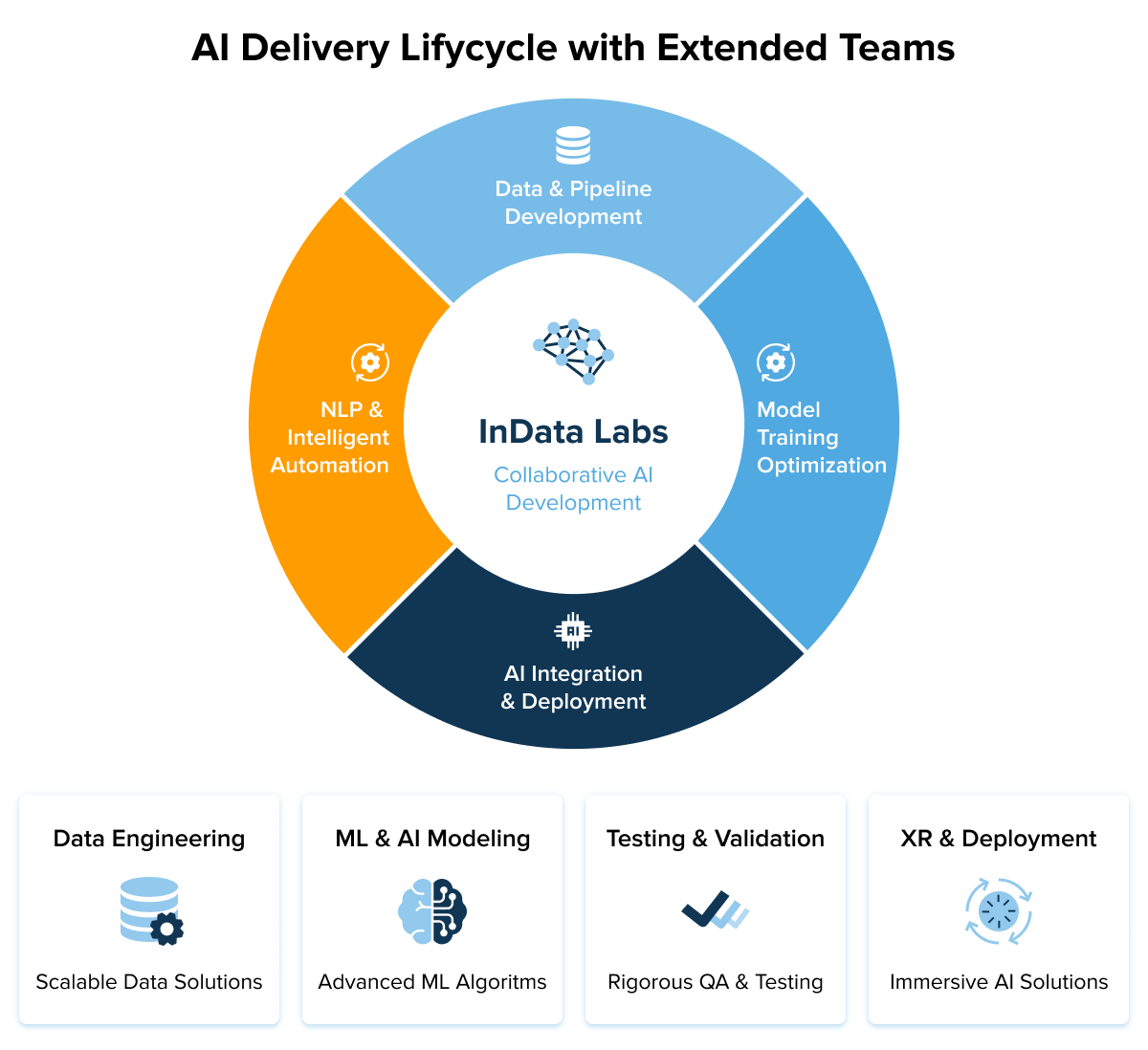
InData Labs works with clients using this model to take end-to-end responsibility for designing, building, and scaling AI solutions, while operating in close collaboration with internal stakeholders.
Across the enterprise AI lifecycle, extended teams enable disciplined execution by combining deep AI and data science expertise with clear ownership of outcomes. This approach supports:
- Scalable AI pipeline development aligned with enterprise data architectures
- End-to-end machine learning lifecycle management, from experimentation to production
- NLP-driven automation and intelligent systems integrated into business workflows
- Delivery of extended reality development services for immersive, enterprise-grade use cases
For AI-first organizations, this collaborative delivery model enables faster experimentation, reduced execution risk, and consistent quality, while ensuring AI solutions integrate seamlessly with existing systems and long-term product strategies.
InData Labs remains accountable for delivery, governance, and results throughout the engagement, without the constraints of traditional hiring models.
Extended team of startups & high-growth companies
An extended team of startups enables founders to move fast without inflating burn rates. Startups frequently leverage extended teams to validate real-world AI business use cases before committing to large-scale in-house hiring. They often extend team capacity to:
- Accelerate MVP development
- Access senior engineers early
- Experiment with AI use cases
- Prepare for investor scrutiny
When team extension is NOT the right choice
To maintain credibility and trust, it’s important to acknowledge that extended development is not a universal solution.
Scenarios where extended teams may not fit
- Very small or short-lived projects
- Highly regulated environments without vendor readiness
- Organizations lacking basic project management maturity
- Teams resistant to collaboration or documentation
In these cases, strengthening house teams or opting for limited staff augmentation may be more effective.
Summary
An extended software development team as a service, when built around strong AI and data science expertise, is no longer just a cost-saving tactic; it is a strategic growth lever.
By combining internal leadership with external specialists in AI, machine learning, and data engineering, organizations can scale efficiently, innovate faster, and respond effectively to evolving market demands.
Key takeaways:
- Extended teams help fill critical skill gaps, improve delivery speed, and enable scalable AI and data-driven development
- Clear collaboration between the core team and extended team is essential for sustained performance and knowledge retention
- The extended team model is especially effective for AI-driven and enterprise-scale projects that require specialized expertise
- Choosing the right software development company directly impacts long-term success, governance, and measurable business outcomes
FAQ
-
An extended group in software development refers to a set of external professionals who collaborate closely with an organization’s internal team.
-
A development team designs, builds, tests, and maintains software solutions aligned with business objectives.
-
An extended team integrates with your internal team, while a dedicated team operates independently under vendor management.
-
Forming, storming, norming, performing, and adjourning.
-
Clarity, Communication, Collaboration, and Commitment.