
Adopting AI can prove to be complex for companies, with the system nested in a core business strategy, and, unfortunately, a startling 95 percent of enterprise AI initiatives fail, the statistics indicate.
There are numerous hurdles to clear when deploying generative AI development for an organisation, and knowing how to ensure your success and what to do helps to benefit greatly from AI in order not to fail.
Currently, a great number of enterprises are still eager to bring artificial intelligence project ideas into their business approach to make operations far easier and attract more clientele.
However, there are instances when leaders fail to recognise the potential of AI; they grant machines a great deal of autonomy while not emphasising misaligned objectives that result from a lack of clarity regarding the problem AI is meant to solve or even from not understanding their negative effects.
Some just consider the AI implementation strategy a simple project like others. For the others, project relevance is decreased by concentrating on the newest AI tools and trends rather than solving practical problems.
Nevertheless, it requires a method based on data, a solid team of specialists, and AI consulting for startup projects to achieve positive results and escape from data science challenges. Let’s look at the common reasons why AI projects fail, with some tips.
The reasons why AI projects don’t succeed
Because of the low percentage of successful AI projects, it has become vital to focus on the key points of why gen AI projects usually fail, as well as prevent a recurrence of previous errors.
Data is the foundation of AI
One of the most widespread AI and machine learning pitfalls is the idea that AI is only about developing new applications and creating new code.
You would be mistaken if you believed that AI software development was similar to what you had previously done for your job. Data is the main priority for artificial intelligence systems, and it cannot be compared to simple software engineering.
Inconsistency between AI goals and ROI
A lack of clarity regarding the purpose of an AI project can lead to needless expenses.
Many failed AI projects haven’t taken the specific purpose of AI tools into consideration, which usually leads to ambiguity in the project’s objectives or misalignment in understanding what the expected ROI will be, creating an environment for project failure.
JCPenney’s mobile app can be one of AI’s failure examples, as clients had to download the app to receive coupons and sales instead of the traditional old method. His aim was digital progress, but as a result, there was a 50% drop in the stock price and a $4 billion loss. Was the objective appropriate to be such a full transformation, or was it better to have a testing period and gather the information about customer preferences?
The importance of data quantity and quality
The crucial part of LLM development is the preparation of data, because AI functions by learning from it. Inadequate data often causes projects to fail, making it difficult for the system to learn or anticipate. Regardless of the type of artificial intelligence—supervised learning or neural networks—its effectiveness is dependent on the quantity of high-quality data available.
As for the quality of data, if you provide your AI with inferior data, it will yield substandard results. And vice versa; that is why it is so important to spend the time to clean the data, transform it, and prepare it for the system. A low-quality set of data will result in a poor model and unreliable output, rendering the AI system as a whole ineffective.
Testing and ongoing data training
Testing artificial intelligence technology in a research environment is not a complicated task, but bear in mind that operating within the reality of business can provide many challenges.
When POC projects are applied in practice, they frequently break down. Evaluating and testing AI systems with authentic, dependable data to assess their performance is essential to know how they will work further. Data always demands control and training for future AI project success. The divide between training data and real-world data can be significant.

Source: Unsplash
Assuming that training data is representative of real-world situations is a frequent error in AI projects. Models that do well in testing but fall short in applications may result from this misalignment. In order to get the most from the model, it’s critical that you assess how well the model aligns with real operational data.
Resource underestimation and a wrong vendor
Resource underestimation is another problem statement for AI projects, because they are resource-intensive and frequently call for large amounts of time and financial commitments. Ensuring sufficient budget and time allocation for these critical components is essential for the success of any AI initiative.
Vendors might give you “hopes” that they are unable to fulfil, so before buying an AI solution, make sure you have done all of your research to make sure your choice satisfies the particular requirements you have for this solution when developing or managing your projects. Look for a solution that will truly satisfy your needs instead of falling for the hype from many of the bigger companies.
Generative AI consulting is a vital step for emerging businesses
Rejection of AI consulting assistance can directly lead to the AI projects failing due to the common mistakes listed above. It primarily concerns emerging businesses that are unfamiliar with AI technology and want to benefit from it for the first time. It assists enterprises in better understanding issues, bottlenecks that are hindering development, etc.
Creating a new AI product
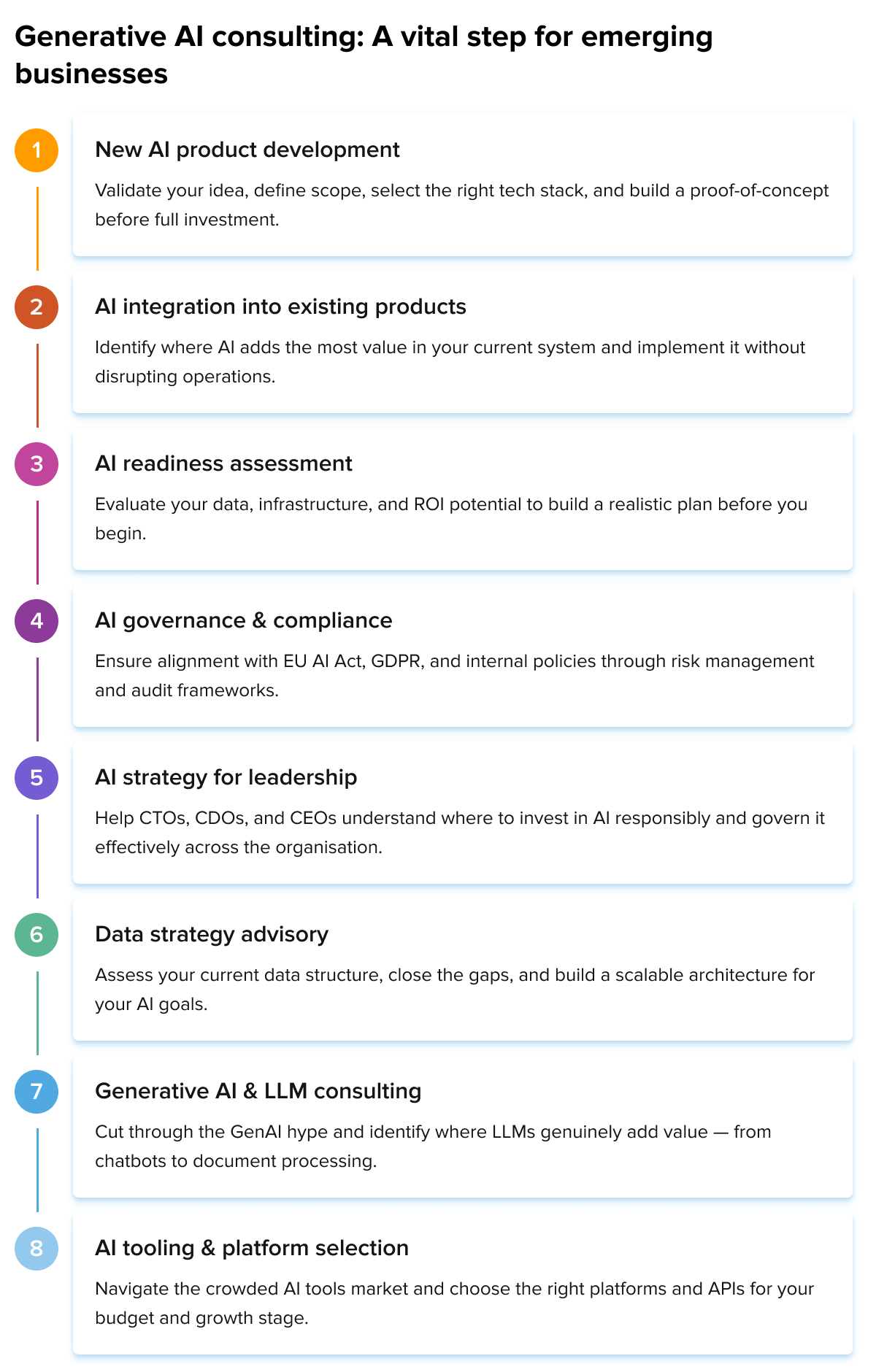
AI project success rate depends on the validation of your idea. Experts in the AI sector help to determine the project’s scope, choose the right technology stack, estimate development costs, and produce a proof-of-concept to help you invest with confidence rather than attempting to determine whether your idea is feasible or not. For those who are just starting to learn about AI, it is really helpful.
The inclusion of AI in the current project
If an organisation has a current product, AI consulting services will be useful as well. By taking your data, code, and the infrastructure, they show you where you would receive the highest value with AI and implement it seamlessly into your current system without disrupting the process.
Examining AI preparation
Thanks to examining AI preparation, you can be sure that your project will follow a realistic plan, especially if you haven’t decided how to get started on AI. Data analysis and technical tools, ROI projections for earlier artificial intelligence failure detection, are typically part of the assessment.
AI management and adherence
AI governance is a must, and the absence of it can be a reason AI projects fail. Adherence to standards such as the EU AI Act and GDPR, outlining applicable policies, audit trails, and risk management to guarantee the transparency and explainability of your AI systems. It is a key step for companies of different scales.

Source: Unsplash
AI strategy for business leaders
An AI strategy for business leaders is designed as a high-level engagement for senior leaders and C-suite teams to better understand AI technologies, identify high-value opportunities, and make informed investment decisions without incurring unnecessary costs. Responsible AI governance has become a strategic priority for CTOs, CDOs, and CEOs, making it essential to work with a trusted technical partner who can provide practical guidance rather than a sales pitch.
Want to learn more about how InData Labs develops secure, scalable, and business-focused custom AI solutions? Watch the video to discover our approach to AI strategy, solution development, implementation, and long-term support that helps organizations maximize ROI while minimizing risks.
Data strategy advisory services
There is no doubt that high-quality data is the foundation of AI project success. AI advisory services are first aimed at evaluating a company’s current data structure and database systems to determine gaps.
As a result, you will get an expandable, flexible data architecture that aligns with your AI goals—regardless of your environment type: on-premise, cloud, or hybrid. It will be extremely beneficial to businesses that do not have an organized data model or fragmented data.
Generative AI and LLM consulting
In order to identify where LLMs actually add value to your workflow, generative AI consulting helps businesses understand the GenAI hype. Processing documents and updating your internal knowledge base for chatbots and other customer-facing AI assistants are two examples of this.
Advice on choosing tools
Because the market for AI tooling options can become quite complex, experts can analyse all available options for platforms and APIs, whether they are MLOps or cloud-based AI services, and help you make a decision based on your budget and the capacity to grow over time, and avoid AI failure.
How to choose an AI vendor?
After examining why AI projects are failing comes the step of choosing an AI vendor. It is important to assess the vendor’s capability to fulfil your specific requirements, both technically and in terms of security and experience within your industry. Important components to consider include the following list of assessment criteria:
Confirm that vendors comply with laws such as the GDPR and CCPA and that they have very strict protocols for handling data securely.
Choose a vendor that is familiar with your industry and has a history of working with companies like yours.
Look at the vendor’s AI algorithms, LLM-agnostic support, etc., when deciding on their capabilities.
The vendor solution should be easily integrated into your current technology and scale with your company’s growth.
Ask to see the total cost for ownership versus the benefits you expect from the vendor, for example, increased productivity.
Make sure the vendor provides enough training and ongoing help in order to allow for successful implementation.
Wrapping up
In conclusion, when we look at what percentage of AI projects fail every year and the clear explanations of the main reasons that give rise to such conclusions and expenses, we can learn from them to succeed and make a profit at the same time.
With the intention of successfully pursuing artificial intelligence projects, you must not only be knowledgeable about them but also incorporate a data focus, match project objectives with your organisation’s overall goals, ensure appropriate data quality and quantity, and provide comprehensive testing, uninterrupted management, and support.
Obliged to AI consulting services for beginners, newborn AI projects will increase the likelihood of success for your organisation’s AI efforts and, as a consequence, decrease artificial intelligence failure.
FAQ
-
Insufficiently defined strategic goals, using poor-quality data, and underestimating the amount of resources needed are causes for why AI projects fail. Additionally, project teams tend to approach AI as a passing trend rather than as a solving agent.
-
A common reason is due to a lack of alignment with the intended or desired business objectives. In many cases, organisations will invest heavily in developing and utilising data science but fail to have a plan or comprehension of how this investment will finally translate to positive effects.
-
By reason of the continuous spread of AI, about 85 million jobs will be eliminated in 2026, according to the forum. The previously existing position is considered to be operated by robots.
-
Poor data quality, inconsistent ROI and AI goals, a lack of comprehensive testing and continuous data training, ethical concerns, and other factors all contribute to AI’s eventual failure.