Choosing the right partner from the many AI consulting companies in the USA is one of the most consequential decisions a business can make in 2026. As artificial intelligence transitions from experimental pilot to enterprise standard, the demand for specialized guidance has never been greater.
According to Future Market Insights, the global AI consulting services market is projected to grow from USD 11 billion in 2025 to nearly USD 91 billion by 2035—a compound annual growth rate exceeding 26%. That trajectory makes the selection of a technically credible, strategically aligned consultancy a matter of competitive urgency.
This guide profiles the leading AI consulting companies in the USA, evaluating each on the basis of technical expertise, industry coverage, delivery track record, and approach to data governance. Whether your organization is pursuing AI strategy development, custom model deployment, or enterprise-wide automation, this list is designed to support an informed procurement decision.
Top AI consulting firms in the USA


What defines a top-tier AI consulting company in the USA?
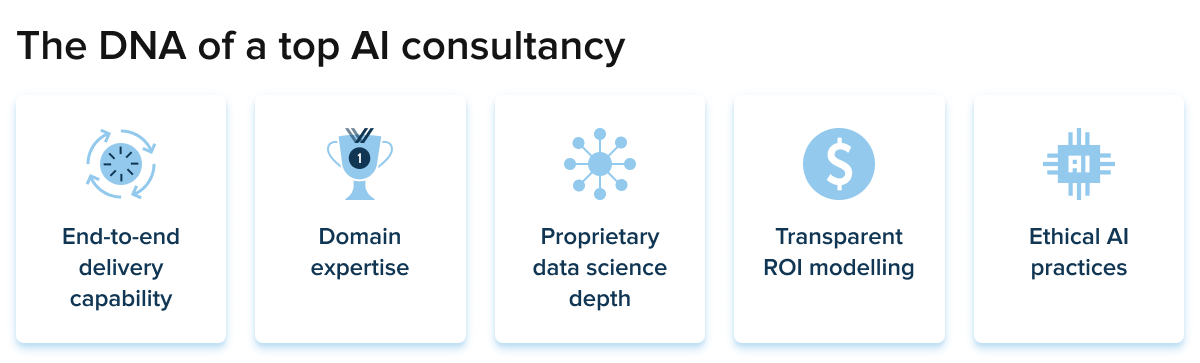
Before reviewing specific providers, it is worth establishing the criteria that distinguish a high-performing AI consultancy from a firm that merely claims AI capabilities. The top AI consulting companies in the USA share several defining characteristics:
- End-to-end delivery capability—from use case identification and data readiness assessment through to model deployment, integration, and ongoing monitoring
- Domain expertise—demonstrated experience in regulated sectors such as healthcare, fintech, and logistics, where compliance requirements shape every aspect of AI implementation
- Proprietary data science depth—In-house expertise in machine learning models, natural language processing, computer vision, and predictive analytics, rather than reliance on off-the-shelf vendor tooling
- Transparent ROI modelling—the ability to quantify the business case before development begins, using conservative, evidence-based forecasts
- Ethical AI practices—structured approaches to bias mitigation, explainability, and regulatory compliance, including GDPR, HIPAA, and CCPA.
With these standards as a foundation, the following profiles represent the most credible providers of AI consulting services in the USA operating at the time of publication.
Key considerations when evaluating AI consulting firms in the USA
Before you sign a contract, here’s what the best AI consulting firms have in common.
AI strategy vs. implementation-focused consulting
A critical distinction among AI strategy consulting firms in the USA is whether a firm leads primarily with strategic advisory or with engineering execution.
Strategy-led consultancies—such as McKinsey and Deloitte—excel at executive alignment, governance frameworks, and transformation roadmaps. Implementation-focused firms—such as InData Labs, RTS Labs, and ThirdEye Data—prioritize production delivery and technical depth. The most effective engagements typically require both, which is why firms that offer genuinely integrated strategy and delivery capabilities command a premium.
Data privacy and regulatory compliance
For businesses operating in regulated sectors, the ability of a consultancy to navigate US data privacy frameworks—including CCPA, HIPAA, and sector-specific standards—is non-negotiable.
AI consulting firms in regulated industries in the United States must demonstrate structured approaches to data governance, access controls, audit trails, and privacy-preserving techniques such as differential privacy and anonymization. Firms with formal compliance certifications, such as ISO/IEC 27001, provide an additional layer of assurance.

Source: Unsplash
Custom model development vs. LLM fine-tuning
The choice between building a custom model from the ground up, fine-tuning an existing large language model, or implementing a RAG-based solution depends on the specificity of the use case, the availability and quality of proprietary training data, and the budget available.
With parameter-efficient techniques like LoRA and QLoRA now dramatically reducing the cost of fine-tuning, the bar for custom adaptation has lowered—making the decision less binary and more about matching the right approach to the right problem.
Firms such as InData Labs offer both approaches, allowing clients to select the path that best balances cost, performance, and long-term maintainability. An experienced AI technology consulting partner will help organizations make this determination based on evidence rather than vendor preference.
ROI timeline and cost structures
AI consulting rates in the USA vary significantly based on the type of firm and the scope of engagement. Boutique and specialist firms typically charge between USD 100 and 250 per hour, offering flexible engagement models that cater to both project-based work and ongoing retainer arrangements. Mid-tier firms generally range from USD 150 to 300 per hour, while larger global consultancies may charge between USD 300 and 600 per hour for senior advisory roles.
For project-based investments in full-scale AI implementations, including change management, costs can range from USD 200,000 to over USD 1 million. The return on investment (ROI) timelines vary depending on the specific use case, but well-structured engagements often yield measurable returns within 6 to 18 months following deployment.
Algorithmic bias and ethical AI
Responsible AI is no longer an optional consideration for enterprise organizations. The best AI consulting firms in the USA incorporate bias detection, fairness auditing, and explainability requirements into every stage of model development.
For organisations in healthcare, financial services, and public sector applications, these practices are also increasingly mandated by regulation. Ensure that any prospective partner can demonstrate a structured methodology for identifying and mitigating demographic, temporal, and categorical bias in training data.
Legacy data integration and AI readiness
One of the most common barriers to successful AI adoption is the state of an organization’s existing data infrastructure. Fragmented data sources, legacy systems, and inconsistent data quality can significantly extend timelines and inflate costs.
This upfront investment in data strategy is one of the strongest predictors of a successful long-term outcome. InData Labs, for instance, offers dedicated data science consulting services focused on exactly this challenge.
Conclusion
The landscape of AI consulting companies in the USA is broad, technically diverse, and growing rapidly.
For organizations seeking a partner that combines deep data science expertise with a practical, business-aligned approach to delivery, InData Labs stands out as a proven choice—offering the full range of artificial intelligence consulting capabilities required to take an organization from AI readiness through to production-grade deployment and ongoing optimization.
Regardless of the engagement model chosen, the most successful AI implementations share a common characteristic: they begin with a clearly defined business objective, a realistic assessment of data maturity, and a partner whose incentives are aligned with long-term outcomes rather than short-term project delivery.
To explore how InData Labs can support your organization’s AI journey, visit the AI consulting services page or review the firm’s portfolio of AI software development and generative AI solutions case studies.
FAQ
-
A top-tier firm combines strategic advisory capability with production-grade engineering, deep domain expertise in relevant industries, and a demonstrable track record of deploying AI systems that deliver measurable business outcomes — not merely proof-of-concept demonstrations.
-
Experienced consultants typically conduct a structured use case discovery process that maps business priorities against data availability, technical feasibility, and expected ROI.
High-impact use cases are those that address a significant operational pain point, are supported by sufficient and accessible data, and can be implemented within a realistic timeline and budget.
-
Well-structured AI implementations typically deliver initial measurable returns within 6–12 months of deployment, with more significant value realisation occurring in the 12–24 month range as models improve and adoption deepens across the organisation.
-
Leading firms build regulatory compliance into the architecture of every AI solution from the outset — applying data anonymisation, access controls, audit logging, and usage policies that align with applicable frameworks. Firms operating in healthcare additionally comply with HIPAA requirements.
-
Generative AI has become a central pillar of enterprise AI strategy, enabling applications ranging from intelligent document processing and customer-facing conversational assistants to internal knowledge management and automated content generation.
The most effective deployments align GenAI capabilities to specific, high-value business processes rather than pursuing broad adoption for its own sake.
-
Evaluate proficiency across the modern AI stack—including LLMs, vector databases, MLOps tooling, cloud AI platforms, and integration middleware. Equally important is evidence that the firm can integrate AI systems into existing ERP, CRM, and data infrastructure without requiring wholesale system replacement.
-
Common KPIs include reduction in manual processing time, improvement in prediction accuracy, cost savings attributable to automation, revenue uplift from AI-driven personalisation, and reduction in error rates. Firms should establish baseline metrics and measurement methodologies before deployment begins.