
Custom AI model development has become a decisive factor for enterprises seeking a measurable competitive advantage beyond off-the-shelf artificial intelligence tools.
While generic AI solutions provide speed and accessibility, they often fail to align with proprietary data sources, industry-specific workflows, and performance benchmarks required in real-world business environments. Organizations investing in custom AI model development gain greater control over model training, the ability to adjust the model’s parameters based on domain-specific objectives, and the flexibility to optimize metrics like accuracy, precision, and recall according to strategic priorities.
Whether the objective is predictive analytics, automation, or custom generative AI models development, understanding the structured AI model development process is essential for transforming an experimental AI project into a successful AI model that performs reliably in production environments.
In highly competitive markets, AI is no longer experimental. It is infrastructure. And infrastructure demands architectural discipline, governance, and long-term scalability.
Why businesses move toward custom AI models
Artificial intelligence adoption is accelerating globally. According to the Stanford University AI Index Report, global investment in artificial intelligence continues to expand rapidly as organizations scale automation, predictive analytics, and generative AI systems across core business operations.
However, as AI initiatives mature, organizations encounter limitations in pre-built tools.
Business indicators that signal the need for custom AI model development:
- Organizations typically transition to custom AI model development when:
- Proprietary training data cannot be effectively used in packaged AI tools
- Model’s performance in generic systems plateaus
- Regulatory compliance requires full control over data sources
- Competitive advantage depends on domain specific insights
- Explainability and governance become mission-critical.
Custom AI development becomes less about experimentation and more about building durable digital capability supported by specialized AI consulting expertise and enterprise implementation strategies.
What is AI model development?
AI model development refers to the structured process of designing, training, validating, deploying, and maintaining machine learning models that solve a clearly defined business problem.
The National Institute of Standards and Technology (NIST) defines artificial intelligence systems as software that can learn from data and improve performance on specific tasks over time.
As outlined in the Wikipedia definition of artificial intelligence, AI systems simulate cognitive functions such as learning, reasoning, and decision-making. In enterprise contexts, this translates into intelligent automation, fraud detection, recommendation engines, forecasting systems, and large language model applications.
Organizations that implement enterprise AI typically follow a structured AI software development process to ensure models move from research to production environments efficiently.
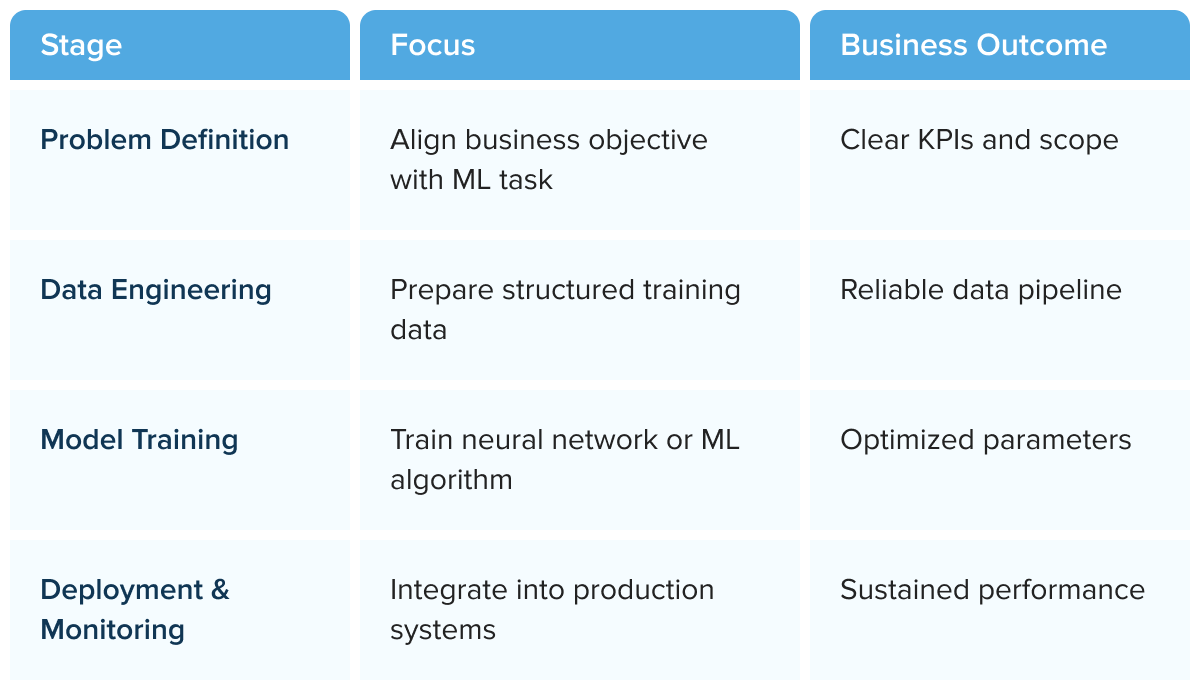
The AI model development process is iterative. It requires continuous monitoring to maintain performance under unseen data conditions.
Key drivers of successful custom AI model development
Getting it right starts with understanding what truly drives results.
Data quality and data sources
High-quality training data remains the single most important factor in building a successful ai model. Machine learning models are fundamentally dependent on the representativeness, structure, and cleanliness of input data.
Organizations often encounter three challenges:
- Incomplete or biased datasets
- Unstructured data requiring preprocessing
- Fragmented data across legacy systems
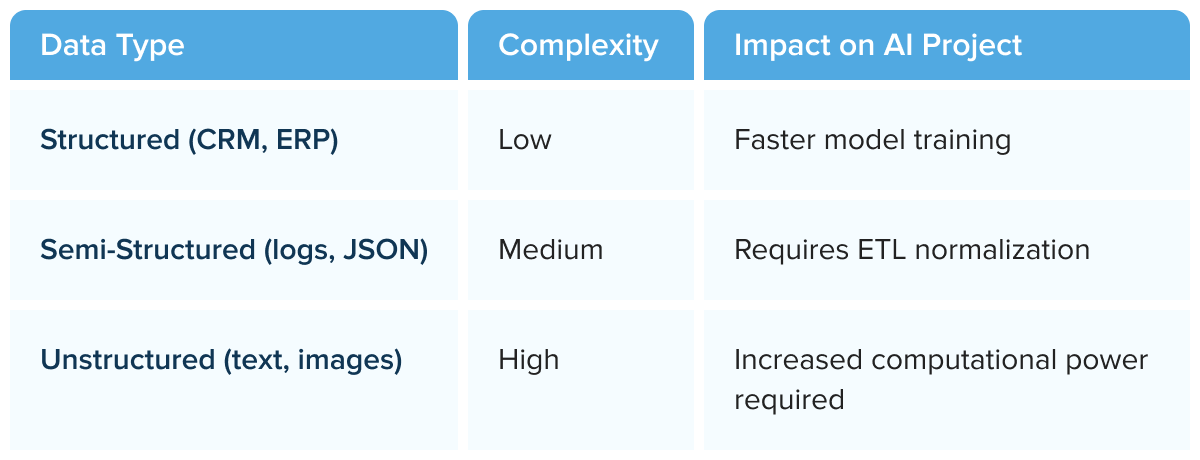
Without robust data governance, even sophisticated neural network architectures underperform.
The strategic role of proprietary data in custom AI model development
One of the most decisive advantages of custom AI model development lies in the ability to train models using proprietary organizational data. While generic AI tools rely primarily on public or aggregated datasets, enterprise systems operate within specialized environments where operational context matters.
Custom AI models allow organizations to incorporate internal data sources that reflect real workflows, customer behavior patterns, operational constraints, and market dynamics.
These systems are often developed as part of broader AI product development initiatives that integrate data engineering, machine learning, and production deployment.
Examples of proprietary datasets commonly used in enterprise AI projects include:
- financial transaction histories
- manufacturing equipment telemetry
- medical diagnostic records
- supply chain logistics data
- customer interaction and behavioral data.
When these domain-specific datasets are integrated into model training pipelines, machine learning models can identify patterns that generic systems cannot capture.
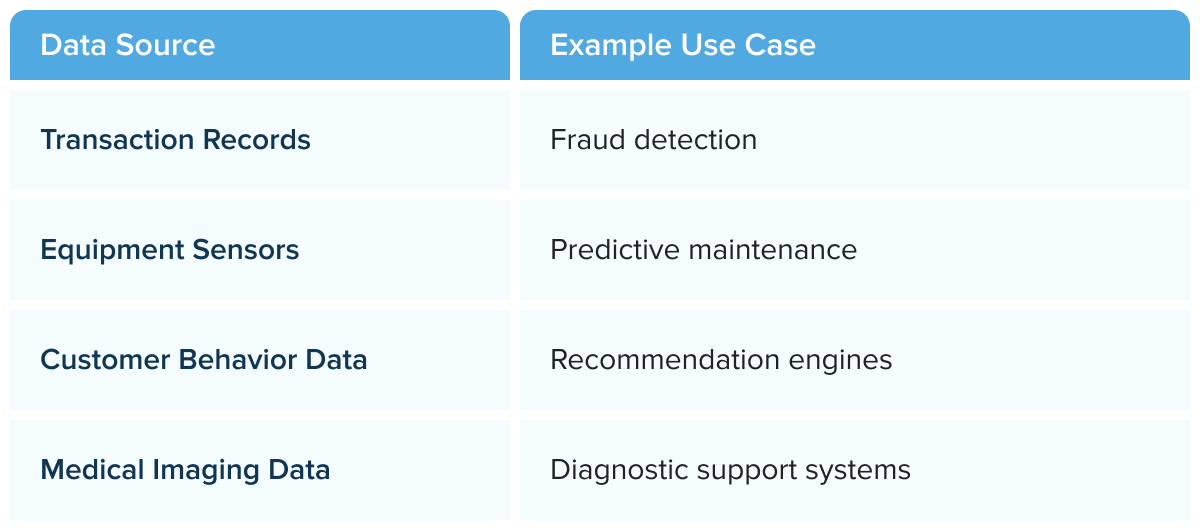
Organizations that successfully operationalize proprietary data pipelines often achieve significantly higher model accuracy and stronger competitive differentiation.
Algorithm design and model training
The performance of AI models requires careful architectural selection and parameter optimization.
Training involves:
- Selecting appropriate machine learning models
- Adjusting the model’s parameters
- Hyperparameter tuning
- Evaluating metrics like accuracy precision, and recall.
Applications such as medical imaging or fraud detection demand near-perfect precision. As noted in various enterprise AI analyses by Forbes Technology Council, higher accuracy thresholds inevitably increase development complexity and cost.
How to build a custom AI model
Building a custom AI model requires both engineering discipline and strategic clarity.
Define the business objective
Translate operational goals into measurable ML tasks. Avoid vague objectives such as “improve automation.” Instead, define quantifiable outcomes.
Prepare training data
This includes:
- Data cleansing
- Standardization
- Labeling
- Anonymization if sensitive.
Data scientists play a central role in structuring usable training data pipelines.
Select architecture
Depending on the use case:
- Gradient boosting algorithms
- Deep neural network architectures
- Transformer-based large language model systems.
Train and evaluate
The model training stage involves experimentation cycles. Engineers validate the model against unseen data to prevent overfitting.
Deploy and monitor
Deployment includes API integration, infrastructure scaling, and real-time performance logging. Wondering how this looks in practice? Here’s how we approach custom AI model development at InData Labs.
The role of baseline models in AI development
A baseline model is often the first analytical model created during an AI project. Although baseline models are intentionally simple, they serve as a crucial reference point for evaluating future model improvements.
Instead of immediately building complex neural networks, data scientists typically begin with simpler algorithms such as linear regression or decision trees. These models allow teams to quickly test whether the available data contains meaningful predictive signals.
Baseline models help teams:
- estimate the predictive potential of available data
- benchmark future model improvements
- identify early data quality problems
- reduce unnecessary computational experimentation.
Once the baseline model establishes a performance benchmark, more advanced architectures can be introduced to improve predictive capability. This staged experimentation approach reduces development risk and ensures that the AI model development process remains data-driven rather than purely theoretical.
How to train custom AI model effectively
Training is rarely a one-time event. It is a controlled optimization process.
Critical considerations in model training
- Availability of computational power
- Balanced training data
- Regularization techniques
- Continuous validation
Model drift occurs when the statistical properties of real world data change over time. This degrades model’s performance.
Managing model drift
- Organizations mitigate drift through:
- Scheduled retraining
- Performance threshold alerts
- Continuous data ingestion pipelines
- A/B validation in production.
Without drift management, even a successful AI model gradually loses relevance.
Develop custom generative AI models
Generative AI represents a significant shift in AI strategy. Enterprises increasingly seek to develop custom generative AI models tailored to their domain knowledge.
Unlike generic chatbots, custom generative AI model development focuses on:
- Domain-specific content generation
- Proprietary document drafting
- Enterprise knowledge retrieval
- Automated reporting.
Modern enterprise solutions increasingly rely on Generative AI models to automate complex reasoning and document generation workflows. These systems allow organizations to process large volumes of information, generate reports and documentation, and assist knowledge workers in analyzing data more efficiently.
When integrated into operational workflows, generative AI technologies help reduce manual effort while improving the speed and consistency of business decision-making.
Many organizations implement these systems as part of broader Generative AI development initiatives designed to support intelligent automation and enterprise knowledge systems. Retrieval-Augmented Generation (RAG) architectures enhance reliability by grounding responses in verified data sources.
A detailed overview of enterprise Generative AI architectures explains how domain-grounded models reduce hallucination risks.
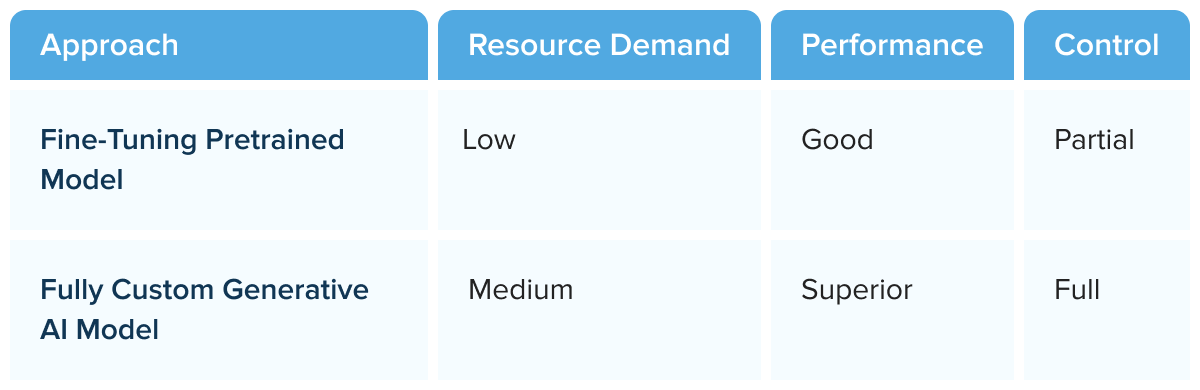
Organizations pursuing custom generative AI models development typically prioritize long-term control over short-term cost savings. Many of these systems power intelligent assistants and enterprise LLM apps designed to automate knowledge workflows.
Integration bottlenecks in custom AI development
Even when the machine learning models are technically sound, integration remains one of the most underestimated risks in custom AI model development.
Established organizations often operate on legacy infrastructure that was never designed to support intelligent systems. As a result, AI deployment becomes less about algorithm performance and more about ecosystem compatibility.

Source: Unsplash
Most integration friction stems from architectural fragmentation. Data may exist in multiple systems without a unified representation. APIs may not support real-time inference. Security layers may introduce latency. These constraints directly impact the model’s performance in production environments.
The most common integration barriers include:
- Legacy system incompatibility
- Disconnected data sources
- API limitations
- Infrastructure scaling constraints
- Latency sensitivity in real-time applications.
In many AI projects, integration consumes more time and budget than model training itself. This is why architecture planning must begin during the feasibility stage rather than at deployment.
Security and ethical considerations
Custom AI model development services must address data privacy, algorithmic fairness, and governance.
According to the OECD AI Policy Observatory, ethical AI frameworks emphasize transparency, accountability, and bias mitigation. Training AI models requires careful handling of sensitive information to prevent data leakage.
Key considerations include:
- Data anonymization
- Differential privacy
- Bias audits
- Explainability mechanisms.
Cost and investment perspective
Custom AI model development is capital-intensive, but strategic in nature.
Core cost drivers:
- Data complexity
- Algorithm sophistication
- Infrastructure requirements
- Maintenance and retraining.
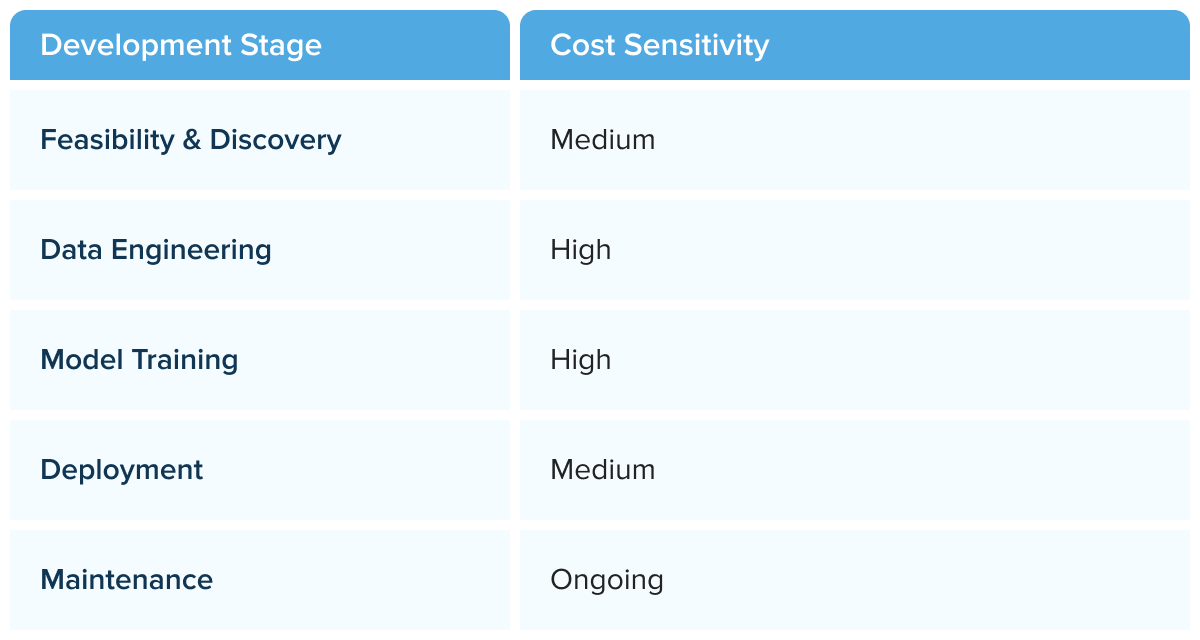
While AI project costs vary significantly, enterprises increasingly treat AI as long-term digital infrastructure rather than short-term tooling.
Data complexity
Intelligent systems depend on high-quality training data. When datasets are incomplete, fragmented, or unstructured, additional preprocessing is required. Extract, Transform, and Load processes increase development timelines and require specialized expertise.
Algorithm sophistication
The more advanced the neural network architecture, the greater the demand for computational power. High-precision applications such as fraud detection or predictive diagnostics require extensive experimentation cycles.
Infrastructure requirements
Scalable deployment environments, GPU clusters, secure storage, and MLOps pipelines all contribute to overall investment.
Maintenance and retraining
AI models degrade without continuous updates. Model drift, changing data distributions, and evolving business requirements make ongoing retraining essential.
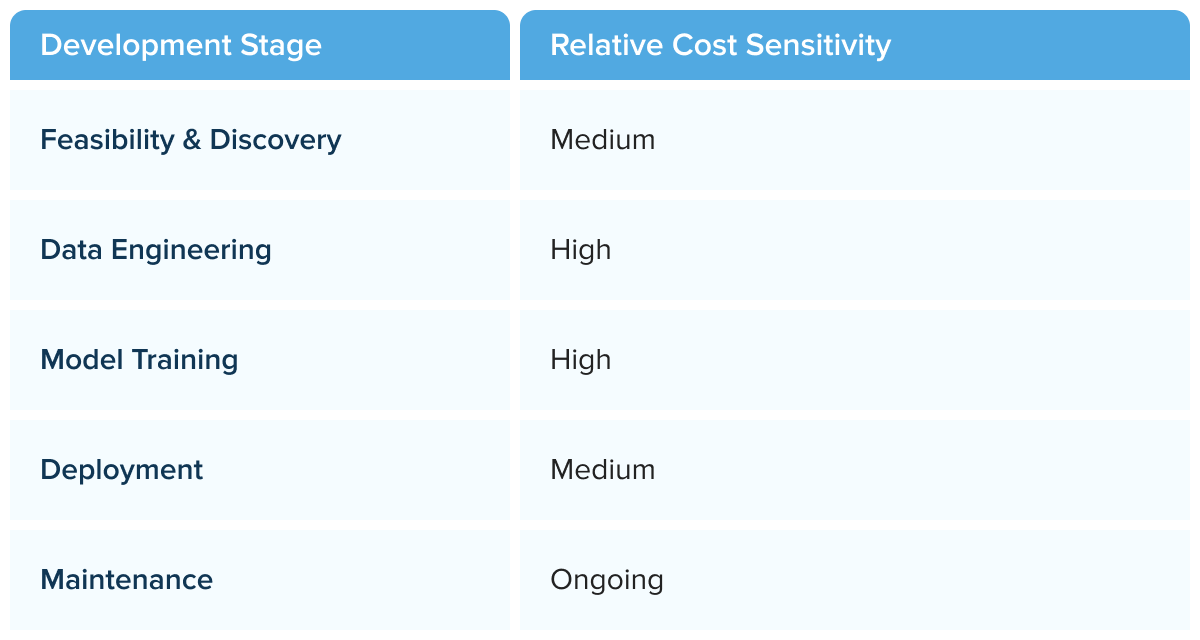
Organizations that approach AI as long-term infrastructure rather than one-time implementation are more likely to achieve sustained project success.
Role of a custom AI model development company
Building a successful AI system requires more than data scientists and code. It requires coordinated architecture, governance, integration, and lifecycle management.
A custom AI model development company typically guides clients through:
- Business problem analysis
- Technical feasibility validation
- Architecture design
- Model training and evaluation
- Deployment and MLOps implementation
- Continuous “monitoring and optimization”.
These initiatives often form part of larger enterprise transformation strategies that deliver Custom AI solutions across industries such as healthcare, finance, manufacturing, and retail.
Partnering with experienced AI model development services reduces technical risk and accelerates delivery timelines.
Organizational capabilities required for AI success
Successful AI implementation requires more than machine learning expertise alone. Effective custom AI model development depends on coordinated collaboration between multiple disciplines across an organization.
AI initiatives typically involve specialists from several domains.
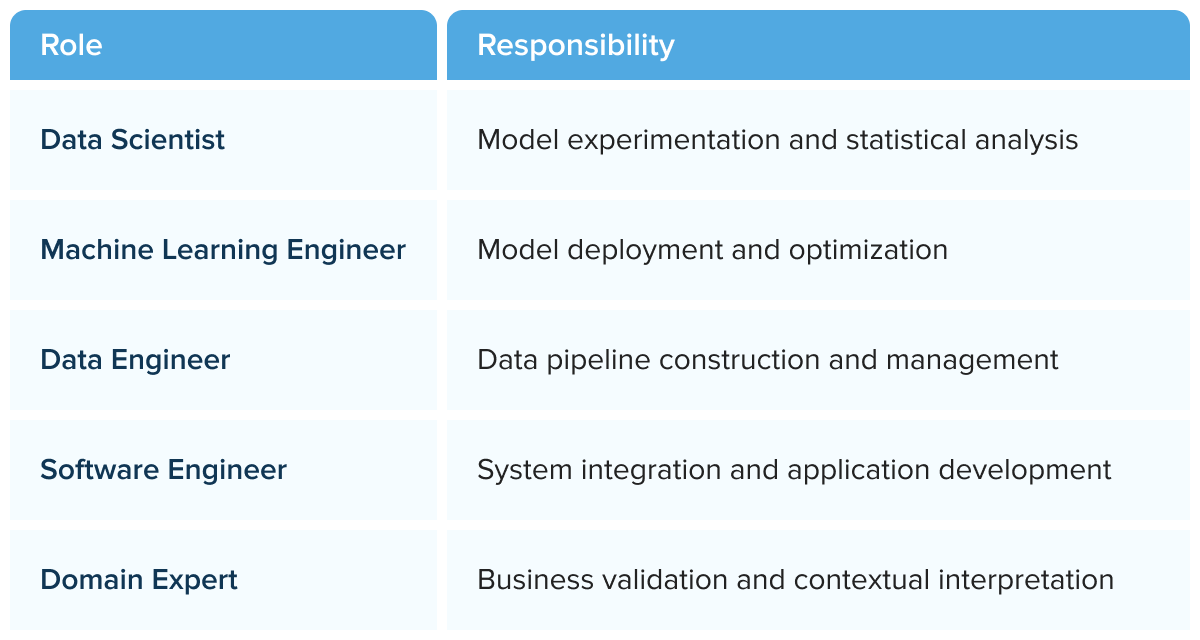
This multidisciplinary structure ensures that AI models remain aligned with real business requirements rather than isolated technical experimentation. Organizations that treat AI as a cross-functional capability rather than a standalone technical project tend to achieve more sustainable results.
Industry applications of custom AI model development
Custom AI models are increasingly being adopted across industries where domain expertise and proprietary data create opportunities for intelligent automation.
Financial services
Banks and financial institutions deploy machine learning models to detect fraud, assess credit risk, and automate regulatory compliance reporting.
Healthcare
Healthcare providers use AI systems to analyze medical images, predict patient outcomes, and support clinical decision-making processes.
Manufacturing
Manufacturers deploy predictive maintenance systems that analyze equipment sensor data to detect potential failures before they occur.
Retail and E-Commerce
Retail companies implement recommendation engines that personalize shopping experiences based on behavioral data and purchase histories.
Across industries, custom AI model development enables organizations to move beyond generic automation toward systems that directly support operational decision-making.
Governance, monitoring, and lifecycle management in AI model development
As organizations move beyond early experimentation with artificial intelligence, one of the most important shifts involves how AI systems are governed and maintained.
Unlike conventional software systems, machine learning models evolve continuously as new data becomes available. Without structured governance and monitoring frameworks, even well-designed AI models can gradually lose reliability.
For this reason, mature enterprises treat custom AI model development not as a one-time implementation but as a lifecycle discipline. Governance frameworks ensure that AI models remain aligned with regulatory standards, ethical guidelines, and business objectives over time.
AI governance in enterprise environments
AI governance refers to the policies, processes, and oversight mechanisms used to manage the development and deployment of AI systems. Effective governance frameworks address several critical areas simultaneously:
- transparency in model decision-making
- accountability for automated decisions
- security of sensitive data sources
- traceability of model training processes
- compliance with regulatory requirements.
Governance structures often include cross-functional oversight teams composed of technical leaders, legal advisors, data scientists, and domain specialists.
Organizations implementing enterprise-scale AI systems typically establish governance policies that define how machine learning models are evaluated, approved, and monitored throughout their operational lifecycle.
Model monitoring and performance management
Once an AI system is deployed into production, its behavior must be continuously evaluated to ensure that predictions remain reliable. Real-world environments introduce new patterns and data distributions that may not exist in the original training dataset. Without monitoring, models may silently degrade.
Model monitoring systems track several types of indicators:
- prediction accuracy and error rates
- distribution shifts in input data
- latency and infrastructure performance
- user feedback and operational outcomes
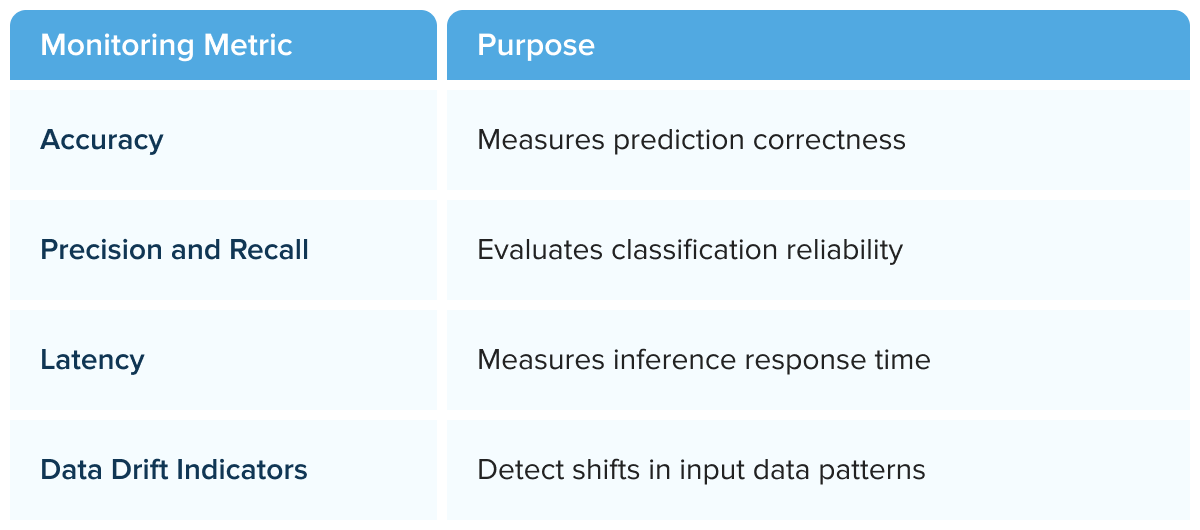
These monitoring signals allow engineering teams to detect performance degradation early and intervene before operational decisions are affected.
Data pipelines and AI infrastructure
The success of custom AI models depends heavily on the reliability of data pipelines. Data pipelines collect, transform, and deliver information required for model training and inference.
In many enterprises, raw data exists across multiple operational systems. Customer relationship management platforms, financial systems, operational sensors, and digital platforms all produce valuable data. However, these datasets often remain isolated unless integrated into a unified pipeline.
A robust data infrastructure typically includes:
- automated Extract-Transform-Load workflow
- centralized data lakes or warehouses
- versioned training datasets
- real-time streaming pipelines for inference.
These pipelines ensure that AI models receive consistent, high-quality data inputs. Without a structured data infrastructure, even advanced machine learning models struggle to deliver reliable results.
MLOps: Operationalizing AI at scale
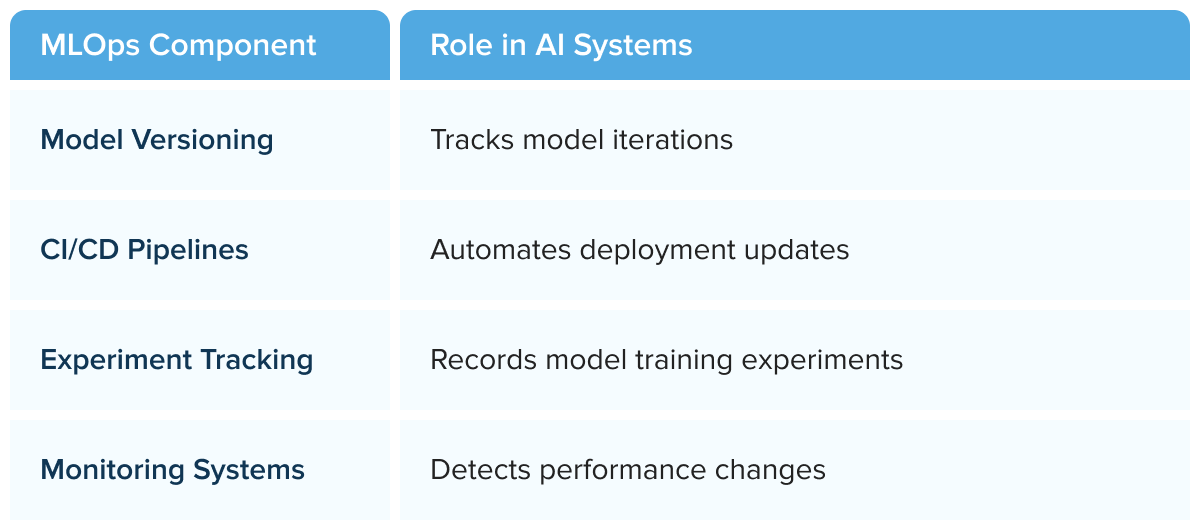
As AI adoption grows, organizations increasingly adopt MLOps frameworks to operationalize machine learning systems. MLOps combines machine learning development with DevOps practices to ensure that AI models can be deployed, monitored, and updated efficiently.
Key components of MLOps environments listed below:
- automated model training pipelines
- version control for datasets and models
- continuous integration and deployment workflows
- automated performance monitoring.
Data security and privacy in AI systems
Security considerations play a central role in enterprise AI deployments. Many organizations train machine learning models using sensitive information such as financial transactions, medical records, or personal customer data.
Advanced techniques such as federated learning and differential privacy further strengthen data protection by allowing models to learn from distributed datasets without exposing raw data.
These approaches help organizations maintain compliance with privacy regulations while still benefiting from data-driven insights.
The role of experimentation in AI innovation
Artificial intelligence projects often require multiple rounds of experimentation before reaching production readiness. Unlike traditional software engineering, machine learning development involves testing alternative hypotheses about which models and features will perform best.
Experiment tracking systems play a crucial role in this process. They allow teams to document which models were tested, which datasets were used, and which configurations produced the most accurate results. Experimentation platforms also support reproducibility. When models are retrained months later, engineers can recreate the exact conditions that produced earlier results.
Evaluating return on investment in AI projects
One of the most important questions organizations ask when investing in custom AI model development concerns the return on investment. Unlike conventional software projects, the value of AI systems often emerges gradually as models learn from new data.
Successful AI initiatives typically generate value through several channels:
- operational efficiency improvements
- cost reduction through automation
- improved forecasting accuracy
- enhanced customer experience personalization.
Organizations that measure these outcomes systematically are better able to evaluate whether AI initiatives deliver meaningful business impact.
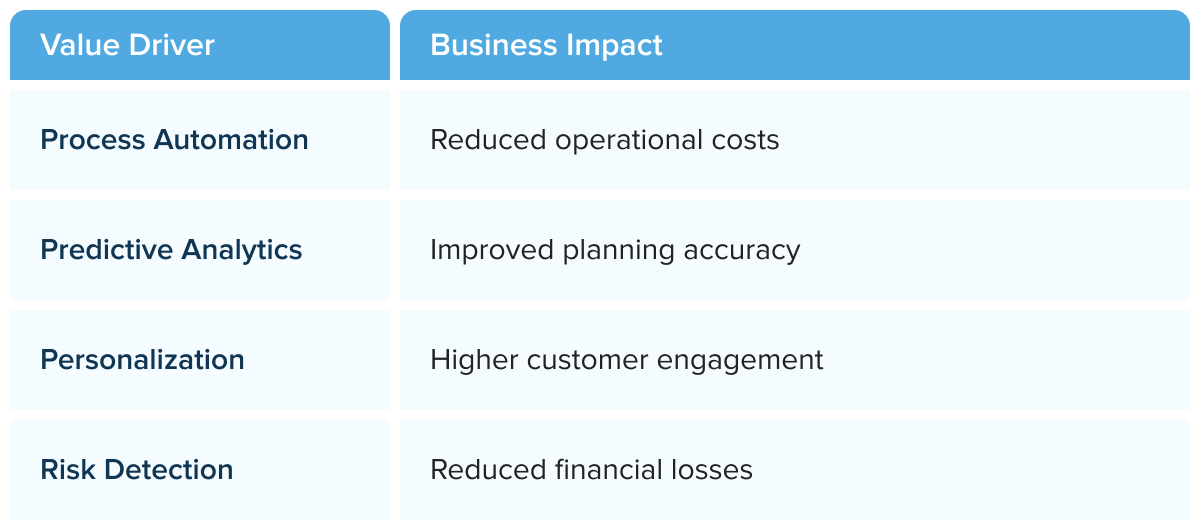
These measurable benefits explain why enterprises increasingly view AI not merely as a technical upgrade but as a strategic investment in digital transformation.
Building sustainable AI capabilities
Perhaps the most important lesson emerging from enterprise AI adoption is that long-term success depends on building sustainable capabilities rather than isolated projects.
The future of AI model development
Artificial intelligence is shifting from experimental pilots to operational backbone. Over the next five years, custom AI development will increasingly focus on scalability, explainability, and vertical specialization.
We can already observe several directional trends:
- Industry-specific custom AI solutions replacing generic SaaS tools
- Hybrid cloud AI infrastructure enabling flexible deployment
- RAG-enhanced large language model systems improving reliability
- AI product development cycles becoming more structured and governed.
While no-code and low-code platforms democratize AI access, enterprise-grade custom ai models will continue to require disciplined engineering, structured data strategy, and long-term maintenance planning.
The organizations that treat AI as strategic capability rather than tactical feature will define the next wave of competitive advantage.
FAQ
-
AI model development is the structured process of designing, training, validating, deploying, and maintaining machine learning models to solve business problems.
-
AI models are developed through business problem definition, data preparation, model training, evaluation, deployment, and continuous monitoring.
-
Yes. Organizations can create custom AI models using proprietary data, open-source frameworks, and scalable infrastructure.
However, when off-the-shelf solutions do not align with the organization’s specific workflows, data architecture, or performance requirements, developing a custom solution becomes essential. In such cases, experienced AI development teams design models that reflect domain-specific objectives, integrate with existing enterprise systems, and operate on curated proprietary datasets.
Machine learning expertise, data engineering capabilities, and production deployment practices enable experienced teams to build AI systems tailored to real operational environments rather than generic use cases.
-
Common categories include predictive models, classification models, recommendation systems, and generative AI models.
-
Model drift reduces performance when real-world data changes. Continuous retraining and monitoring mitigate this issue.