
Over the last couple of years, AI in construction has been a trend leading the sector of the industry to transform. From planning and design to resource management and safety, artificial intelligence is revolutionizing the established workflows and unlocking efficiencies that previously seemed unimaginable. But what exactly is new that AI brings to the industry, and how can businesses benefit from it?
Read this article further, and learn what AI is in the construction industry, its real-life use cases, and why now is the best time to implement this technology into your business.
What is AI in construction?
AI for construction business is the integration of advanced technologies such as computer vision, smart building IoT with AI, and machine learning into construction processes. This innovation provides not only automation but also the ability for machines and systems to extract valuable insights, make decisions, and predict outcomes.
For example, machine learning algorithms can predict possible delays, cost increases, and safety risks by scrutinizing vast amounts of prior data. Meanwhile, real-time monitoring driven by computer vision can spot risks and enforce safety measures for workers. When applied properly, these tools can turn conventional construction into a safer, more effective, and more intelligent place.
Benefits of AI in construction
AI benefits in construction are mostly based on automating repetitive tasks that lead to lower costs and improved efficiency and security. The list of them is the following:
Cost reduction
AI outperforms traditional cost estimation methods, which hinder responding to dynamic expense fluctuations.
By analyzing historical and real-time data like project scope and contact details, AI tools provide rapid and accurate estimates, building the foundation for real-time monitoring and in-flight adjustments. With such effective analytics, companies can stay financially on track when faced with increasing material, labor, and regulatory expenses.
Improved safety
AI in construction market is especially effective in predicting safety risks. By continuously assessing equipment conditions, AI can pinpoint faults and suggest timely maintenance to enhance safety and minimize disruptions. It also leverages computer vision to review on-site video feeds, detecting unsafe behaviors, like missing protective gear or improper equipment use.
Project management optimization
AI for construction project management provides numerous optimizations. AI analyzes project proposal data to provide fast and easy scheduling, enabling faster project kickoff and cutting preparation time from days to hours.
It also anticipates cost overruns from project complexity and technical hurdles, improves resource allocation accuracy, spots backup options when suppliers fail to deliver, and predicts delays such as material delivery issues.
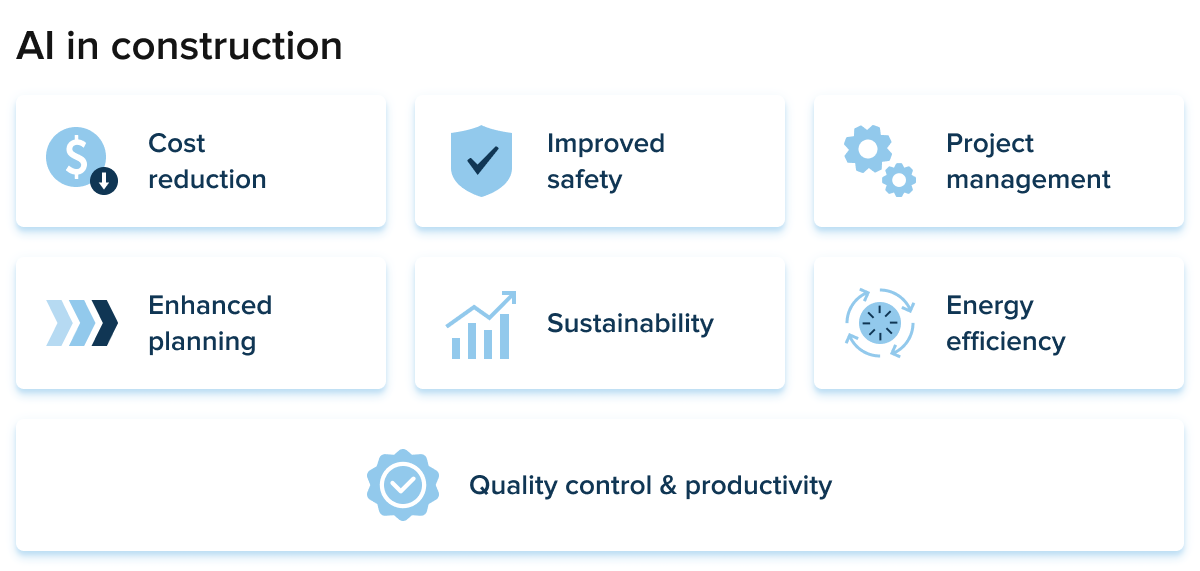
Enhanced planning and design
AI systems analyze historical and ongoing project portfolios in real time to assess schedule options, outlining resource needs and costs for informed decisions. It can also enhance design iteration by rapidly building diverse design variations and estimating their costs.
AI consulting allows teams to request design alternatives based on various criteria like energy effectiveness, cost, a building’s structural length, and so on. AI-driven 3D models assess these elements in conjunction with both mechanical, electrical, and plumbing (MEP) layouts and project sequencing. Hence, companies can handle project planning faster and more precisely, which leads to increased quality and saved resources.
Sustainability
AI for construction industry also helps companies to make their business more sustainable by cutting waste and carbon emissions. For example, the waste of materials can be reduced with the use of 3D printers that more effectively make walls, floors, and other structural elements.
By analyzing data from sensors embedded in existing concrete structures, designers can utilize AI tools to adjust concrete mix designs, leading to the development of more durable buildings and less carbon emissions.
Compared to traditional bricks, the recycled ones don’t need kiln firing and produce about 90% fewer carbon emissions. Eco-friendly materials are usually more expensive; however, AI can forecast usage and expenses with precision, making their adoption more feasible.
Energy efficiency
Nowadays, companies emphasize energy efficiency to reduce their ecological footprint in construction and adhere to compliance requirements.
However, tracking energy usage needs plenty of data. For instance, HVAC (heating, ventilation, and air conditioning) systems have to pay attention to weather changes, indoor conditions, room size and shape, air quality, and any use of solar batteries. AI algorithms can process this information immediately to predict energy demand, streamline consumption, and reduce expenses.

Source: Unsplash
AI in construction industry allows businesses to make complicated things achievable for almost everyone, such as making energy audits a regular part of building design or ensuring renewable resources are grid-connected. It’s a huge step forward, as, according to the United Nations Environment Programme report, this year the level of carbon emissions from the construction industry has stopped rising for the first time since 2020.
Advanced analytics
Based on building information models (BIMs) and blueprints, AI-driven systems can provide a more precise calculation of both direct costs (labor, materials, and equipment) and indirect costs (insurance and equipment maintenance). As a result, business owners and constructors can predict project delivery, minimize costs, and improve quality, scheduling, and safety control.
Increased productivity
AI solutions streamline material selection and quoting, providing faster supply delivery and maintaining workflow efficiency. Generative AI for construction can enhance resource allocation by identifying which teams need specific equipment and at what time, while supporting schedule adherence.
AI-driven predictive maintenance supports machinery upkeep to minimize risks of downtime and accidents that hinder productivity. The development of robotics also changes the industry: when company owners utilize semiautonomous bulldozers to prepare jobsites, their employees have more time for handling other tasks.
All in all, AI in construction greatly improves businesses’ productivity by improving safety, project planning and scheduling, materials procurement, and other spheres. To learn more about AI predictive maintenance and its benefits for business productivity, please watch a video:
Quality сontrol
AI software can review designs and 3D models to detect potential issues and minimize rework. On-site, AI-driven robots perform tasks like bricklaying and welding with enhanced precision and consistency. Sensors and cameras, including those mounted on drones, monitor progress to verify compliance with quality standards.
Drones equipped with AI can even compare aerial land surveys against blueprints to spot discrepancies. As a result, GenAI in construction provides high quality even before the start of the construction and maintains it during the whole process.
A real-world example of AI-powered quality control in action is InData Labs‘ roof installation inspection solution. Using computer vision and spatial analysis, the system automatically detects fasteners, validates panel alignment, and measures precise spacing in real time — eliminating manual inspection entirely. Watch the video to see how it works in practice.
AI in construction сase study
From safety monitoring to project planning, AI is already delivering impressive benefits to companies. Still, it can be not entirely clear how they achieve such results. Here are 5 examples of AI in construction case studies that really work:
Quality control
Any professional construction company wants to offer their customers the best service.
However, this is not always a simple task, because of the restrictions of traditional inspection methods and the complexity of modern designs. AI for construction is revolutionizing quality control by reducing waiting times, increasing precision, and simplifying inspections. As a result, companies using generative AI can not only boost safety and meet regulations but also performance.
By capturing visuals and data in real-time, AI-driven cameras, drones, and sensors provide continuous monitoring of construction sites. They use advanced image recognition to make sense of the data, pointing out flaws, safety issues, or even deviations from the design.

Source: Unsplash
AI systems have been trained on huge datasets of labeled images to be able to catch a variety of possible threats accurately. For instance, AI for construction productivity can spot a technology installation that is not done correctly or a missing part of the structure, thereby allowing the team to fix the issue before it becomes a big problem and leading to delays that can be quite expensive.
During the project, AI-powered drones take high-quality photos of construction sites in a matter of minutes; it’s the smart software that accompanies the data that helps the rest of the team find the issues. This process eliminates the need for slow manual checking, and the whole thing is done much faster, which in turn shortens project timelines.
Risk mitigation
Risk is an inherent element of construction work, especially when the job is large and there are many subcontractors working on different parts that are interdependent. Generative AI for construction is changing the way these risks are managed by helping the contractors to spot, assess, and manage possible issues in a timely manner, which in turn leads to smoother and safer implementation of the project.
AI solutions utilize machine learning development to oversee construction sites, automatically ranking potential issues by severity. As an illustration, subcontractors can be evaluated with risk scores, allowing project managers to focus on high-risk groups and address concerns before they intensify.
AI-driven site inspections, combined with analysis of 3D models and video footage, help reduce long-term quality risks by enabling early identification of defects or deviations from project plans. generative AI development also outperforms traditional methods for on-site security by analyzing video feeds 24/7 to avoid the risk of theft or vandalism, even on large-scale projects.
Enhanced site safety
Safety measures in the workspace play a pivotal role in any industry, but in construction, they’re especially important, as this industry has the highest fatality rates among all industries.
According to statistics, the number of fatal cases has decreased over the past few years but is still pretty high. The statistics made by the International Labour Organization show approximately 60,000 fatal cases are happening on construction sites worldwide each year. Construction is the sector with the biggest number of deaths among all industries in every part of the globe, with 20% of all workplace fatalities in the US, 28% in the UK, and 24% in the EU.
Fortunately, AI software development is changing safety protocols by providing real-time monitoring and proactive measures to minimize risks and protect workers. AI-powered cameras and sensors continuously check AI construction sites for possible risks. It can identify faulty machinery, dangerous workplace conditions, or employees lacking protective equipment.
They avoid accidents in advance by flagging risks and delivering prompt messages to workers and managers. For example, AI systems review video streams and sensor data to detect early signs of mechanical issues or instability, ensuring rapid corrective measures.
Source: Unsplash
Wearable AI tech, such as smart vests and helmets, facilitates safety measures by overseeing workplace environmental factors and monitoring worker locations. Emergency SOS buttons and real-time incident reporting tools provide swift action in emergencies, while communication platforms keep all stakeholders informed to strengthen workplace safety.
AI for construction safety also forecasts maintenance requirements for essential systems, such as HVAC (Heating, Ventilation, and Air Conditioning) and electrical systems. This helps keep equipment functional and reduces the risk of interruptions that might create unsafe environments. Tackling safety issues through data-driven approaches allows AI to foster a safer workspace and save the lives of thousands of workers.
Predictive maintenance for detecting anomalies
As one of the first uses of AI for construction, predictive maintenance is still reshaping equipment management by boosting workplace safety, expanding machinery lifespans, and preventing costly interruptions.
The process is concentrated on scrutinizing sensor data, like performance stats, vibration, and temperature, with the use of generative AI consulting to spot unusual behaviors and patterns that may lead to equipment malfunctions.
For example, it can spot abnormal heat increases in a bulldozer’s hydraulics or irregular pressure in a concrete pump. When unusual patterns are detected, the system notifies operators and suggests guidance on avoiding possible failures. This approach both reduces unforeseen equipment failures and retains peak performance, ensuring project workflows remain uninterrupted.
It should be noted that AI’s role in predictive maintenance reaches beyond just machinery. As AI for construction safety, AI for predictive maintenance can check HVAC and electrical systems on construction sites to spot possible disruptions and secure ongoing functionality. Moreover, sophisticated image recognition tools strengthen this process by examining site visuals to identify defects and quality concerns needing attention.
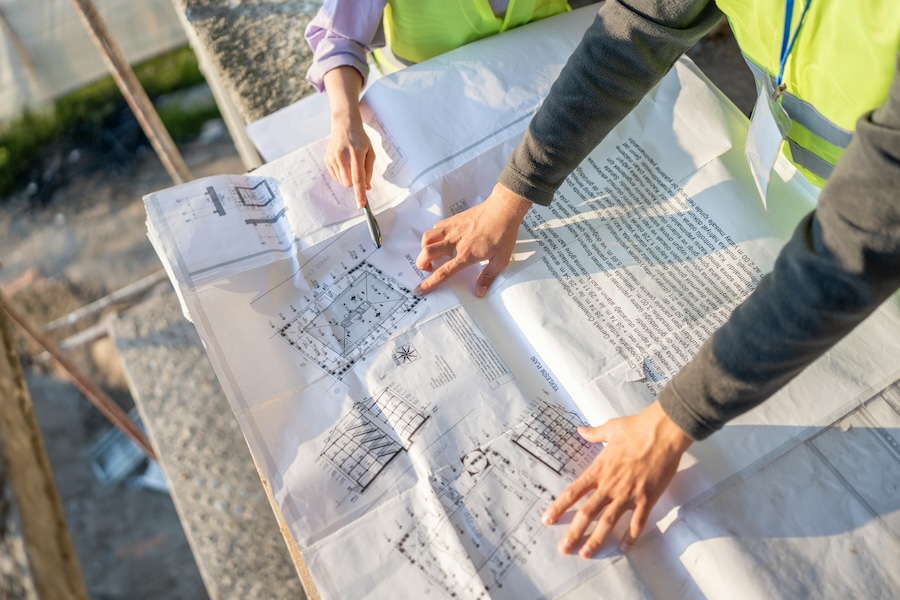
Improved design and planning
Using AI in construction allows architects, engineers, and professionals to revolutionize the construction design and planning process by having innovative tools under their belt to streamline workflows and improve decision-making.
One of the biggest achievements in this sphere is the integration of AI-powered Building Information Modeling (BIM). This 3D model-based process combines engineering, architectural, and mechanical, electrical, and plumbing (MEP) plans to advance safety, improve collaboration, and optimize budget through early clash detection and accurate estimates.
In addition, generative design driven by machine learning consulting advances planning to the next level. AI systems offer a wide range of design possibilities within set parameters such as cost, efficiency, materials, and compliance. Through repeated learning cycles, these algorithms generate refined 3D models that deliver innovative solutions for performance and sustainability goals.
Source: Unsplash
AI is also imperative in the planning phase to maintain quality standards. These advanced systems allow adjustments ahead of budget by reviewing BIM designs and models to detect potential issues. As a result, companies can reduce costly errors and speed up project schedules.
Additionally, AI architecture design optimizes resource planning and automates budget preparation. Through the analysis of complex datasets, such as historical trends, codes, and zoning laws, AI assists construction companies in forecasting material needs and costs more accurately to eventually speed up the bidding stage.
Challenges of adoption
The use of AI in construction can be a game-changer for your business, but it also comes with challenges. The implementation process is often complicated and requires not only integrating all the needed technologies into your workflow. Here are the key ones:
The importance of human oversight
At first glance, artificial intelligence construction engineering simplifies human work by freeing employees from numerous tasks.
However, AI and automation are effective only with proper human oversight. It’s important for engineering teams to have regular critical checkups to make sure AI complies with real-world conditions.
Business owners should also remember that AI can handle monitoring and documentation, but legal responsibility lies only on decision-makers who must ensure compliance with safety standards and building codes. The same applies to ethical responsibility and contextual judgements, as the technology may struggle with prioritizing tasks, interpreting context, and making nuanced decisions.
The most important thing in working with artificial intelligence is to know how to balance automation and human oversight. These technologies are used not to replace human expertise but to enhance it. Only with the effective collaboration of human and artificial intelligence, these innovative technologies can bring such benefits as enhanced quality control, improved effectiveness, better risk management, and sustainable practices.

Source: Unsplash
Cost
The cost of adopting AI for construction is probably the key obstacle for many companies, as purchasing AI software, drones, sensors, and robotics requires serious capital. Integrating AI with existing systems, such as BIM (Building Information Modeling), ERP (Enterprise Resource Planning), and project management systems, can also be financially costly, especially for start-ups and small businesses.
Adopting AI is a time-consuming process due to the complexity of implementation and the time needed to train employees how to work with AI tools. It also should be noted that ROI (return on investment) is not immediate either, and such benefits of implementation as improved efficiency and reduced downtime may take years to appear.
Overcoming industry opposition to AI
Despite all the widely known benefits of AI in construction, there are a lot of long-standing enterprises that are still hesitant to apply these technologies to their business. The construction industry is well-recognized for adhering closely to traditional practices.
Some owners find the idea of adopting artificial intelligence too sophisticated, but most business leaders are concerned that AI may replace human workers or disrupt established practices. According to statistics, approximately 45% of construction businesses use AI, and only 1% have scaled AI across projects.
Typically, this resistance stems from ignorance of how this technology works and what benefits it may bring to a business. Providing accurate information and clear guidance is a must-have to win over this resistance.
Construction owners should explain to their employees the correct information about how AI is a tool that can empower human resources, not replace them. The explanation of the technology and the focus on its benefits may help to open the minds of workers throughout the firm and enable the smooth assimilation of AI into the everyday process.
Final words: The future of AI in construction
According to the statistics, the AI construction market has risen from 863.67 million in 2024 to USD 1.08 billion in 2025 and is expected to reach USD 5.22 billion by 2032.
Cutting-edge technologies like predictive maintenance, autonomous equipment, and sustainability-oriented solutions are paving the way for smarter, data-powered practices. Autonomous drones and robots are already revolutionizing tasks, such as surveying sites, laying bricks, and transporting materials. The precision and accuracy allow for both minimizing mistakes and facilitating overall productivity.
AI is also transforming maintenance processes. Predictive tools scrutinize sensor data to predict equipment repairs, enabling construction firms to switch from reactive to proactive maintenance strategies. This method cuts repair expenses, extends the lifespan of critical assets, and minimizes equipment downtime, keeping site operations seamless.
Another area where artificial intelligence construction engineering is reaching new milestones is sustainability. As the problem of climate change gets more important every year, AI-driven tools can help construction companies make their workflow greener by reducing waste, optimizing material usage, and designing energy-efficient buildings.
Besides physical tasks, artificial intelligence is streamlining project communication and collaboration. Upcoming AI platforms will facilitate administrative tasks like reporting and scheduling, while advanced natural language processing will make collaboration with AI tools more user-friendly for teams.
With the gradual integration of AI in construction, the potential of the technology to be a source of innovation, a tool for efficiency, and a supporter of sustainability will be increasing. As this particular area in the construction industry is still quite a niche, the early adopters will position themselves as leaders and thus be able to influence the industry. If you want to join them, it’s already time to get moving.
FAQ
-
AI effectively shows itself on every stage of the construction process, but it’s especially effective in boosting safety, efficiency, and sustainability by analyzing data, automating tasks, and providing sound decision-making.
-
It’s a common concern of many construction leaders, but, fortunately, it’s wrong. AI can’t replace builders; it only helps them do their job more effectively and safely. Moreover, AI tools can work properly and bring the desired benefits only with human guidance.
-
It’s impossible for artificial intelligence to construct a building, as it can’t do physical tasks like pouring concrete or laying bricks.
However, it can play a crucial role in providing the heavy lifting by construction drones, robots, and automated machinery. AI can also help design a 3D model of a building, saving teams time and money.
-
Artificial intelligence can’t project a building independently, as a licensed engineer or architect can do.
However, it can significantly help in the planning and design process. It can even enrich their resources by developing design options, checking feasibility, and providing sustainability.