The use of artificial intelligence is the best decision for companies that want to be on track and maximize the benefits of innovative technologies. However, generative AI implementation is a meticulous journey that requires significant attention and professional skills. This guide will explain in detail the peculiarities of each implementation stage, so that your new original solution can bring you all the benefits of this technology.
Since the release of ChatGPT only two years ago, every industry has faced the changes that previously seemed unimaginable. Nowadays, generative AI implementation is not a unique business strategy but a necessity if you want your business to stay relevant.

Source: Unsplash
However, it is still a very sophisticated process that not every company can handle properly. Read this guide to learn about the recent benefits, use cases for your industry, and all the necessary steps to make your implementation process successful.
What are the benefits of implementing generative AI
Traditional methods based on human input have teams primarily focus on routine tasks. By taking on routine tasks, artificial intelligence marked a turning point in every industry workflow, allowing people to concentrate most of their efforts on designing creative solutions for new business strategies.
According to statistics, 89% of organizations are moving forward with their GenAI actions, while 92% of businesses are planning to scale up their investments between 2025 and 2027.
Early AI adopters considerably outperform those without it by turning AI capabilities into measurable advantages, such as expense optimization, elevated time-to-market, and increased margins. But AI isn’t limited to only these well-known benefits. Here are some more capabilities that can broaden the new horizons of your business:
- Decision-making improvement. Transform raw data into executive summaries to use in strategic planning and predictive insights creation that reduces uncertainty.
- Skill augmentation and innovation. Boost overall team output and enable experimentation that previously was too costly by empowering teams with AI assistants that drive ideation, research, and innovation.
- Personalization at scale. Customers of the modern market value personalization the most. AI helps companies to fulfill their customers’ needs by constantly scrutinizing the new data of their purchase behavior to deliver tailored customer experiences on the level human resources can’t reach.
Step 1: Defining your AI goals
Strategic lucidity is what distinguishes successful implementations from costly experiments. Before finding a team and choosing platforms, define how AI can find solutions to your business difficulties and what kind of success you expect it to bring.
To begin with, focus generative AI work on the company’s biggest needs. Do you want AI to improve data analytics or find innovative solutions for tracking equipment failures? If you realize that low code doesn’t work for your business anymore, it’s time to try a customized complex AI solution. It should be noted that this process requires professional assistance, so the best solution will be an experienced team for it.
Step 2: Identify high-impact use cases
It’s crucial to set the company’s unique goals for which AI can help find solutions. Successful AI implementation requires careful analysis of not only the current processes of your business to identify where GenAI can make a difference, but also the analysis of how AI is typically used in your industry.

Source: Unsplash
Build a pipeline of practical GenAI use cases by inviting ideas from across the organization. Maintain a shared, always‑accessible repository where employees can submit suggestions as they arise. Early quick wins help inspire confidence and fuel progressively larger, more ambitious initiatives.
Turn the chosen use case into a persuasive business case that wins executive backing and secures the necessary investment. Ground your ROI estimates in conservative, evidence‑based assumptions rather than overly optimistic forecasts that could weaken trust. Though AI is primarily famous for being actively used in the industries of marketing, tech communications, and retail, it is not limited to only them.
Step 3: Getting all data in order
The most important thing in a good AI implementation is not even a budget or an experienced team. It’s the data used to train your generative AI apps. More AI projects fail due to bad data than any other factor, which is why data preparation is also the most time-consuming part of the development process.
Data audit and access
Begin by making a complete list of all data sources connected to your chosen use case. For instance, if you are deploying a customer service chatbot, catalog sources like knowledge-base articles, support tickets, product guides, FAQs, and previous customer interactions.
Once identified, map out your data environment to see its scale, diversity, and speed. Generative AI deployment, especially at enterprise scale, usually requires considerable amounts of data. For supervised fine-tuning, it’s recommended to have at least 10 000 high-quality training examples. At this point, it’s also important to document data lineage so you can trace how information moves through the organization and identify potential bottlenecks.
Then, estimate the availability of each information source. Some data can be locked in legacy systems, spread across multiple teams, or complicated to extract. It’s crucial to evaluate centralization strategies to overcome such difficulties.
Lastly, review your data lakes, warehouses, and integration platforms to ensure they support generative AI implementation, or new systems must be introduced.
Data cleaning and preparation
Apply strict data-cleaning processes to maintain the quality of your LLM and generative AI implementation. This means eliminating duplicates, resolving errors, handling incomplete data, and implementing consistent formatting across all inputs.
To strengthen reliability, include domain specialists in the data cleansing workflow. Customer service managers should check how support tickets are categorized, while product experts should validate the technical content. Human oversight at this stage helps catch subtle issues that automated cleaning could fail to detect.
Once the data is verified, divide it into training (70%), validation (20%), and testing (10%) sets. Preserving strict separation between them prevents overfitting and ensures reliable performance evaluation.
Lastly, build data pipelines that can maintain ongoing improvements and additions. As static datasets lose relevance quickly, establishing workflows that can both systematically provide fresh information and uphold the highest quality control will be a good solution to a serious problem.
Data governance
Nowadays, data governance regulations are strict and differ from country to country. To save money and time, set up clear data governance policies before initiating model development. Identify data owners, implement clear access controls, and develop usage policies that detail acceptable applications for each data type.
To oversee AI data practices and ensure organization-wide alignment, create a governance committee with representatives from legal, business, IT, and compliance.

Source: Unsplash
One of GenAI advantages is that it can outperform traditional processes in fairness. However, it’s only possible when bias mitigation is intentionally and consistently applied during development. To make it possible, actively address bias in training data by checking for demographic, temporal, or categoric imbalances that could result in discriminatory outcomes.
Ensure every governance decision is documented and supported by meticulous audit logs, including data origin, cleaning methods, bias-reduction techniques, and approval steps. As a result, you get documentation transparency that shows your reliability and responsibility, which can attract new customers.
Data compliance
Build regulatory compliance into the very start of any GenAI implementation strategy to avoid penalties, delays, and reputational harm.
Regulations like GDPR, HIPAA, CCPA, and various industry‑specific standards set strict rules for how data must be collected, stored, and used. When working with sensitive data, apply privacy-preserving methods, such as anonymization and differential privacy. With these techniques, you can ensure data safety while still extracting valuable insights from the datasets.
Step 4: Choosing the right GenAI platforms
Choosing the best platform for your project is one of the most critical decisions you need to take for successful LLM and generative AI implementation, as it directly impacts the pricing, time spent on implementation processes, and the platform’s flexibility in the future. Based on a business’s technical capability and objectives, there are three options you may opt for when searching for a suitable platform:
- Pre-trained models and APIs, such as Google Vertex AI, OpenAI GPT models, or Azure OpenAI, allow the quickest deployment. This is the most convenient method for standardized use cases, e.g., customer service or content creation automation, since all models provide rapid access to powerful generative abilities without requiring extensive ML knowledge.
- Enterprise AI platforms, e.g., Microsoft Azure ML, IBM WatsonX, Google Cloud AI, provide end-to-end services covering data engineering, model testing, launch, and governance. This is a perfect solution for organizations where oversight and scalability are a priority, due to offering greater control than APIs, while providing strong security, compliance features, and technical assistance.

Source: Unsplash
Custom model development is most suitable for highly specialized applications where standard platforms underperform. Unlike other approaches, this one needs deep expertise and computational resources. If you want to experience AI in its full complexity and, in this way, stand out from other companies, turn to a team of experienced engineers that can tailor a custom model development based on your business’s needs.
Step 5: Assembling a reliable team
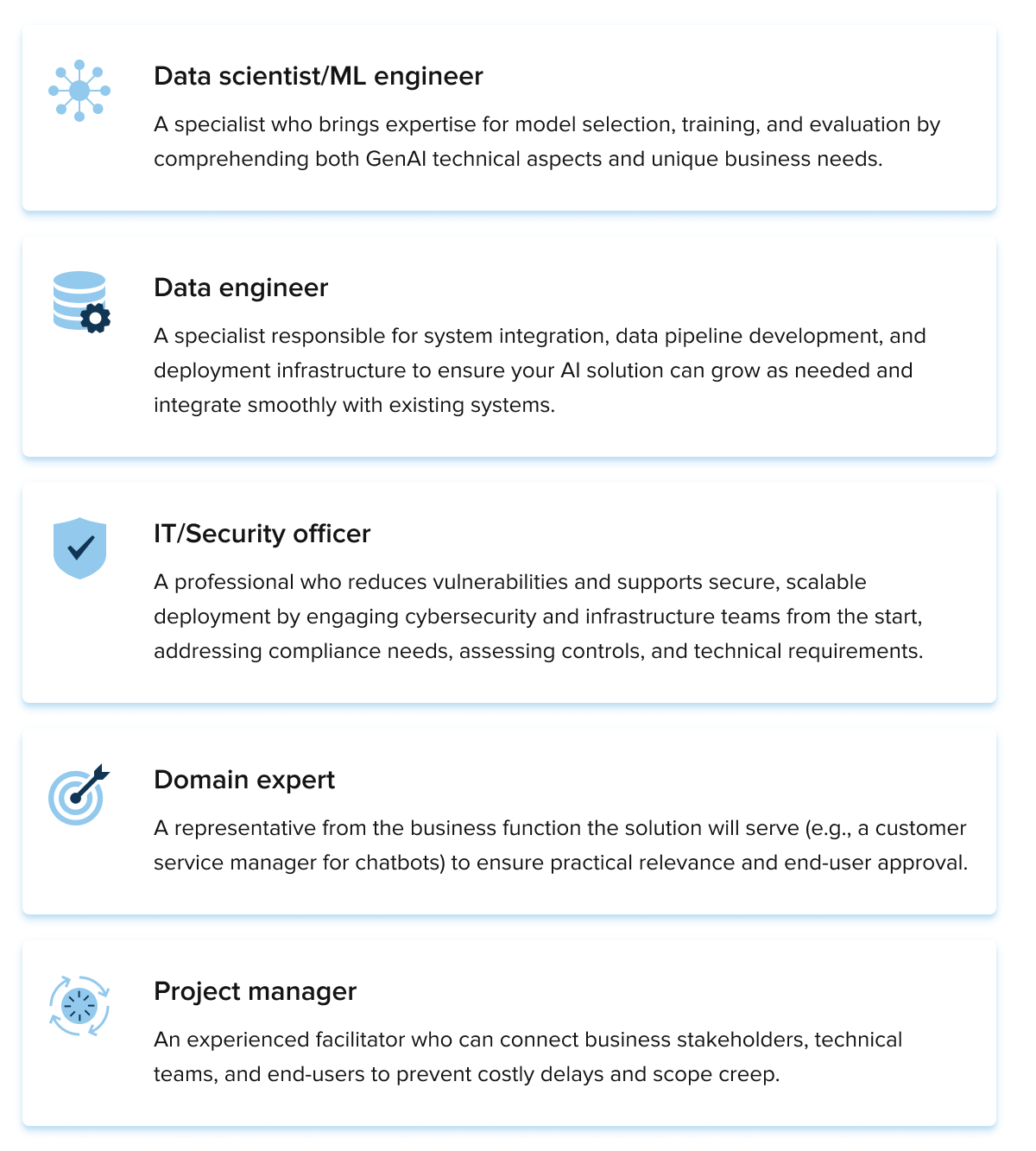
Generative AI implementation is a complicated process that requires the best specialists across different disciplines, as it combines technical skills, domain expertise, and business comprehension to keep performing well. Core roles to implement AI include:
Step 6: Launching your solution
Moving from an operational prototype to a production-ready system is an important milestone in the deployment process; it is when a business finds out if the solution works as expected. If you want to guarantee dependability and sustained success, smooth integration, thoughtful planning and facilitative onboarding must be provided.
Plan a seamless integration
When creating a generative AI implementation service, it is vital to build a robust deployment architecture that takes into account the scalability, security and integration requirements. Cloud platforms could be a solution too, as they are more scalable and flexible than conventional on-premises installations.
Train users
Whether a deployment is successful or not is often dependent on change management and user testing. Even the best technical solutions might fail if organizations are not ready or choose to resist.
Cultivate personalized training plans for each group that focus on how they can use this AI solution. For example, the instructions for sales teams will be different from those for customer service agents, and will differ from those for marketing clerks. Give the users hands-on, case-based training, not the details.

Source: Unsplash
Develop channels of feedback that encourage customer input, and that show that it is taken seriously. Set up group conversations, establish continuing surveys and usage monitoring to discover where training is weak, and improve on that. If you listen to what the users have to say, you will win their trust.
Step 7: Ongoing monitoring and improvement
The deployment of your solution establishes not the end but only the beginning of your GenAI implementation experience. Using generative AI for success means relying on continuous monitoring, routine optimization cycles, and structured scaling plans. Even the best-designed solution can quickly lose its effectiveness and innovation if its owners ignore such practices.
Check performance and outcomes
Use a vast monitoring system where both business and tech metrics are scanned. Determine the performance of your business outcomes against established targets, such as savings, quality improvements, efficiency gains, or revenue growth.
On the technical side, study failure rates, latency, availability, and resource utilization. Monitor how well your app is performing in terms of real-life usage, and focus on those feedbacks as a way to improve the quality of output.
Build a culture of innovation
If you do AI right, focus on never stopping improvement and innovation. Use learning resources and opportunities on generative AI topics to develop your employees. To get your teams excited about actually working with AI, hold internal hackathons, learning sessions, or workshops. This nature of collaboration promotes ideas and ownership in a fresh way, which has the advantage for business owners.
Expand GenAI applications
Once your first AI solution turns successful, keep exploring AI opportunities by finding new spots in your business where this technology can customize experiences, optimize processes, and enhance decision-making. Promote an experimentation culture across your teams, letting them brainstorm new solutions and use cases for it.
Top industries where AI delivers real impact
Discover how AI transforms healthcare, finance, retail, manufacturing, and more with smarter, faster, data-driven solutions.
Logistics
The use of AI software in logistics makes the operation processes in this industry smarter, faster, and more cost-effective. The benefits include reduced operational costs, enhanced efficiency and safety, advanced customer experience, smarter transportation forecasting, strategic asset positioning, and improved data quality and optimization. Here are some use case ideas for you to inspire:
Machine learning algorithms further enhance these forecasts, enabling teams to anticipate peak periods and hot markets, minimize stock shortages and overstock, decrease inventory costs, mitigate shocks, and maintain efficient customer service levels. The adoption of generative AI enables flexible pricing schemes, minimizes wastage, and boosts profitability, positioning it as an essential component in improving supply chain agility.
A practical example of this in action is InData Labs’ work with AsstrA, a global transportation and logistics company. The InData Labs team developed a machine learning-powered freight rate prediction software that extracted data from the client’s transport management system, analysed complex route and market variables, and delivered actionable rate forecasts — doubling freight prediction accuracy and significantly reducing human error in decision-making.
This project demonstrates how AI-driven demand and pricing forecasts translate directly into measurable operational efficiency gains for logistics businesses.
Generative AI consulting and implementation services optimize transportation routes, reducing vehicle idle time, fuel consumption, and emissions, thereby lowering a carbon footprint without slowing delivery times. AI also enables real-time energy management in warehouse environments.
Based on real-time operational needs, it adapts lightning, cooling, and heating, cutting energy waste and enhancing overall effectiveness. Moreover, AI can scrutinize packaging data to advise on eco-friendly materials, which allows specialists to make more sound decisions in shipping and storage. Avoiding overstocking and dead stock helps reduce waste, lowering the need for disposal and resource consumption.
Fintech
Nowadays, artificial intelligence covers all core operations of financial services to amplify revenue and overall efficiency. AI provides end-to-end customer-centric solutions and advanced personalization, which leads to enhanced customer satisfaction. It also gives teams more time for creative tasks and decision-making, as routine tasks can be effectively handled by AI agents. Take a look at the following use cases:
AI algorithms provide innovative anti-fraud systems that monitor transaction patterns in real time to spot anomalies that may signal potential fraud, enabling proactive measures to prevent financial loss. They help organizations to stay ahead of cybercriminals by continuously learning from new data to adapt to evolving fraud tactics. This process also strengthens the trust with customers, which can be effective for attracting new clients.
Manufacturing
First of all, AI in manufacturing optimizes processes and reduces delays. AI can quickly process extensive amounts of new data, minimizing downtime and ensuring production runs smoothly without human intervention. AI-powered robots can carry out operations like packaging, welding, and assembly with consistent accuracy and speed, contributing to faster and more reliable production. AI in manufacturing use cases include:
Healthcare
AI brings valuable advantages in healthcare by overcoming its biggest inefficiencies: administrative overload, rising operational costs, delayed diagnostics, and limited access to care.
AI enhances diagnostic accuracy and speed by analyzing medical images within minutes, which is very useful in decision-making situations that cost someone’s life. This reduces diagnostic errors, improves patient survival tests, and shortens time-to-treatment. AI also helps in turning conversations into clinical notes, allowing doctors to spend more time with patients instead of paperwork. Use cases are the following:
AI tools can optimize molecules of already existing drugs for stability, effectiveness, and safety. They can also predict molecular properties, like toxicity, solubility, and binding affinity. These processes cut the development time from 10-15 years to approximately 5-7 years, while reducing costs and improving success rates.
They also help all kinds of patients with their medication management by notifying them when they have to take their pills, explaining the needed dosage, and tracking adherence. With these tools, the treatment process becomes more comprehensible for people far from medicine and very helpful in countries with a medium-sized healthcare sector.
E-commerce
As one of the industries with the highest level of competition, E-commerce is unimaginable without a generative AI implementation service.
Here, trends change every hour, which is why AI is an essential tool for processing vast amounts of data in a short time without losing the quality of performance. It also helps in providing every customer with personal recommendations and offers, which is now the most important way to bring attention to your business.
With AI agents, your customers get hyper-personalized offers that always perfectly reflect their needs, resulting in boosted user satisfaction. If you want to outperform your competitors, this is your choice.
InData Labs built and deployed a multi-agent AI solution on their own website — a fine-tuned virtual assistant paired with AI analytical agents that handle complex visitor queries, perform lead scoring, and automate opportunity creation in CRM, boosting conversion from chats into qualified sales opportunities.
Marketing
AI is reshaping traditional marketing roles from routine work to more strategic decision-making. The opportunity to analyze customer data in real time allows businesses to manage data at a speed that no human can handle, gain valuable insights, and use them in real time to optimize targeting, personalize experiences, and maximize return on investment (ROI).
InData Labs developed an ML-powered customer review analytics solution for a large US E-commerce platform that automatically detects and analyses sentiment across product reviews — enabling the team to act on customer dissatisfaction in real time and identify upselling opportunities with precision.
Retail
Today, the biggest trend in retail is the application of personalization. However, customers’ needs are very fluctuating, and no professional team can keep up with them. The best solution will be the use of GenAI for data analytics that can continuously analyze browsing behaviour and purchase history to deliver tailored product recommendations.

Source: Unsplash
Conclusion
It’s no secret that immense AI potential can make your business unrecognizable in a good way. But it’s only possible if you comprehend your goals, build a strong team, and know which platforms will be best for your solution.
Successful AI implementation pivots on careful data management, long-term goal planning, and thoughtful model development and integration. Remember that even after deployment, your solution requires continuous checking and improvements. If you fulfill all these conditions, in return, you will get a revolution in your business operation, making it even better. As artificial intelligence is rapidly developing, all these benefits are only the beginning, and its real possibilities are truly endless.
FAQ
-
A successful GenAI implementation starts with a structured and effective roadmap. First of all, define your needs and answer the question of why your organization needs AI right now.
Then, find your industry’s AI use cases and choose the one that is suitable for your solution. After that, start careful data preparation: this is the most important and time-consuming part of the whole process.
-
Our main goal is to find the spot where business value, feasibility, and readiness meet each other. To do so, we scrutinize your business priorities, map pain points, estimate data availability and quality, and score use cases with an impact-feasibility matrix.
-
An effective implementation requires a good development strategy that usually consists of 7 stages. They include: defining goals, finding your industry’s use cases, preparing data, choosing the right platform, building a team of professionals, deploying your solution, and ongoing monitoring.
-
Technically, you can create your own generative AI by using existing models via APIs, customizing existing foundation models, and training them from scratch.
However, you won’t get the expected results. AI implementation is known for its business-changing solutions, but to get them, you need a meticulous implementation plan based on your business needs, budget, and industry. It’s hard to do it on your own, so it’s better to contact a team of experienced professionals like us. Together, we will help you to implement AI into your business at its best.