Every student had dreamt of an ideal classroom experience where they can learn at their own pace, get immediate and helpful feedback, and professional guidance from a smart assistant who understands their unique strengths and weaknesses. Well, this isn’t a dream anymore, but a groundbreaking reality with the involvement of AI agents in education in 2026.
Let’s dive in and see how AI agents in education are changing the teaching and learning style. We’ll explore the nature, potential, and future outlook of AI agents in education.
AI agents and virtual assistants in education
Generative AI development in 2026 has gone off the rails, making huge transformations in the education industry. Educational AI agents and virtual assistants help educators and students learn and improve teaching experience in various ways.
AI agents
An AI agent is an element of software that uses AI to function to achieve goals and finish jobs that have more than one step on its own. An AI agent can make data-driven decisions, use tools (like browsers or APIs), and remember the past interactions with people.
Virtual assistants
Virtual assistants for educators are the bots or digital assistants who provide administrative, creative, or technical support to businesses.
But are they good at handling administrative tasks for teachers? Yes, they are. Operating as independent contractors, virtual assistant education platforms help tutors and students by saving their time and scaling operations by handling routine tasks from any location.
Types of AI agents used in education
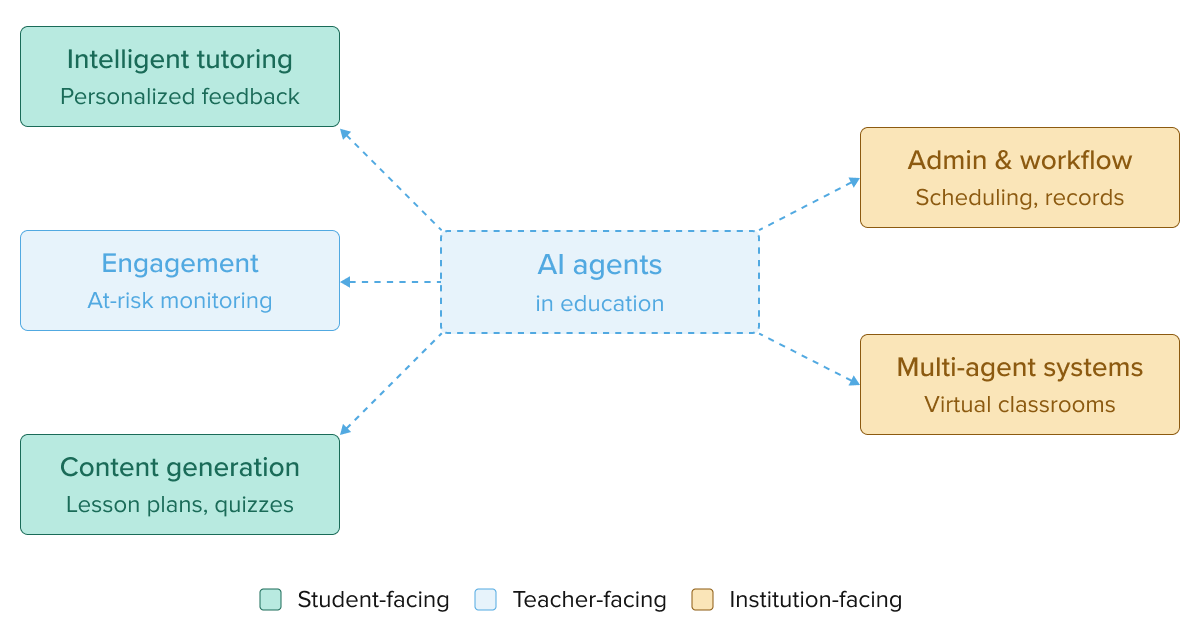
Before you decide to build an AI agent in education, it is crucial to know its types. The type of AI agents used in the education Industry includes:
- Intelligent tutoring agents: These types of virtual assistants for educational institutions offer personalized, on-demand training and feedback. They evaluate student performance, adapt to their learning patterns, and guide them in difficult subjects.
- Engagement and support agents: They offer quick and personalized assistance by monitoring the sentiments of students, their attendance, and their assignments. The popular example is predictive risk models, which identify children at risk of falling behind and provide tailored resources and guidance.
- Content generation agents: By producing outlines, tests, and multimedia resources, these agents expedite lesson planning and material development for teachers while cutting down on time spent on administrative duties.
- Administrative and workflow agents: These agents manage scheduling, respond to student questions via chatbots around the clock, and automate record updates in order to improve institutional efficiency. To develop virtual assistant to manage the administrative workflow, you need to contact a top development provider.
- Multi-agent systems: These are intricate systems in which a variety of AI agents work together to oversee virtual classrooms, offer comprehensive support, and deliver simulated, real-world training scenarios.
Why businesses should invest in AI agents
Here are some of the major reasons why businesses should invest in AI agents:
1. Improved operational efficiency
AI chatbot development helps businesses by making the processes easier, which speeds up daily tasks. By automating more tasks and requiring less human input, businesses can save time, get better results, and focus on strategic activities and new ideas.
2. Enhanced customer support
Virtual assistants that are driven by AI offer 24/7 customer service with quick responses and personalized conversations. This makes customers happier, cuts down on response times, and helps companies handle a lot of customer questions without having to pay a lot more for support staff.

Source: Unsplash
3. Reduced operational costs
These agents streamline routine tasks like scheduling, data processing, and communicating with customers for businesses to cut down on labor costs and operational overhead. AI agents also cut down on mistakes made by humans, which boosts speed and lowers long-term costs for maintenance and management.
4. Better decision-making
A lot of real-time data is analyzed by AI bots to find insights and make predictions. These smart systems with GPT Integration help companies make faster and more data-driven decisions. They help by spotting market trends that increase efficiency in daily operations for businesses. They improve strategic planning and overall business performance.
5. Personalized user experience
AI agents include a virtual education assistant that keeps track of their actions, hobbies, and how much they interact with things to give each user a personalized experience and suggestions. This amount of customization makes customers more interested, keeps them around longer, and helps businesses build stronger relationships with the people they want to reach.
Benefits schools and universities gain from adoption of AI agents and virtual assistants
The adoption of conversational virtual assistant and AI agents in schools and universities can significantly improve learning and teaching experiences and automate administrative tasks. Here are some of the benefits of adopting them:
1. Less paperwork
AI agents help to automate repetitive administrative tasks such as attendance, scheduling, grading, and answering student queries, giving educators and staff more time to focus on teaching and student development.
2. Improved student support
Virtual assistants offer instant academic support, answer student questions around the clock, and provide educational materials anytime, anywhere, thereby enhancing access and student satisfaction in educational environments.
3. Enhanced learning experience
AI powered tools help by empowering educators and universities, allowing them to deliver personalized learning experiences. They improve student performance, speed of learning, and preferences of individual students, engagement, and academic outcomes.

Source: Unsplash
4. Improved data-driven decision making
AI systems help institutions identify learning gaps, improve curriculum planning, and make smarter academic and operational decisions by analyzing student performance and behavioral data.
5. Increased efficiency in operations
Automation allows institutions to become more efficient across the board by streamlining workflows, reducing human error, and maximizing resources in every department.
The role of AI agents in the education industry
Artificial intelligence makes education easier to deliver, access, and consume. What makes AI agents really important for the education department is the combination of autonomy and the ability to learn from data and change dynamically, a stark contrast to typical edtech tools that operate on fixed logic.
They are applied in individualized learning, administrative automation, and inclusive pedagogy, ultimately transforming the function of the teacher from knowledge dispenser to facilitator of inquiry.
1. Personalized learning and tutoring
One of the most transformational applications of AI agents in education is personalization. These agents may assess a learner’s prior knowledge, skill level, and learning style in real time to deliver content customized to their needs.
To improve the speed, complexity, and teaching style, these agents use AI components. This prevents students from getting bored and overwhelmed. They are more likely to retain information and study deeply.
2. Automated feedback and assessment
AI agents can instantly grade assignments, quizzes, and even open-ended responses using natural language processing. More importantly, they provide immediate, formative feedback, helping students understand mistakes in the moment.
3. Real-time progress monitoring and early intervention
AI agents can track academic performance, behavioural patterns, and engagement metrics to identify students at risk of falling behind. This predictive capacity of an AI agent for education enables teachers and counsellors to intervene early, addressing academic or socio-emotional challenges before they escalate.
4. Language translation and inclusive learning
In linguistically diverse classrooms or for students with learning disabilities, AI agents serve as real-time translators, speech-to-text facilitators, or reading assistants. This reduces barriers for English Language Learners (ELLs) and students with special educational needs.
5. Virtual teaching assistants and 24/7 support
People are massively adopting AI chatbots, using them to get answers to FAQs about coursework, deadlines, or school policies. They reduce teacher workload and ensure students receive round-the-clock support.
6. Gamified and experiential learning
AI agents can drive adaptive learning games and virtual simulations that respond to user input. By gamifying learning, students become active participants in problem-solving, decision-making, and exploration, which is especially valuable in STEM education.
7. Streamlined administrative workflows
Beyond the classroom, AI agents are improving back-office efficiency, handling enrolment, timetable generation, student information systems, and more. This allows school leaders and administrative staff to focus on strategy and well-being.
Together, these applications illustrate how AI agents are not just tools; they are collaborative partners in the educational ecosystem. They support learners, augment educators, and streamline systems, laying the foundation for more adaptive, inclusive, and effective education models.
Do educators need special training to use these tools?
Yes, educators often need basic to advanced training to effectively use the AI agent and virtual assistant in education.
While many educational AI agents incorporate user-friendly interfaces, proper training helps teachers understand how to integrate these technologies into lesson planning. They also use them for classroom management, student assessment, and personalized learning experiences.
With the right guidance, educators can use AI tools to automate administrative tasks, improve student engagement, track learning progress, and create more interactive and efficient educational environments.
Are there risks or limitations to consider?
There are several benefits to using AI agents and virtual assistants, but schools and universities need to know some of the risks and limitations before they are put into place.
Conclusion
In the above-provided details and information we discussed the role of AI agents and Virtual assistants in the education industry.
We hope by now you have understood how important AI agents in education are, how they help teachers, universities, institutes, and students. If you are a business looking forward to building an AI agent for education, contact a professional AI agent development provider. Stay tuned for more informative updates.
FAQ
-
AI agents and virtual assistants are intelligent software systems that help automate educational tasks such as answering student queries, managing schedules, providing personalized learning support, and assisting teachers with administrative activities.
-
AI-powered assistants offer personalized learning experiences by analyzing student performance, recommending study materials, providing instant feedback, and supporting students with 24/7 access to educational resources and guidance.
-
No, AI agents are designed to support educators rather than replace them. They help automate repetitive tasks and enhance learning experiences, while teachers continue to provide human interaction, mentorship, and emotional understanding.
-
Most AI education platforms use security measures such as encryption and authentication to protect student information. However, institutions must ensure compliance with data privacy regulations and implement strong cybersecurity practices.
-
The cost depends on features, complexity, integrations, and AI capabilities. Basic AI educational assistants may cost around $10,000–$30,000, while advanced AI-powered learning platforms can exceed $100,000 or more.