
In the present-day scenario, there is no doubt that companies using generative AI stay ahead and get the utmost from this technology for their purposes. Apart from that, generative AI deployment can have the potential to drastically alter business operations for the better. The use cases of automation of processes will assist in understanding how to benefit from AI to be flexible and prepared.
In contemporary digital ecosystems, generative artificial intelligence has emerged as a fundamental capability, and generative AI development firms have been in high demand over the last few years.
We can deploy it on a regular basis, also for free, for our everyday purposes, for instance, ChatGPT, or enterprises can implement custom AI development into our operating systems, not only to keep up with new technologies but also to work efficiently and improve the interaction with clients.
In addition, GenAI’s advantages are still surprising, as it is able to produce unique images and text content by performing common functions of AI. GenAI finds patterns and builds models from structured data using advanced machine learning algorithms and neural networks. From the original input data, it generates additional relevant, original content based on a large database of previously stored data.
The automation of procedures is revolutionising a number of industries and has the potential to greatly strengthen the world economy if its useful applications are widely adopted.
Generative AI applications in practical settings
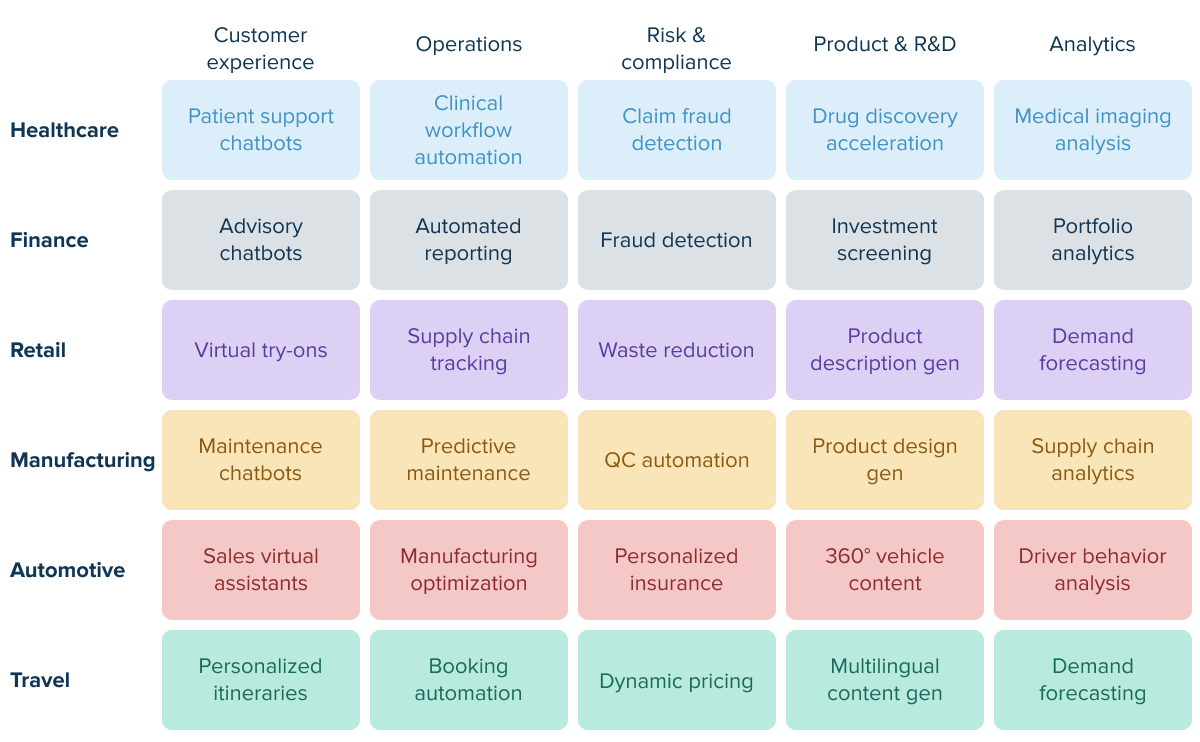
There are many practical uses for GenAI. These various cases, chatbots, RAG technologies, and so on are organised in multiple ways and are currently being used in businesses looking to reduce operational expenses, increase the quality of products and services, enhance the productivity of employees, and create better ways of managing risk.
There are two categories of GenAI use cases: those for end users and those for businesses. Tools that assist with large-scale content generation or workflow automation are two examples. Let’s delve more into the specific examples of best-value generative AI solutions, which will be useful for both individuals and companies to know.
Gen AI solutions in medical and biological sciences
Curious how generative AI is reshaping medical and biological sciences? Read our full breakdown of the latest solutions and use cases.
AI-powered drug discovery
The drug creation process is accelerated through GenAI’s ability to forecast atomic architecture, find enchanted chemicals, and simulate chemical functions. Because of this, research and development expenses and time are significantly reduced, giving a wider range of people access to reasonably priced medications.
The development of preventive care
Medical imaging could be enhanced via GenAI, which generates reports for MRIs, CT scans, and individual X-rays and reconstructs lacking data to identify existing patterns and abnormalities to assist with possible earlier diagnoses and tracking disease progression better.
AI support for clinical consultations and reminders
Due to GenAI analytics consulting tools, clinical visits for patients, particularly those who struggle cognitively, can benefit from capturing notes automatically, reminding them when they need to take their medications, and helping them remember when to make their next routine check-up or refill their prescription.
Personalised care plan automation
Generative AI solutions for hospitals are a catalyst for care plans as AI builds an integrated patient profile combining electronic health record data, genetic info, and past performance. Providers may use this information to provide recommendations on therapies that have a greater chance of being effective than traditional methods.
Payers’ agent support enhancement
Through the use of AI, health insurance companies can enhance call centre agents by analysing customer conversations, summarising what was discussed during those conversations, and providing real-time analysis.
Besides, generative AI solutions in insurance assist with claim processing, identifying things that might be contrary to the insurance companies’ policies, as well as pointing out items that may be considered fraudulent.
Artificial intelligence in financial services
Discover the real-world impact of AI in financial services.
Automation of business procedures
AI technology is capable of creating new tools aimed at enhancing wealth management and investment advisory services.

Source: Unsplash
Specifically, the use of OCR and NLP combined with advanced generative AI banking solutions builds systems that extract critical financial information from various sources and evaluate institutional investment and broking clientele, as well as screening stocks.
GenAI for fraud detection
The common AI application also includes the upgrading of fraud detection systems. The synthetic transaction data is designed for fraud detection and helps to make more accurate and effective fraud detection models with anomaly detection capabilities. In addition to producing reports on suspicious activity for law enforcement, GenAI can summarise complicated cases to help compliance teams finish investigations more quickly.
Better documentation support
Generative AI solutions for CRM integration and drafting and reviewing critical documentation can save significant time in the creation and review process. Investment policy drafting, loan application creation and review, compliance communication, client correspondence drafting, etc., are a few examples of applications.
Gen AI solution consultancy services
Gen AI chatbot solutions can help both internal and external resources by offering conversational, context-sensitive responses to intricate financial queries. By analysing market data, portfolio objectives, and individual transaction activity, GenAI supports portfolio advisory services by offering tailored investment recommendations as well.

Source: Unsplash
Implementing AI in retailing
Learn about how AI tools are changing the rules of the game in retail, opening up opportunities for business growth.
Quicker supply chain administration
AI is widely leveraged in supply chain administration as the fastest available way nowadays to track inventory. It also serves as a generative AI revenue solution because artificial intelligence enables businesses to reduce waste and avoid expenses, improving efficiency by monitoring inventory movement, sales patterns, trends, and the storage space required for products.
AI tools for answering queries
One more innovative generation artificial intelligence solution in the retail sector is smart chatbots that could significantly aid with query resolution, which includes responding to customers about enquiries, frequently asked questions, billing-related issues, etc., on time, resulting in a much better customer experience.
Customisation through virtual try-ons
By offering customers tailored product recommendations based on their interests, past purchases, and past shopping behaviour, generative artificial intelligence is able to boost the way consumers shop. Furthermore, nowadays GenAI makes it possible for people to virtually try on items so they can see how they will look before making a final purchase.
Prospects for genAI in electronics and manufacturing
Integrating genAI will transform the basis of both electronics and manufacturing, changing possible solutions into easy-to-use solutions.
AI agents for upkeep support
Generative AI sustainability consulting solutions can considerably upgrade upkeep support, as AI-based conversation assistants could be trained with product instructions and breakdown documentation in order to support on-site staff when trying to figure out what to do about equipment. This will help reduce potential downtime.
Using GenAI in predictive maintenance
In order to forecast potential equipment failure, artificial intelligence systems can make use of past maintenance activities and performance data very quickly.
GenAI for data analytics
GenAI gets better at every aspect of the supply chain by utilising historical forecasts and contemporary analytical techniques.
For example, it might keep the right inventory levels with the usage of live customer requests, thereby limiting wasted goods, and enhance space use by examining how to store things by identifying patterns in the way that people use that storage.
Enhancement of product design
Thanks to generative AI for cloud solutions and integration to speed up design, streamline production, and improve product performance. GenAI also helps manufacturers evaluate different design ideas so that they can work well but at as low a cost as possible, perform as predicted, and be designed accurately. All of this results in improved productivity and lower production disruptions.
GenAI’s technological use cases
AI takes part in technological achievements to usher in much greater efficiency.
AI-agents for real-time knowledge management
By having a dynamic knowledge base and library with training materials and best practice information available, real-time customised coaching and interaction using artificial intelligence can offer a personalised response to the needs of an organisation. This enables staff members to receive up-to-date information on enterprise-wide communications and training initiatives, organisational changes, and product enhancements.
If you’ve heard “agentic AI” everywhere but still aren’t sure what it actually means — this 2-minute explainer will make it click.
Automation productivity due to AI
There is no doubt that most innovative generative AI solutions available also result in reducing the technical debt of an enterprise due to time constraints and human errors. It is reached by automating code reviews and testing, making small edits to code without disrupting functionality, and providing the ability to identify and prioritise critical problems to allow developers to concentrate on higher-level, strategic tasks to improve overall team productivity.
AI-powered tools for developing new products
AI provides companies with the ability to create functions and applications through GenAI and ML solutions. As a result, organisations are able to develop faster and significantly reduce the amount of manual coding in developing software applications.
Generative AI contract management software solutions aimed at upgrading apps suggest the best system architecture and user interface, design layouts based on product usage, readily create mock-ups or prototypes, and supply a tailored approach to the design phase.
AI improvement of a product lifestyle
GenAI offers advantages during each stage, from product creation to product retirement, allowing for quicker data-driven decision-making by analysing both historical data and current market trends. It can review and examine customer feedback, stakeholder feedback, and historical data through the use of NLP.
GenAI provides designers the ability to explore design solutions and how to improve each respective feature based on technical feasibility, as well as required laws and regulations.
Artificial intelligence in the automotive sector
Know how to reach productivity and safety levels through all aspects of the automotive lifecycle with AI in the automotive realm.
AI chatbots for vehicle sales
Automotive tools for implementing generative AI solutions are beginning to be explored for vehicle sales purposes. Qualifying leads, scheduling test drives, answering technical questions, and offering financing options bring professional quality, thereby improving the dealership’s ability to sell, all while using virtual assistants designed specifically.
Enhanced promotion and content production
The more captured and better content you have, the more purchases you will achieve. Custom generative AI solutions can benefit consumers by getting a 360-degree view of the vehicle, thus allowing them to view and explore all available features of the vehicle without having to visit the vehicle and physically inspect it on the dealer’s lot. Thus, due to AI-powered content, the final purchase is reached faster than ever.
Customised client experience with AI
Harnessing generative AI, become more informed about the human behaviour behind the wheel.
By simulating driver patterns, you can evaluate and iterate on the capabilities of your new technologies and developments with unparalleled precision and help to choose the right type of car for clients. AI is advancing the design of human-centred solutions in the industry by tailoring suggested actions or offering extra support based on individual driving styles.
Gen AI to simplify insurance and financing
Transforming auto insurance through AI gives your clients a chance to enter into a modern-day world of personalised auto insurance.
By using smart algorithms that analyse GPS tracking to calculate how your clients drive, you’re able to charge them a fairer premium than what is currently being offered. In the end, this will improve the level of customer satisfaction you provide and create a distinct advantage relative to your competitors.
Automation of gaming and media
Significant changes in gaming and media are the result of AI input.
AI for game development and automation
Generative AI integration development effectively takes place in the gaming realm and media space, as artificial intelligence is capable of functioning like a ‘co-pilot’ for coding processes, writing, and creating movies and storyboards, enabling smaller companies to produce higher-quality materials much more quickly.
Smart NPCs using LLMs
More realistic scenarios and natural behaviour are achieved with the impact of AI, making both media and gaming realms more dynamic. NPCs driven by LLMs are a new type of gaming experience that provides a shift away from the scripted, creating responses to players’ commands in real time, thus enhancing immersion and enabling the use of open-ended dialogue.
Automation of qualitative content production
GenAI SaaS solutions have evolved from experimental trial phases to being a necessity for enterprise-level infrastructure in games. Through advances in the automation of producing quality content quickly, AI has also helped enhance human creativity. Asset generation (2D/3D), NPC dialogue, narrative design, and procedural world generation are just a few of the uses for GenAI. There is a significant trend towards multi-modal AI, which includes text, image, and 3D generation capabilities.
AI systems for testing and quality control
Generative AI data solutions are modifying quality assurance into automated, intelligent, and continuous processes for testing and quality control in gaming and media. These systems use ML, computer vision, and reinforcement learning to replicate human players, identify visual defects, and improve performance within large, complex, and continually changing environments.
The transformation of the traveling realm
The travel industry is about to enter a new era of generative AI, fostering more secure trips and better client services.
Easy travel preparation via AI tools
With AI-based tourism technology, travelling is simple with quick planning and preparation that deliver customised itineraries, on-demand trip ideas, automatic booking features, and significantly reduced planning time. GenAI models can help users identify the best available prices and deal forecasts, increasing efficiency in the travel planning process.
AI chatbots for customer support
Previously, clients were not able to interact with chatbots in an informal way or have the ability to make requests for what they needed. But these days, AI-powered chatbots provide 24/7 support via SMS, email, phone calls, etc., for FAQs regarding changes made while travelling, like making changes to flights, buying tickets, and other tasks where the customer would like assistance after hours or at a time that works best for them.
AI-powered pricing and revenue management
Dynamic pricing and revenue management in travel and tourism are taking advantage of AI technologies to determine the best price for a product by examining real-time data such as competitor pricing, trends in bookings, weather, and local events.
Generative AI enterprise solutions allow hotels and airlines to be less dependent on their manual, static pricing tags, leading to revenue increases. For airlines, there is the ability to adjust fares instantly based on the speed with which customers have made their purchase and on the changes occurring in the marketplace.
How to get GenAI live
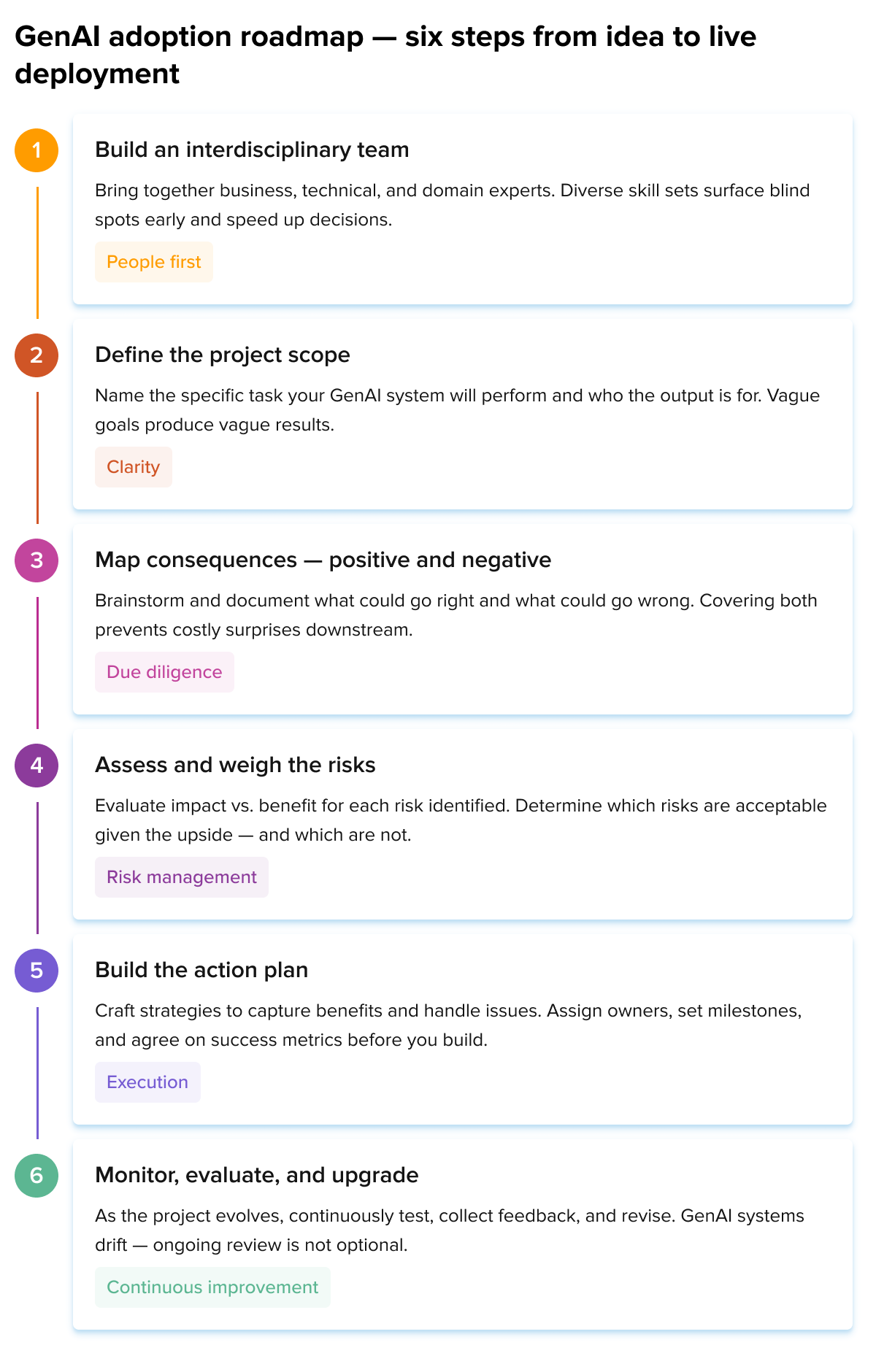
Here’s how to take a GenAI idea from first sketch to live deployment, in six steps.
Wrapping up
At this point, generative AI will be the base of the most successful autonomous enterprises and will usher in a new era of capability for employee and business productivity. Generative AI solutions companies are already allowing organisations to take advantage of by deploying, servicing, and managing complex systems at an unprecedented level of ease and efficiency.
As early adopters of the generative AI revolution, it is wise to make the most of this extraordinarily potent technology and usher in a new era of business success by leading the way in innovation and advancement.
FAQ
-
Generative AI is an AI that will create completely new and original work (text, images, coding for applications, sounds, etc. ) using learned information or patterns from the existing data. Traditional AIs, on the other hand, exist to perform analyses of existing data and solve identifiable or predictable problems and complete predefined tasks, whereas generative AI solution development can be viewed as a collaborative partner that proactively develops new solutions.
-
The top five generative AI tools are Microsoft Copilot for productivity, Anthropic’s Claude for writing and analysis, OpenAI’s ChatGPT for general text and chat, Midjourney for artistic imagery, and Runway ML for creating videos. These five tools are at the forefront of enterprise productivity, text generation, image creation, and video creation.
-
Before studying how to build a generative AI solution, to assess whether your company is prepared to use AI, you will need to undertake an in-depth review of multiple aspects within your organisation, since the adoption of AI typically requires the establishment of a base from which the company can grow, not necessarily simply by purchasing additional technology.
-
For a typical implementation of a customised artificial intelligence system by the end of 2026, you would generally expect to spend between $50, 000 and more than $1, 000, 000, depending on the generative AI solutions’ stock, your requirements, and how long it will take to complete. Most mid-range (between $50, 000 and $300, 000) projects will be completed within 4–12 months.
-
When deciding whether to build your own AI or use an existing model, it is essential to weigh factors such as speed of delivery, initial cost, and need for a competitive advantage. Typically, using an off-the-shelf model will allow for faster deployment and have lower upfront costs. However, if you are looking for long-term scalability, data security, or specific accuracy, you may want to develop a custom AI model.
-
To escape the risks of generative AI solutions in business, ensure compliance with regulations such as GDPR/CCPA, employ a “data protection by design” approach, conduct FTO searches and IP protection activities, comply with emerging AI regulatory developments such as the EU AI Act, and validate marketing claims to ensure there is no misrepresentation when marketing services.
-
Updating AI models as technology changes involves integrating continuous ingestion of data and implementing different types of retraining strategies based on different architectural models. Model drift occurs when the data patterns become different from the originally trained models; therefore, models should be retrained regularly using either periodic or ad hoc methods to keep them accurate and relevant.