














Contact Us
Contact Us

Generative AI Integration Services for Businesses Ready to Move From Pilot to Production

Proven generative AI integration — built to fit your operations and hold up at scale

Trusted by Innovative Companies

Our Generative AI Integration Services

Most businesses don't need another standalone AI tool — they need generative AI working inside the systems they already run. We help you connect large language models, AI agents, and chatbots to your existing software stack and internal data pipelines, so generative AI becomes part of how your teams already work, not a separate app they have to learn.
  • Integration Readiness & System Mapping

    Before any code is written, we map your existing systems, data flows, and workflows to identify where generative AI can plug in with the least disruption and the highest impact — and just as importantly, where it shouldn't. You get a clear integration plan, not a guess.
  • API & Platform Integration

    We connect foundation models and custom AI components to the platforms your teams already use — Salesforce, Microsoft Dynamics 365, SAP, ServiceNow, HubSpot, or your own custom-built systems — through secure, well-documented APIs.
  • Data & Knowledge Connectivity

    Your AI is only as useful as the data it can reach. We wire generative AI components into your internal knowledge bases, document repositories, and databases, so the outputs reflect your business context — not generic, disconnected answers.
  • Workflow & Process Embedding

    Rather than adding a new tool to your stack, we embed AI capabilities directly into existing workflows — ticket routing, approval chains, reporting cycles — so automation happens where the work already happens, with minimal disruption to how teams operate.
  • Cross-Platform & Cloud Compatibility

    Whether your infrastructure runs on AWS, Azure, GCP, on-premises, or a hybrid setup, we design integrations that fit your existing architecture rather than asking you to change environments to accommodate the AI.
  • Secure by Connection

    Connecting AI to live systems means it touches live data — so every integration point gets its own access controls and monitoring, on top of the security and compliance foundation we build into every project.
  • Integration Testing & Ongoing Support

    Every integration goes through compatibility testing, performance checks, and monitoring setup before go-live. After deployment, our team tracks model behavior across your systems and keeps integrations stable as your platforms and vendor APIs evolve.

The Foundation Behind Every Project

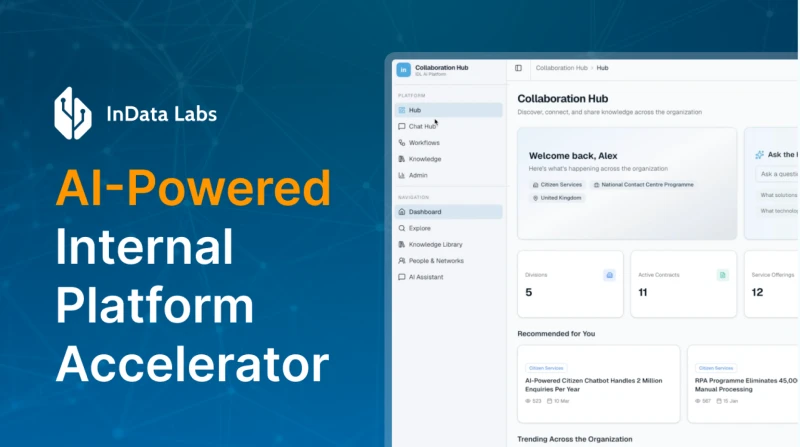
Every project we deliver is powered by our Internal AI Platform Accelerator — a production-ready foundation that lets us move from idea to working solution fast.

Built on a Platform, Not from Scratch

We don’t start every AI project from zero. Our Internal AI Platform Accelerator already has the infrastructure in place — models, storage, orchestration, logging, and analytics — so we go straight to solving your problem. That means we can validate an idea against your real data and deliver a working RAG system or agent in weeks, not months.

You own the final codebase — no platform lock-in.

Integration Changes the Outcome

The data is consistent: AI embedded into real workflows drives ROI, saves time, and outperforms model choice or budget as the deciding factor.
  • 77% vs 33%
    of organizations with AI embedded into workflows report positive ROI — vs. just 33% of those without.
    Eliassen Group, 2026
  • 3.3 hrs/Week
    saved per user when AI works inside existing workflows — about a month of time back per year.
    Eliassen Group, 2026
  • #1 Lever
    workflow redesign is the single biggest factor in whether AI delivers real business impact — ahead of model choice or budget.
    McKinsey, 2026
Ready to Integrate Generative AI? Get a Clear Answer in 5 Minutes.
Answer 10 questions across your data, systems, workflows, team, and budget to get an instant integration readiness score — plus a short list of next steps before you scope a pilot.

Take a Free AI Integration Readiness Check

The Integration Process of Generative AI

Our generative AI integration process breaks down into seven stages, each with a clear owner and a clear exit criterion:
  1. generative ai

    Discovery and use-case scoring

    — identifying where generative AI would change business outcomes, not just save a few minutes here and there.
  2. data architecture

    Architecture and model selection

    — choosing between commercial APIs, open-source models, or a hybrid approach based on cost, data sensitivity, and latency.
  3. data engineering and architecture

    Data integration

    — connecting the model to the data sources it needs, with access controls your security team will actually sign off on.
  4. Improved Productivity

    Fine tuning and testing

    — adjusting the generative AI system against real scenarios before anyone outside the project sees it.
  5. engine integration

    Workflow integration

    — wiring the solution into the tools people already use, rather than asking them to open a new tab.
  6. recommendation engine

    Deployment and monitoring

    — going live with performance tracking in place from day one, not added retroactively.
  7. Custom AI Solutions

    Ongoing support

    — because the integration process of generative AI doesn't end at launch; models drift, business needs shift, and something needs to be watching.
Not sure where to start? We'll assess your workflows and show you exactly where generative AI would create real leverage.

See AI and Data Analytics at Work

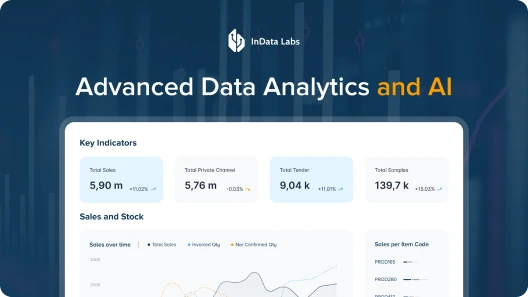
From virtual assistants to sales forecasting — watch how we bring AI to life across industries. 2-minute videos, real results.
  • Watch Demo
  • Watch Demo
  • Watch Demo
  • Watch Demo
  • Watch Demo
  • Watch Demo
  • Watch Demo
  • Watch Demo
  • Watch Demo

Benefits of Generative AI Integration

Done right, integration turns generative AI from a standalone tool into a measurable driver of business performance.
  • AI

    Reduced Operational Costs

    Automate repetitive tasks and free up team capacity.
  • High-Quality Results

    Higher Customer Satisfaction

    Faster, more accurate responses across support channels.
  • engine integration

    Scalable Automation

    Systems that grow with demand, not headcount.
  • AI

    Faster Decision-Making

    Real-time insights from your own data, not delayed reports.
  • transparent processes

    Improved Process Accuracy

    Fewer manual errors across repetitive workflows.
  • error risk

    Improved Risk Management

    Spot anomalies and flag issues before they escalate.
  • Improved Visibility

    Increased Operational Agility

    Adapt workflows quickly as business needs shift.
  • Self improvements

    Data-Driven Innovation

    Uncover patterns that inform new products and services.
Ready to see which of these benefits applies to your business?

Let Our Clients Do the Talking

GenAI Integration and Customization Services

Generic models don't know your industry, your compliance rules, or your brand's voice. Our GenAI integration and customization services fix that — fine-tuning on your data, tailored prompts and guardrails, built for the way your business actually works.
Not sure which service fits your use case? Let's scope it together.

Trusted Technology Partnerships

Our technology partnerships with AWS and Databricks reflect our commitment to building scalable, enterprise-grade AI solutions. We help clients solve complex data, analytics, and AI challenges — from scalable data lakes and warehouses to end-to-end machine learning pipelines.
Industries We Bring Generative AI Integration To

From regulated data in healthcare and fintech to high-volume operations in retail and logistics, we adapt generative AI integration to the compliance requirements, systems, and workflows specific to your industry.
  • finance banking

    Fintech

    • Automated financial reporting
    • Analytics for credit scoring
    • Fraud prevention
    • Customer service automation
    • Wealth & investment management
    • Compliance management
  • healthcare

    Healthcare & Pharma

    • Drug discovery and R&D
    • Clinical and patient care
    • Administrative efficiency
    • OCR & healthcare business processes optimization
    • Genomics and precision medicine
    • Medical image analysis
  • ecommerce

    Retail & E-commerce

    • Demand forecasting and inventory
    • Predictive maintenance
    • Supply chain and operations
    • Fraud and loss prevention
    • Sustainability and compliance
    • Marketing and advertising
    • AI Search and discovery
  • logistics

    Logistics & Supply Chain

    • Demand and supply planning
    • Route and fleet optimization
    • Warehouse and fulfillment operations
    • Freight and carrier management
    • Documentation and compliance
  • manufacturing

    Manufacturing

    • Design and engineering
    • Production planning and scheduling
    • Quality control & predictive maintenance
    • Supply chain and procurement
    • Digital twins and simulation
  • marketing

    Sales & Marketing

    • Content generation & personalization at scale
    • Lead generation and qualification
    • Customer insights
    • Sales forecasting
    • Customer retention and expansion
  • AI

    Sports & Wellness

    • Athlete performance and training
    • Injury prevention and recovery
    • Game strategy and analytics
    • Predictive player analytics
    • Facility and venue management
  • icon-gaming

    Entertainment & Games

    • Game content creation
    • Player experience and personalization
    • Marketing and audience engagement
    • Analytics and player insight
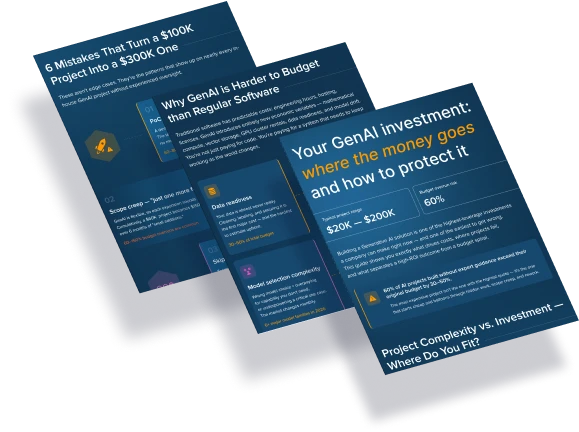
Your GenAI Investment: Where the Money Goes — and How to Protect It
Get the free report and see exactly where your AI budget is going, the hidden risks draining it, and how to safeguard your investment. Fill in the form to download.
Download

Why Teams Choose InData Labs

Experience, scale, and follow-through are what separate a working AI integration from a stalled pilot — here's what we bring to the table.
  • High-Quality
    12+ Years on the Market
    Over a decade of hands-on experience building AI and data solutions that hold up in production.
  • deep learning
    150+ AI and ML Projects Delivered
    From pilots to full-scale rollouts, across use cases where "close enough" isn't good enough.
  • 80+ Specialists in-House
    Data scientists, ML engineers, and architects under one roof — no stitching vendors together.
  • engine
    Industry-Proven Across 8+ Verticals
    Finance, healthcare, retail, manufacturing, and more — we adapt the approach, not just the pitch.
  • like
    Reliable Development Partner
    We stay through deployment and adoption, not just the demo.
  • Custom GenAI Accelerator Platform
    InData Labs developed an internal platform that cuts solution development time from 1–2 months to 1–2 weeks.

Meet Our Engineering Team

The people behind generative AI consulting services very integration — data scientists, ML engineers, and architects who've shipped AI systems that actually stay in production.
  • Vitaly Znachenok
    Head of IT, DevOps
  • Yauheni Miadzvedz
    Data Science Team Lead
  • Andrew Mytko
    Data Scientist, AI/ML
  • Palina Dounar
    Data Scientist, LLM
  • Ihor Zarichnyi
    Data Scientist, CV
  • Joao Ribeiro
    Business Intelligence Engineer
  • Dzmitry Kalenda
    Full Stack Engineer
  • Aleh Tarasevich
    Front-End Engineer

Our Generative AI Toolkit

We build solutions rooted in leading-edge technology.
  • Foundation Models & API

    • openAI
    • gemini
  • RAG & Agents

    • langchain
  • Vector Search & Retrieval

  • NLP / ML

    • hugging face
    • logo-spacy
    • Pytorch technology
    • SCIKIT LEARN technology
  • Voice & Audio

  • Evalution & LLMOps

    • ML Flow
  • Cloud & Deployment

    • docker
    • kubernetes
  • Developer Productivuty

FAQ

  • Generative AI integration lets you automate repetitive work, speed up content and code production, and surface insights buried in unstructured data — all without replacing your existing systems.

    Done right, it reduces manual workload across support, sales, operations, and knowledge management while improving consistency and turnaround time. InData Labs designs integrations around your actual workflows, so the AI slots into how your teams already operate rather than forcing a new process on them.

  • Value shows up in three places: cost savings from automating manual tasks, revenue growth from faster and more personalized customer experiences, and better decision-making from AI-generated insights across large datasets.

    The exact mix depends on where you deploy it — internal tooling, customer-facing products, or both. A ChatGPT integration built for internal knowledge search, for instance, tends to show up first as cost savings, while one embedded into a customer-facing product shows up as revenue growth. A well-scoped generative AI integration ties each use case back to a measurable business metric from day one, rather than treating AI as a standalone experiment.

  • Before any model touches production data, we run a data audit — checking for gaps, duplication, inconsistent formatting, and bias in the training or reference data.

    For retrieval-augmented setups, this also means structuring and cleaning your knowledge base so the model retrieves accurate, relevant context instead of noise. Poor data quality is the single biggest cause of hallucinations and irrelevant outputs, so this step isn’t optional in any project we run.

  • Yes. Most enterprise environments still run on legacy CRMs, ERPs, or custom-built internal tools, and a full system replacement is rarely realistic. We typically connect generative AI capabilities through APIs, middleware layers, or lightweight connectors that sit alongside legacy infrastructure, so you get modern AI functionality without a disruptive rip-and-replace migration.

  • Not by default. We architect integrations so proprietary and sensitive data stays within your environment or a controlled private instance, and we do not use client data to train public foundation models.

    Depending on your compliance needs (GDPR, HIPAA, SOC 2, etc.), we can implement on-premise or private-cloud deployment, data masking, and strict access controls so your information never becomes part of a third party’s training set.

  • Generic consulting usually stops at a strategy document. Generative AI integration services for business solutions end with a working system connected to your actual data and tools — the only version of the advice that changes what your teams do on a Monday morning.

  • Timelines vary by scope, but well-defined use cases (a support chatbot, a document summarization tool, an internal search assistant) typically show measurable results within 8–14 weeks of deployment.

    As an experienced generative AI integration company, InData Labs prioritizes fast, low-risk pilot phases so you can validate ROI on a narrow use case before scaling the investment across the business.

  • Generative AI development gets a model built. Generative AI integration is what makes it useful — connecting that model to your CRM, your document repositories, your support desk, your ERP, and your people’s daily routines. This is usually the point where companies realize that hiring a generative AI development company to build a model isn’t the same as having a partner who can actually wire it into how the business runs.


    Integrating generative AI into a single department is one thing; integrating generative AI into business strategy is another. The first is a project. The second is infrastructure, and it needs the same rigor as any other core system: authentication, monitoring, data governance, and a clear path from proof of concept to production. That’s the practical difference between a demo that looks impressive in a meeting and a generative AI system your teams still trust six months later.

  • Start smaller than feels necessary. How to integrate generative AI into an existing process usually goes wrong when the first deployment touches too many systems at once. A single, well-instrumented proof of concept — with a rollback plan — tells you more than a company-wide rollout with no baseline to compare against.

  • Sequence it. Pick the workflow with the clearest, most measurable outcome first, prove the model and the integration pattern there, then reuse that same architecture — data connectors, monitoring, fine tuning approach — for the next department instead of rebuilding from scratch each time.

Have a Different Question?

Contact InData Labs

Want to start getting value from your data? Fill the form. Click send. Let's talk.

    By clicking Send Message, you agree to our Terms of Use and Privacy Policy.