
In times when generative artificial intelligence continues to impress with new functions and opportunities, it’s easy to forget about the difficulties that may arise due to its use, especially the ones connected with security and intellectual property. In the situation, when the rules of AI utilization are still unclear on the legal level, AI enterprise governance becomes the only way to protect your organization from penalties and ensure its safety.
Read this article further to know more about the importance of this framework for modern business and how to implement it in your own organization.
What is AI enterprise governance?
AI enterprise governance refers to the combination of processes, structures, and oversight that ensure custom AI software is properly built and deployed across an organization. As companies expand their use of generative AI, strong governance becomes essential to ensure AI efforts align with business goals, meet ethical and regulatory requirements, and maintain consistent, reliable model behavior in production.
In an organization, the way people govern AI affects the financial return on their investments. If there are no clear policies, assigned owners, or methods to manage risks, AI projects often become slow or experience security problems that people could have avoided. To many observers, a lack of trust from stakeholders is a common result of those missing controls.

Source: Unsplash
Due to findings in recent research, difficulties with governance are the primary reason why artificial intelligence does not expand further within large companies.
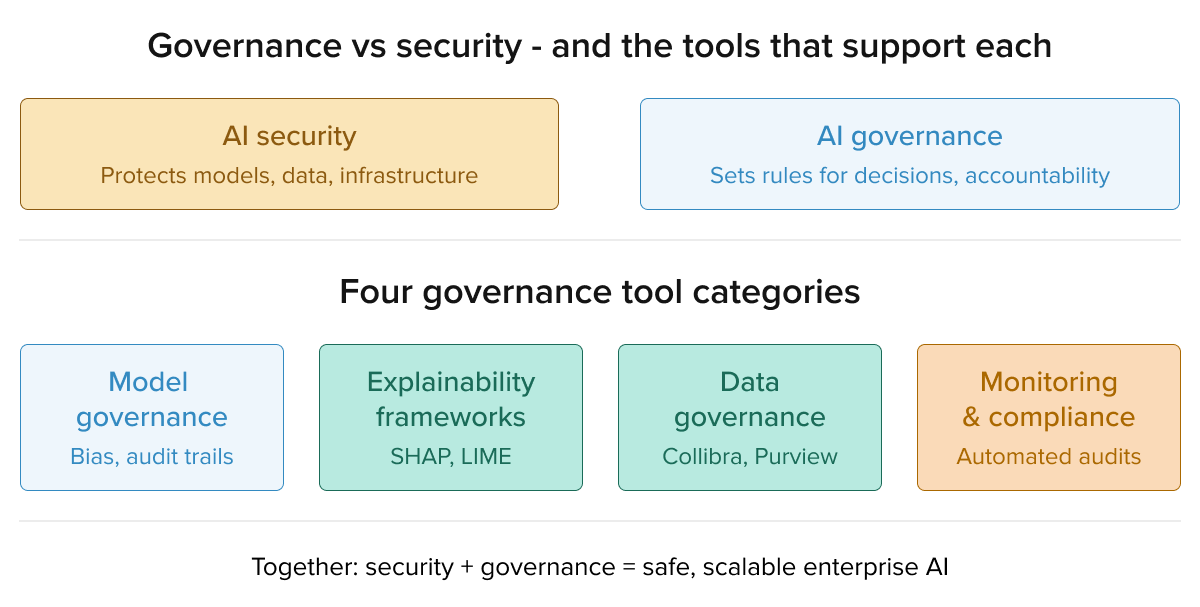
This involves establishing accountability, developing policies, analyzing risks, and upholding transparent and ethical operations. The development of both security and governance provides the groundwork for safe and scalable enterprise AI development solutions.
What is the importance of AI governance in modern enterprises?
In less than a decade, generative AI, the newest stage of artificial intelligence, turned from an experiment to an imperative for businesses that want to stay competitive in the modern market.
On the one hand, AI integration solutions cut coding times from days to minutes, accelerate content creation, tailor user and employee experiences, streamline operational processes, and automate cybersecurity tasks. On the other hand, they enhance the risks of compliance and regulation, data bias and reliability, and a loss of trust when users lack clarity of how AI models work and how they are governed.
Growing organizational demand
Despite AI business consulting services having already shown what they are capable of, they still can’t work properly on their own. Successful companies know that AI can bring impressive results only under strict human supervision.
The research shows that 47% of organizations faced at least one negative generative AI consequence. The figures show that now the AI risk is tangible and that controls must go beyond model outputs to cover access, purpose, and context restrictions. Continuous AI monitoring and explainability help prevent unexpected behaviors and enable faster response.
Public and regulatory pressures
As AI has become an inseparable part of every industry, its laws are gradually becoming stricter and more explicit. As for the beginning of 2026, over 72 countries have proposed more than 1000 AI-related policy initiatives focusing on transparency, safety, and human rights. Some of the most noticeable laws include:
- European Artificial Intelligence Act (EU AI Act): After becoming fully acceptable on 2 August, this act will be the world’s first comprehensive AI act.
- AI Bill of Rights: Came into force in October 2022, this American law protects civil rights, data privacy, and safety.
- Executive Order 14179: Signed on January 23, 2025, this order supports AI development free from social agendas, ideology, and politics.
- AI Promotion Act: This Japanese act was fully enacted in September 2025 to promote AI development through innovation rather than strict penalties.
Organizations understand the risks associated with the use of AI and take steps to strengthen data privacy, mitigate bias, and comply with legal obligations. Failures to maintain compliance may lead to fines reaching millions of dollars and, depending on the seriousness of the situation, even force a shutdown of the operation.
How to implement AI governance
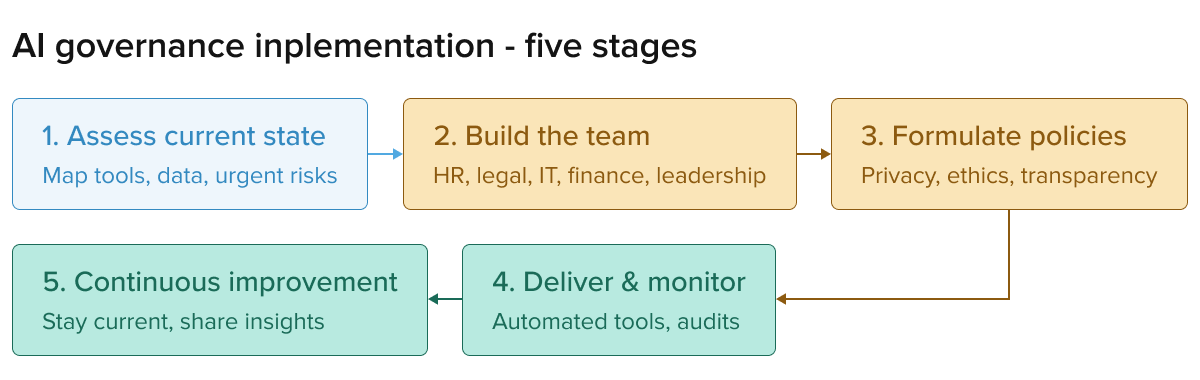
AI governance implementation is a sophisticated process that requires not only the use of AI systems that are secure but also a detailed plan tailored to your organization and goals. However, there are some stages that any good artificial intelligence services company can’t skip. Here they are:
Estimate current status and pinpoint risk
Begin by assessing your current AI strategy consulting and how you plan to utilize artificial intelligence in the future.
Once you comprehend the full set of tools used to handle, store, and work with your data, you can get a clearer picture of your recent environment, including the most urgent risks your organization faces.
Build a team and create buy-in
Besides AI product development experts, successful AI enterprise governance requires a multi-disciplinary team that provides oversight for AI projects. Take into consideration that the committee should consist of not only technical department specialists.
Experts from HR, finance, IT, legal, operations, and leadership will ensure there are no critical operational areas that are overlooked. Bring in talent—especially those who already possess AI expertise and are highly motivated to learn new skills. Once the team is gathered, set up a regular meeting rhythm and delegate clear roles and responsibilities.
Although artificial intelligence is already a part of almost every person’s everyday life, there are still many people being afraid of the fact that they will lose their jobs to this new technology. It’s easy to understand why.

Source: Unsplash
The task for business leaders should be to prevent the fears. This could be achieved by presenting employees with the advantages of using AI, reassuring them that they won’t lose their jobs and that they will work in the best way possible without being made redundant.
Showing empathy makes a significant difference. Rather than dismissing their concerns, help them see the broader context and understand that adopting AI is an unavoidable shift. By making every member of your staff a part of the journey and your business’s future, you can help your employees to embrace the technology and even start to feel positive about it.
Formulate policies
Once your team is in place, begin developing policies that outline:

As AI governance standards are constantly developing, your policies can’t be a non-modifiable document. The committee should continually check what’s working and what isn’t. One of their main responsibilities is to keep on improving policies so they can adhere to the best options for stakeholders, employees, and compliance purposes.
Delivery
Planning has a limited value if the organization can’t execute it properly. If your team lacks expertise in enterprise AI governance, bring in coaches, mentors, and AI project managers to strengthen planning, mitigate risks, and support successful implementation.
Keep in mind that AI initiatives involve experiments and take time to yield outcomes. Even then, scaling an initiative can go off-plan, so companies should budget additional funds to cover any unexpected costs.
As AI systems are learning and evolving nonstop, holding 24/7 human supervision will not be a practical approach. It’s better to apply automated tools that will continuously analyze AI model behavior, performance metrics, and compliance.
Foster a culture of ongoing improvement
Since AI is evolving quickly, it’s crucial to build a culture of ongoing improvement where your teams stay up to date with rising AI trends. Employees should be encouraged to share their insights with one another and stay committed to making your custom AI solution stronger day by day.
AI governance tools for enterprises
As the AI governance role in enterprise digital transformation is significant, the market is full of governance frameworks for deploying them. The quality of the final product directly depends on the quality of the chosen tools, which is why it’s essential to choose the ones that fit perfectly for your business case. There are several main types of AI governance tools for enterprises you should consider while making your decision.
Model governance platforms
Model governance platforms focus on specialized software solutions built to handle the whole lifecycle of AI models to mitigate risk, maintain compliance, and lower risks. Their main features include automated documentation, model registries, performance oversight, bias spotting, and audit trail production.
Platforms like IBM’s Watson OpenScale, Credo AI, and Fiddler AI provide AI for project management and other industries with transparency reports, fairness metrics, and bias detection.

Source: Unsplash
As a result, businesses can improve regulatory compliance and risk management, boost operational efficiency and scalability, and get advanced security.
Explainability frameworks
Explainability frameworks are systematized policies and oversight processes that companies use to make enterprise AI governance solutions transparent, comprehensible, and accountable, ensuring models remain fully auditable for regulatory requirements and fairness.
Complex models can work as “black boxes.” However, these systems are not effective when it comes to mitigating risk in high-stakes industries, such as healthcare, finance, and human resources. Explainability frameworks like SHAP or LIME help address this situation by documenting decision-making processes and data inputs, thereby narrowing the gap between human understanding and “black box” models.
Data governance solutions
Top experts in enterprise-level AI governance utilize data governance solutions from industry-leading enterprise platforms like Informatica, Alation, and Collibra to establish data quality, security, and regulatory compliance. If your business handles specific software stacks, it is a good choice to take a look at open-source solutions like Apache Atlas or cloud-native tools like Microsoft Purview.
Challenges of applying AI governance
The latest innovations in AI governance for enterprises demonstrate how they can improve an organization’s security and effectiveness. However, it is a highly structured process that presents several challenges businesses should be aware of before integrating this technology into their workflow.
Sheer complexity
AI models, especially deep learning models, are often opaque and difficult to interpret, leading to systems that act like “black boxes.” It means that the reasoning behind a model’s outputs can’t be clearly explained.
Such models require strong technical proficiency in developing, maintaining, and troubleshooting. The best practice to prevent this situation is to keep models “explainable” and well-documented as much as possible.
A rapidly changing AI landscape
Despite AI already being a powerful tool for numerous industries and practices, it’s still in its formative stage and is considerably changing every few days. New tools and techniques emerge far more quickly than any policies can keep up with, which is why governance frameworks for deploying agentic AI in enterprises should know how to adapt to these changes.
Data quality
It’s no secret that the quality of AI models depends on the quality of data they were trained on. The report shows that 52% of top experts in enterprise-level AI governance consider data quality and availability the biggest obstacle to adopting artificial intelligence.
Uncertainty with legal and regulatory changes
Nowadays, AI governance standards are only at the stage of shaping. It can be hard to navigate an already uncertain path, which is why AI enterprise governance teams should be extremely experienced and precise.
Enterprise AI governance: Final thoughts
The use of AI governance tool solutions to help enterprises implement artificial intelligence ensures innovation, safeguarding, and societal gain from AI technology. It makes sure businesses tackle their problems and use AI technology without any hitches.
FAQ
-
Enterprise AI governance is a framework that protects AI systems against risks by providing consistent, ethically grounded guardrails, policies, and procedures. It ensures that AI adoption complies with both companies’ strategic goals and local laws and regulations. As a result, the use of AI becomes transparent, responsible, and fair.
-
Companies take intellectual property leakage prevention seriously, which is why this process usually consists of a layered set of technical, operational, and contractual controls. The measures include encryption in transit and at rest, data minimization, confidential data detection frameworks, input sanitization, zero-trust access controls, and others.
-
With new types of attack surfaces being opened up by RAG, such as retrievers, vector databases, and embeddings, AI governance will protect sensitive data using various controls on the entire RAG stack. This can be done because it leverages privacy-preserving approaches, zero-trust-based access control on retrieval and generation, and other strategies.
-
A robust AI policy framework is based on clear governance principles that ensure safe, transparent, and ethical use of AI that complies with all organizational and societal expectations. There are 5 core pillars of ethical AI: fairness, accountability, transparency, security, and privacy.
-
The difference between traditional data governance and AI-based data governance is that the latter tends to have a wider area of concern. It may cover data and systems, but also how to govern algorithmic risk & model behavior in the longer term and the societal impact of using AI.