
Big data in E-commerce is no longer a competitive advantage reserved for tech giants — it has become a baseline requirement for any online retailer serious about growth.
As global E-commerce continues to expand, the volume, velocity, and variety of data generated by customers, transactions, and supply chains has reached a scale that traditional analytics tools simply cannot handle.
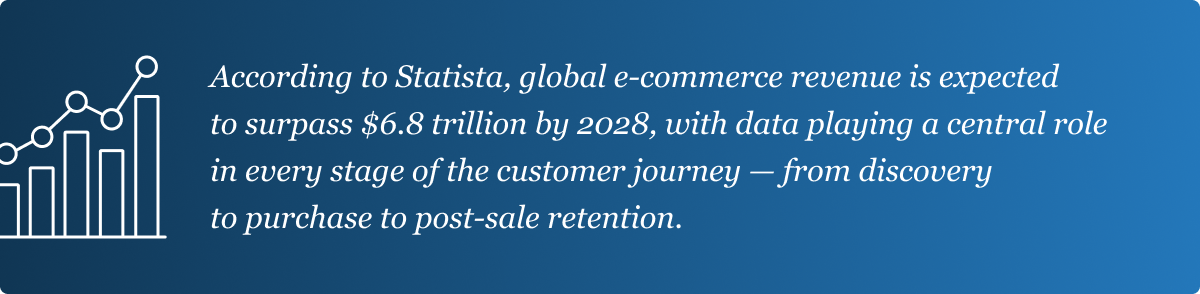
Retailers that invest in Big data analytics today are not just optimizing operations — they are building the infrastructure for long-term competitive advantage.
Data analytics for E-commerce covers a broad spectrum: from understanding customer preferences and predicting demand to optimizing pricing, reducing cart abandonment, and personalizing every touchpoint at scale. This guide breaks down what Big data in E-commerce means in practice, the key use cases driving results in 2026 and beyond, and how your business can get started.
Why Big data is a must in E-commerce
The essential benefit of Big data in E-commerce is the ability to make data-driven decisions with confidence. One can see which activities are most popular among customers, which types of content drive the most engagement, and which channels deliver the highest traffic volumes. When business owners know that, they are far more likely to choose the right paths for growth.

Source: Unsplash
Big data also enables businesses to deliver genuinely personalized customer experiences. According to multiple resources, personalization can reduce customer acquisition costs and lift revenues. In B2B E-commerce, business shoppers expect tailored experiences during the purchasing process.
Companies that want to deliver this level of personalization must know their customers deeply, and a robust Big data analytics strategy is the most reliable way to get there.
The adoption of Big data for E-commerce is accelerating for several interconnected reasons:
- Customers expect real-time, relevant experiences — and punish brands that fail to deliver
- Supply chain volatility requires predictive, data-driven inventory management
- Marketing budgets face increasing scrutiny, demanding measurable ROI
- Competition from marketplaces like Amazon and Alibaba forces smaller retailers to differentiate on experience and efficiency
- AI and machine learning are unlocking new analytical capabilities that were unavailable just a few years ago.
The relationship between Big data and E-commerce marketing analytics
One of the most impactful applications of E-commerce marketing analytics is the ability to attribute revenue precisely to specific campaigns, channels, and customer segments. E-commerce businesses have access to an unprecedented volume of behavioral data — from website sessions and click patterns to email open rates and social media interactions.
E-commerce business analytics powered by Big data allows marketing teams to move beyond vanity metrics and focus on what actually drives conversions.
By combining first-party customer data with market intelligence and campaign performance data, retailers can build highly targeted campaigns that speak directly to individual customer preferences — rather than broad demographic assumptions.
Marketing strategies built on Big data analysis consistently outperform those based on intuition. A Forbes analysis found that data-driven marketing decisions improve customer acquisition efficiency by up to 30% and significantly increase lifetime value.
How Big data is used in the E-commerce industry
There are many ways to use Big data for E-commerce. All of them share one common goal: delivering better customer experiences, improving sales performance, and optimizing internal operations. Here is what Big data enables for online retailers:
1. Customer analytics — Understanding clients by analyzing purchasing preferences, browsing patterns, and engagement behaviors. This information drives improvements in marketing campaigns, UX design, and product assortment.

Source: Unsplash
2. Hyper-personalization — Knowing customers enables individual product recommendations, dynamic content, and tailored promotions based on previous purchases and real-time behavior. This improves customer satisfaction and drives sales performance analytics by delivering the right product at the right time.
3. Optimized pricing — Dynamic pricing powered by Big data allows retailers to adjust prices in real time based on demand signals, competitor pricing, inventory levels, and customer segments. This is one of the most direct applications of Big data in sales.
4. E-commerce marketing analytics — From improved SEO to personalized email campaigns and paid media optimization, data analysis is essential for marketing teams aiming to maximize return on ad spend.
5. Security and fraud prevention — Automated Big data analytics can detect atypical patterns in payments and account activity instantly, protecting customers and reducing financial losses.
6. Customer experience — Recognizing the most common support issues and resolving them proactively is far more achievable with Big data. Many problems can be prevented before they occur, significantly improving the customer experience and reducing churn.
7. Predictive analytics — Big data in sales enables forecasting of trends, demand spikes, and inventory needs — giving companies the foresight to prepare rather than react.
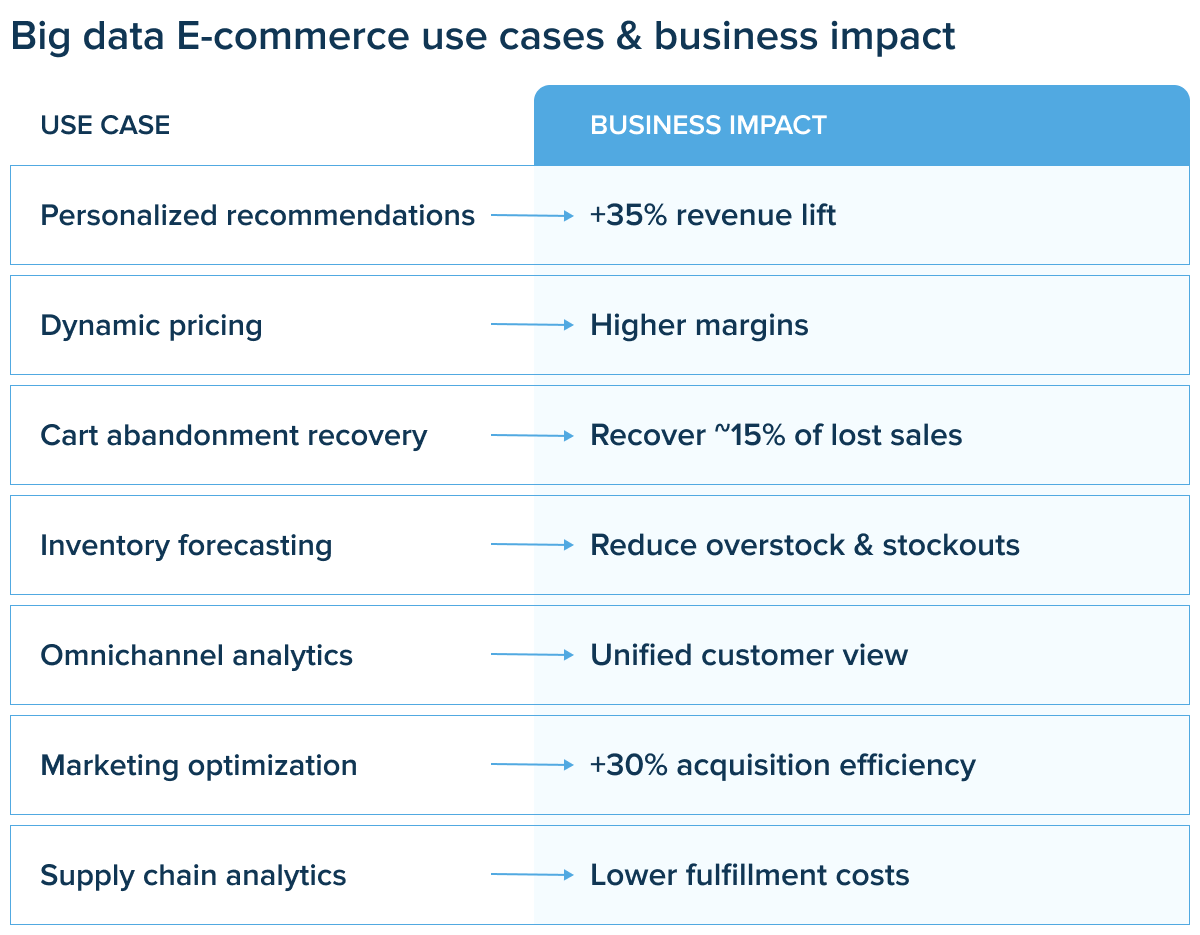
Personalized product recommendations
Recommendation engines are one of the most mature and commercially proven applications of Big data and E-commerce together.
By analyzing purchase history, browsing behavior, wish lists, and session data in real time, retailers can surface highly relevant products for each individual user.
Amazon, which accounts for nearly 40% of US E-commerce sales according to eMarketer, attributes approximately 35% of its revenue to its recommendation engine.
This is a direct result of integrating online shopping behavior with advanced Big data and knowledge management systems that continuously learn and improve.
For mid-market retailers, implementing even a basic recommendation layer — powered by collaborative filtering or machine learning — can deliver meaningful uplift in average order value and repeat purchase rates.
Dynamic pricing and inventory optimization
Big data in retail use cases increasingly centers on pricing intelligence and stock management. Retailers using predictive analytics can anticipate demand fluctuations — driven by seasonality, competitor behavior, or macroeconomic signals — and adjust pricing and inventory accordingly.

Source: Unsplash
This prevents both overstock situations that erode margins and stockouts that damage customer trust. Data science in E-commerce has made it possible for even mid-sized retailers to implement sophisticated demand forecasting models that previously required enterprise-level investment.
Cart abandonment recovery
Cart abandonment is one of the most costly challenges in E-commerce, with average abandonment rates hovering around 70% according to Baymard Institute. Big data enables retailers to understand exactly where and why customers drop off — whether due to unexpected shipping costs, a cumbersome checkout process, or simple distraction.
Omnichannel customer intelligence
For retailers operating both online and offline, Big data facilitates omnichannel integration by creating a unified view of each customer across every touchpoint.
Purchase history from physical stores, loyalty program data, app behavior, and website sessions can all be combined to build a single customer profile. This unified profile powers more relevant marketing, better inventory allocation across channels, and a seamless customer experience regardless of where the interaction takes place.
Supply chain and logistics optimization
Big data and sales performance analytics extend well beyond the storefront. Supply chain data — including supplier lead times, shipping performance, warehouse capacity, and external factors like weather or geopolitical events — can be analyzed to reduce fulfillment costs and improve delivery reliability.

Source: Unsplash
UPS, for example, uses advanced Big data analytics to optimize delivery routes, saving millions of miles and significant fuel costs annually. E-commerce businesses of all sizes can apply the same principles to improve last-mile delivery performance and reduce operational overhead.
E-commerce website analytics: What to track
One specific and highly actionable area of E-commerce data analytics is website analytics. Every online store generates continuous behavioral data that, when properly analyzed, reveals exactly how customers navigate, where they drop off, and what drives conversion.
Here are the key data types worth collecting for analytics for E-commerce sites:
- Customer behaviors and shopping journeys
- Website traffic with session lengths and bounce rates
- Heatmaps and scroll depth
- Traffic sources and attribution
- A/B testing results
- Marketing campaign performance
- Transaction-based metrics, including average order value and purchase frequency
- Customer lifetime value (CLV)
- Cart abandonment rate and recovery performance
- Mobile vs. desktop behavior
Who is an E-commerce data analyst?
To execute an E-commerce data analytics strategy effectively, businesses can hire a dedicated E-commerce data analyst responsible for implementing the right data collection processes and translating raw data into actionable business decisions.
An effective E-commerce data analyst should:
- Know how to use required tools and Big data applications in E-commerce
- Have experience with business intelligence platforms
- Be able to communicate findings to both technical and non-technical stakeholders
- Monitor market trends and benchmark against competitors
- Evaluate sales and marketing performance based on quantitative evidence
- Recommend process improvements based on data patterns
As E-commerce business analysis grows in complexity, many organizations choose to partner with specialized data science in E-commerce providers rather than build entirely in-house — particularly for advanced use cases involving machine learning or real-time analytics.
What data does E-commerce use?
Every E-commerce business is unique, but the following data categories apply broadly across the industry:
- Product data — SKUs, descriptions, pricing, availability, reviews, and ratings. This data reveals which products sell best and which are underperforming.
- Vendor data — Supplier information, including catalogs, delivery timescales, and payment terms. Critical for supply chain management and new product introduction.
- Sales data — Transaction records including prices, quantities, discounts, and conversion rates. Reveals buying patterns and pricing sensitivity among customer segments.
- Customer data — Demographic and behavioral data about who your customers are, how they shop, and what drives their loyalty. The foundation of customer preferences analysis and personalized marketing.
Primary sources of Big data in E-commerce
To collect the information required for Big data commerce analytics, online retailers must monitor multiple data streams:
- Search engine data — keyword trends, organic visibility, and competitive positioning
- Competitor analysis — pricing, product range, promotional activity, and customer reviews
- Social media — customer sentiment, brand engagement, and emerging trend signals
- Price comparison platforms — benchmarking and pricing strategy validation
- Analytics tools — Google Analytics 4, Mixpanel, and industry-specific platforms provide granular behavioral data
- CRM and loyalty systems — first-party customer data with high commercial value
- Third-party data providers — market intelligence, demographic enrichment, and external trend data
How Big data helps retailers compete
Big data gives retailers the intelligence to act faster, price smarter, and serve customers better than the competition. Here is how.
Understand their customers
Online sellers must know what their clients want and how they want it. Personalized experiences based on data — including spending habits, shopping preferences, and interests — consistently result in higher conversion rates and growing revenue.
Improve marketing strategies
The more accurately online stores can target their marketing efforts, the more likely they are to reach the right audience at the right time with the right message. Automated tools for E-commerce marketing analytics allow companies to scale quickly without spending extra resources on manual analysis.
Personalize customer service
Data analytics enables individual service based on each customer’s needs. Personalized interactions ensure customers return because they feel valued — leading to higher retention and loyalty, which drives steady profits.
Reduce costs
By analyzing customer behavior patterns over time, retailers can predict when products are likely to sell out and optimize restocking accordingly. Process optimization also reduces operational costs by enabling internal teams to focus on high-value work rather than repetitive manual tasks.
The future of Big data in E-commerce
The intersection of Big data and E-commerce will continue to deepen through 2026 and beyond, driven by several converging trends:
1. Generative AI for product discovery — LLMs and generative AI are beginning to reshape how customers search for and discover products, creating new data streams and new analytical requirements.
2. Real-time personalization at scale — Advances in streaming data processing are making it possible to personalize every interaction in real time, rather than relying on batch-processed segments.
3. First-party data strategy — With the continued deprecation of third-party cookies, retailers are doubling down on first-party data collection — making owned analytics infrastructure more valuable than ever.
4. Predictive commerce — AI-powered demand forecasting, automated replenishment, and dynamic pricing are converging into what analysts are calling “predictive commerce” — where Big data in sales decisions happens autonomously and continuously.
Source: Unsplash
5. Privacy-preserving analytics — As data regulations tighten globally, privacy-first analytics techniques — including federated learning and differential privacy — are becoming part of the standard E-commerce data toolkit.
Summary
Big data and E-commerce are inseparable in the modern retail landscape. From personalization and dynamic pricing to supply chain optimization and fraud prevention, the ability to collect, process, and act on large volumes of data is now a fundamental requirement for competitive online retail.
Businesses that invest in the right data infrastructure today — whether through internal capability building or partnership with experienced providers — will be best positioned to capitalize on the AI and analytics innovations that are reshaping commerce over the next several years.
FAQ
-
Big data refers to datasets that are too large, fast-moving, or complex for traditional analytics tools to handle effectively. In E-commerce, this includes everything from clickstream data and social media signals to real-time transaction records and supply chain feeds.
Traditional analytics typically processes structured, historical data in batches. Big data analytics processes structured and unstructured data in real time, enabling decisions at a speed and scale that traditional methods cannot match.
-
The main sources include website and app behavioral data, transaction records, CRM and loyalty program data, social media and review platforms, email and marketing campaign data, supply chain and logistics systems, search engine data, and third-party market intelligence providers. The most valuable retailers combine all of these into a unified data platform.
-
By analyzing individual customer behavior — browsing history, purchase patterns, abandoned carts, and engagement signals — in real time, Big data systems can surface highly relevant product recommendations, personalized promotions, and tailored content for each user. This goes far beyond segment-based targeting and enables truly individual experiences at scale.
-
Predictive analytics uses historical sales data, seasonality patterns, external signals like weather or economic indicators, and machine learning models to forecast demand at a product and location level.
This allows retailers to optimize stock levels, reduce overstock and stockouts, improve supplier relationships, and significantly reduce the cost of carrying inventory.
-
Big data analytics reveals exactly where and why customers abandon their carts — whether due to unexpected costs, friction in the checkout process, or behavioral signals like price comparison.
Retailers can use this insight to trigger personalized recovery campaigns, simplify checkout flows, offer dynamic incentives, and address the specific barriers that affect different customer segments.
-
Big data is used across every function in E-commerce — from marketing and personalization to inventory management, pricing, fraud detection, customer service, and logistics.
The goal is always the same: use data to make faster, smarter, more profitable decisions. InData Labs helps E-commerce businesses design and implement Big data analytics strategies tailored to their specific goals, data maturity, and technology stack.
-
The most common challenges include data silos across systems, inconsistent data quality, the complexity of real-time data processing, scalability of infrastructure as data volumes grow, and the talent required to build and maintain sophisticated analytics pipelines.
Partnering with an experienced data science in E-commerce provider significantly reduces implementation risk and time to value.
-
Leading E-commerce businesses implement a combination of technical and governance measures: data encryption at rest and in transit, role-based access controls, data minimization practices, compliance with regulations like GDPR and CCPA, and increasingly, privacy-preserving analytics techniques.
Data governance frameworks and regular security audits are essential components of any mature big data commerce strategy.
-
Cloud-based analytics platforms have dramatically lowered the barrier to entry. SMBs can start with focused use cases — such as customer segmentation, email personalization, or inventory forecasting — using affordable SaaS tools before scaling to more sophisticated infrastructure. Working with an external data analytics partner for specific projects is often more cost-effective than building a full in-house team.