Global digitalization has led to the inflow of immense amounts of data. It means that Big data analytics companies are riding the wave of popularity these days. And their stand is justified.
Without data analytics, organizations aren’t able to comb through this avalanche of information. Hence, raw data renders all activities ineffective. That is why data analytics has become an indispensable part of businesses of all sizes. It allows them to make smarter business decisions and deliver improved products and services.
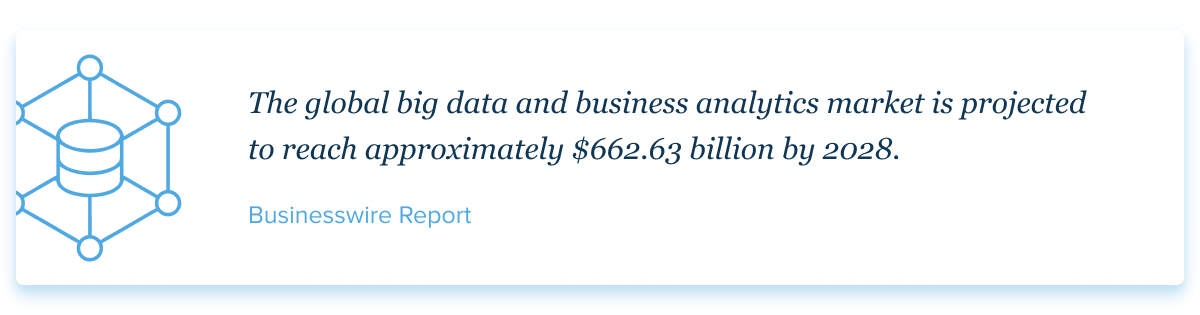
So if your records still go unanalyzed, it’s high time to contact some Big data development company.
To save you time and effort, we’ve compiled a list of top Big data services companies. This will allow you to choose the best Big data analytics companies for your business to achieve the business goals set. We’ll also walk you through the major trends of the Big data analytics market.
The best Big data analytics companies
Data analytics is an umbrella term. It encompasses a great number of data analysis techniques. All of them transform intelligence into insights that contribute to the decision-making process.
Virtually any industry can benefit from this discipline. Big data retail helps companies tap into the minds of their customers and grow their revenue. Precision medicine and Big data complement each other to predict diseases and recommend an effective treatment. You get the gist – smart analytics consulting companies are your friends.
InData Labs
Location: Nicosia, Cyprus
Established in 2014, InData Labs is one of the leading data science companies with a global stand on the market. It provides a wide range of full-cycle services for AI development in various domains. The company specializes in digital health, martech, logistics, and E-commerce, as well as game & entertainment, fintech, and others.
InData Labs has a solid track record of 150+ successful Big data and AI projects. Its clientele includes a variety of companies all over the world and multiple industries. Within the realm of data science, this company is an expert in predictive analytics, forecasting, and recommendation systems development. Natural language processing, Generative AI and ChatGPT, data retrieval/extraction, and OCR are also the fortes of this company.
Today, its R&D center guides global businesses in achieving operational accuracy and efficiency. InData Labs also works in partnership with other R&D departments to deepen their expertise in smart business solutions. With machine learning and artificial intelligence, this company offers bespoke innovative data analytics solution services that support businesses.
Databricks
Location: USA, San Francisco
If we’re talking about the tech giants among big data companies, Databricks is one of those companies. As a top big data service provider, it is an enterprise software company founded by the creators of Apache Spark. The company inherits the finest of data warehouses and lakes. This powerful combo has laid the ground for an open and unified platform for stats and AI.
The company’s platform unifies all records, analytics, and AI workload. This solution simplifies your IT architecture and gets rid of the operational silos. This way, organizations enable massive-scale engineering and collaborative data science. As one of the leading big data services company options on the market, Databricks‘ portfolio includes A-list companies like Shell and T-Mobile. Amazon and Google also work in close partnership with this tech provider.
Alteryx
Location: USA, California
Established in 1997, Alteryx is one of the oldest tech companies on the market. But despite the age, it still takes a leading position among Big data analytics consulting companies. The company’s products are mainly used for data science and analytics. The mission of the company is to make advanced analytics accessible to any data specialist.
For example, Alteryx Analytics presents a platform for intuitive data preparation, blending, and transformation. With this platform, users can prepare statistics within mere hours. All these – with no special skills or professional developer help. Hence, the company offers a different expertise-free approach to analytics with excellent transformation capabilities and an intuitive interface.
Talan
Location: France, Paris
This company is one of the top healthcare Big data analytics companies. Besides its prime location, Talan also has offices all over the world, including London, Geneva, New York, Hong Kong, and others. Its expertise is not limited to Big data services only. The vendor also offers tech strategy consulting, smart automation, AI, and other services.
For over 10 years now, Talan has been supporting organizations in digital transformation. Today, their experts guide companies in data visualization, warehousing, information security, and others.
BJSS
Location: United Kingdom, Leeds
This award-winning software agency is considered being among the best companies for Big data analytics in the UK. In 2018, their contribution was awarded a Queen’s Award for Enterprise. Today, they provide tech services to the British government and work with the world’s largest organizations.
BJSS offers a wide range of tech consulting services, including Machine Learning and AI, cloud, and automation. In particular, the team enhances enterprise data platforms and helps manage the provision of data. The company also boasts expertise in predictive and prescriptive analysis. On top of it, it’s an acknowledged provider of proven machine learning solutions for businesses.
Atlasopen
Location: Australia, Victoria
Atlasopen is a top-tier data and software engineering company from Australia. They offer a wide range of services that span various verticals. Their team works across web and app development, cloud, and data fields. Other services are rooted in the Digital Marketing sphere.
AtlasOpen works closely with Government and global enterprises to gather insights from their records. They also help businesses to turn input from source systems into manageable cloud-based systems for data science preparedness. Coupled with ML and AI, their rich expertise develops solutions that power and shape the future.
Adastra North America
Location: Canada, Toronto
The Adastra company is among Canada’s top 300 ICT companies. It positions itself as an international consulting company that delivers functional solutions in various sectors. Since 2000, Adastra has narrowed its expertise to data processing, analysis, and warehousing.
The experts behind Adastra offer end-to-end data services. They support the transformation journey from inception to deployment and maintenance for effortless client execution. With 20 years of experience, Adastra has over 2,000 employees and offices in 11 countries.
MuSigma
Location: United States Chicago
MuSigma is a genuine leader among the world’s Big data Analytics and Decision Sciences companies. The company has Unicorn status in the US and over 140 Fortune 500 companies in the portfolio. MuSigma has been named Walmart’s Supplier of the Year and is Microsoft’s preferred Analytics partner.
Today, big data provider transforms the decision sciences journey for global businesses. Mu Sigma’s expertise spans all levels of the decision support stack. The team supports their clients at the stages of data engineering and science and decision science.
IBM
Location: United States, New York
Next on our Big data analytics companies list is the true behemoth of the hi-tech landscape. A Glassdoor search for data science roles at IBM currently yields 16K openings. A team of this size is necessary to deliver robust cloud-based analytics solutions like the Watson Studio.
Overall, IBM is one of the best companies for Big data analytics. The company stands at the forefront of AI-driven innovation to help data scientists manage and analyze the inflow of information. This technological titan operates through five segments. These include cloud & cognitive software as well as business and technology services. Systems and global financing are also at the center of the mind for IBM.
Teradata
Location: United States, California
Let’s finish this walk of fame with another A-list celebrity in the data science world. Teradata is a connected multi-cloud data platform company. The company is best known for its Vantage platform. The platform targets business challenges by integrating analytic functions and tools.
Vantage provides a suite of descriptive, predictive, and prescriptive analytics features. The solution also brings forward autonomous decision-making capabilities, ML functions, visualization tools, and more. The company’s products and services focus on business intelligence, cloud platforms, and consulting.
Where are we heading next?
Fully adopted Big Data analytics peeked its head in the tech world not long ago. Just a few years ago, companies relied on traditional analytics techniques and worked around historical insights.
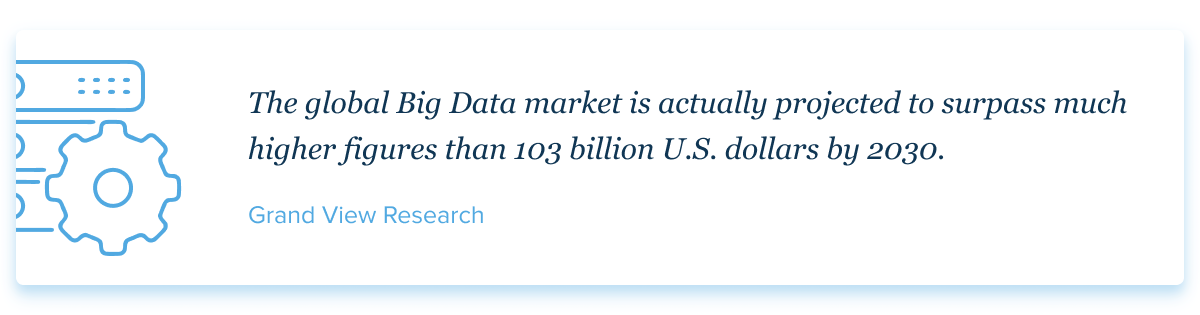
But how is Big data used in business?
How companies use Big data analytics in 2026
There’s one thing that jolts 97% of companies into embracing AI and macro data. And this is the universal nature of Big Data Analytics. The application area of this discipline is massive.
Let’s have a look at some of the examples:
Real-time decision-making – Businesses have moved beyond batch processing to treat live data streams as the default, enabling systems to react to data within seconds or milliseconds for use cases like website personalization and instant fraud detection in banking.
AI-driven automation and predictive modeling – AI and machine learning are becoming increasingly central, automating complex data analysis tasks, uncovering deeper insights, enabling more accurate predictive modeling, and driving hyper-personalization, with generative AI further transforming how teams explore and interact with data.
Industry-specific applications:
- Retail/e-commerce: companies use behavioral analytics to optimize pricing, inventory, and customer targeting in real time
- Healthcare: big data powers predictive diagnostics and personalized treatment planning, and analyzing electronic health records, patient history, and lab results helps predict which patients are at high risk of complications or readmission
- Financial services: institutions depend on large-scale data processing to detect fraud within milliseconds and manage risk exposure
Data governance and compliance – With growing regulatory pressure, businesses are required to develop robust big data governance frameworks and ensure compliance with data security regulations like GDPR or HIPAA.
Synthetic data adoption – pharmaceutical companies use synthetic data to augment clinical trial datasets, while banks use it to stress-test models against scenarios their real data doesn’t contain.
Multimodal analytics – Companies are unifying previously siloed data types, since structured and unstructured data were historically analyzed in separate pipelines, producing incomplete pictures — now multimodal platforms handle heterogeneous inputs (text, images, audio) within unified frameworks.
Cloud migration – U. S. enterprises show 68% cloud-native analytics usage, and 47% of enterprises plan full cloud analytics migration.

Source: Unsplash
Data democratization – Organizations are pushing toward self-service analytics, making data insights accessible to non-technical teams rather than gatekeeping through IT/data science departments.
Enterprise adoption disparity – large companies with 10, 000+ employees lead adoption at 78%, while mid-sized companies (100+ employees) show only 43% adoption, revealing a scaling gap based on company size.
Strategy consulting integration – major consulting firms like McKinsey (via QuantumBlack) and BCG (via BCG Gamma) now run dedicated analytics divisions, signaling how central data has become to business decision-making.
5 Big data analytics trends
Besides the rapid rise of AI, the year 2026 has been shaped by significant IT shifts. The latter has also influenced the tenor of information and revealed new horizons.
Real-Time Analytics as the Norm – Batch processing is still around, but it’s no longer sufficient for competitive advantage — companies now treat real-time data streams as a default, whether for website personalization or instant fraud detection in banking.
AI-Driven Analytics and Automation – AI and machine learning are becoming increasingly central, automating complex data analysis tasks, uncovering deeper insights, enabling more accurate predictive modeling, and driving hyper-personalization, with generative AI further transforming data exploration and interaction.
Multimodal Data Analytics – Structured and unstructured data have historically been analyzed in separate pipelines, producing incomplete pictures — multimodal analytics platforms, accelerated by advances in large language models and computer vision, now handle heterogeneous inputs like text, images, and audio within unified frameworks.

Source: Unsplash
Stronger Data Governance and Compliance – Organizations that can demonstrate clear data lineage, access controls, and quality standards unlock use cases like AI deployment, data monetization, and cross-border data sharing, while regulatory pressure from GDPR, CCPA, and sector-specific mandates continues to grow.
Rise of Synthetic Data – Pharmaceutical companies use synthetic data to augment clinical trial datasets, and banks use it to stress-test models against scenarios their real data doesn’t contain — as GDPR enforcement tightens and AI training data scrutiny increases, synthetic data is moving from workaround to first-choice tool.
Together, these trends show that in 2026, success in Big Data hinges on processing information faster, smarter, and more responsibly than ever before.
Wrapping up
Companies of all sizes yearn for a bird’s-eye view of internal and external business operations. But companies that use Big data analytics transitioned from words to actions. One of the major benefits of this practice is its predictive ability. Analytics tools predict the results of strategic decisions, which optimizes operational efficiency and reduces company risks.
Big data combines relevant and accurate information from multiple sources to accurately describe the market situation. Today, companies, government agencies, healthcare providers, and financial and academic institutions are all harnessing their power to improve business prospects and customer experience.
FAQ
-
Choosing the right partner for Big Data development is one of the most critical decisions a company can make. Big Data projects involve complex architecture, sensitive information, and long-term scalability needs — a poor vendor choice can lead to inflated costs, security vulnerabilities, or a solution that simply doesn’t scale as your data grows. The right partner, on the other hand, brings not just technical execution but also strategic guidance: helping you avoid common pitfalls, choose the right tech stack, and build a system that adapts as your business evolves.
When evaluating vendors, it’s worth looking at their track record with similar projects, the depth of their engineering team, how transparent they are about timelines and costs, and whether they take time to understand your specific business context rather than offering a one-size-fits-all solution.
One example of a company operating in this space is InData Labs, a data science and big data development company that works with organizations on building custom data pipelines, analytics platforms, and AI-driven solutions. They’re one of several providers worth researching if you’re comparing options — alongside other established players in the market — to see which team’s experience and approach best fits your project’s scope and industry.
Ultimately, the best vendor isn’t necessarily the biggest name, but the one whose expertise most closely matches your specific data challenges and business goals.
-
A big data company is an organization that specializes in helping businesses collect, store, process, analyze, and derive insights from large, complex datasets — the kind of data that’s too big, fast-moving, or varied for traditional data-processing tools to handle efficiently (often described by the “3 Vs”: Volume, Velocity, and Variety).
These companies generally fall into a few categories:
- Big data platform providers – companies that build the core infrastructure/software for processing large datasets (e. g., Databricks, Snowflake, Cloudera)
- Big data analytics companies – firms that build tools or dashboards to turn raw data into actionable insights (e. g., Alteryx, Tableau, Sisense)
- Big data consulting/services companies – firms that help other businesses design, build, and manage custom big data solutions, pipelines, and architecture (often called “big data development” or “big data services” companies)
- Cloud providers with big data services – companies like AWS, Google Cloud, and Microsoft Azure that offer big data infrastructure as part of their broader cloud ecosystem
In short, a big data company helps organizations turn massive, messy datasets into something usable — whether that’s through software products, cloud infrastructure, or hands-on engineering and consulting services.
-
Leading Big Data Analytics Service Providers in the US:
- InData Labs – A data science and big data development company offering services like custom analytics solutions, data pipeline architecture, and AI-driven platforms for businesses looking to build tailored big data infrastructure.
- Databricks (San Francisco, CA) – Founded by the creators of Apache Spark, offers a unified platform combining data warehousing, data lakes, and AI/ML workloads. Works with major clients like Shell and T-Mobile.
- Snowflake (Bozeman, MT) – A cloud-based data platform known for its data warehousing and sharing capabilities, widely used for scalable analytics across industries.
- Alteryx (Irvine, CA) – Specializes in intuitive data preparation, blending, and advanced analytics tools designed to be accessible without heavy coding or developer support.
- Cloudera (Santa Clara, CA) – One of the earlier players in the big data space, offering enterprise data management and analytics across hybrid and multi-cloud environments.
- Palantir Technologies (Denver, CO) – Known for large-scale data integration and analytics platforms used heavily in government, defense, and enterprise sectors.
- Tableau (Seattle, WA, part of Salesforce) – A leading data visualization and business intelligence platform that helps organizations turn complex datasets into interactive dashboards.
- AWS (Amazon Web Services) (Seattle, WA) – Offers a broad suite of big data services (Redshift, EMR, Glue, etc. ) as part of its cloud ecosystem, used by companies of all sizes.
-
Data analytics companies help businesses turn raw data into actionable insights that drive better decision-making. Their core functions typically include:
- Data collection and integration – Gathering data from multiple sources (databases, apps, sensors, social media, transactions) and consolidating it into a usable format
- Data cleaning and preparation – Removing errors, duplicates, and inconsistencies so the data is accurate and ready for analysis
- Data storage and management – Building and maintaining data warehouses, data lakes, or cloud infrastructure to store large volumes of information securely and efficiently
- Data analysis and modeling – Applying statistical methods, algorithms, and machine learning models to identify patterns, trends, and correlations within the data
- Predictive and prescriptive analytics – Using historical data to forecast future outcomes (predictive) and recommend specific actions to achieve desired results (prescriptive)
- Data visualization and reporting – Creating dashboards, charts, and reports that present complex findings in a clear, digestible way for business stakeholders
- Custom analytics solutions – Building tailored tools, pipelines, or platforms specific to a client’s industry, business goals, or existing tech stack
- Consulting and strategy – Advising businesses on how to build a data-driven culture, choose the right tools, and align analytics initiatives with broader business objectives